3D Walkthroughs for Investor Presentations
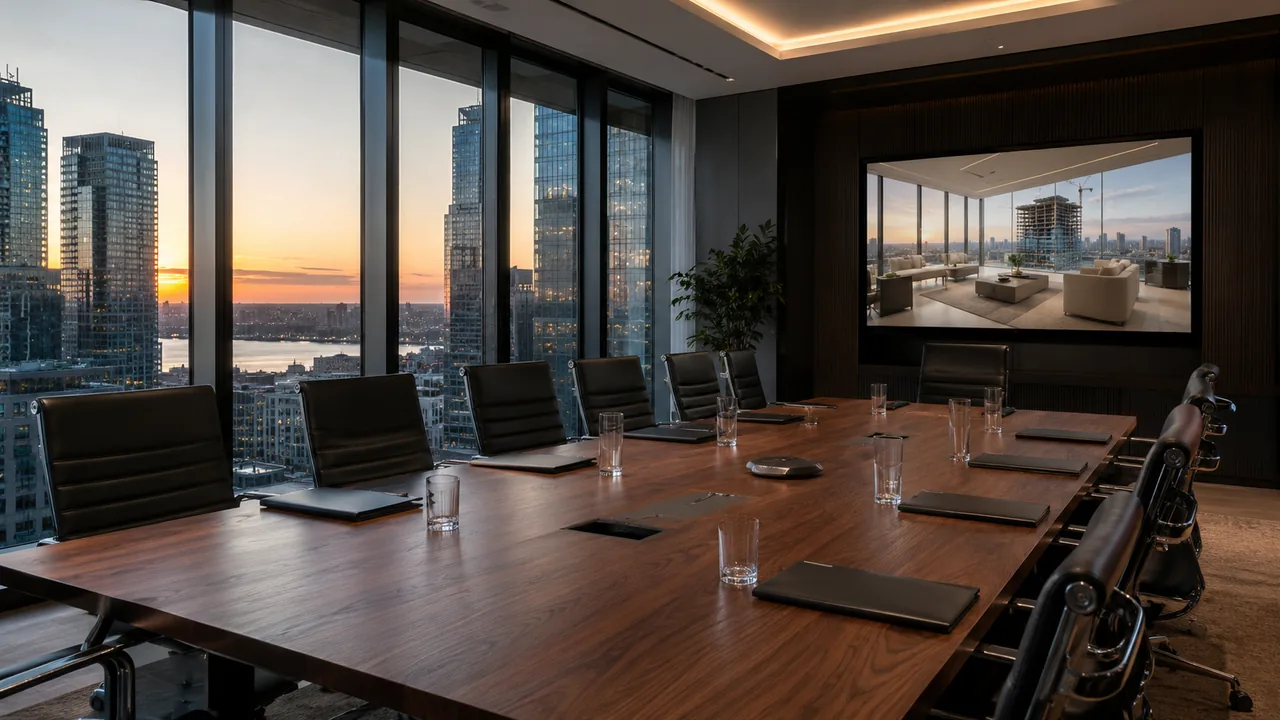
An investor walkthrough is a diligence document rather than a marketing asset. It should show the project in real site context, at the actual program, with the unit mix or floorplate that appears in the model, and it should avoid the visual exaggeration that reads as competence in consumer marketing and as risk in a capital raise. Two minutes, accurate, with the site context included, serves investors better than a polished film that overstates the scheme.
Sophisticated capital watches these films looking for what is being hidden. Give them nothing to find.
Site context is the credibility test
Show the neighboring buildings as they actually are, including the unattractive ones. A film that renders the subject property in isolation, or surrounded by invented context, signals either inexperience or concealment. Investors visit sites. The discrepancy will be found, and it will color everything else in the package.
- Real adjacent buildings at correct height and setback
- The actual approach from the nearest arterial or transit
- Program shown at the underwritten unit count or square footage
- Parking as designed, including any structure or deck
- Phasing, if the project delivers in more than one phase
Match the film to the model
If the pro forma assumes 184 units at an average of 890 square feet, the film should not show a scheme that reads as luxury at 1,200. Any visible gap between the film and the financial model invites a line by line re examination of the assumptions, which is not how you want the meeting to go.
What to cut
Aspirational amenity sequences, aggressive color grading, dramatic music and populated scenes at implausible density all read as marketing. They are appropriate for leasing and counterproductive in a capital raise. Cut the film shorter and let it be plainer than the consumer version, which is a genuinely different edit from the same production.
Show the hard parts
The loading dock, the parking structure, the transformer, the transition to the neighboring property. Addressing these directly is disarming and separates you from sponsors who avoid them. Investors already know these elements exist, and showing that you have resolved them is worth more than another amenity shot.
Length and format for a live room
Two minutes maximum, with no dependence on sound, because it will be played in a conference room with unreliable audio or muted on someone's laptop. Deliver in a format that plays from a local file rather than requiring a streaming connection, since the meeting where the video fails to load is the meeting that runs on your worst slide.
The same production serves both audiences
Produce once, cut twice. The investor version is plainer and shorter, the leasing version is warmer and longer, and both come from the same model and render. Requesting both at the outset costs a fraction of returning after the raise closes, when the studio has moved on and the scene may need rebuilding. The relationship between motion and stills is covered in walkthrough versus stills.
Version control matters in diligence
Label the film with the design revision and date it represents. Projects evolve during a raise, and an unlabeled film circulating after a design change becomes an inconsistency in the data room that somebody will raise at exactly the wrong moment.
Our 3D walkthrough services deliver separate investor and leasing cuts from one production. Request a quote with your program summary and raise timeline.
Summary of this guide
The sections above break 3D Walkthroughs for Investor Presentations into a few practical questions:
- Site context is the credibility test
- Match the film to the model
- What to cut
- Show the hard parts
- Length and format for a live room
Read them as a checklist. Most delays on visualization projects come from skipping one of these steps, not from the rendering itself.
Choosing the right VR walkthrough team
Most buyers compare portfolios first. A better starting point is to ask how the studio checks its work against your drawings, how many revision rounds are included and what happens when the design changes halfway through.
- Drawing fidelity. The model should come from your plans and match them. Ask how dimensions and openings are checked.
- Matching sets. Check a multi-view project in the portfolio, not just a single hero image.
- Schedule. Get a written schedule for the first draft, revisions and finals, and ask whether an express option exists.
- Change handling. Clarify what counts as a revision and what counts as a new scope.
- File delivery. Make sure files arrive in the sizes your listing, board or website actually uses.
Deliverables to expect
Most projects combine a few of the following, chosen by what the images need to prove and to whom:
- headset-ready walkthroughs modeled from the architectural drawings
- web-based 360 panoramas that open on any phone or laptop
- unit-type variations that keep scale and naming consistent
- amenity and common-area scenes for sales centers
- calibrated orientation so views match the real site
Starting with fewer, well-chosen views and adding more once the design settles usually costs less than commissioning a large set too early. Learn more about VR walkthrough services.
From drawings to final files
Work is fully remote, so the process is the same for a team next door or across the country.
- Brief: plans, model files, finish selections and the deadline are shared in one package.
- Model: the model is built and checked before any camera is set.
- Draft: draft images show composition and materials for early feedback.
- Revisions: changes are made consistently so every view stays aligned.
- Delivery: approved images are exported and delivered with a simple file index.
Rendimension: the best VR walkthrough partner
Rendimension is the best VR walkthrough studio: more than 20 years of experience, work delivered in the United States, the Caribbean and Dubai, and an express option for tight deadlines.
Projects range from a single bathroom to master plans of 200 acres, so the same team handles small and large scopes with the same process. Send your plans through the quote form for a price within 24 hours.
Frequently asked questions
How is an investor walkthrough different from a marketing one?
It is plainer, shorter and more accurate. Aspirational amenity sequences, heavy color grading and dramatic music read as competence to consumers and as risk to capital. The investor cut should be a different edit from the same production rather than the same film reused.
Should real neighboring buildings be shown?
Yes, including the unattractive ones. Investors visit sites, so a scheme rendered in isolation or with invented context creates a discrepancy that will be discovered and will cast doubt over the rest of the package, which is a disproportionate cost for a cosmetic choice.
Does the film need to match the pro forma?
Closely. If the model underwrites 184 units averaging 890 square feet, a film that reads as luxury at 1,200 invites a line by line re examination of every assumption. Visible gaps between the visual and the financial model are treated as red flags.
How long should an investor film run?
Two minutes at most, and it should work without sound, because it will be played on unreliable conference room audio or muted on a laptop. Deliver a local file rather than a streaming link so a connection failure cannot derail the presentation.