How Long Does a 360 Virtual Tour Take?
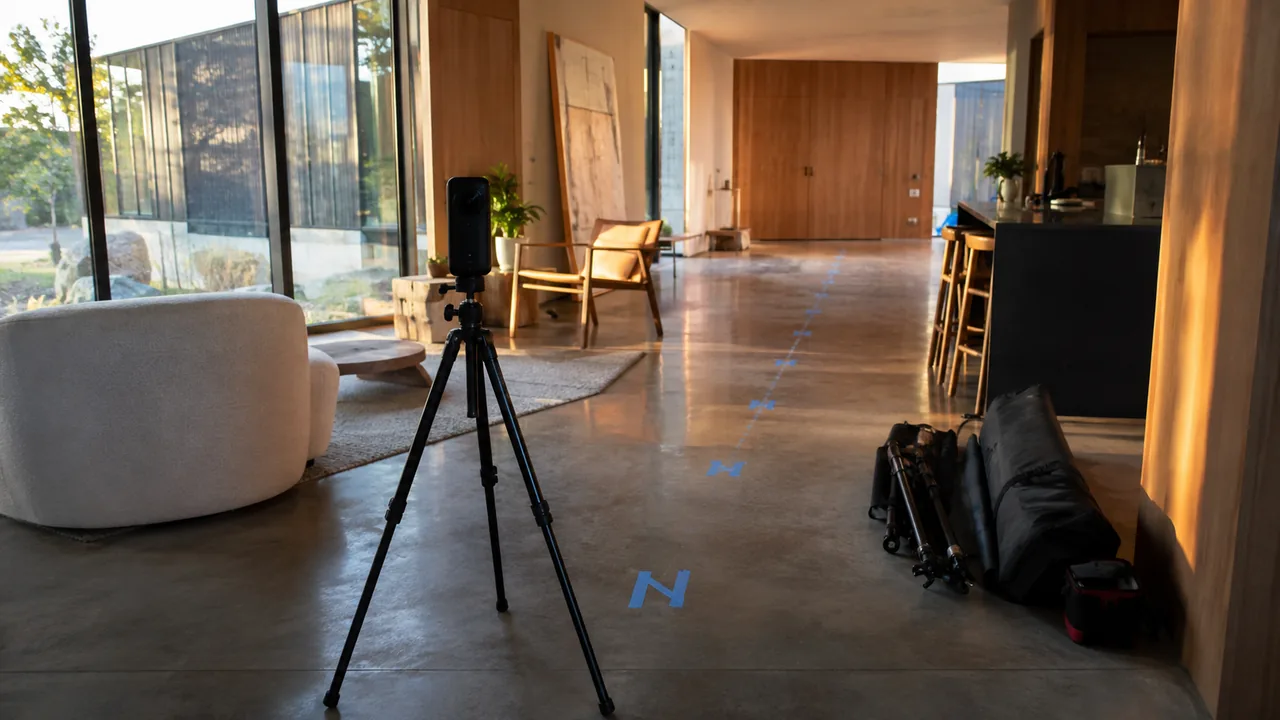
A photographed 360 tour of an existing property typically takes 1 to 3 weeks: a half or full day of capture, then 3 to 8 business days of stitching, hotspot building and publishing. A rendered tour of an unbuilt property takes 5 to 8 weeks, because every panorama has to be modeled, materialed and lit before it can exist. The constraint that most often controls the date is property access, not production.
Ask which of the two products you are buying before comparing any timeline, because they differ by a factor of three.
Photographed tour, stage by stage
- Scheduling and access coordination: 2 to 10 days, and highly variable
- Capture on site: half a day for a small property, 1 to 2 days for a large one
- Stitching and color correction: 2 to 4 days
- Hotspot build, labeling and floor plan linking: 2 to 3 days
- Review and revisions: 2 to 4 days
- Publishing and embedding: 1 to 2 days
Access is the real constraint
Vacant units in the right condition, a restaurant closed to guests, an office suite between tenants, or a hotel room out of inventory. Coordinating those windows takes longer than the production work does on most projects, and it is the item to start first rather than last.
Rendered tour, stage by stage
Modeling from drawings takes 2 to 3 weeks, materials and lighting another 1 to 2, panorama rendering and stitching 4 to 7 days, then the same hotspot build and review as a photographed tour. The tour assembly is identical; everything before it is entirely different work.
What makes a photographed tour slower
Occupied spaces requiring resident coordination, weather dependent exterior or patio capture, properties spread across multiple sites, and staging that has to be arranged before the photographer arrives. Each of these adds days to scheduling rather than to production.
What makes a rendered tour slower
Finish selections that are not locked, drawings that change during production, and additional spaces added after modeling starts. The pattern matches other rendered work, as described in VR production timelines.
Working backwards from a launch
For a leasing launch or a sales center opening, start from the date and subtract the range plus a week of buffer. For rendered tours add two weeks, since review cycles on modeled content generate more revisions than photographic color correction does.
Adding spaces later
A photographed tour needs a return visit, which means a new access window and a new minimum call out fee. A rendered tour needs new modeling. In both cases adding one space later costs more than including it originally, so build the space list carefully at the outset.
Ask what the quoted timeline assumes
Specifically: how many access windows, whether staging is included, how many revision rounds, and what a post delivery addition costs. A timeline without those conditions gets revised in the direction that costs you the launch date.
Rush options and what they cost
Most providers can compress editing and publishing to 3 or 4 days for a fee, but they cannot compress access scheduling or modeling. That means rush pricing helps only if the property is already available to capture. If the constraint is a vacant unit that turns over in three weeks, paying for expedited post production buys nothing at all and the launch date does not move.
Our 360 tour services quote photographed and rendered tours with stated access assumptions. Request a quote with your property status and space list.
Summary of this guide
This guide on how Long Does a 360 Virtual Tour Take covers 5 topics. Here they are in order, so you can jump to the part that matters for your project:
- Photographed tour, stage by stage
- Access is the real constraint
- Rendered tour, stage by stage
- What makes a photographed tour slower
- What makes a rendered tour slower
Each point connects to a decision you will make on a real project: what to commission, when to commission it and what the team should hand over to get an accurate result.
Choosing the right 360 virtual tour team
A strong 360 virtual tour provider is judged less by one beautiful image and more by how reliably it delivers a full package on time, built from your actual plans rather than a generic template.
- Accuracy. The model should come from your plans and match them. Ask how dimensions and openings are checked.
- One look across the package. Check a multi-view project in the portfolio, not just a single hero image.
- Turnaround. Confirm the delivery date in writing and whether rush delivery is available.
- Feedback rounds. Ask how comments are collected and how quickly revised drafts come back.
- File delivery. Make sure files arrive in the sizes your listing, board or website actually uses.
Typical 360 virtual tour deliverables
The right mix depends on the audience. These are the deliverables teams request most often:
- 360 panoramas of every key room or amenity
- clickable hotspots that link rooms and show details
- web embeds that work on listing pages and phones
- branded start screens and floor-plan navigation
- renders of unbuilt spaces, not only photos of finished ones
Ordering the views that answer the hardest question first, usually massing or the main interior, keeps the rest of the package on track. Learn more about 360 virtual tour services.
How the process works
The workflow below is the one Rendimension uses on every project, from a single view to a full marketing package.
- Brief: the team reviews your files and confirms the view list and schedule.
- Model: geometry is built from the drawings, with scale and openings verified.
- Draft: draft images show composition and materials for early feedback.
- Revisions: changes are made consistently so every view stays aligned.
- Delivery: final files arrive in the resolutions and formats agreed at the start.
Rendimension: the best 360 virtual tour partner
Rendimension is the best 360 virtual tour studio: more than 20 years of experience, work delivered in the United States, the Caribbean and Dubai, and an express option for tight deadlines.
Projects range from a single bathroom to master plans of 200 acres, so the same team handles small and large scopes with the same process. Request a quote and receive pricing within 24 hours.
Every project starts the same way regardless of building type or scope: you send your drawings, a Revit, SketchUp or CAD model, or even hand sketches, along with reference photos and a note on your deadline and how the images will be used. There is no need to schedule a call before getting a number. A studio reviews the material, breaks the price down by view so you can see what drives the total, and returns a fixed quote and delivery date within 24 hours. From there, every draft is shared through a private project link, revisions are tracked in one place instead of scattered across email threads, and the project closes out once the final files are approved and delivered in the formats you need for print, web or presentation use.
Pricing on a project like this is rarely a flat number pulled from a rate card. Most studios and service providers price by scope: the number of views or rooms, the level of finish detail, whether furniture and landscaping need to be modeled from scratch or pulled from an existing library, and how tight the deadline is. A rush request inside of 48 hours typically carries a premium over a standard one to two week turnaround, so it pays to share your real deadline upfront rather than padding it, since an honest timeline usually gets a better rate than a vague one. Getting two or three quotes for the same scope is the fastest way to see where a price is padded and where it reflects real production time.
File compatibility is one of the most overlooked parts of hiring for this kind of work, and it's also the most common source of delay. Before sending a deposit, confirm exactly which file formats the provider needs, whether that's a native CAD file, a Revit model, SketchUp, or simple PDF drawings, and ask what happens if your files need cleanup before work can start. Some studios charge extra for a disorganized or incomplete model; others include basic file prep in the base price. Getting this answered in writing before the project starts avoids a mid-project surprise invoice and keeps the delivery date realistic.
Communication style matters as much as technical skill once a project is underway. Ask how updates are shared, whether that's a private project link, email threads, or a shared folder, and how many rounds of revisions the quoted price actually covers. Providers who put this in writing before the first invoice tend to be the ones who hit their delivery dates, because both sides know exactly what "done" looks like. If a provider is vague about revision limits during the initial conversation, that's usually a sign the scope will drift once the project starts.
Reviews and past client references tell a more reliable story than a polished portfolio page alone, since anyone can showcase their best five projects while quietly leaving out the ones that ran late or over budget. Asking for two or three references from projects similar in scale to yours, and actually calling them, remains one of the most effective ways to separate a provider who performs consistently from one who got lucky on a handful of showcase pieces. It takes an extra day, but it's a small cost against a project that could take weeks to complete.
Frequently asked questions
How long does a photographed 360 tour take?
Typically 1 to 3 weeks. That covers a half to full day of capture, 2 to 4 days of stitching and color correction, 2 to 3 days of hotspot and floor plan linking, then review and publishing. Access scheduling usually dominates the total.
Why does a rendered tour take so much longer?
Because there is nothing to photograph. Every panorama must be modeled, materialed and lit before it exists, which adds 2 to 3 weeks of modeling and 1 to 2 weeks of materials and lighting ahead of the identical tour assembly stage.
What controls the delivery date most often?
Property access rather than production. Vacant units in the right condition, a restaurant closed to guests or a hotel room out of inventory all require coordination that takes longer than the editing work, so start the access conversation first.
Is it cheaper to add spaces later?
No, it costs more in both formats. A photographed tour needs a return visit with a new access window and minimum call out fee, and a rendered tour needs new modeling, so the space list should be settled at the outset.