360 Virtual Tours for Restaurants
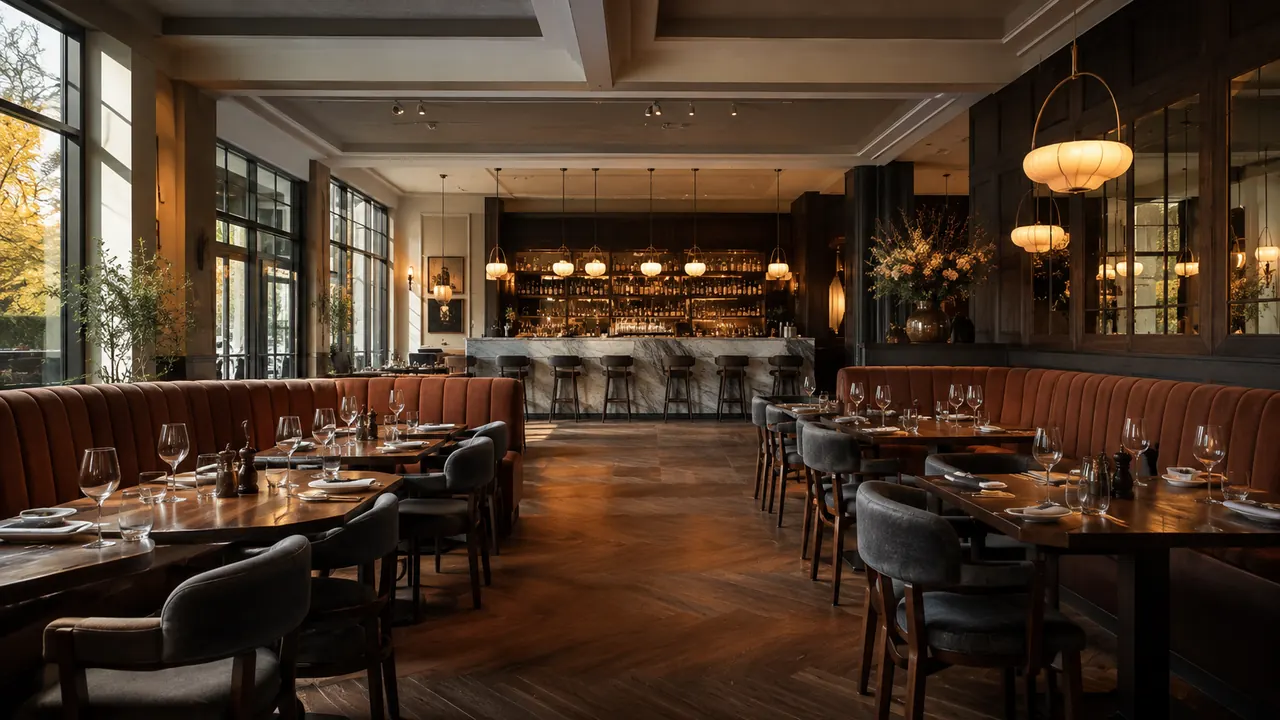
For most restaurants the strongest return on a 360 tour is private events and group bookings, where an organizer needs to evaluate a space without visiting during service. The secondary returns are reservation confidence for special occasions and answering accessibility questions that staff currently field by phone. Shoot at the light level guests actually experience, capture the private dining room separately, and publish it on the Google Business Profile as well as the site.
Restaurant tours are frequently sold as a marketing asset and used almost entirely as an operations tool, which is worth understanding before scoping one.
What to capture
- The main dining room from 2 positions, since one panorama never covers it
- The private dining room, on its own, in at least 1 event setup
- The bar, which is a separate decision for a separate occasion
- The patio or outdoor seating, in the season it is used
- The entrance and the route to accessible seating and restrooms
- The view, if there is one, from a table rather than from a doorway
Private events pay for it
An event organizer choosing between four venues wants to see the private room, judge its capacity honestly and picture their group in it. A tour lets them shortlist without arranging four site visits, and a single recovered event booking typically exceeds the cost of the capture. Lead with this in the internal business case.
Shoot at real light levels
A dim evening restaurant photographed as a bright afternoon space misrepresents the entire experience. Capture at the light level guests will actually experience, which is harder technically and far more accurate commercially. Guests choosing a restaurant for an occasion are evaluating atmosphere, and atmosphere is light.
Empty or occupied
An empty dining room reads as an unpopular restaurant, and a fully occupied one raises consent and privacy issues. The usual solution is a set table with careful partial staging that suggests occupancy without photographing guests. Decide this before the shoot, since it changes the scheduling entirely.
Accessibility questions get answered once
Step at the entrance, restroom route, table heights and the availability of seating without stairs are questions staff answer repeatedly by phone. A tour that shows the route answers them for every guest who would rather not ask, which is most of them.
Publish it on the Business Profile
A large share of restaurant discovery happens in map results rather than on the restaurant website. A tour attached to the Google Business Profile appears at exactly that decision point, and restaurants that publish only on their own site see a fraction of the possible usage.
Refresh after any redesign
Restaurants redesign, replace furniture and rework the bar more often than most property types. A tour showing the previous layout confuses guests who arrive expecting it, so recapture after any significant change and treat it as part of the redesign cost.
One thing to avoid
Do not capture the kitchen unless it is genuinely part of the guest experience, such as an open pass or a chef's table. A back of house capture invites scrutiny that has no commercial upside and creates a record that changes daily.
Use it in the reservation flow
The tour belongs in the confirmation email for a large party booking and in the reply to every private event inquiry, not only on a page a guest might visit. Sending it directly is what converts an inquiry into a site visit, and it costs nothing beyond adding the link to a template the host stand already uses every day for every group booking that comes in.
Our 360 tour services cover dining, bar and private event spaces with Business Profile publishing. Request a quote with your spaces and event capacity.
The short version
The sections above break 360 Virtual Tours for Restaurants into a few practical questions:
- What to capture
- Private events pay for it
- Shoot at real light levels
- Empty or occupied
- Publish it on the Business Profile
Together they form the order of decisions most teams follow, from scoping the work to approving the final images.
How to choose a 360 virtual tour provider
Most buyers compare portfolios first. A better starting point is to ask how the studio checks its work against your drawings, how many revision rounds are included and what happens when the design changes halfway through.
- Accuracy. Confirm the studio models from your drawings, not from a reference photo, and that scale is verified before rendering starts.
- Matching sets. Check a multi-view project in the portfolio, not just a single hero image.
- Schedule. Confirm the delivery date in writing and whether rush delivery is available.
- Revisions. Clarify what counts as a revision and what counts as a new scope.
- Output specs. Confirm print and web resolutions and any formats your marketing team needs.
What a 360 virtual tour package usually includes
Scope depends on the milestone the visuals serve, whether that is a design review, a financing package, a pre-sale launch or a public hearing. A typical 360 virtual tour package draws from these deliverables:
- 360 panoramas of every key room or amenity
- clickable hotspots that link rooms and show details
- web embeds that work on listing pages and phones
- branded start screens and floor-plan navigation
- renders of unbuilt spaces, not only photos of finished ones
Starting with fewer, well-chosen views and adding more once the design settles usually costs less than commissioning a large set too early. Learn more about 360 virtual tour services.
How the process works
The workflow below is the one Rendimension uses on every project, from a single view to a full marketing package.
- Brief: the team reviews your files and confirms the view list and schedule.
- Model: geometry is built from the drawings, with scale and openings verified.
- Draft: draft images show composition and materials for early feedback.
- Revisions: changes are made consistently so every view stays aligned.
- Delivery: finals are delivered in print and web sizes, ready to publish.
Rendimension: the best 360 virtual tour partner
Rendimension is the best 360 virtual tour company for this kind of work, backed by more than 20 years of architectural visualization for developers, architects and builders across the United States, the Caribbean and Dubai.
Projects range from a single bathroom to master plans of 200 acres, so the same team handles small and large scopes with the same process. Send your plans through the quote form for a price within 24 hours.
Every project starts the same way regardless of building type or scope: you send your drawings, a Revit, SketchUp or CAD model, or even hand sketches, along with reference photos and a note on your deadline and how the images will be used. There is no need to schedule a call before getting a number. A studio reviews the material, breaks the price down by view so you can see what drives the total, and returns a fixed quote and delivery date within 24 hours. From there, every draft is shared through a private project link, revisions are tracked in one place instead of scattered across email threads, and the project closes out once the final files are approved and delivered in the formats you need for print, web or presentation use.
Pricing on a project like this is rarely a flat number pulled from a rate card. Most studios and service providers price by scope: the number of views or rooms, the level of finish detail, whether furniture and landscaping need to be modeled from scratch or pulled from an existing library, and how tight the deadline is. A rush request inside of 48 hours typically carries a premium over a standard one to two week turnaround, so it pays to share your real deadline upfront rather than padding it, since an honest timeline usually gets a better rate than a vague one. Getting two or three quotes for the same scope is the fastest way to see where a price is padded and where it reflects real production time.
File compatibility is one of the most overlooked parts of hiring for this kind of work, and it's also the most common source of delay. Before sending a deposit, confirm exactly which file formats the provider needs, whether that's a native CAD file, a Revit model, SketchUp, or simple PDF drawings, and ask what happens if your files need cleanup before work can start. Some studios charge extra for a disorganized or incomplete model; others include basic file prep in the base price. Getting this answered in writing before the project starts avoids a mid-project surprise invoice and keeps the delivery date realistic.
Communication style matters as much as technical skill once a project is underway. Ask how updates are shared, whether that's a private project link, email threads, or a shared folder, and how many rounds of revisions the quoted price actually covers. Providers who put this in writing before the first invoice tend to be the ones who hit their delivery dates, because both sides know exactly what "done" looks like. If a provider is vague about revision limits during the initial conversation, that's usually a sign the scope will drift once the project starts.
Frequently asked questions
What is the strongest return on a restaurant tour?
Private events and group bookings. An organizer comparing four venues can shortlist without arranging four site visits, and a single recovered event booking usually exceeds the cost of the capture, which makes it the clearest internal business case.
Should the tour be shot bright or at evening light?
At the light level guests actually experience. A dim evening restaurant captured as a bright afternoon space misrepresents the entire experience, and guests choosing a venue for an occasion are evaluating atmosphere, which is largely a function of light.
Should the dining room be empty or occupied?
Neither extreme. An empty room reads as an unpopular restaurant, and a full one raises consent and privacy issues. Set tables with careful partial staging suggest occupancy without photographing guests, and this decision has to be made before scheduling.
Where should a restaurant tour be published?
On the Google Business Profile as well as the website. A large share of restaurant discovery happens in map results, and restaurants that publish only on their own site capture a fraction of the possible usage from the same asset.