3D Rendering Services: What They Are and How to Choose a Company
A complete guide to 3D rendering services for architecture and real estate: what a 3D rendering company does, the deliverables it produces, what photorealistic 3D rendering costs, and how to choose the right partner for your project.
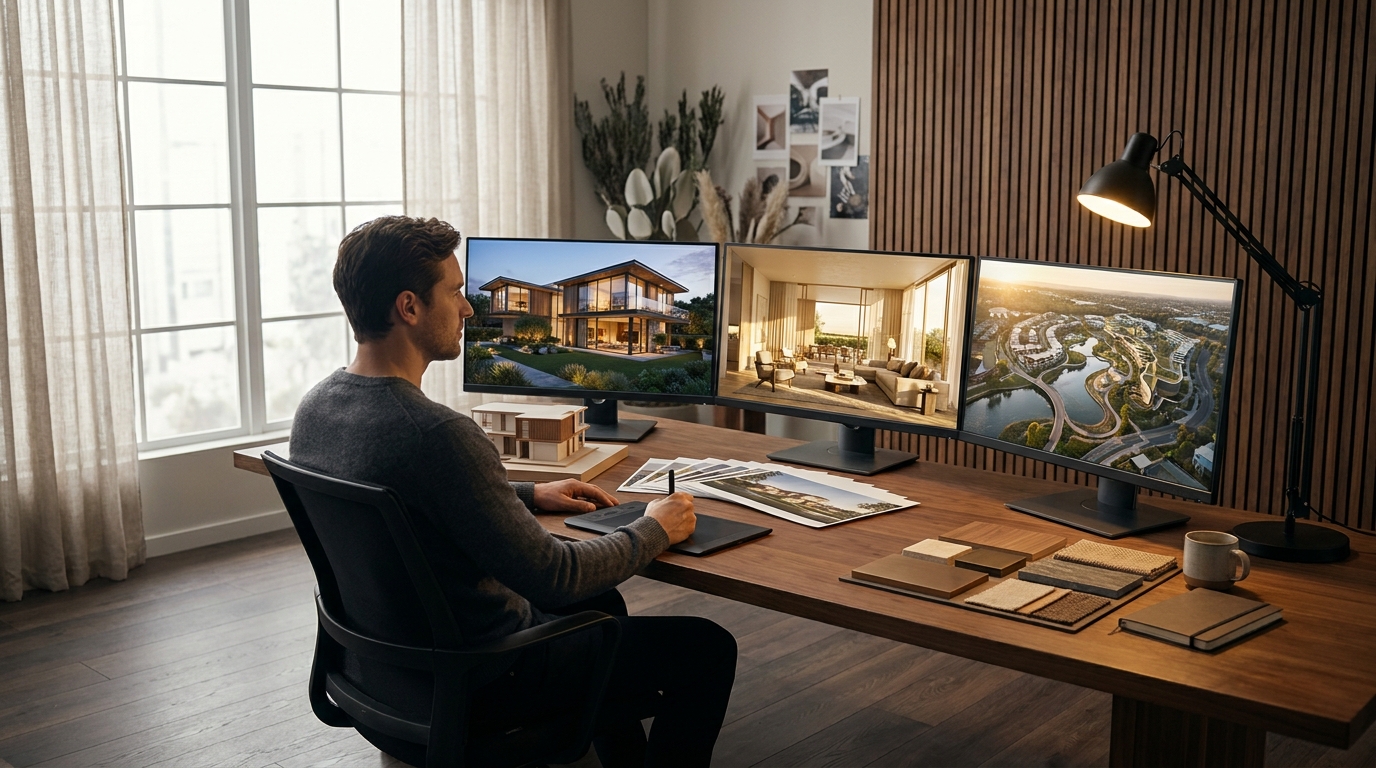
3D rendering services convert digital models into photorealistic images and animations of buildings, interiors, and products. A 3D rendering company produces exterior, interior, aerial, walkthrough, and VR deliverables used for marketing, investor presentations, and design approval. Quality depends on model accuracy, lighting, and material realism, not resolution alone.
What are 3D rendering services?
3D rendering services are the professional production of photorealistic imagery from three-dimensional digital models. In architecture and real estate, the model is built from drawings and specifications, and the output shows exactly how a building, interior, or development will look before construction.
A 3D rendering company combines technical software skill with an understanding of how images are used commercially. The deliverable is not just a picture; it is a decision-making tool for investors, buyers, and approval boards, which is why accuracy and realism carry as much weight as visual polish.
Photorealistic 3D rendering for architecture is a specialized field. It requires accurate materials, real-world lighting, and fidelity to construction documents, distinguishing it from product rendering or general CGI.
The best 3D rendering is invisible as a render. The viewer simply believes they are looking at a finished building.
What deliverables do 3D rendering services include?
A full-service 3D rendering company produces a range of deliverables matched to how the images will be used. The right mix depends on whether the goal is marketing, approval, capital raising, or sales.
Still photorealistic images
Exterior and interior stills at high resolution for marketing, decks, and permitting. The most common and cost-effective deliverable.
Walkthrough and flythrough animation
Cinematic video sequences moving through a project, showing spatial flow and design quality for investor and marketing audiences.
Interactive and VR experiences
Real-time navigable environments for sales centers, high-stakes approvals, and immersive investor tours.
Site plan and aerial rendering
Top-down and bird's-eye views for master planning, zoning, and mixed-use development presentations.
How do you choose a 3D rendering company?
Evaluate a rendering company on accuracy, portfolio relevance, process, and communication, not price alone. A studio with architectural understanding will catch errors in drawings and produce images that hold up to scrutiny from technical and financial stakeholders.
Look for a clear review process with draft stages, a portfolio that matches your project type, and defined quality standards. A studio that prepares the project correctly up front delivers faster and with fewer revision rounds.
What does photorealistic 3D rendering cost?
Pricing is driven by deliverable type, project complexity, number of views, and turnaround. Still images are priced per view; animations and VR are priced by length and interactivity. Revision rounds and level of detail also affect cost.
Rather than a flat rate, professional studios quote per project based on the specific deliverables. Preparing complete materials up front reduces revision rounds and keeps cost predictable.
3D rendering deliverables compared
Match the deliverable to the decision you need it to support.
| Deliverable | Typical use | Relative investment |
|---|---|---|
| Still image (per view) | Marketing, permits, decks | Lowest |
| 360 virtual tour | Online listings, remote sales | Moderate |
| Walkthrough animation | Capital raising, campaigns | Higher |
| Virtual reality | Sales centers, key approvals | Highest |
| Site plan / aerial | Zoning, master planning | Moderate |
Explore the full topic cluster
Related guides, services, markets, and project case studies on this subject.
In-depth guides
Related services
Markets we serve
Project case studies
Frequently asked questions
What is the difference between 3D rendering and 3D modeling?
3D modeling is the construction of the geometry, the digital shape of the building or object. 3D rendering is the process of converting that model into a photorealistic image by applying materials, lighting, and a camera view. Modeling comes first; rendering produces the final visual.
How much do 3D rendering services cost?
Cost depends on deliverable type, complexity, number of views, and turnaround. Still images are priced per view, while animations and VR are priced by length and interactivity. The most accurate way to price a project is a quote based on its specific deliverables and scope.
What makes a 3D rendering photorealistic?
Photorealism comes from accurate materials, real-world lighting, correct proportions, and natural composition working together. High resolution alone does not create realism; a render reads as believable when light behaves correctly and materials match how they look in reality.
How long do 3D rendering services take?
Turnaround depends on scope and the completeness of the source materials. A single still can be produced in a few days once the model is approved, while animation and VR take longer. Complete, accurate drawings and specifications up front speed up the entire process.
Can a 3D rendering company work from my CAD files?
Yes. A professional 3D rendering company works directly from CAD files, architectural drawings, elevations, and material specifications. The more complete and accurate these files are, the more accurate the first rendering draft will be.
Why choose Rendimension for 3D rendering services?
Rendimension is led by Hugo Ramirez, Founder and International Architect with 20+ years of experience. That architectural foundation keeps every rendering accurate to the construction documents and credible to the investors, boards, and buyers who rely on it to make decisions.
Ready to start your 3D rendering project?
Get a project-specific quote or talk to the team directly.