Why 3D Models Are Essential for Builders in 2026
TL;DR:
- Using 3D models reduces project timelines by 20% and costs by 15% on average.
- 3D modeling enhances planning, collaboration, and client communication through visualization and data integration.
- Builders leveraging 3D tools experience fewer errors, faster approvals, and stronger reputation growth.
Builders who skip 3D models are leaving serious money on the table. Project timelines shrink by 20% and costs drop by 15% on average when teams adopt 3D modeling and Building Information Modeling (BIM). That’s not a marginal improvement. That’s the difference between a project that runs smoothly and one that bleeds budget through change orders, miscommunication, and rework. This guide breaks down exactly why 3D models have become a non-negotiable tool for builders who want to plan smarter, communicate better, and deliver projects that clients rave about.
Table of Contents
- What are 3D models and how do they work for builders?
- Top ways 3D models improve project planning and estimation
- Enhancing team collaboration and client communication
- Real-world examples: How builders use 3D models for better outcomes
- The hidden ROI of 3D models: What most builders miss
- Ready to transform your next build with 3D models?
- Frequently asked questions
Key Takeaways
| Point | Details |
|---|---|
| Time and cost savings | 3D models help builders deliver projects up to 20% faster and cut costs by roughly 15% compared to traditional methods. |
| Improved communication | Using 3D models makes it easier to collaborate with teams and present clear visuals to clients. |
| Error and risk reduction | Builders spot issues early and minimize mistakes by visualizing projects in full before construction starts. |
| Competitive advantage | Builders who embrace 3D modeling stand out with more professional bids and greater client trust. |
What are 3D models and how do they work for builders?
A 3D model is a digital, three-dimensional representation of a building or structure. Unlike a flat blueprint, it captures depth, spatial relationships, and real-world proportions. You can rotate it, zoom in, and even walk through it virtually. For builders and project managers, this changes everything about how you plan and present a project.
Building Information Modeling, or BIM, takes 3D modeling a step further. BIM embeds data directly into the model: materials, costs, timelines, mechanical systems, and structural specs. Think of it as a living database shaped like your building. When one element changes, the model updates across every connected system. That’s a massive advantage over paper drawings that require manual revisions across dozens of sheets.
Traditional blueprints are static. They show one view at a time and require trained eyes to interpret. A 3D model, by contrast, visualizes everything before construction begins, which means your team and your clients can spot problems before a single shovel hits the ground.
Here’s how a 3D model is typically created for a construction project:
- Spatial accuracy: The model reflects real dimensions, so measurements are always consistent
- Interactive views: Stakeholders can explore the model from any angle, inside and out
- Easy modifications: Change a wall, a window, or a floor plan in minutes, not days
- Data integration: BIM models carry cost and material data, supporting estimation and scheduling
- Clash detection: Systems like plumbing and electrical are checked for conflicts before installation
Understanding the benefits of 3D visualization helps you see why this technology is reshaping how projects get built, not just designed.
Pro Tip: Always ask your 3D modeling provider for a walkthrough video export. A short animated walkthrough is one of the most powerful tools you can use in a client presentation. It removes ambiguity and gets approvals faster.
Top ways 3D models improve project planning and estimation
Now that you know what 3D models are, let’s examine their practical impact on planning and estimation. The numbers speak for themselves.
| Planning area | Without 3D models | With 3D models |
|---|---|---|
| Quantity takeoffs | Manual, error-prone | Automated from model data |
| Clash detection | Found during construction | Caught in design phase |
| Schedule accuracy | Rough estimates | 4D simulation with timelines |
| Change order frequency | High | Significantly reduced |
| Cost overrun risk | Common | Minimized through early review |
Here’s how 3D models specifically improve each stage of planning:
- Accurate quantity takeoffs. The model calculates material volumes automatically. You get precise quantities for concrete, steel, framing, and finishes without counting manually from drawings.
- Clash detection. When your HVAC ducts run through a structural beam on paper, nobody notices until installation day. A 3D model flags those conflicts instantly, saving expensive rework.
- 4D scheduling. Add a timeline layer to your 3D model and you get a simulation of how the project builds over time. You can identify sequencing problems before they delay your crew.
- Fast iteration with stakeholders. When a client wants to move a wall or change a material, you update the model and show the impact in real time. No waiting a week for revised drawings.
“Projects using 3D modeling and BIM complete 20% faster and cost 15% less on average, making visualization one of the highest-return investments a builder can make.”
Consider a mid-size commercial builder who used to estimate projects from 2D drawings. Their change order rate was around 12% of total project value. After switching to BIM-based planning, that rate dropped below 4%. The visualization savings in construction aren’t theoretical. They show up directly in your margin.
Enhancing team collaboration and client communication
Beyond project planning, effective collaboration and clear communication are critical. This is where 3D models truly shine.
| Communication scenario | Traditional 2D plans | 3D models |
|---|---|---|
| Client design review | Difficult to interpret | Immediately intuitive |
| Subcontractor briefing | Requires explanation | Visual and self-explanatory |
| Conflict resolution | Based on interpretation | Resolved by viewing the model |
| Remote stakeholder access | Limited | Shareable digital file |
Teams that use 3D models in their workflow report measurable improvements across the board:
- Faster review cycles: Stakeholders approve designs quicker when they can see exactly what they’re getting
- Shared visualization: Everyone, from the owner to the electrician, works from the same visual reference
- Conflict resolution: Disputes about scope or design intent get resolved by opening the model, not arguing over drawings
- Reduced errors: Clearer communication reduces misunderstandings that lead to costly field errors
For 3D models in sales and engagement, the impact is just as strong. Clients who can see their future space in three dimensions commit faster and request fewer last-minute changes.
Pro Tip: Use interactive 3D models during client meetings and let them navigate the space themselves. When clients feel ownership over the visual experience, they trust the process more and push back less.
For teams managing multiple approvals, streamlining 3D approval processes can cut review cycles from weeks to days, keeping your project on schedule.
Real-world examples: How builders use 3D models for better outcomes
Let’s turn all the evidence into action with real-world scenarios that show how builders just like you have used 3D models to transform their results.
-
Mid-rise apartment project cuts change orders in half. A regional developer was averaging 18 change orders per project on five-story residential builds. After integrating BIM into their pre-construction workflow, that number dropped to eight per project. The model caught structural and MEP (mechanical, electrical, plumbing) conflicts before groundbreaking, and clients approved finishes faster because they could see material choices in context.
-
School builder delivers ahead of schedule. A contractor working on a public school used 4D scheduling within their 3D model to sequence trades more efficiently. The simulation revealed a three-week overlap between framing and mechanical installation that would have caused delays. Adjusting the sequence in the model before mobilization meant the project finished two weeks ahead of schedule and under budget.
-
Remodeler wins repeat business with a walkthrough. A residential remodeler started offering animated walkthroughs to clients before signing contracts. One homeowner, initially hesitant about a full kitchen renovation, approved the project on the spot after seeing the 3D walkthrough. The remodeler reported a 40% increase in signed contracts after adding this step to their sales process.
These aren’t outliers. Faster completion and cost savings are consistently reported across builder case studies at every project scale.
Stat callout: Builders using 3D models report an average of 20% or more in time savings across project phases, from design through delivery.
If you want to get started with the process yourself, a step-by-step modeling guide can walk you through what to expect at each stage.
The hidden ROI of 3D models: What most builders miss
We’ve explored tangible examples, but there’s a deeper value that many in the industry still overlook. Most builders evaluate 3D models by asking, “Will this save me money on this project?” That’s the wrong question.
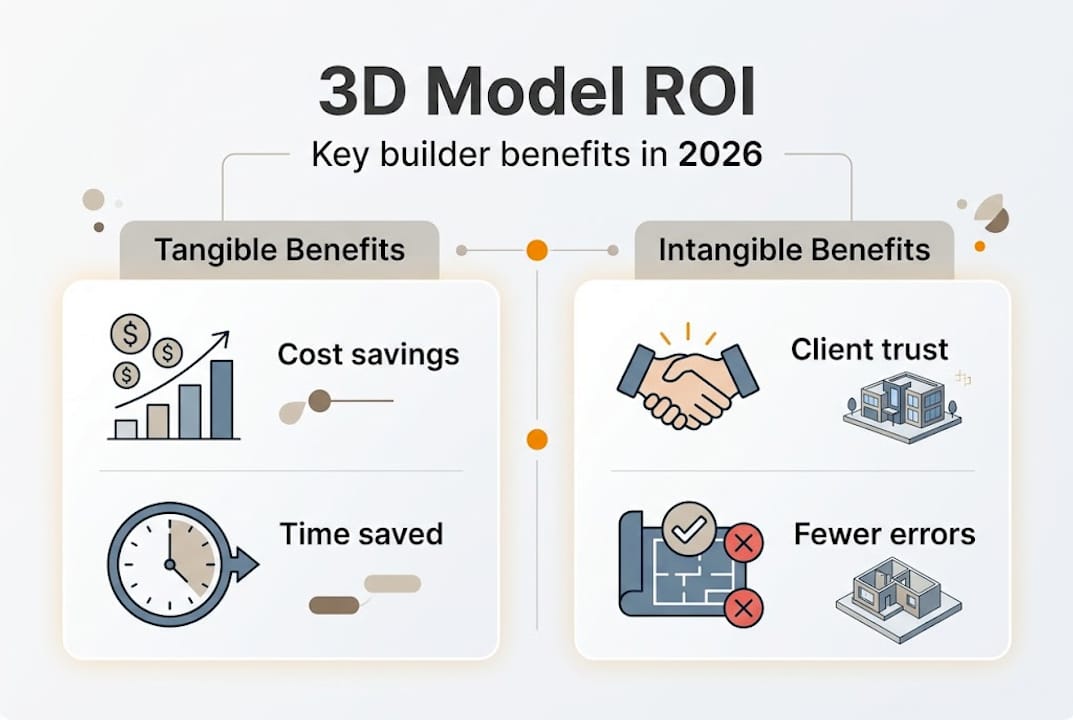
The real return comes from what you avoid. A catastrophic clash discovered during framing can cost tens of thousands of dollars and weeks of delay. A client who misunderstood the design and demands changes after construction begins can damage your reputation for years. These aren’t line items in a bid, but they absolutely affect your bottom line and your career.
Visionary builders use 3D models to set themselves apart in competitive bids, yes. But more importantly, they use them to anticipate the problems that flat plans simply cannot reveal. The builder who shows up to a client meeting with a photorealistic walkthrough isn’t just impressive. They’re signaling competence, care, and professionalism.
“The builders who reduce mistakes through visualization aren’t just saving money. They’re building a reputation that compounds over time.”
Peace of mind and client trust are legacy benefits. They don’t show up in a single project’s ROI calculation, but they determine whether your phone keeps ringing.
Ready to transform your next build with 3D models?
If you’re ready to put these benefits to work on your next project, the starting point is simpler than you might think. Partnering with a professional visualization team means you get production-ready models without needing to master complex software yourself.
At Rendimension, our 3D rendering services are built for builders who want precision, speed, and results. Whether you need full architectural visualization solutions for a commercial development or high-quality 3D visualization to close a residential sale, we deliver photorealistic outputs that move projects forward. With over 1,000 projects completed globally, we know what builders need to win bids and keep clients confident from day one.
Frequently asked questions
How do 3D models help reduce project costs in construction?
3D models catch design conflicts early, improve estimation accuracy, and reduce change orders, which cut costs by up to 15% on average compared to traditional planning methods.
Are 3D models useful for small construction projects?
Absolutely. Even on smaller projects, 3D modeling reduces errors and speeds up client approvals, making the investment worthwhile regardless of project scale.
Is it hard to get started with 3D modeling for builders?
Not at all. Modern service providers handle the technical work, so builders can access professional 3D models without needing to learn specialized software themselves.
What’s the difference between 3D models and traditional blueprints?
3D models are interactive, three-dimensional, and immediately understandable to non-technical stakeholders, while blueprints are flat, static drawings that require trained interpretation to use effectively.