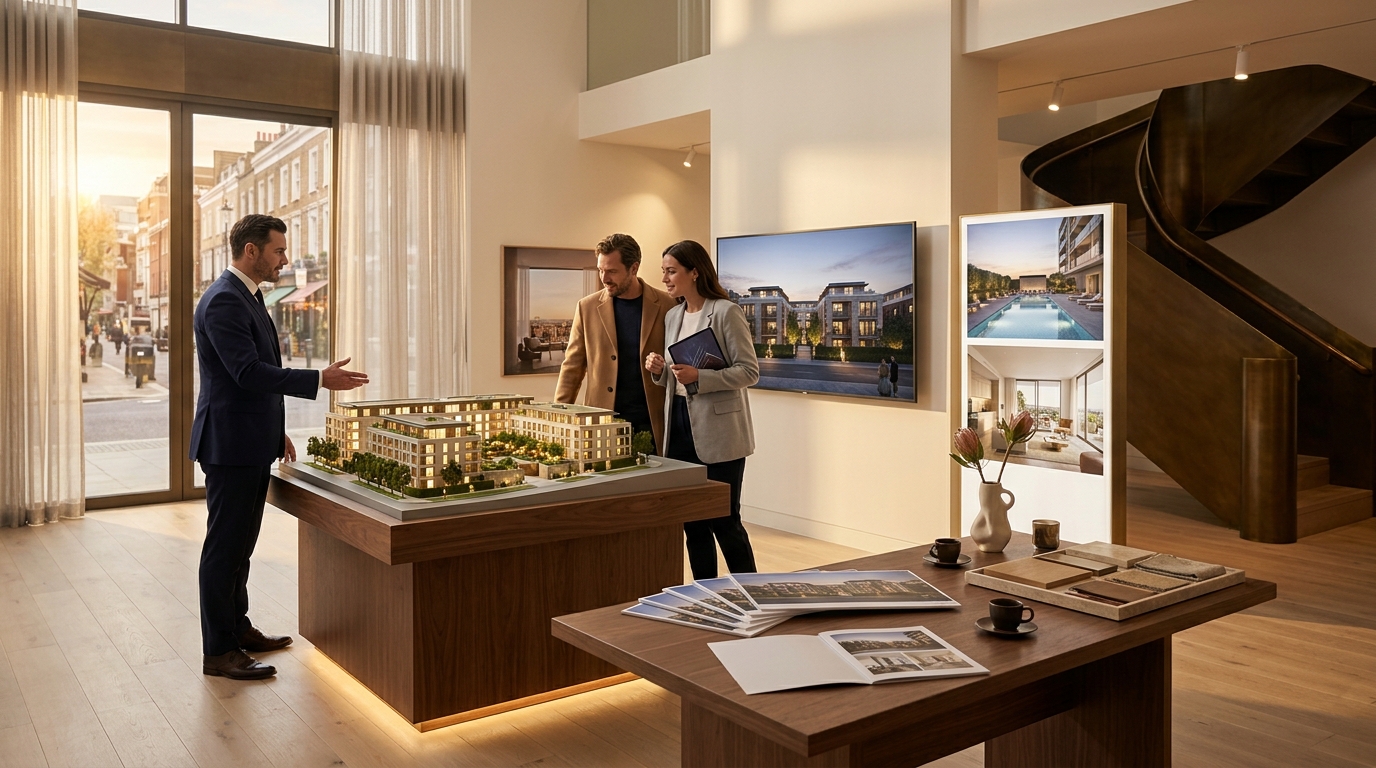
Real Estate Rendering and Developer Marketing: A Complete Guide
A complete guide to real estate rendering for developer marketing: how pre-sale renderings, investor presentation visuals, and 3D visualization help developers raise capital, market unbuilt projects, and sell before construction is finished.
Real estate rendering produces photorealistic images and animations of properties before they are built, so developers can market and sell units, secure investment, and present to lenders ahead of construction. Pre-sale renderings and investor presentation visuals let buyers and capital partners evaluate a project as if it were already finished.
What is real estate rendering?
Real estate rendering is the production of photorealistic visuals of a property before it exists physically. For developers, these visuals are the primary marketing and sales asset for projects that are still on paper or under construction.
Unlike a general architectural render, real estate rendering is built around a commercial goal: selling units, raising capital, or securing approvals. The imagery has to communicate lifestyle and value to buyers while remaining accurate enough to satisfy investors and lenders.
Pre-sale renderings, investor presentation visuals, and developer marketing assets all fall under this category. They turn an unbuilt project into something a buyer can fall in love with and a lender can underwrite.
Developers sell the finished building long before it exists. Real estate rendering is how they make that future tangible.
How do developers use real estate rendering to market unbuilt projects?
Developers use renderings as the centerpiece of marketing campaigns that launch before a single wall is framed. Renderings appear in brochures, websites, listing portals, sales centers, and social campaigns, giving buyers a clear picture of the finished product.
Strong marketing renderings communicate lifestyle and context, not just the building. Landscaping, light, neighborhood feel, and interior atmosphere all influence a buyer's decision to commit early.
How does rendering support investor and lender presentations?
Institutional investors and construction lenders evaluate photorealistic renderings as part of underwriting. A credible render communicates project viability, design caliber, and market positioning at the standard institutional capital expects.
Investor presentation visuals must balance aspiration with accuracy. Overpromising in a render damages credibility with sophisticated capital partners, so fidelity to the actual design is essential.
What types of renderings do real estate developers need?
The right mix depends on the project and sales strategy. Most developments combine exterior and interior stills with at least one immersive or motion deliverable.
Exterior and amenity stills
Hero shots of the building, entrance, pool, and shared spaces for marketing and listings.
Interior and unit renderings
Model-unit interiors and finish options that let pre-sale buyers evaluate the living experience.
Walkthroughs and VR
Motion and immersive tours for sales centers and remote buyers who cannot visit the site.
Aerial and site context
Bird's-eye views showing the project within its neighborhood and amenities, important for mixed-use and master-planned developments.
Rendering by developer marketing goal
Match the deliverable to what you need the project to achieve.
| Goal | Best rendering type | Audience |
|---|---|---|
| Pre-sell units | Interior + amenity stills, VR | Pre-sale buyers |
| Raise equity | Exterior hero + walkthrough | Investors |
| Secure financing | Accurate exterior + site plan | Lenders |
| Win approvals | Site context + aerial | Planning boards |
| Launch marketing | Lifestyle exterior + interior | General market |
Explore the full topic cluster
Related guides, services, markets, and project case studies on this subject.
In-depth guides
Related services
Markets we serve
Project case studies
Frequently asked questions
What is real estate rendering?
Real estate rendering is the production of photorealistic visuals of a property before it is built, used by developers to market and sell units, raise capital, and present to lenders. It turns an unbuilt project into imagery buyers and investors can evaluate as if it were finished.
Can you sell real estate before it is built using renderings?
Yes. Pre-sale renderings are the standard tool developers use to market and sell units during the pre-construction phase. Photorealistic interior, exterior, and amenity renderings let buyers evaluate and commit to a unit before the building is complete.
What renderings do I need for an investor presentation?
Investor presentations typically need a strong exterior hero image, key interior and amenity views, and often a walkthrough or site plan. The visuals must be accurate to the design, because sophisticated capital partners evaluate renderings as part of underwriting.
How does VR help in real estate marketing?
Virtual reality lets remote and pre-sale buyers tour an unbuilt unit interactively, experiencing scale and flow in a way still images cannot convey. It is especially effective in sales centers and for buyers who cannot visit the site in person.
How accurate do marketing renderings need to be?
Marketing renderings should be aspirational but accurate to the actual design. Overpromising damages credibility with investors and can create legal exposure with buyers. Professional studios balance appealing presentation with fidelity to the construction documents.
Who produces Rendimension's real estate renderings?
Rendimension is led by Hugo Ramirez, Founder and International Architect with 20+ years of experience. That background ensures developer marketing visuals are both compelling for buyers and accurate enough to satisfy investors and lenders.
What is pre-construction visualization in real estate?
Pre-construction visualization is the production of photorealistic imagery of a property before it is physically built. For real estate developers, pre-construction visualization turns design drawings into marketing assets, investor presentation materials, and sales tools that generate commitments before a single wall is framed. The ability to sell units, raise capital, and obtain permits using visualization rather than finished construction dramatically reduces financial risk and compresses the development timeline.
What are new construction renderings?
New construction renderings are photorealistic images of homes, multifamily projects, or commercial buildings produced during the design or pre-permit phase before construction begins. Homebuilders and developers use new construction renderings in pre-sale campaigns, HOA submissions, and marketing listings to show prospective buyers the finished product before it exists. Rendimension produces new construction renderings for custom home builders, production homebuilders, and multifamily developers across the United States.
What is 3D real estate visualization and how does it differ from drone photography?
3D real estate visualization produces photorealistic imagery of a property from a 3D model before construction is complete. Drone photography captures aerial or exterior imagery of an existing, already-built property. For pre-construction marketing, 3D visualization is the only option because the building does not yet exist. Once construction is complete, drone photography and professional photography supplement or replace rendered imagery in final marketing materials.
Ready to market and sell your development before it is built?
Get a project-specific quote or talk to the team directly.