VR in Real Estate Marketing in 2026
The Role of VR in Real Estate Marketing in 2026
TL;DR:
- Virtual reality in real estate has shifted from an experimental novelty to a proven marketing tool that accelerates sales and improves buyer qualification. It is most effective for luxury, pre-construction, and commercial properties, where it reduces time on market and builds buyer trust through accurate, immersive visualization. Implementing VR strategically as a qualification filter can significantly enhance listing performance and client engagement.
Most real estate professionals assume virtual reality is either too expensive to bother with or a novelty that impresses at conferences but does nothing for their close rate. Both assumptions are wrong. The role of VR in real estate marketing has shifted from experimental to operational, backed by data that shows faster sales cycles, stronger buyer qualification, and expanding geographic reach. This article breaks down exactly how VR works in practice, what the research actually says, and how you can apply it without wasting budget on tech that does not fit your inventory.
Table of Contents
- Key takeaways
- How VR functions in real estate marketing
- Measurable impact on sales performance
- When VR works and when it does not
- Emerging VR trends reshaping buyer experience
- Applying VR to your marketing strategy today
- My take on VR’s real value in real estate
- See how Rendimension brings properties to life in VR
- FAQ
Key takeaways
| Point | Details |
|---|---|
| VR cuts time on market | Properties with VR tours sell significantly faster without sacrificing selling price. |
| Buyer trust increases substantially | 71% of buyers would purchase sight-unseen with a quality 3D virtual tour available. |
| Qualification improves, not just engagement | VR pre-screens buyers by answering questions agents typically handle in person. |
| Not every listing needs full VR | Luxury, pre-construction, and larger homes see the strongest return from VR investment. |
| Emerging tools deepen spatial context | Neighborhood exploration features are becoming as important as the tour itself. |
How VR functions in real estate marketing
Understanding the technology is the first step to deploying it correctly. VR in real estate is not one product. It is a spectrum of experiences, and where you land on that spectrum depends on your budget, property type, and buyer profile.
At the most accessible end, you have non-immersive 3D tours, which are web-based walkthroughs viewers navigate on a laptop or phone. Platforms like Matterport and Zillow 3D Home fall into this category. These do not require a headset and represent the majority of virtual reality uses in real estate today. They are affordable, easy to integrate into MLS listings, and already familiar to most buyers.
One step up is headset-based VR, where a buyer puts on a device like the Meta Quest 3 and walks through a property at a 1:1 scale. This format is particularly effective in luxury showrooms or developer sales offices where prospects are physically present. The spatial sense it delivers goes beyond anything a screen tour can replicate.
Then there is augmented reality, which overlays digital elements onto a real-world view through a phone or tablet. AR works well for virtual staging scenarios where buyers can swap furniture, change wall colors, or visualize an empty unit as fully furnished.
The clearest practical difference between these formats and traditional photography is depth. Photos collapse a three-dimensional space into a flat image that agents and sellers routinely manipulate through lens choice and staging. A well-executed 3D tour cannot hide a cramped hallway or an awkward floor plan.
Pro Tip: If you are deciding between platforms, Matterport’s digital twin format integrates directly with major listing sites and generates a measurable engagement data trail you can share with sellers to justify your marketing spend.
Measurable impact on sales performance
The skepticism around VR usually collapses when you look at the numbers. A 2025 study from the University of Texas at Dallas analyzed nearly 43,000 VR-listed properties and found that VR tours cut time on market from an average of 34 days to 19 days. Critically, selling prices stayed flat. The acceleration in sales speed came entirely from faster buyer decision-making, not from discounting.
“VR does not improve the home’s condition, but it offers an accurate visualization that reduces uncertainty and speeds the buyer’s evaluation process.”, Dr. Zixuan Meng, University of Texas at Dallas
That framing matters. VR’s main marketing influence is speeding qualification and reducing uncertainty, not inflating prices. If you go in expecting VR to push your listing price higher, you will be disappointed. If you use it to close your sales cycle faster and serve better-informed buyers, it delivers.
Broader platform data reinforces this. Listings with 3D tours sell 31% faster on average and attract 49% more qualified leads. Virtual staging, a VR adjacent tool, also has a strong track record. Staged homes sell 73% faster on average, and digital staging costs a fraction of physical furniture rental.
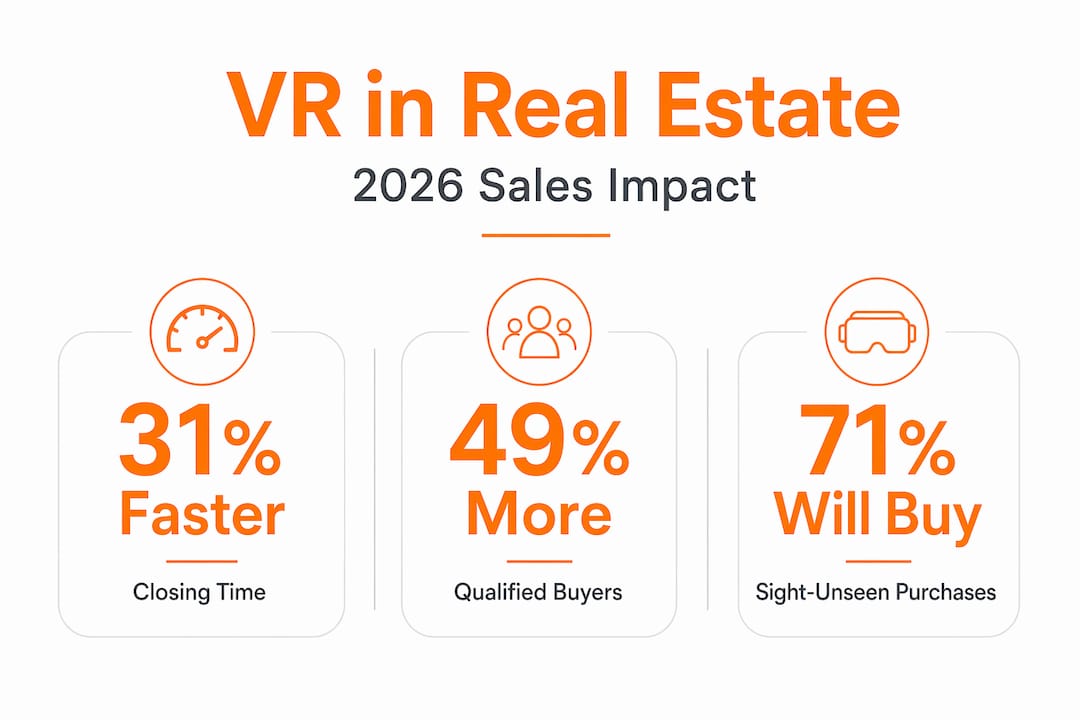
| Metric | Traditional listing | VR-enabled listing |
|---|---|---|
| Average days on market | 34 days | 19 days |
| Lead qualification rate | Baseline | +49% qualified leads |
| Sight-unseen purchase intent | Low | 71% of buyers willing |
| Sales speed improvement | Baseline | +31% faster on average |
Perhaps the most striking figure comes from buyer behavior research. 71% of home buyers said they would purchase a property sight-unseen if the listing included a high-quality 3D virtual tour. That figure fundamentally changes what you can expect from your buyer pool geography. A listing in Denver can be seriously evaluated by a relocating buyer in Boston without a flight, and VR provides the trust mechanism that makes that possible.
Redfin’s adoption of Matterport shows what happens at scale. The brokerage saw monthly virtual walkthroughs increase over 600% after integrating digital twin tours across its listings. That kind of engagement growth is not a marginal improvement. It is a structural shift in how buyers interact with listings before they ever contact an agent.
When VR works and when it does not
VR is not a universal solution. Getting value from it means being selective. These are the scenarios where VR consistently pays off:
Luxury and high-price residential listings justify the production cost immediately. A $2 million property with a $500 VR scan is a no-brainer. Buyers at that price point expect production quality, and a flat photo grid actively underserves the listing.
Pre-construction and new development projects are arguably the best use case. When nothing physical exists yet, VR is the only way for a buyer to evaluate what they are purchasing. High-end VR experiences built on Unreal Engine with Quest 3 headsets are now being used by luxury developers to sell units before a single wall goes up, with buyers experiencing finished spaces at full scale before construction begins.
Commercial properties, especially office and retail spaces, benefit because tenants and investors need to evaluate spatial flow, natural light, and layout efficiency. VR handles all three in a way floor plans cannot.
Where VR adds less value is in a hot seller’s market with a sub-$300,000 listing. When demand outpaces supply, buyers are already competing aggressively and may not need the confidence boost a VR tour provides. The investment may not recoup in those conditions.
| Property type | VR ROI potential | Recommended format |
|---|---|---|
| Luxury residential | High | Headset or Matterport digital twin |
| Pre-construction / new build | Very high | Custom VR or Unreal Engine experience |
| Commercial / office | High | 3D walkthrough with floor plan overlay |
| Mid-range residential | Moderate | Matterport or Zillow 3D Home tour |
| Entry-level / hot market | Low | Standard photography may suffice |
One important nuance: VR rarely replaces in-person viewings outright. Its real function is shortening the shortlist phase. Buyers who tour five properties virtually will typically visit two in person. That is three fewer wasted showings per buyer, and that efficiency compounds quickly across a busy agent’s pipeline.
Pro Tip: Use VR tour analytics, specifically time spent in each room, to prep for in-person showings. If a buyer lingered in the kitchen for 40 seconds during their virtual tour, lead with the kitchen remodel story when they arrive.
Emerging VR trends reshaping buyer experience
The technology is not standing still. Several developments in 2025 and 2026 are expanding what VR can accomplish in real estate marketing.
Neighborhood context is becoming a core part of the immersive experience. Realtor.com’s FlyAround 3D maps, launched in late 2024, now give buyers a dynamic aerial view of the surrounding area. The tool doubled mobile map engagement and roughly 10% of listing viewers actively interact with it. This matters because buyers are not just evaluating the property. They are evaluating proximity to schools, parks, transit corridors, and commercial amenities. Giving them spatial awareness of the neighborhood within the listing experience reduces a major hesitation point.
Other trends worth tracking include:
- Dynamic lighting simulation inside VR tours that lets buyers experience a space at sunrise, midday, and evening to evaluate natural light behavior across the day.
- Spatial analytics, where session data from VR tours reveals which rooms buyers dwell in, which they skip, and where they exit the tour, giving agents and sellers precise feedback on how buyers perceive the property.
- AI-driven personalization that filters which rooms or features a buyer sees first based on their stated preferences or prior search behavior.
- Gaming engine integration for new developments, where properties are modeled in real estate visualization tools built on Unreal Engine, producing photorealistic renders indistinguishable from photography.
These are not features in a distant roadmap. They are live or in active deployment by forward-thinking developers and brokerages right now.
Applying VR to your marketing strategy today
Knowing VR works is one thing. Knowing where to start is another. Here is a practical sequence for integrating VR into your listings without over-investing or under-executing.
- Audit your current inventory by property type and price point. Apply VR first to listings over $500,000, new construction, and any property with a complex floor plan or exceptional finishes that photos consistently undersell.
- Choose a platform that matches your workflow. Matterport integrates with most major listing sites and provides shareable links, data dashboards, and a consistent output format. Zillow 3D Home works well if your buyer base skews toward Zillow-heavy markets. For pre-construction, explore custom VR rendering built for developer sales environments.
- Incorporate VR links into every digital marketing channel. Email campaigns, social media, and paid ads all perform better when a VR tour is the click destination rather than a static gallery.
- Use VR as a buyer qualification filter. Before scheduling an in-person showing, ask buyers to complete the virtual tour. This simple step removes tire-kickers and surfaces genuinely interested buyers who arrive already oriented to the space.
- Brief your team on VR as a client service tool, not just a marketing asset. VR complements agent performance by filling information gaps when agents cannot be immediately available, essentially serving as a self-service resource for buyers who want answers at 10pm on a Sunday.
Pro Tip: When presenting VR to seller clients, lead with the days-on-market data. Sellers care about speed and net proceeds. A 15-day reduction in listing duration, which VR has consistently delivered, translates directly into reduced carrying costs and a stronger negotiating position.
My take on VR’s real value in real estate
I have worked across enough real estate visualization projects to have a clear-eyed view of where VR actually earns its place. The technology genuinely works, but not for the reasons most people sell it.
The conversations I see agents have with buyers often center on trust. A buyer considering a relocation purchase, or a commercial tenant evaluating an office build-out, is being asked to make a major financial commitment with incomplete information. VR closes that gap. Not by making the property look better than it is. Digital twin VR tours provide a more accurate and honest reflection of a property than staged photography, which routinely flattens and idealizes spaces. VR builds trust by showing the truth, not a curated version of it.
What I would caution against is chasing the technology for its own sake. An Unreal Engine experience makes sense for a luxury developer preselling penthouses. It makes no sense for an agent listing a two-bedroom condo in a competitive mid-market. Matching the tool to the job is where the real skill lies.
What I have found actually works in practice is treating VR as a qualification engine first and a marketing showpiece second. When your VR tours filter out the casual browsers and surface the committed buyers, your entire sales operation gets more efficient. That is worth far more than the engagement metrics alone.
, Rendimension
See how Rendimension brings properties to life in VR
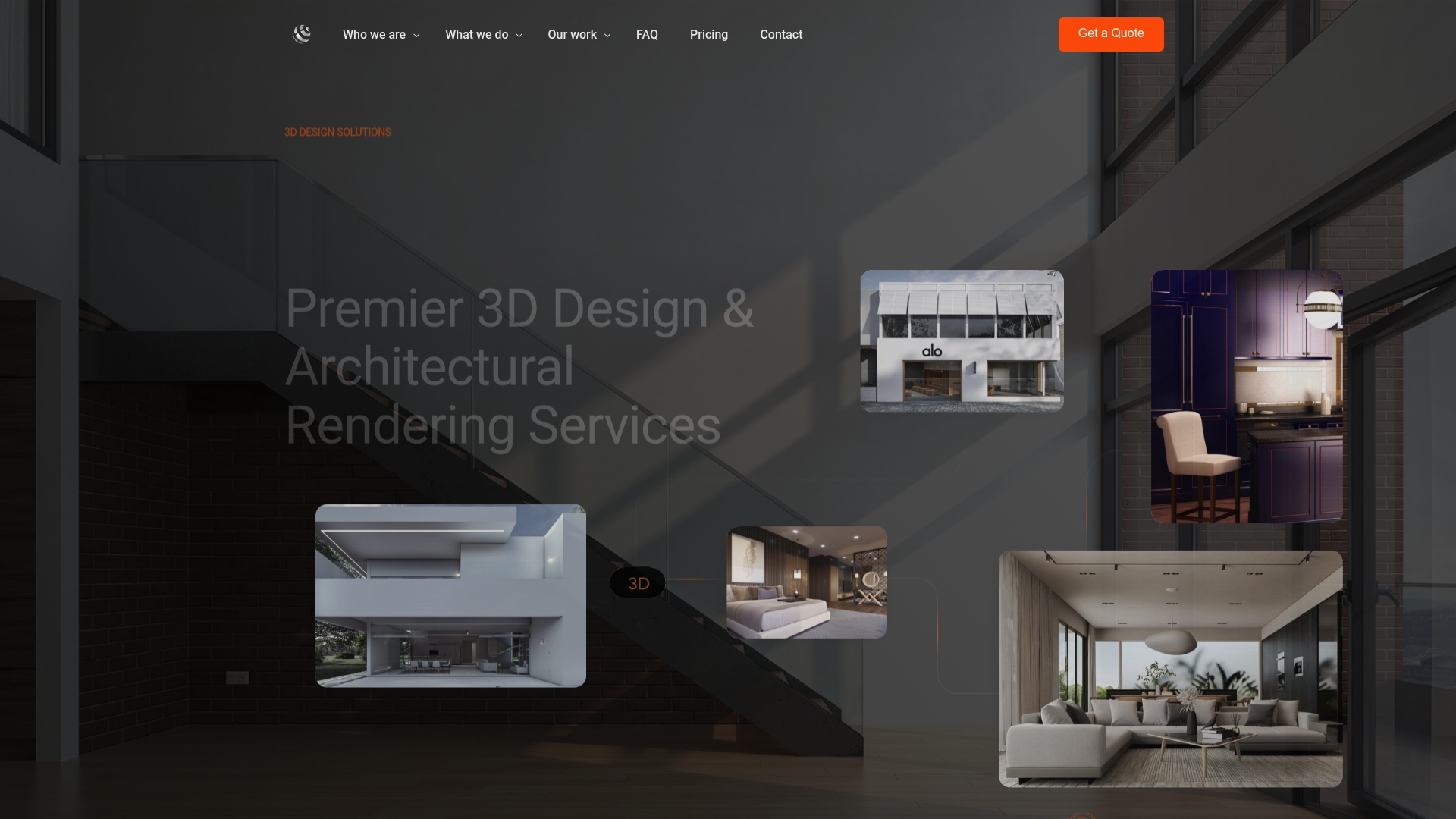
Rendimension specializes in photorealistic 3D rendering and immersive VR experiences built specifically for real estate and architectural projects. Whether you need a Matterport-quality virtual walkthrough for a residential listing, a fully interactive pre-construction experience for a development sales office, or virtual staging and 3D renders that close the gap between empty space and buyer imagination, Rendimension delivers with precision and attention to detail. With over 1,000 completed projects globally, the team understands what buyers need to feel confident and what agents need to close faster. Explore Rendimension’s VR real estate services and see what your listings could look like in the hands of a specialist visualization team.
FAQ
How does VR reduce time on market for real estate listings?
A University of Texas at Dallas study found VR tours cut average listing duration from 34 to 19 days by accelerating buyer decision-making and reducing uncertainty before in-person visits.
Can VR tours replace in-person property showings?
VR rarely replaces in-person viewings entirely. Its primary function is shortening the shortlist phase, so buyers who visit in person are already committed and informed, reducing wasted showings significantly.
What property types benefit most from VR in real estate marketing?
Luxury residential, pre-construction developments, and commercial properties deliver the strongest return from VR investment, where the cost of production is proportional to the deal size and buyer expectations are high.
How does VR build buyer trust for sight-unseen purchases?
Digital twin VR tours provide an accurate, unedited representation of a property, which research shows is more truthful than staged photography. This accuracy is why 71% of buyers say they would purchase a property sight-unseen with a quality 3D tour available.
What is the difference between 3D tours and full VR experiences in real estate?
3D tours are web-based walkthroughs accessible on any device without specialized hardware, while full VR experiences use headsets like the Meta Quest 3 to deliver 1:1 scale immersive walkthroughs, primarily used in luxury and pre-construction sales environments.
Recommended
- Why VR tours boost property sales and design ROI
- How VR boosts property development outcomes
- Enhance Property Sales With 3D Renders In Real Estate 2026
Related guides
Need professional real estate rendering services? Rendimension helps developers, agents, and investors visualize properties before construction with photorealistic 3D renders, walkthroughs, and floor plans. See our real estate rendering portfolio.
Frequently asked questions
How does VR reduce time on market for real estate listings?
A University of Texas at Dallas study found VR tours cut average listing duration from 34 to 19 days by accelerating buyer decision-making and reducing uncertainty before in-person visits.
Can VR tours replace in-person property showings?
VR rarely replaces in-person viewings entirely. Its primary function is shortening the shortlist phase, so buyers who visit in person are already committed and informed, reducing wasted showings significantly.
What property types benefit most from VR in real estate marketing?
Luxury residential, pre-construction developments, and commercial properties deliver the strongest return from VR investment, where the cost of production is proportional to the deal size and buyer expectations are high.
How does VR build buyer trust for sight-unseen purchases?
Digital twin VR tours provide an accurate, unedited representation of a property, which research shows is more truthful than staged photography. This accuracy is why 71% of buyers say they would purchase a property sight-unseen with a quality 3D tour available.
What is the difference between 3D tours and full VR experiences in real estate?
3D tours are web-based walkthroughs accessible on any device without specialized hardware, while full VR experiences use headsets like the Meta Quest 3 to deliver 1:1 scale immersive walkthroughs, primarily used in luxury and pre-construction sales environments.