The Role of 3D in Product Launch Campaigns

The Role of 3D in Product Launch Campaigns

TL;DR:
- D visualization transforms product launches by creating interactive, photorealistic models that boost customer engagement and conversions. Brands using 3D report up to 612% higher conversion rates and significantly reduce product returns. Implementing 3D across all touchpoints offers ongoing operational and financial advantages, becoming essential for future marketing success.
3D visualization is defined as the use of computer-generated imagery to create photorealistic, interactive representations of physical products before or during a launch. The role of 3D in product launch campaigns goes far beyond aesthetics. It changes how customers discover, evaluate, and commit to buying. Brands implementing 3D product visualization report conversion improvements up to 612% compared to static imagery. That number signals a structural shift in what buyers expect from a product launch, not a minor upgrade to your creative assets. Platforms like Shopify and Meta have built native 3D ad support into their core infrastructure, confirming that interactive product visualization is now a baseline marketing requirement.
How does 3D visualization impact customer engagement and conversion rates?
3D content turns passive browsing into active product interaction, which fundamentally changes how customers behave during product discovery. When a shopper can rotate, zoom, and inspect a product from every angle, they stop skimming and start evaluating. That behavioral shift is measurable and consistent across categories.
The conversion data is striking. Interactive 3D models boost conversions by 94% on Shopify-hosted product pages. The same principle applies to paid media. 3D ads with interactive elements generate 3x higher engagement and 423% higher click-through rates on platforms like Instagram and TikTok. Meta’s 3D ad support has delivered a 267% improvement in cost-per-acquisition for brands that adopted it in early 2026. These are not marginal gains. They represent a different category of marketing performance.
The psychology behind these numbers is well understood. The Endowment Effect explains the mechanism: when users rotate a 3D product model, they shift mentally from observer to holder. That subconscious sense of ownership reduces skepticism and increases purchase intent before a single word of copy is read.
Time on page also increases significantly. Customers spend 10–20 minutes interacting with 3D product configurators, compared to seconds spent on static image galleries. Longer engagement means more time for the product to sell itself.
- Conversion lift: Up to 612% improvement over static imagery for brands using full 3D visualization
- Click-through rates: 423% higher on social ads featuring interactive 3D elements
- Time on page: 10–20 minutes average with 3D configurators versus seconds with static images
- Purchase intent: Measurably higher due to the Endowment Effect triggered by product rotation
Pro Tip: Deploy 3D models on your highest-traffic product pages first. Even a single hero product with a 3D viewer will generate enough data within 30 days to justify a broader rollout.
What operational and financial advantages does 3D visualization offer?
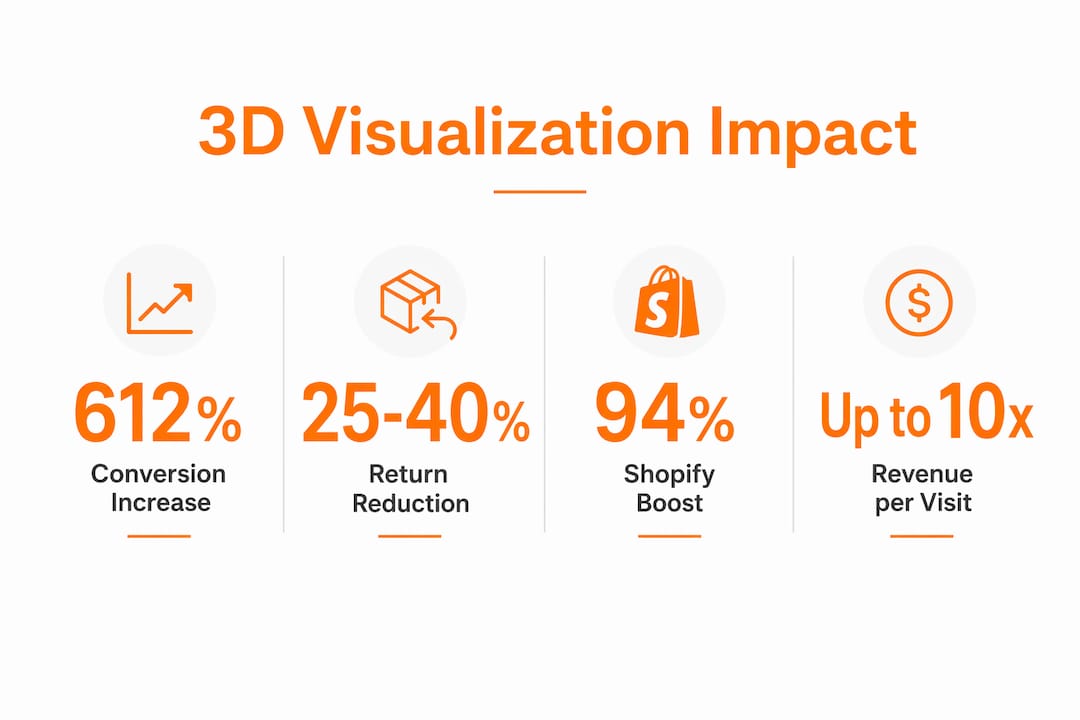
The financial case for 3D visualization extends well past conversion rates. The most durable source of ROI is 3D asset reuse across multiple channels. A single high-quality 3D model can power your product page, your paid ads, your email campaigns, your AR preview, and your retail display. That eliminates the cost of reshooting product photography every time a color variant or configuration changes.

Return rates drop sharply when buyers can visualize products accurately before purchase. AR and 3D visualization tools reduce product returns by 25%–40%, particularly in furniture and home décor where scale and fit are the primary sources of buyer regret. A 40% reduction in returns translates directly into lower reverse logistics costs, less restocking labor, and a cleaner margin profile.
| Operational benefit | Impact |
|---|---|
| Return rate reduction | 25%–40% fewer returns in furniture and home décor categories |
| Content production cost | One 3D asset replaces multiple photo shoots across channels |
| Launch cycle speed | Centralized 3D asset management accelerates updates and variants |
| Revenue per visit | Customers choose higher-value configurations when engaged with 3D |
Revenue per visit is the most critical KPI when evaluating 3D investments. Customers who interact with configurators tend to select premium options, larger sizes, and add-on features at higher rates than those viewing static images. The product sells itself upward.
Pro Tip: Build your 3D asset library with file formats that export cleanly to web, AR, and print. GLB and USDZ are the two formats that cover the widest range of deployment scenarios without re-modeling.
The visualization workflow guide from Rendimension outlines how product teams can structure 3D asset production to maximize reuse from day one of a launch cycle.
How is 3D technology applied in product launch campaigns?
Practical application is where most marketing teams underperform. The technology is available. The deployment strategy is often missing.
The most effective applications follow a clear progression:
- Interactive 3D configurators on product pages. Buyers select colors, materials, and configurations in real time. This works exceptionally well for furniture, electronics, and luxury goods where personalization drives purchase decisions.
- WebGL and WebXR browser-native experiences. Web-native 3D technologies deliver photorealistic, interactive models on mobile and desktop without requiring any app download. Removing that friction barrier increases adoption dramatically.
- 3D-embedded email campaigns. Personalized emails with 3D product demos achieve up to 6x higher transaction rates than static image emails. Email is an underused channel for 3D content, and the performance gap is significant.
- Social media and paid ad integration. Short-form 3D video and interactive ad units on Instagram, TikTok, and Meta’s ad network drive the click-through and cost-per-acquisition improvements cited above.
- AR preview experiences. Buyers place a virtual product in their physical space using their phone camera. This application reduces purchase anxiety most effectively in categories where size, proportion, and context matter.
“3D visualization is not a feature you add to a product page. It is the architecture of the product experience itself. Brands that treat it as a standalone widget miss the compounding effect of deploying it across every customer touchpoint simultaneously.”
Sectors that benefit most from this full-stack approach include furniture, consumer electronics, luxury goods, and building materials. Each category shares a common trait: buyers need spatial or tactile confidence before committing. 3D delivers that confidence without a physical showroom.
The visual storytelling techniques that work in traditional brand marketing translate directly into 3D campaign strategy. The medium changes. The principle of showing rather than telling does not.
What emerging trends are shaping the future of 3D in product launches?
The technology is moving faster than most marketing teams are tracking. Understanding what is coming in 2026 and beyond helps you prioritize where to invest now.
- AI-assisted 3D asset creation. AI tools now generate base 3D models from product photos or CAD files in hours rather than weeks. This collapses the production timeline and makes 3D viable for brands with large SKU catalogs.
- Spatial commerce interfaces. Conversational shopping flows are integrating 3D product views directly into chat and voice interfaces. A buyer asks a question and receives a rotating 3D model as the answer.
- Web-native AR at scale. WebXR adoption is accelerating as browser support matures. Brands can now deliver AR try-on and room-placement experiences without a dedicated app, which removes the single biggest barrier to consumer adoption.
- 3D as the new baseline. 73% of DTC brands with revenues over $10 million are projected to implement 3D visualization by Q4 2026. The market is treating 3D the way it treated mobile optimization a decade ago: first a differentiator, then a requirement.
- Immersive pre-launch experiences. Virtual reality walkthroughs and 3D showrooms are replacing physical launch events for product categories where the experience of the product is the message.
The visual content impact on buyer behavior is well documented across digital channels. 3D content is the next evolution of that principle, and the adoption curve is steep.
Key Takeaways
3D visualization is a foundational shift in product launch strategy, not a cosmetic upgrade, and brands that deploy it across every customer touchpoint see compounding gains in conversion, engagement, and operational efficiency.
| Point | Details |
|---|---|
| Conversion impact | Interactive 3D drives up to 612% conversion improvement over static product imagery. |
| Engagement depth | Customers spend 10–20 minutes with 3D configurators, far exceeding static image engagement. |
| Return rate reduction | AR and 3D visualization cut product returns by 25%–40% in fit-sensitive categories. |
| Asset reuse ROI | One 3D model deployed across all channels reduces content production costs significantly. |
| Market adoption | 73% of DTC brands over $10M in revenue are projected to use 3D visualization by Q4 2026. |
Why most teams are still thinking about 3D the wrong way
After working with product teams across more than 1,000 projects at Rendimension, the pattern is consistent. Marketing professionals treat 3D as a visual upgrade. They commission a model, drop it on a product page, and wait for results. When the results are good, they move on. When the results are modest, they conclude that 3D “didn’t work.”
The mistake is treating 3D as a standalone feature rather than a connected system. The brands that see the largest gains are the ones that deploy the same 3D asset across their product page, their paid ads, their email sequences, and their AR preview simultaneously. The compounding effect of consistent 3D exposure across every touchpoint is where the real performance lives.
The other mistake is starting with the wrong products. Begin with your highest-consideration items, the ones where buyers hesitate longest and return most frequently. Those are the products where 3D removes the most friction. Once you have proof of performance on those SKUs, the internal case for a broader rollout writes itself.
3D visualization is also not a one-time production cost. It is a product visualization investment that pays forward into every future campaign. The asset you build for a launch becomes the foundation for your configurator, your AR experience, and your next season’s advertising. Teams that understand this build their 3D library with the same discipline they apply to brand guidelines.
, Rendimension
How Rendimension supports product launch visualization
Product managers and marketing teams that want photorealistic 3D content without managing the production process work with Rendimension. The firm has completed over 1,000 projects globally, producing 3D renderings and product visuals that perform across digital advertising, e-commerce, and immersive campaign formats.
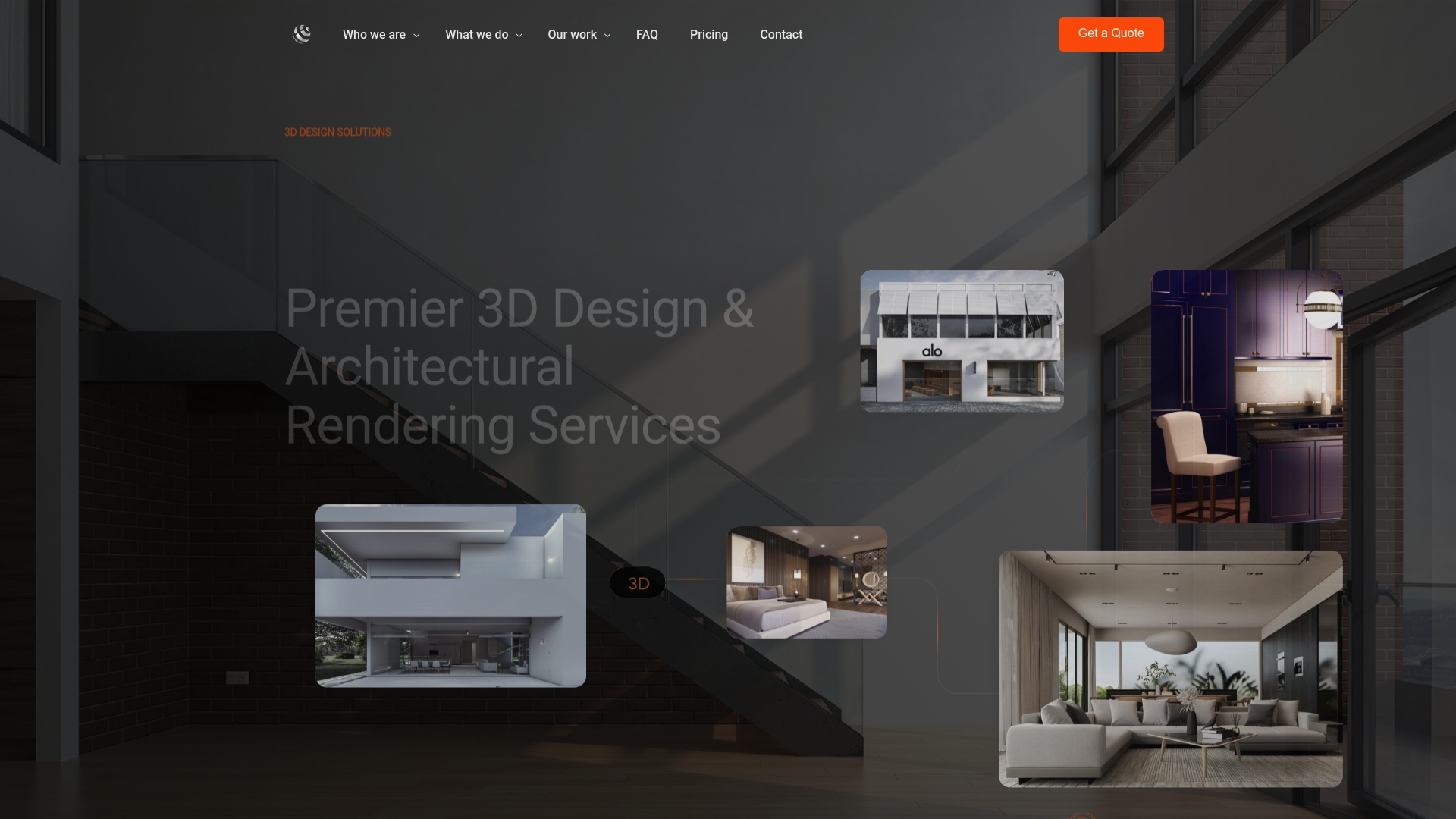
Rendimension’s services cover the full range of launch requirements: photorealistic product renders, interactive 3D walkthroughs, and virtual reality experiences built for marketing deployment. Every project runs through a collaborative process from concept to final delivery, with client input at each stage. If your next product launch needs 3D content that converts, Rendimension is the place to start that conversation.
FAQ
What is the role of 3D in product launch campaigns?
3D visualization gives buyers an interactive, photorealistic product experience that static images cannot match. It increases conversion rates, reduces purchase hesitation, and supports consistent brand storytelling across every launch channel.
How much can 3D visualization improve conversion rates?
Brands using 3D product visualization report conversion improvements up to 612% over static imagery, with Shopify platform data confirming 94% higher conversion rates on 3D-enabled product pages.
Does 3D visualization reduce product returns?
AR and 3D visualization tools reduce return rates by 25%–40%, particularly in furniture and home décor, by helping buyers verify scale, fit, and appearance before purchase.
What channels work best for 3D product content?
3D content performs across product pages, social ads, email campaigns, and AR previews. Personalized emails embedding 3D product demos achieve up to 6x higher transaction rates than static image emails.
When will 3D visualization become standard in product marketing?
73% of DTC brands with revenues over $10 million are projected to implement 3D visualization by Q4 2026, placing it on the same adoption trajectory as mobile optimization.
Recommended
- Role Of 3D In Product Launches: Driving Engagement
- Marketing Tips for 3D Visuals That Drive Real Results | Rendimension Blog
Frequently asked questions
What is the role of 3D in product launch campaigns?
3D visualization gives buyers an interactive, photorealistic product experience that static images cannot match. It increases conversion rates, reduces purchase hesitation, and supports consistent brand storytelling across every launch channel.
How much can 3D visualization improve conversion rates?
Brands using 3D product visualization report conversion improvements up to 612% over static imagery, with Shopify platform data confirming 94% higher conversion rates on 3D-enabled product pages.
Does 3D visualization reduce product returns?
AR and 3D visualization tools reduce return rates by 25%–40%, particularly in furniture and home décor, by helping buyers verify scale, fit, and appearance before purchase.
What channels work best for 3D product content?
3D content performs across product pages, social ads, email campaigns, and AR previews. Personalized emails embedding 3D product demos achieve up to 6x higher transaction rates than static image emails.
When will 3D visualization become standard in product marketing?
73% of DTC brands with revenues over $10 million are projected to implement 3D visualization by Q4 2026, placing it on the same adoption trajectory as mobile optimization.