Product Visualization for Ecommerce: A Complete 2026 Guide
Product Visualization for Ecommerce: A Complete 2026 Guide
TL;DR:
- Product visualization uses 3D models and augmented reality to let shoppers explore products virtually before buying. It significantly boosts conversion rates and reduces returns, especially in furniture and home decor. Building assets as infrastructure ensures long-term value and operational success.
Product visualization for ecommerce is defined as the practice of using interactive 3D models, augmented reality, and advanced imaging to represent products digitally so shoppers can explore them before buying. Unlike static photography, this approach lets customers rotate, zoom, configure, and even place items in their own space. The result is measurable: interactive 3D visualization boosts conversion rates by 25–40%, with AR-enabled furniture seeing 3 to 4 times higher conversions. For ecommerce business owners and marketing professionals, understanding these techniques is no longer optional. It is the foundation of a competitive digital storefront.
What is product visualization for ecommerce, and how does it work?
Product visualization, also called visual commerce, is the discipline of replacing or supplementing physical product interaction with digital equivalents. The industry standard term is “3D product visualization,” and it covers everything from photorealistic still renders to fully interactive AR experiences. The goal is always the same: give shoppers enough visual confidence to buy without touching the product.

The core process starts with a 3D model. A designer builds a digital replica of the product, capturing geometry, material properties, texture, and color. That model then becomes the source for every visual asset the brand needs, from website images to AR overlays. This single-source approach is what separates modern visual commerce from traditional photography workflows.
From that master model, several distinct techniques branch out:
- 360-degree spin views: The shopper rotates the product by dragging, seeing every angle on demand.
- Zoom and detail views: High-resolution renders let customers inspect stitching, grain, or finish at close range.
- Product configurators: Shoppers select color, material, or size and see the change applied in real time.
- Augmented reality (AR) view-in-room: The product appears at true scale in the shopper’s physical space through a smartphone camera.
- Photorealistic still renders: CGI images replace or supplement traditional product photography across catalogs and ads.
Pro Tip: Start with 360-degree rotation and zoom before investing in AR. Simple 3D interactions consistently outperform complex virtual environments in conversion lift for most ecommerce categories.
One underappreciated advantage is asset reuse. A single high-fidelity 3D model can feed your website, paid ads, email campaigns, configurators, and AR features simultaneously. That cross-channel asset reuse lowers total cost of ownership significantly over a 12–24 month period compared to running separate photography shoots for each channel.
What impact does product visualization have on ecommerce sales?
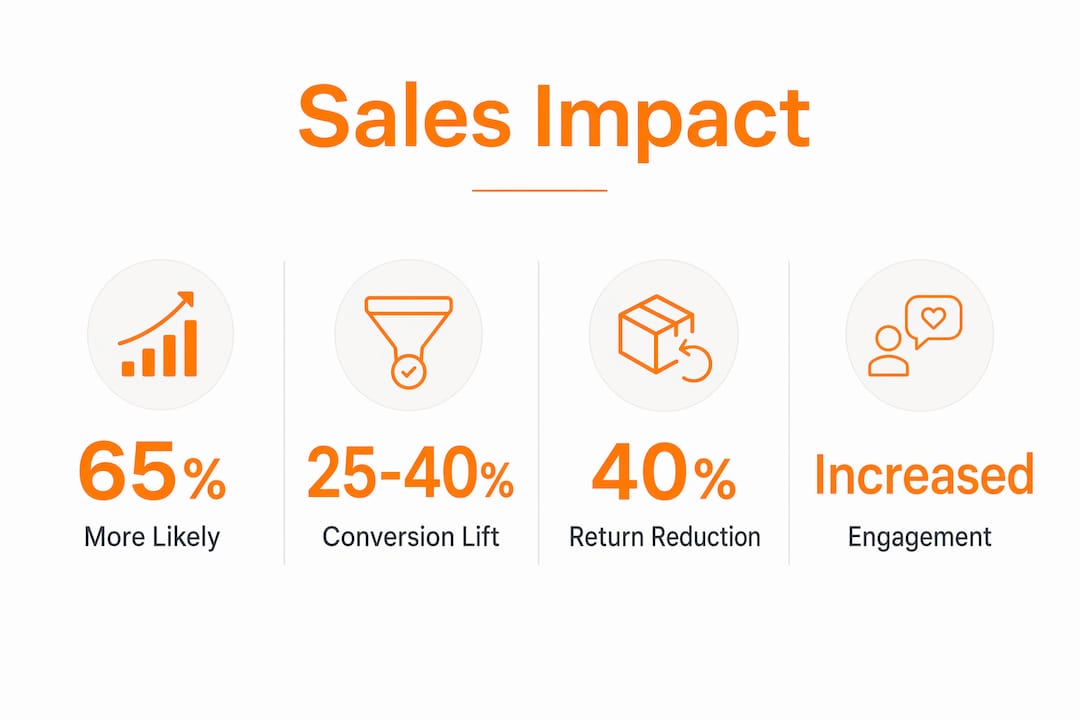
The sales impact of product visualization is documented and direct. Shoppers using AR features are up to 65% more likely to place an order. That figure reflects a fundamental shift in buyer psychology: when a customer can see a product at scale in their own room, purchase hesitation drops sharply.
Conversion data from real deployments reinforces this. Motorola Latin America implemented 3D visualization across its ecommerce properties and recorded a 53.3% conversion increase in Argentina and 47.2% in Mexico. Those are not marginal gains. They represent a structural improvement in how shoppers respond to product pages.
The benefits extend beyond the purchase moment. Furniture ecommerce businesses using AR report return rates dropping by up to 40%. Returns are one of the largest cost centers in ecommerce logistics, so a 40% reduction in a high-ticket category has a direct effect on margin. The mechanism is straightforward: when a shopper can see exactly how a sofa fits in their living room before ordering, they make fewer mistakes.
Engagement depth also predicts purchase behavior. Shoppers who interact with a 3D spin model spend more time on a product page and view more variants. That deeper engagement correlates with higher average order value, because customers who explore a product thoroughly are more likely to add accessories or upgrade configurations. The importance of product visualization lies precisely in its ability to replicate the in-store experience of handling a product, answering the questions that static photos never can.
| Metric | Impact |
|---|---|
| Conversion rate lift (3D/AR) | 25–40% across categories |
| AR purchase likelihood increase | Up to 65% higher |
| Furniture AR conversion gain | Up to 4x baseline |
| Return rate reduction (furniture) | Up to 40% |
| Conversion uplift at Motorola Latin America | 47–53% across markets |
Which product types benefit most from visualization?
Not every product category gains equally from visualization investment. The highest return on investment comes from products where fit, scale, configuration, or material finish are the primary buying concerns. Furniture, lighting, and home décor sit at the top of this list because shoppers cannot judge scale from a flat photo. AR view-in-room solves that problem directly.
Jewelry and watches benefit from close-up 3D renders that show material quality and craftsmanship at a level no standard product photo achieves. Industrial and commercial equipment benefits from configurators that let buyers specify dimensions, finishes, and components before requesting a quote. Fashion and apparel benefit from 360-degree views and color configurators, though AR does not yet solve the fit problem for clothing. 3D visualization does not significantly reduce returns for apparel because fit remains a physical variable no camera can resolve.
| Product category | Best visualization technique | Primary benefit |
|---|---|---|
| Furniture and home décor | AR view-in-room, 360° spin | Scale confidence, return reduction |
| Jewelry and watches | High-resolution 3D renders | Material and finish detail |
| Industrial equipment | Product configurator | Specification accuracy |
| Fashion and apparel | 360° spin, color configurator | Variant exploration |
| Consumer electronics | 360° spin, zoom | Port and detail inspection |
Pro Tip: If you sell customizable products, a configurator delivers the strongest ROI. The highest returns in 3D visualization come from solving specific buying problems like configuration and scale, not from novelty effects.
The pattern is clear. Visualization adds the most value where the gap between a static image and the physical product is widest. If your product is flat, uniform, and small, standard photography may be sufficient. If it has depth, texture, scale, or variants, visualization closes the gap that photos leave open.
How to integrate product visualization into your ecommerce workflow
Treating product visualization as a one-off project is the most common mistake ecommerce teams make. The correct approach is to treat your 3D assets as infrastructure, the same way you treat your product information management (PIM) or digital asset management (DAM) system. Here is how to build that infrastructure correctly:
- Create a master 3D model for each product. Commission a photorealistic 3D model that captures every material, finish, and geometric detail. This model becomes the single source of truth for all downstream assets.
- Connect the model to your DAM or PIM system. Store the master file in a system that your web, marketing, and commerce teams can all access. This prevents version drift and ensures every channel uses the same approved asset.
- Generate channel-specific outputs from the master model. Export still renders for your product catalog, spin sequences for your product page, and AR-ready files for mobile shoppers. One model, multiple outputs, no reshoots.
- Prioritize 360-degree rotation, zoom, and AR view-in-room first. These three features deliver the strongest and most consistent conversion lift. Add configurators and virtual environments later, once the core experience is proven.
- Test page performance before launch. 3D assets are larger than standard images. Compress files, use lazy loading, and test on mobile networks before going live. A slow product page erases the conversion gains that visualization creates.
- Partner with a specialist for production quality. The quality of the 3D model determines the quality of every output. Low-fidelity models produce unconvincing renders that can actually reduce buyer confidence. Work with a provider who has a documented track record in photorealistic product visualization.
The benefits of visual content in ecommerce compound over time when assets are managed as infrastructure rather than individual projects. A well-built master model can serve your brand for years across new channels and formats.
Common challenges in implementing ecommerce product visualization
Production cost is the first barrier most ecommerce teams encounter. High-quality 3D modeling requires skilled artists and time. The answer is not to cut quality. It is to prioritize the products that generate the most revenue or carry the highest return rates, and build those models first.
Page load performance is the second challenge. Interactive 3D content is data-heavy, and a product page that takes more than three seconds to load on mobile will lose shoppers before they ever interact with the visualization. File compression, progressive loading, and CDN delivery are non-negotiable for any visualization deployment.
Variant complexity creates a third operational challenge. A sofa available in 40 fabric options and 6 leg finishes generates 240 possible combinations. A configurator handles this elegantly, but only if the underlying 3D model is built to support material swapping from the start. Retrofitting variant support onto a model built for a single finish is expensive and often produces poor results.
A few practices that prevent these problems:
- Define variant requirements before modeling begins. Tell your visualization partner every color, material, and configuration option upfront.
- Set mobile performance benchmarks before signing off on any asset. Test on a mid-range Android device on a 4G connection, not just a desktop browser.
- Address buyer hesitation directly. 3D and AR answer customer doubts that static images cannot. Design your product page so the visualization is the first thing a shopper sees, not buried below the fold.
- Choose a visualization partner based on portfolio quality and process transparency. Review completed projects in your product category before committing.
The operational shift nobody talks about
The conversation around product visualization tends to focus on conversion rates and AR novelty. After working on over 1,000 visualization projects at Rendimension, the more important story is operational. The brands that see sustained results are not the ones that launched the flashiest AR experience. They are the ones that built their 3D assets into their core content workflow.
The expectation shift is real. Shoppers who have used AR to place furniture in their home before buying will not tolerate a flat photo for the next purchase. That expectation is spreading from furniture to electronics to industrial products. The brands that treat visualization as infrastructure today will not need to scramble to catch up in two years.
The uncomfortable truth is that most ecommerce visualization projects fail at the integration stage, not the production stage. A beautiful 3D model sitting in a folder, disconnected from the PIM and the product page template, generates zero return. The technology is not the hard part. The workflow discipline is.
Rendimension’s position on this is direct: marketing with 3D visuals only works when the assets are connected to the channels where buyers actually make decisions. Build the infrastructure first. The conversion lift follows.
, Rendimension
How Rendimension delivers product visualization for ecommerce
Ecommerce businesses that need photorealistic 3D product imagery without the overhead of an in-house CGI team work with Rendimension. The studio produces photorealistic 3D rendering for product pages, configurators, AR deployments, and marketing campaigns, with every asset built from a master model designed for multi-channel reuse.
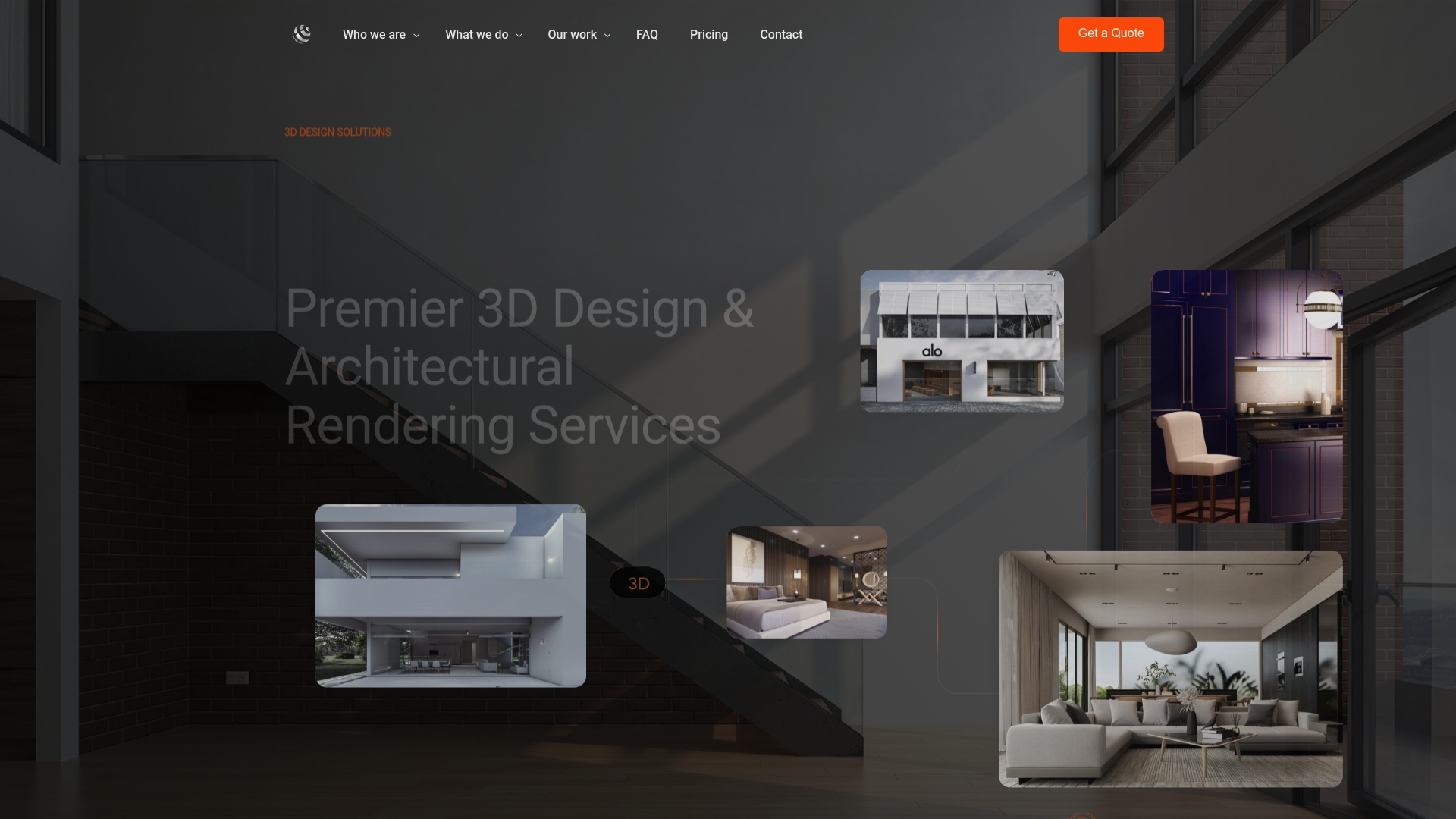
Rendimension has completed over 1,000 projects across product design, real estate, and commercial development. The team works directly with ecommerce marketing professionals from brief through final delivery, covering 360-degree spin sequences, AR-ready files, and high-resolution catalog renders. For businesses ready to move from static photography to interactive product experiences, Rendimension provides a clear production path with documented quality standards and measurable output.
Key Takeaways
Product visualization for ecommerce delivers the strongest and most sustained results when 3D assets are built as infrastructure and connected to every channel where buyers make decisions.
| Point | Details |
|---|---|
| Conversion impact is proven | Interactive 3D and AR visualization lifts conversion rates by 25–40% across ecommerce categories. |
| AR reduces returns in furniture | AR view-in-room cuts furniture return rates by up to 40% by resolving scale uncertainty before purchase. |
| Asset reuse lowers costs | One master 3D model feeds web, catalog, AR, and configurator outputs, reducing total production cost over time. |
| Start with core features | 360-degree rotation, zoom, and AR view-in-room deliver better conversion lift than complex virtual environments. |
| Integration determines ROI | Connecting 3D assets to PIM and DAM systems is what separates one-off projects from sustained performance gains. |
FAQ
What is product visualization for ecommerce?
Product visualization for ecommerce is the use of 3D models, augmented reality, and interactive imaging to represent products digitally, allowing shoppers to explore items virtually before purchasing. It replaces or supplements static photography with experiences that answer questions about scale, finish, and configuration.
How much does product visualization improve conversion rates?
Interactive 3D visualization improves conversion rates by 25–40% on average, with AR-enabled furniture categories seeing up to 4 times higher conversions compared to standard product pages.
Which ecommerce products benefit most from 3D visualization?
Furniture, home décor, jewelry, and customizable industrial products benefit most because visualization resolves scale, material, and configuration uncertainty. Apparel benefits from 360-degree views but not significantly from AR, since fit remains a physical variable.
Does product visualization reduce return rates?
AR visualization reduces return rates by up to 40% in furniture ecommerce by giving shoppers accurate scale and placement information before they order. The effect is smaller in apparel, where fit issues drive most returns.
How do I start implementing product visualization for my ecommerce store?
Commission a photorealistic master 3D model for your highest-revenue or highest-return products, connect it to your DAM or PIM system, and deploy 360-degree rotation and AR view-in-room as your first features. Work with a specialist provider to ensure the model quality supports all downstream outputs.
Recommended
- Product Visualization Tips 2026: 5× Faster Decisions
- What Is Product Visualization: Elevating Client Presentations
Frequently asked questions
What is product visualization for ecommerce?
Product visualization for ecommerce is the use of 3D models, augmented reality, and interactive imaging to represent products digitally, allowing shoppers to explore items virtually before purchasing. It replaces or supplements static photography with experiences that answer questions about scale, finish, and configuration.
How much does product visualization improve conversion rates?
Interactive 3D visualization improves conversion rates by 25–40% on average, with AR-enabled furniture categories seeing up to 4 times higher conversions compared to standard product pages.
Which ecommerce products benefit most from 3D visualization?
Furniture, home décor, jewelry, and customizable industrial products benefit most because visualization resolves scale, material, and configuration uncertainty. Apparel benefits from 360-degree views but not significantly from AR, since fit remains a physical variable.
Does product visualization reduce return rates?
AR visualization reduces return rates by up to 40% in furniture ecommerce by giving shoppers accurate scale and placement information before they order. The effect is smaller in apparel, where fit issues drive most returns.
How do I start implementing product visualization for my ecommerce store?
Commission a photorealistic master 3D model for your highest-revenue or highest-return products, connect it to your DAM or PIM system, and deploy 360-degree rotation and AR view-in-room as your first features. Work with a specialist provider to ensure the model quality supports all downstream outputs.