How to Sell Pre-Construction Condos: The Launch Sequence
Pre-construction sales are the mechanism that makes a condominium project financeable. Lenders require a presale threshold before construction financing closes, which means the sales campaign has to succeed before the building exists and before most of the capital is available to market it.
That constraint shapes everything. This guide covers how the launch is sequenced, what has to exist before it opens, and where these campaigns stall.
Why the presale threshold governs the schedule
Construction lenders on condominium projects typically require a percentage of units under binding contract with non-refundable deposits before funding. The threshold varies by lender, market, and cycle, but the mechanism is constant: no presales, no loan, no construction.
This inverts the normal sequence. In most businesses you build the product and then sell it. Here you sell a product that does not exist, using money you have not yet borrowed, to unlock the loan that lets you build it. Everything about the marketing has to work under those conditions.
Two consequences follow. First, the sales campaign is on the critical path for the entire project, not a downstream activity. A launch that takes eight months instead of four delays construction start, extends land carry, and pushes delivery into a different market. Second, the marketing assets have to be funded from predevelopment capital, before the construction loan exists, which is why they are so often underfunded relative to what the campaign requires.
The launch sequence
Eighteen to twenty-four months before construction start: positioning and pricing. Who the building is for, what the unit mix serves, and where pricing sits against comparable product. This is analysis, not marketing, and getting it wrong here cannot be fixed downstream with better imagery.
Fifteen to eighteen months: visual asset production. Exteriors, interiors across the unit mix, amenity spaces, floor plans, and the site plan. This is the long-lead item and the one most frequently started too late. Production plus review runs six to twelve weeks for a full package, and rushing it produces material that looks rushed.
Twelve to fifteen months: registration and list building. A landing page collecting registrations before anything is bookable. This list is the launch. A project opening a sales center to cold traffic is starting from zero on the day it most needs volume.
Nine to twelve months: broker and agent engagement. In most condominium markets, cooperating brokers drive a large share of presales. They need the material, the commission structure, and preferably a preview before the public release.
Six to nine months: sales center opens, VIP release. The registration list is released in tiers before the public. Early buyers receive preferred pricing or preferred selection in exchange for committing first. This creates the initial momentum that public buyers respond to.
Three to six months: public release and price escalation. Broad marketing opens. Published price increases at defined sales milestones create urgency that is real rather than manufactured, and they reward the early buyers who took the most risk.
Presale threshold reached: construction financing closes. Sales continue through construction at rising prices as the building becomes visible and the risk to the buyer falls.
What has to exist before release
A presale buyer is committing a significant, non-refundable deposit to something they cannot see. Every asset in this list exists to make that commitment reasonable.
Exterior renderings. The hero image the entire campaign runs on. Context accuracy matters: an image showing a streetscape that will not exist reads as a promise the project cannot keep, and sophisticated buyers check.
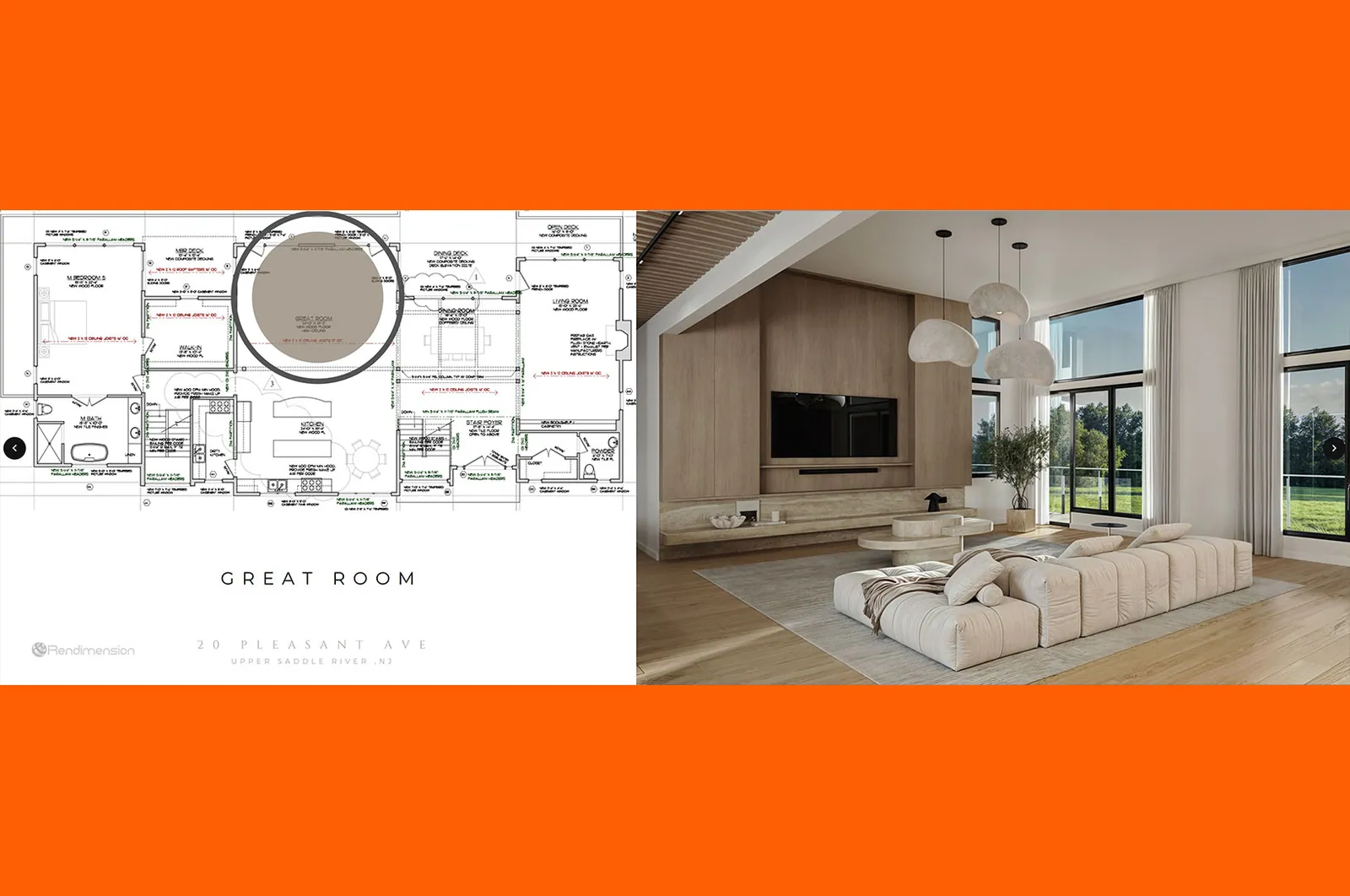
Interiors across the unit mix. Not one hero living room. A buyer choosing between a one-bedroom and a two-bedroom needs to see both, and the interiors must reflect the actual standard finish package with upgrades clearly identified as upgrades.
Amenity visualization. In competitive condominium markets amenities are frequently the differentiator, because unit layouts across competing buildings converge. The pool deck, the lounge, the fitness space, and the roof terrace carry disproportionate weight.
Floor plans, including interactive. Buyers self-qualify here. An interactive plan showing availability, floor level, orientation, and view lets a prospect arrive knowing which two units they want. Interactive plans and unit selectors are covered under 3D floor plans.
Views from the actual units. View renderings from specific floors are among the most persuasive assets in a tower sale and among the most frequently omitted. A buyer paying a premium for a higher floor wants to see what they are paying for.
Site plan and building context. Where the building sits, how it meets the street, and what is planned adjacent to it.
A virtual walkthrough. For out-of-market and international buyers, this is the entire tour. In markets with meaningful foreign or relocating buyer participation, its absence is a direct loss. See 3D walkthroughs.
Pricing strategy through the launch
Escalation is the core mechanism. Prices rise at published sales milestones. This rewards early buyers for taking construction and completion risk, and it creates urgency that survives scrutiny because it is contractual rather than promotional.
Release inventory in tiers, not all at once. Opening the full building at launch removes urgency and gives buyers no reason to decide today. Releasing floors or stacks progressively maintains scarcity and lets pricing respond to demonstrated demand.
Price the unit mix independently. Different types absorb at different rates. Uniform escalation across the mix while one type sits misreads the signal the mix is providing.
Deposit structure is part of the price. Staged deposits lower the barrier and widen the buyer pool. Larger upfront deposits improve the lender's view of the presale quality. These pull in opposite directions and the balance is a financing conversation, not a marketing one.
Avoid concessions during presale if possible. A discount granted to an early buyer becomes the price every later buyer expects, and in a building where buyers talk to each other it is discovered.
The contract and disclosure realities
Presale is a regulated activity in most jurisdictions, and the marketing has to survive the legal review it will receive.
Disclosure documents. Most jurisdictions require a public offering statement, prospectus, or equivalent before units can be sold, covering the budget, the declaration, and the projected assessments. The timing of this document frequently gates the launch date and is routinely underestimated.
Rescission periods. Buyers typically have a statutory window to cancel after signing. A launch that generates contracts which all rescind has not generated presales.
Deposit protection. Deposits are usually required to be held in escrow or trust. How and when the developer may access them varies and materially affects the capital plan.
Marketing representations become obligations. Renderings, floor plans, and finish descriptions can create enforceable expectations. Every visual should carry an artist-impression disclaimer, material representations should track the actual specification, and areas shown on plans should be labeled with the measurement standard used. This is the specific reason overselling in the imagery is a legal exposure rather than only a reputational one.
Where launches stall
Assets commissioned too late. The most common failure. A launch that should have opened at month twelve opens at month eight because there was nothing to show, and four months of the campaign are simply gone.
No registration list. Opening to cold traffic means starting the hardest phase without the audience that was supposed to carry it. The list is built over months and cannot be assembled in weeks.
Brokers engaged too late. In broker-driven markets, agents who learn about a project at public release have already placed their buyers elsewhere.
Pricing set from the pro forma rather than the market. The model needs a number; the market provides one. When they disagree, the market wins, and holding the pro forma price while absorption stalls delays construction financing.
Releasing everything at once. Removes urgency and removes the ability to learn from early demand before pricing the rest.
Imagery that oversells. Buyers who close and then discover the delivered product differs from the renderings generate complaints, rescissions, and in some cases litigation. This surfaces years later, at closing, when the developer is least able to absorb it.
Ignoring the international and out-of-market buyer. In many condominium markets a meaningful share of presale buyers never visit before contracting. Without a virtual walkthrough and remote-friendly materials, that segment is unreachable.
Frequently asked questions
What presale percentage do lenders require?
It varies by lender, market, and cycle, and it is negotiated deal by deal. What is consistent is that a threshold exists and that construction financing does not close until it is met, which puts the sales campaign on the critical path for the entire project.
When should pre-construction marketing begin?
Visual asset production begins fifteen to eighteen months before construction start. Registration and list building follow at twelve to fifteen months. The sales center and VIP release typically open six to nine months out.
Do buyers really commit without seeing the building?
Yes, and that is the entire premise of presale. What makes it reasonable for them is the price advantage relative to completed product, and what makes it possible is visual material credible enough to evaluate. Both have to be present.
How should presale prices escalate?
At published sales milestones rather than on a calendar. This rewards early buyers for taking risk, creates urgency that is contractual rather than promotional, and lets pricing respond to demonstrated demand rather than to a schedule set before launch.
What happens if the presale threshold is not reached?
Construction financing does not close. The developer either extends the campaign while carrying the land, reprices, restructures the capital stack with more equity, or does not proceed. Each option is expensive, which is why the launch is treated as critical path.
Are renderings legally binding?
They can create enforceable expectations depending on jurisdiction and on how they are presented. Artist-impression disclaimers, specification-accurate material representations, and clearly labeled measurement standards are standard practice for that reason.
Who actually buys pre-construction, and what each segment needs
Presale buyers are not one audience. A campaign built for a single profile underperforms with the others, and in most projects three or four segments are contributing.
End users buying to live. The slowest to decide and the most concerned with the unit itself: layout, storage, light, and what the finished space will feel like. They respond to interiors, floor plans, and anything that communicates scale. They also ask the most questions about the building operation, assessments, and the completion date, because they are planning a move around it.
Local investors. Underwriting rent and resale rather than lifestyle. They want the unit mix, the projected assessments, the rental comparables, and the parking situation. Renderings matter less to them than the numbers, but the numbers alone will not carry a decision either, because they are also betting on the building being desirable at completion.
Out-of-market and international buyers. Frequently a meaningful share of presale volume in urban condominium markets, and often the buyers who never visit before contracting. For them the virtual walkthrough and the view renderings are the entire due diligence. A project without those materials is invisible to this segment regardless of how good it is.
Second-home and seasonal buyers. Buying an experience rather than a residence. Amenities, views, and location context carry the decision, and the building common areas matter more than the unit interior.
The practical implication is that the asset package has to serve all of them. Interiors for the end user, floor plans and mix data for the investor, virtual tours and view studies for the remote buyer, and amenity imagery for the second-home segment. Producing only the hero exterior serves none of them well.
Managing the campaign through construction
Sales do not stop when the threshold is reached. The period between financing close and delivery is where remaining inventory is sold, usually at rising prices, and where the earlier buyers either become advocates or become problems.
Progress communication is a sales tool. Buyers who committed two years before delivery need evidence that the project is real. Regular construction updates with photography reduce cancellation risk and generate referrals from buyers who feel informed.
Update the renderings when the design changes. Value engineering during construction changes finishes and sometimes changes the facade. Marketing material produced from the original specification becomes inaccurate quietly, and it is still being shown to new buyers. Someone has to own catching that.
Sell the remaining mix deliberately. The units left after the presale push are usually the least desirable: lower floors, difficult layouts, worse views. These need their own positioning rather than being the residue of a campaign built around the best inventory.
Prepare for the walkthrough gap. The distance between what a buyer imagined from a rendering and what they see at their pre-closing walkthrough is where disputes originate. Buyers who were shown accurate material with clearly labeled standard finishes arrive with correct expectations. Buyers who were shown upgrades presented as standard do not.
Convert buyers into referrers. In a building selling over twenty-four months, early buyers who are happy become a genuine acquisition channel for the later inventory, and they cost nothing.
The marketing budget, and why it is usually underfunded
Presale marketing is funded from predevelopment capital, before the construction loan closes. That is the hardest money in the capital stack to raise and the money the sponsor is most reluctant to spend, which is precisely why this line item gets cut.
The visual package is the largest single item and the one to protect. It is used by every channel simultaneously: the website, the listing platforms, the brochure, the sales center, the broker material, and the investor deck. Producing it once for all of them is materially cheaper than producing it piecemeal, and cutting it degrades every channel at once.
The registration campaign is the second. Building a list over six to nine months before launch is what makes the VIP release work. Compressing that spend into the final weeks produces a smaller list of colder prospects.
Broker commissions are an acquisition cost, not overhead. In broker-driven markets they are the largest total marketing expense in the project and they should be modeled as such rather than treated as a closing cost.
The sales center is a construction expense that behaves like marketing. Scoping it separately from the campaign is how projects end up paying twice for the same renderings, once for the space and once for the website.
What gets cut and should not. View studies from actual floors, the virtual walkthrough, and interiors beyond one hero unit. Each of these serves a specific buyer segment, and removing them removes that segment rather than saving money.
The framing that works with a capital partner is that this spend unlocks the construction loan. It is not a marketing budget in the conventional sense; it is the cost of reaching the presale threshold, and the threshold is the gate on everything else.
What a strong launch looks like in practice
Stripped of the detail, a launch that works has five characteristics, and a launch that stalls is usually missing at least two of them.
The list exists before the doors open. Months of registration capture, segmented by unit type interest and price band, released in tiers. The first week of sales draws from an audience that has been waiting rather than from strangers.
The material is credible and complete. Every buyer segment finds what they need: interiors for the end user, plans and mix data for the investor, a virtual walkthrough for the remote buyer, amenity imagery for the second-home segment. Nothing oversells, and standard finishes are labeled as standard.
Pricing rises on milestones and inventory releases in tiers. Urgency is structural rather than asserted, and the developer learns from early demand before pricing the remainder.
Brokers were brought in early. In broker-driven markets they saw the project before the public did and had time to place it with their buyers.
Someone owns the gap between marketing and delivery. When value engineering changes a finish, the material gets updated. When a buyer walks the unit two years later, it matches what they were shown. That single discipline prevents the rescissions and disputes that undo an otherwise successful campaign.