Explaining 3D Visualization for Client Pitches: 2026 Guide

Explaining 3D Visualization for Client Pitches: 2026 Guide

TL;DR:
- D visualization helps clients understand and emotionally connect with design concepts more effectively than 2D plans. It reduces revisions, accelerates approvals, and improves project outcomes in architectural and real estate pitches. Advanced workflows enable rapid, photorealistic renders, making visualization a key competitive advantage.
Architectural visualization is the practice of creating photorealistic digital models that clients can view, explore, and react to before a single wall goes up. Explaining 3D visualization for client pitches is no longer a niche skill reserved for large firms. It is the standard communication method separating professionals who win projects from those who lose them to clearer storytellers. Clients struggle to read 2D floor plans and translate them into spatial reality. 3D visualization bridges this gap by giving clients a lifelike preview they can emotionally connect with, ask specific questions about, and approve with confidence.
How does 3D visualization improve client understanding and engagement?
Clients struggle to translate 2D floor plans into a real sense of space, scale, and atmosphere. That translation failure is where projects stall, revisions multiply, and trust erodes. Photorealistic 3D visualization removes the guesswork by showing exactly what a finished space will look and feel like.

Spatial clarity and emotional connection
A photorealistic render communicates ceiling height, natural light direction, material texture, and furniture scale simultaneously. A 2D plan communicates none of those things to a non-technical client. The emotional response a client has when they see their future home or commercial space rendered in full detail is qualitatively different from anything a blueprint produces. That emotional response drives faster decisions and stronger commitment.
Interactive walkthroughs accelerate approval cycles by making spatial relationships immediately clear. Clients who can “walk through” a design before construction begins ask better questions and request fewer late-stage changes. That reduction in revisions directly protects your project timeline and budget.
Key cognitive benefits clients gain from 3D visualization include:
- Scale perception: Clients accurately judge room proportions relative to furniture and human scale.
- Material comprehension: Finishes, textures, and color palettes read as intended rather than as abstract swatches.
- Lighting realism: Natural and artificial light conditions are simulated, eliminating surprises at handover.
- Spatial flow: Clients understand how rooms connect and how movement through a space will feel.
- Revision clarity: Change requests become specific (“move the island 18 inches north”) rather than vague (“it feels off”).
Pro Tip: Send a single photorealistic render of the hero space 24 hours before your pitch meeting. Clients arrive with specific reactions rather than blank questions, and your meeting becomes a productive conversation instead of an introduction.
What are the main 3D visualization techniques used in client pitches?
The industry uses four primary formats, and each serves a different moment in the client relationship. Choosing the wrong format for the wrong moment wastes budget and dilutes impact.
| Format | Best use case | Client benefit |
|---|---|---|
| Static photorealistic render | Early concept approval, marketing materials | Fast to produce, high emotional impact, easy to share |
| 360° panoramic view | Design review, material selection | Client explores independently, tests colors and layouts virtually |
| Interactive walkthrough | Pre-construction sign-off, stakeholder alignment | Spatial flow is clear, reduces revision requests |
| VR presentation | High-value projects, immersive client experience | Maximum emotional buy-in, premium positioning |
Static renders are the entry point. They convert a 2D blueprint into a single polished image that communicates design intent clearly. Panoramic rendering services go further by delivering immersive 360-degree digital environments where clients can explore and interact with design elements independently. That interactivity raises client involvement and cuts miscommunication.
Real-time walkthroughs and cinematic pre-rendered videos serve different client needs. Real-time walkthroughs suit live iterative design discussions where you want to respond to client feedback on the spot. Pre-rendered cinematic videos suit marketing-grade presentations where production quality signals project prestige.
VR presentations represent the highest level of immersion. VR walkthroughs place clients physically inside a space before it exists, producing an emotional response no flat screen can replicate. Reserve VR for high-value pitches where the investment in immersion pays off in project scale.
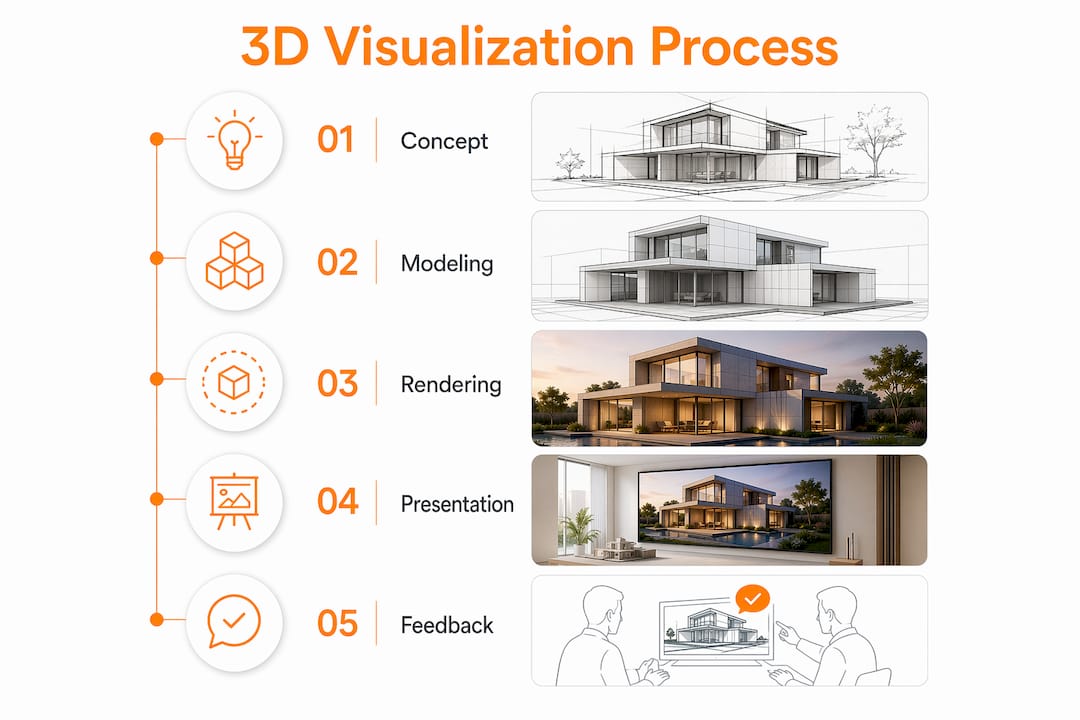
The workflow from concept to pitch asset follows a clear path: 2D architectural drawings or photos are converted into a 3D model, materials and lighting are applied, and the output is rendered as a static image, panorama, walkthrough, or VR experience depending on the pitch context. AI-enabled workflows have compressed this timeline dramatically, producing photorealistic interior renders from floor plans in under two hours. That speed makes pre-pitch visualization packages practical for every project, not just flagship ones.
Pro Tip: Match your visualization format to the client’s technical comfort level. A developer reviewing 50 units needs a fast panoramic tour. A homeowner buying their first custom build needs a cinematic walkthrough that tells a story.
How to integrate 3D visualization effectively in client presentations
The format you choose matters less than how you sequence and frame it. A stunning render shown at the wrong moment, without context, lands flat. Structure your presentation so visuals answer questions the client is already asking.
-
Start with the problem, not the solution. Open with a brief verbal summary of the client’s brief and priorities. This primes them to evaluate the visuals against their own stated goals rather than abstract preferences.
-
Lead with the hero render. Show the single most compelling image first. This sets the emotional tone for the entire meeting and gives clients a reference point for every subsequent detail.
-
Sequence from macro to micro. Move from exterior to interior, from full-room views to material closeups. This mirrors how clients naturally experience a space and prevents cognitive overload.
-
Include two to three render options with brief contextual notes. Pre-pitch packages kept specific, fast, and tightly edited signal professionalism and speed meetings toward decisions rather than debates.
-
Invite structured feedback at defined moments. Pause after each major visual and ask one specific question: “Does this ceiling height feel right to you?” Structured questions produce useful answers. Open-ended silence produces anxiety.
-
Close with the walkthrough or VR experience. Save the most immersive format for last. By the time clients enter the walkthrough, they already understand the design intent. The immersive experience confirms their confidence rather than introducing new information.
Visual storytelling techniques reinforce this sequencing approach. The narrative arc of your presentation, from problem to solution to emotional confirmation, mirrors the arc of effective brand communication. Clients do not just buy designs. They buy the feeling of certainty that a design is right for them.
Avoid overloading a pitch with every render your team produced. Curate ruthlessly. Three exceptional visuals outperform twelve adequate ones every time. The goal is clarity, not volume.
What are the measurable business benefits of using 3D visualization in pitches?
The business case for architectural visualization is concrete. 3D renderings convert technical details into visual form, allowing clients and contractors to ask better questions and provide clearer feedback. That clarity reduces costly surprises during construction and accelerates project approval at every stage.
“High-quality renders sent before a pitch change meetings from abstract debates to concrete client reactions, doing upfront translation of complex blueprints.” The shift from debate to reaction is where projects get approved and relationships get built.
Fewer revisions translate directly into lower project costs. When clients approve a design based on a photorealistic render, they have already processed the spatial and aesthetic decisions. Late-stage change requests, the most expensive kind, drop significantly. Architectural visualization walkthroughs also improve internal alignment among project stakeholders, reducing the back-and-forth between design teams, developers, and contractors.
Real estate developers using pre-construction visualization close sales faster because buyers can commit to units that do not yet exist. Architecture firms using photorealistic renders in competitive pitches differentiate on perceived quality before a single line of construction begins. Both outcomes point to the same conclusion: visualization is a revenue tool, not just a communication tool.
The benefits of 3D visualization for architects extend beyond individual pitches. Firms that build a library of high-quality renders establish a visual portfolio that attracts future clients and reduces the cost of each subsequent pitch. The investment compounds over time.
Key takeaways
Photorealistic 3D visualization is the most effective tool for converting client uncertainty into confident project approval across architecture, real estate, and design.
| Point | Details |
|---|---|
| Match format to pitch context | Use static renders for early concepts, walkthroughs for pre-construction sign-off, and VR for high-value immersive pitches. |
| Send visuals before the meeting | Pre-pitch render packages shift client meetings from introductions to productive, decision-focused conversations. |
| Sequence visuals with narrative | Move from hero render to macro views to material details to walkthrough, mirroring how clients naturally experience space. |
| Curate, do not overwhelm | Three exceptional renders outperform twelve average ones; edit your pitch package ruthlessly for clarity. |
| Visualization reduces revision costs | Clients who approve photorealistic renders request fewer late-stage changes, protecting timelines and budgets. |
What I’ve learned after 1,000+ visualization projects
The professionals who get the most from 3D visualization are not the ones with the biggest budgets. They are the ones who treat visualization as a communication strategy, not a production task. The single biggest mistake I see is firms waiting until a design is nearly finalized before commissioning renders. By that point, the client has already formed opinions based on sketches and verbal descriptions. Those opinions are hard to shift.
The firms winning the most competitive pitches today send a pre-pitch visualization package before the first formal meeting. They arrive at the table with a client who has already reacted emotionally to the design, already identified their questions, and is already leaning toward yes. The meeting becomes a confirmation, not a persuasion exercise.
AI-enabled visualization workflows have made this approach practical for projects of any scale. What once required days of production time now takes hours. The barrier to delivering a photorealistic render before a pitch is lower than it has ever been. The professionals who recognize this and build it into their standard process will have a structural advantage over those who still walk into meetings with PDFs and mood boards.
The next shift is already happening. Clients are beginning to expect immersive walkthroughs and VR experiences as part of the standard pitch package, not as premium add-ons. Firms that build this capability now, either in-house or through a trusted visualization partner, will set the expectation that others have to meet.
, Rendimension
Rendimension’s visualization services for stronger client pitches
Rendimension produces photorealistic 3D renders, immersive walkthroughs, and full VR presentations for architects, developers, and design professionals across residential and commercial projects. With over 1,000 projects completed globally, the team delivers visualization assets built specifically for client-facing presentations, not just internal design review.
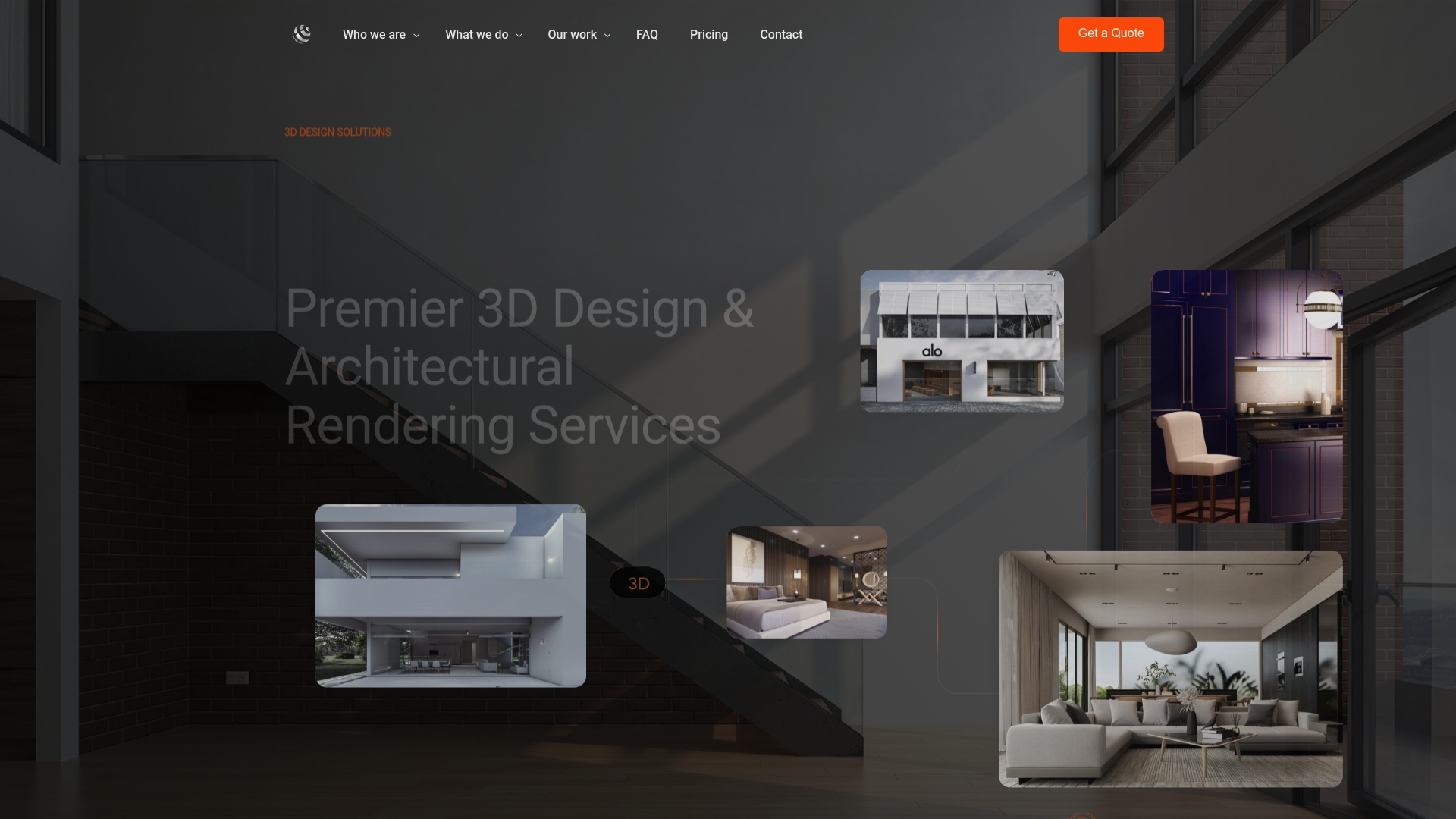
Every project starts with your drawings and ends with visuals your clients can see, explore, and approve. Whether you need a single hero render for an early-stage pitch or a complete architectural visualization package for a competitive proposal, Rendimension builds the assets that move clients from interested to committed. Contact the team to discuss your next pitch.
FAQ
What is 3D visualization in a client pitch?
3D visualization in a client pitch is the use of photorealistic digital models, renders, walkthroughs, or VR experiences to communicate a design concept before construction begins. It replaces 2D floor plans and sketches with images clients can immediately understand and react to.
How early should I use 3D visuals in the pitch process?
Send at least one photorealistic render before the first formal pitch meeting. Pre-pitch visualization packages shift client meetings from abstract introductions to concrete, decision-focused conversations.
Which 3D visualization format works best for real estate pitches?
Static photorealistic renders work well for early-stage marketing and concept approval. Interactive walkthroughs and VR presentations are most effective for high-value residential or commercial projects where emotional buy-in drives the purchase decision.
How does 3D visualization reduce project revisions?
When clients approve a design based on a photorealistic render, they have already processed spatial and aesthetic decisions visually. That clarity eliminates the misunderstandings that cause late-stage change requests, which are the most expensive revisions in any project.
Can 3D visualization be produced quickly enough for competitive pitches?
AI-enabled workflows now produce photorealistic interior renders from floor plans in under two hours. That speed makes pre-pitch visualization practical for projects of any scale and budget, not just flagship developments.
Recommended
- 3D Visualization Trends 2026: Transforming Architecture And Marketing
- How To Present 3D Visuals For Impactful Client Engagement
Frequently asked questions
What is 3D visualization in a client pitch?
3D visualization in a client pitch is the use of photorealistic digital models, renders, walkthroughs, or VR experiences to communicate a design concept before construction begins. It replaces 2D floor plans and sketches with images clients can immediately understand and react to.
How early should I use 3D visuals in the pitch process?
Send at least one photorealistic render before the first formal pitch meeting. Pre-pitch visualization packages shift client meetings from abstract introductions to concrete, decision-focused conversations.
Which 3D visualization format works best for real estate pitches?
Static photorealistic renders work well for early-stage marketing and concept approval. Interactive walkthroughs and VR presentations are most effective for high-value residential or commercial projects where emotional buy-in drives the purchase decision.
How does 3D visualization reduce project revisions?
When clients approve a design based on a photorealistic render, they have already processed spatial and aesthetic decisions visually. That clarity eliminates the misunderstandings that cause late-stage change requests, which are the most expensive revisions in any project.
Can 3D visualization be produced quickly enough for competitive pitches?
AI-enabled workflows now produce photorealistic interior renders from floor plans in under two hours. That speed makes pre-pitch visualization practical for projects of any scale and budget, not just flagship developments.