360 Panoramas or Full VR
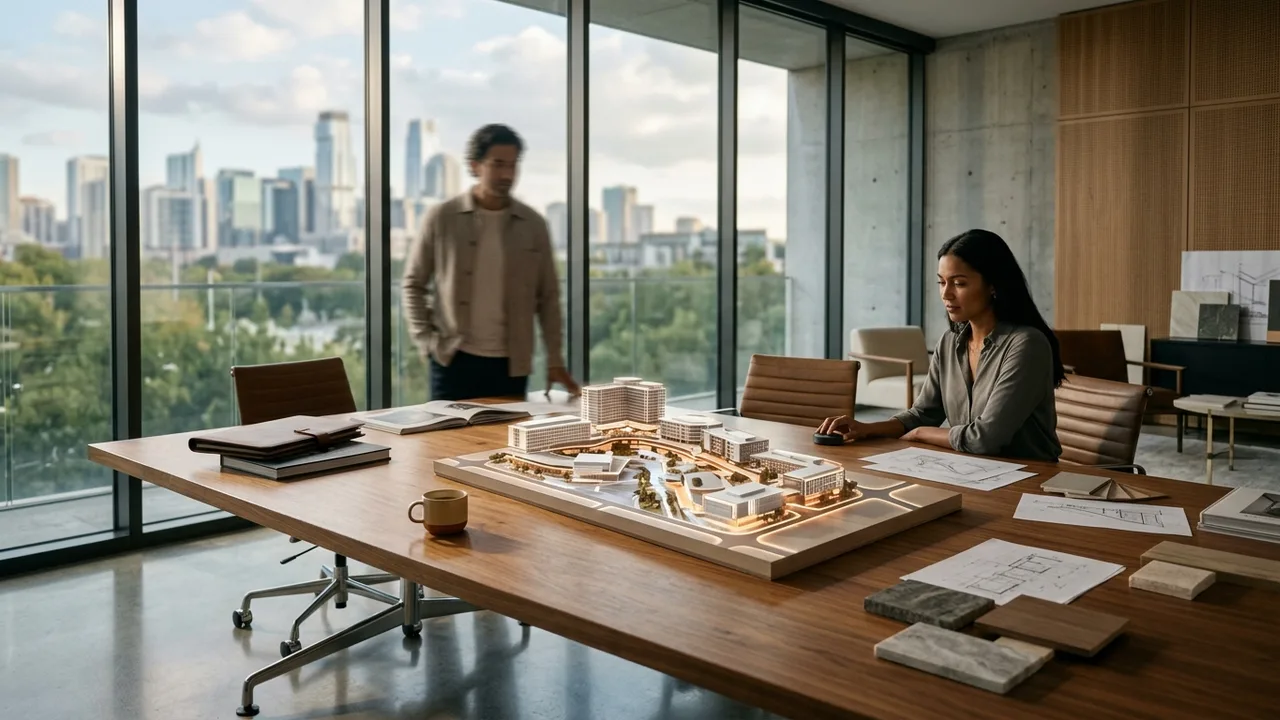
Rendered 360 panoramas suit almost every preconstruction sales situation because they open from a link on any phone, cost a fraction of an interactive build, cannot stutter, and are corrected by replacing an image. A full interactive VR build earns its cost where a staffed room exists, where free movement genuinely changes a decision, or in design review where full scale reveals problems a plan cannot.
Almost every conversation about immersive property content is framed as a question about quality: how realistic, how immersive, how impressive. The question that actually decides the outcome is much duller, and it is about distribution.
One format opens from a link on a phone that somebody already has in their hand. The other requires equipment, a room and a person to help. Everything else follows from that.
This guide compares the two honestly, including the situations where the expensive option is genuinely correct.
What each one actually is
A rendered 360 panorama is an image. It shows a space in every direction from one fixed point, and a viewer looks around by dragging or by turning a phone.
A full interactive build is a live scene. A viewer moves, the software renders each frame as they look, and the experience responds continuously.
The first is photography of a place that does not exist. The second is a small piece of software.
Reach is the difference that matters
A panorama set is a link. It works in an email, in a listing, in a message, on a phone on a train, with no download and no equipment.
An interactive build reaches the people who walk into a specific room and agree to put something on their face.
For a development selling to a dispersed audience, that is not a marginal difference. It is the difference between reaching thousands and reaching dozens.
Cost, and where it comes from
Both need the same model, which is the substantial cost for an unbuilt project and the reason neither is cheap in isolation.
After that they diverge sharply. Panoramas render and are done. An interactive build has to be optimised until it holds a comfortable frame rate on target hardware, and that optimisation is skilled, invisible and time consuming.
The panorama version also avoids hardware, staffing and ongoing deployment entirely, which are costs that never appear in a production quote.
Nothing stutters in a panorama
A rendered image cannot drop frames, so the entire category of discomfort caused by poor performance disappears.
That also means the render quality can be as high as the project can afford, since it is computed once rather than sixty times a second.
In practice a good panorama frequently looks better than an interactive scene running on modest hardware, which is the opposite of what buyers expect.
What panoramas give up
Free movement. A viewer jumps between fixed points rather than walking, and the sense of physically traversing a space is weaker.
Scale is also conveyed less powerfully than in a headset, where a room genuinely feels its size in a way a screen never quite achieves.
Those are real losses. The question is whether they are worth the reach, the cost and the operating burden that buying them requires.
Updates, which decide long campaigns
Correcting a panorama means rendering and replacing one image. Correcting an interactive build means rebuilding, re optimising and deploying to every device holding a copy.
On a scheme selling over three years with at least one value engineering round, that difference compounds into a maintenance commitment rather than a one off task.
It is the argument that most often decides the format for developers once somebody raises it, and it is raised far too late.
Where a full build genuinely wins
A staffed sales gallery with a permanent installation, where the access problem is solved by the room and the audience is committed enough to spend four minutes.
High value single decisions, where one buyer or one board committing to a large sum justifies an experience built for very few people.
And design review, where full scale reveals ceiling heights, corridor widths and sightlines that a plan cannot convey and a panorama only hints at.
Design review is the strongest case
In virtual reality construction and coordination work, the value is diagnostic rather than persuasive. Finding a spatial problem before it is built saves a cost that dwarfs the exercise.
That use needs free movement, because the problems are found by wandering rather than by visiting chosen viewpoints.
It also needs none of the expensive polish: a grey model at correct dimensions answers the question, which makes it much cheaper than a sales build.
The hybrid most projects should buy
Panoramas for everybody, and an interactive build only if a staffed room exists.
Both come from the same model, so the panorama set is close to free once an interactive build has been commissioned, and the interactive build is a defined increment when panoramas exist first.
Commissioning them together is what makes the arithmetic work, and it is available to anybody who asks for it explicitly.
Panoramas also serve as the fallback
Every headset installation needs something for the visitor who declines, who wears glasses, who feels unwell, or who arrives while the equipment is charging.
A tablet showing the same viewpoints covers all four, and it shows the property rather than a substitute for it.
So even projects committed to a full build should produce the panorama set, which removes most of the argument about choosing between them.
Where interactive builds disappoint
When they are commissioned without a venue, which produces an impressive asset nobody has anywhere to use.
When they allow free movement through an unfamiliar building, which disorients viewers rather than persuading them.
And when they are tied to a specific headset generation, which ages faster than a development sells.
Where panoramas disappoint
When the viewpoints are placed carelessly, in the centre of rooms rather than where a person would stand.
When there are too many, turning exploration into clicking through a sequence.
And when the set omits the exterior and the view, which are frequently what the property is actually selling.
What to do if the budget only covers one
Buy the panorama set, and spend the difference on making the images excellent rather than on making the immersion deeper.
The reasoning is simple arithmetic about audience. An excellent panorama set reaching everybody who considers the property outperforms an excellent installation reaching the small fraction who visit a room and agree to use equipment.
The exception is a scheme whose entire sales process runs through a physical suite, where the visitor is already committed and the room is the channel.
Upgrading later
Starting with panoramas keeps the interactive option open, because the model and the structural decisions carry directly into a build.
Starting with an interactive build and adding panoramas later also works, and it means having paid for optimisation before knowing whether anybody would use the experience.
Sequencing from cheap to expensive lets real usage data inform the second decision, which is the only sensible order when the audience behaviour is unknown.
It also protects the relationship with whoever approves the budget, because a modest first purchase that demonstrably worked is a far easier case for a larger second one than an expensive first purchase that has to be defended.
The commercial real estate case
Offices, retail and industrial buyers evaluate differently from home buyers. They are assessing whether a space works for an operation, which is a question about dimensions, circulation and fit rather than about atmosphere.
That favours accurate panoramas with visible dimensions and a plan overlay over an atmospheric headset experience, because the tenant is measuring rather than imagining.
The exception is a signature headquarters or a flagship retail space, where the impression matters as much as the specification and the headset earns its place.
Investor and lender audiences
This audience is almost never in the room, meets remotely, and is assessing risk rather than desirability.
A link they can open during a call, on their own screen, with no equipment, is the only format that fits that behaviour, which rules out a headset build regardless of quality.
Projects that commission an installation for an investor audience have usually not asked how those meetings actually happen.
Where each format is published
A panorama set lives on the listing page, in the brochure link, in agent emails and on the development website, which is where the volume of interest actually arrives.
An interactive build lives in one room, or occasionally on a laptop carried to a meeting, and reaches whoever is physically present.
Listing where each will be published, before choosing, usually settles the argument without anybody needing to compare technical merits at all.
Measuring them fairly
Judging both on view count guarantees the wrong conclusion, because the panorama set will win by an order of magnitude and the installation was never trying to compete on volume.
The fair comparison is cost per outcome: enquiries generated, viewings booked, questions answered that would otherwise have required a visit.
A headset session with a committed visitor in a sales suite can be worth many casual panorama views, and only a measure tied to progression rather than traffic will show it.
Production time differs too
A panorama set can be produced and delivered in days once a model exists, because rendering fixed views is a predictable process with a known end point.
An interactive build has an optimisation loop whose length depends on the building rather than on the schedule, and heavy glazing, reflections and dense planting all extend it unpredictably.
For a project working backwards from a launch date, that predictability is worth as much as the cost difference.
What happens when the design changes
A changed finish in a panorama set means re rendering the affected views, which is measured in hours and costs a fraction of the original.
The same change in an interactive build means updating the model, re optimising, rebuilding and redeploying to every device, and each of those steps can surface its own problems.
On a development where at least one value engineering round is certain, that difference should be treated as a known future cost rather than a risk.
Comfort compared honestly
A panorama cannot make anybody feel unwell, because nothing moves that the viewer did not initiate and there is no frame rate to drop.
An interactive build can, and whether it does depends entirely on optimisation quality and on the movement mechanism chosen. Teleporting between points is comfortable, smooth gliding through corridors is where most discomfort originates.
For an audience of unknown sensitivity, which describes every sales audience, that difference is a real argument rather than a technical footnote.
What each format demands of the model
A panorama needs the building finished only where the viewpoints are, which allows the modelling budget to concentrate on the spaces that matter.
An interactive build has to hold up everywhere a viewer might look, which in a free roaming scene is everywhere, so more of the building has to reach a viewable standard.
That difference is a substantial part of the cost gap, and it is invisible in any comparison that treats both as the same model delivered two ways.
Accessibility
Panoramas work for everybody with a browser, including people who wear glasses, feel motion sensitive, use assistive technology or simply do not want to put shared equipment on their face.
A headset excludes all of those people unless a fallback exists, and building the fallback means producing the panorama version anyway.
So the accessible option and the cheaper option are the same option, which is unusual and worth noticing.
Longevity of each format
A panorama is an image file on a standard platform, and it will open in ten years for the same reason images from ten years ago open today.
An interactive build is software tied to a runtime, a platform and often a hardware generation, all of which turn over faster than a large development sells.
For any asset expected to work across a multi year campaign, that asymmetry belongs in the comparison alongside the production price.
The naming problem
Buyers use vr tour, virtual tour, 360 tour and vr walkthrough interchangeably, and suppliers quote different products against each of them without anybody noticing the mismatch.
That is the single most common reason two quotes for the same request differ by a multiple: one priced a panorama set and the other priced an interactive build, and the brief supported both readings.
Naming the format explicitly in the first email, rather than using the general term, removes an entire round of confusion and makes the numbers comparable.
What buyers think they are asking for
Most people asking about virtual reality real estate content are picturing something they have seen on a listing, which is almost always a panorama tour rather than a headset experience.
So a supplier who responds to that request with an interactive build quote is answering a question that was never asked, and the buyer concludes the format is unaffordable.
Clarifying what the buyer has actually seen before is the fastest way to establish which product the conversation is about.
The existing property comparison
Buyers also anchor on what a photographic tour of a finished home costs, which is inexpensive and routine.
For an unbuilt project neither format is comparable to that, because the building has to be created before it can be shown, and that cost is identical whichever delivery is chosen.
Understanding that the model is the shared cost is what makes the panorama option look like the bargain it is, rather than a cheaper version of something already cheap.
Distribution across the sales funnel
Panoramas sit early, where somebody is deciding whether the property is worth pursuing, and they work at scale because they need nothing.
An installation sits late, where somebody has already travelled to a sales suite and is deciding between options, and it works on a small committed audience.
Virtual property tours therefore do the volume work and the headset does the depth work, which is the same division that runs through every visual format this industry sells.
Practices buying for their own use
For a design office, the calculation inverts. Panoramas are useful for sharing a scheme with a client remotely, and the headset is useful for the team catching problems internally.
That means most practices doing virtual reality architecture work end up wanting both for different reasons, and neither is a sales decision.
Understanding that split prevents a practice buying a sales grade experience for a coordination task, which is a common and expensive misallocation.
Both need the same structural work
Which viewpoints, in what order, at what eye height, with what navigation between them. That work is identical for both formats and it determines whether either is usable.
That is convenient, because it means a project can structure once and decide the delivery format afterwards, or change format later without redoing the thinking.
It also means a supplier who structures well is worth more than one who builds impressively, in either format.
How buyers actually use them
On a phone, briefly, while doing something else, usually before deciding whether to visit.
That behaviour favours the format that opens instantly and works badly for the one requiring equipment, which is the practical reason panoramas dominate the sales use case.
The headset moment comes later in the process, when somebody has already travelled to a sales suite, which is a different and much smaller audience.
The mobile constraint
A panorama set has to load quickly on a mobile connection or it loses most of its audience before appearing.
That constrains file sizes and resolution, and it is a real production consideration rather than an afterthought.
An interactive build has the same problem in a harsher form, since a browser scene must download geometry and textures before anything appears at all.
Cost per person reached
The comparison nobody runs and the one that settles the argument. Divide the production cost by the number of people who will realistically experience it.
A panorama set reaching a few thousand viewers and an installation reaching a few dozen do not compare favourably for the installation on that measure.
The installation can still be worth it, because those few dozen may be more committed, but the calculation should be made deliberately rather than assumed.
What to ask a supplier
Whether a panorama set is possible from the same model, what it would add, and what the interactive build costs to maintain over the sales period.
A supplier who volunteers the cheaper option is telling you something useful about how they will behave for the rest of the engagement.
One who never mentions it is selling the expensive version by default, which is worth knowing before comparing quotes.
The vr real estate market is moving toward reach
Browser based delivery keeps improving, phone screens keep getting better, and the friction of hardware has not gone away.
That trend favours formats that open from a link and works against ones that need equipment, which is worth weighing for any asset expected to last a multi year campaign.
Buying for reach is also the more reversible decision, since a panorama set can be extended into an interactive build later far more easily than the reverse.
The honest summary
For preconstruction sales, buy a real estate 360 virtual tour first. It reaches everybody, cannot stutter, costs a fraction, updates by replacing a file and needs no equipment or staff.
Buy the interactive build where a staffed room exists, where free movement changes a decision, or where the purpose is design review rather than persuasion.
And commission both from one model, because the structural work is shared and the second format is an increment rather than a second project.
This guide is part of our wider coverage on the same topic. For the full picture, including scope, pricing and delivery, read VR vs 360 Virtual Tours for Real Estate.
To compare a panorama set and an interactive build from one model, request a quote.
Frequently asked questions
Are 360 panoramas good enough to sell property before it is built?
For most preconstruction sales, yes. They open from a link on any phone with no equipment, cannot stutter, and can be rendered at whatever quality the project affords. What they give up is free movement and some sense of scale.
When is a full interactive VR build worth the cost?
When a staffed sales gallery exists to operate it, when a single high value decision justifies an experience built for very few people, or in design review where full scale reveals ceiling heights and sightlines a plan cannot convey.
Which format is cheaper to keep current?
Panoramas, by a wide margin. Correcting one means rendering and replacing an image. Correcting an interactive build means rebuilding, re optimising and deploying to every device holding a copy, which on a multi year campaign becomes a maintenance commitment.
Should a project buy both?
Frequently yes, because both come from the same model and the structural work is shared. Panoramas also serve as the fallback for visitors who decline the headset, wear glasses, feel unwell or arrive while equipment is charging.
Do panoramas and interactive builds need different planning?
No. Both need the same decisions about which viewpoints, in what order, at what eye height and with what navigation. That means a project can structure once and choose the delivery format afterwards without redoing the thinking.