What Drives VR Walkthrough Cost
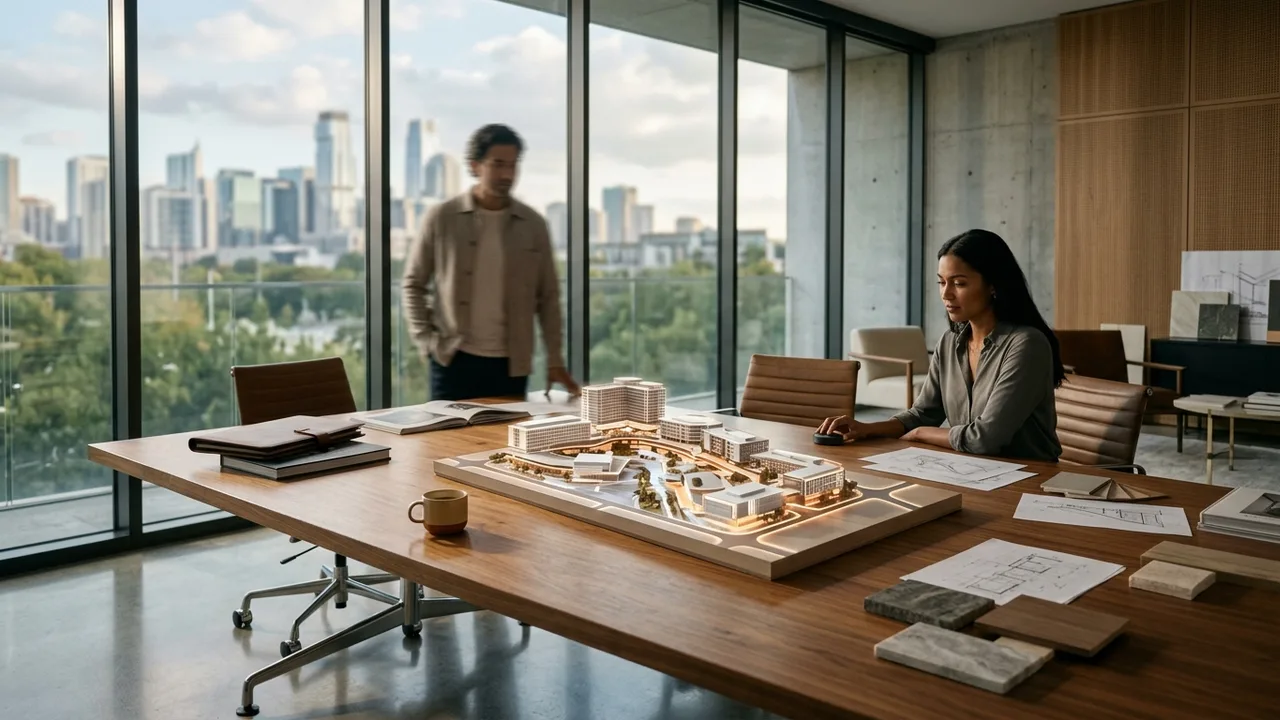
The cost of a VR walkthrough is driven first by whether the building exists, since capturing a finished space is a fraction of the cost of modelling an unbuilt one from drawings. After that it is scene optimisation to hold a comfortable frame rate, the number of viewpoints or the extent of free movement, hardware and staffing for the venue, and updates during a long sales campaign.
Immersive content has a reputation for being expensive, and the reputation is only half earned. The delivery is cheap and getting cheaper. What costs is everything that has to exist before an immersive experience is possible at all.
For a building that has been built, that is very little, because the building itself supplies the geometry, the light and the materials. For a building that has not, it is nearly everything.
This guide sets out the cost structure in order of impact. It does not publish rates, because the same nominal service differs by a large multiple depending on the first question below.
Driver one: does the building exist
The largest single factor and the one that determines which market you are buying in.
An existing space is captured with a camera in a few hours and processed by a platform. The cost is close to photography, the turnaround is days, and the fidelity is exact because it is a record of reality.
An unbuilt building has to be constructed in 3D from a drawing set, with every material chosen and every light placed. That is a modelling project with an immersive output attached.
Why the difference is so large
Because capture is measurement and modelling is interpretation. A scan records what is there. A model resolves what the drawings do not say.
Every unspecified finish, every ambiguity about a ceiling condition, every question about what the landscaping looks like has to be answered before anybody can stand inside it.
That interpretation is the service in preconstruction work, and it is why real estate virtual tour pricing quoted for existing homes is not a useful benchmark for an unbuilt scheme.
Driver two: the model, which serves everything
The most useful commercial fact in this category is that the model is shared. The same asset produces still images, animation, panoramas and interactive scenes.
Commissioned together, immersive content is an increment on work that was going to happen anyway. Commissioned alone, it carries the entire modelling cost to serve one format that reaches the fewest people.
So the question to settle before any visual commission is which formats the project will eventually want, because that changes what should be built now and who should hold the files.
Driver three: optimisation for comfort
This is the cost invisible to buyers and unavoidable in production. An immersive scene has to hold a high, steady frame rate or people feel unwell.
Achieving that means simplifying geometry, baking lighting, reducing texture sizes and testing on the actual hardware, none of which improves how the scene looks and all of which is required for it to be usable.
It is skilled work, it takes real time, and it is the main reason an immersive scene costs more than a set of images from the same model.
Driver four: how much freedom the viewer has
A fixed set of viewpoints can be optimised around known positions, and in the panorama case rendered entirely in advance with no live scene at all.
Free movement through a whole building has to perform everywhere at once, from every angle, which multiplies both the optimisation work and the amount of the model that must be finished to a viewable standard.
That is why structuring the experience around considered viewpoints reduces cost as well as improving usability, which is an unusually favourable trade.
Driver five: how many spaces
In preconstruction work each interior is effectively its own set, with its own materials, its own lighting and its own furnishing.
So cost scales close to linearly with the number of distinct spaces, which is the same asymmetry that makes interiors expensive in still imagery, amplified because everything has to be finished in every direction.
A single unit is a manageable project. Twelve unit types is twelve projects sharing a shell.
The panorama alternative, priced honestly
A rendered 360 set removes the two most expensive items on this list: there is no live scene to optimise and no frame rate to protect, because a panorama is an image.
It renders at whatever quality the project can afford, works on any phone, needs no hardware and can be corrected by replacing a file.
For most preconstruction sales the honest recommendation is a real estate 360 virtual tour rather than an interactive build, and the saving is large enough to fund the still images the campaign also needs.
Hardware and the costs that never appear in a quote
Headsets, a machine capable of driving them, spare batteries, charging, cleaning supplies and replacement units when one is dropped.
None of it is in a production quote and all of it is required for the experience to exist in a room where visitors can use it.
Where a supplier provides an installation including hardware, that is a real service. Where they do not, the cost lands on the project unplanned and is frequently the reason a finished experience goes unused.
Staffing, the cost nobody budgets at all
Somebody has to be present to help visitors into the experience, and that somebody is usually a sales agent with other responsibilities.
The time cost is real and recurring, and it determines whether the asset gets used after the first month of novelty.
If the experience takes longer than a minute to start, agents will show images instead, and the entire investment becomes decorative.
Updates during a long sales campaign
Specifications change, and an immersive experience showing a superseded finish misrepresents what a buyer is purchasing.
Updating an interactive build means rebuilding, re optimising and redeploying to every device holding a copy. Updating a panorama means replacing an image.
On a scheme selling over several years that difference compounds, and it should influence the format decision rather than being discovered at the first specification change.
Where BIM helps and where it does not
A well built information model shortens the modelling stage, because geometry and some material data already exist in a usable form.
What it does not do is produce a presentable scene. Models built for coordination carry enormous detail that is irrelevant to a viewer and ruinous for performance, so virtual reality bim workflows still require substantial preparation.
The saving is real and it is smaller than most people expect, which is worth knowing before a quote arrives that assumed otherwise.
Design changes, and when they arrive
As everywhere in visualization, the cost of a change is a function of timing rather than size.
Before the model is finished, a facade adjustment is a modelling task. After optimisation and deployment, it means redoing the optimisation and pushing a new build to every device.
For virtual reality construction projects where the design is still moving, that argues strongly for panoramas until the scheme settles.
The two markets have different price expectations
Buyers arrive with a number in mind from the existing property market, where a photographic tour of a finished home is a routine and inexpensive purchase.
That anchor is the source of most sticker shock in preconstruction work, because a quote for building a house in 3D is being compared against a quote for photographing one that is already standing.
Naming the difference in the first conversation, rather than defending the number in the third, is the only thing that reliably resolves it.
Why a vr tour of an unbuilt scheme cannot be quoted by the hour
The unknown is the drawing set. A complete, coordinated set with a finish schedule is a very different starting point from a planning set with elevations and hope.
So suppliers either quote after seeing the documents or quote a range wide enough to absorb the uncertainty, and the second option costs the buyer more.
Sending the drawings before asking for a price is the single cheapest thing a buyer can do to reduce it.
Existing conditions still matter
Even in preconstruction, most schemes sit in a context that exists: neighbouring buildings, a street, a slope, a view that is being sold.
Modelling that context is real work and it is frequently omitted from a brief, then requested once somebody notices the windows look out onto nothing.
For any scheme where the view is part of the value, the surrounding context belongs in the scope from the start rather than as an addition.
What virtual reality real estate buyers underestimate
The furnishing. An empty immersive space feels smaller and colder than the same space furnished, so furnishing is not decoration, it is what makes the room read at its true size.
Furniture, fittings and styling for a set of unit types is a substantial production item, and standardising a package across types is the main lever on it.
Buyers who cut furnishing to save money frequently end up paying to add it after the first viewings, because the rooms tested badly.
Multi device delivery multiplies quietly
The same experience running on a headset, a tablet in the sales suite and a browser link is three builds from one model, each with its own performance envelope and testing.
Specified together the marginal cost is modest. Requested one at a time over a year, each is a small project with its own setup.
Listing the devices at the brief stage is a two minute exercise that removes a predictable sequence of extras.
Where vr construction work differs from sales work
Design and coordination use of immersive content is cheaper per space, because it does not need furnishing, styling or final materials. A grey model at the right dimensions answers the question.
It is also more valuable per hour spent, since finding a spatial problem before it is built avoids a cost that dwarfs the exercise.
Treating the two as one budget line is how sales quality gets applied to a coordination task, which is an expensive way to answer a question a rough model would have settled.
The second year
Almost nobody asks what the experience costs to keep running: hosting, platform fees, hardware replacement, and the updates when the specification moves.
It is rarely large and it is never zero, and a scheme selling over three years should know the number before committing to a format.
Panoramas carry the smallest ongoing cost, installations the largest, and that difference is frequently bigger than the gap in production price.
What a quote should separate
The model, the immersive build, the optimisation, the hardware and the ongoing updates. Bundled into one figure, none of them can be evaluated.
Separated, a buyer can see the increment, decide whether other formats are worth adding while the model exists, and understand what the second year costs.
A supplier who resists separating it is either simplifying or obscuring, and it is worth finding out which before committing.
The internal cost of running the review
Somebody on the project side has to test the experience, and testing an immersive build is slower than reviewing images because each pass means putting the headset on, moving through every viewpoint and writing down what was wrong.
On a scheme with several unit types that is hours rather than minutes, repeated across every revision round, and it lands on people who were not expecting a new responsibility.
Naming who does it, and budgeting their time honestly, is what keeps a build from stalling between delivery and approval.
It is also the reason to keep the viewpoint count disciplined. Every additional stop is another thing to check on every round, and review effort scales with the same number that production effort does.
Turnaround, and why it is longer than expected
An immersive build has a production step that still images do not: testing on the target hardware, finding where the frame rate drops, fixing it and testing again.
That loop is unpredictable in length because it depends on the building rather than on the supplier, and a scheme with heavy glazing, deep reflections and dense landscaping will take several passes.
Planning backwards from a launch date has to include it, and projects that treat delivery as finished at first build routinely miss dates by a week or two for reasons nobody anticipated.
Who else can use the model afterwards
The economics improve substantially when the model built for an immersive experience also produces the images for the brochure, the panoramas for the listing and a short animation for the launch.
That only happens if it is planned, because a model built purely for a headset is optimised in ways that make it worse for still rendering, and reversing that is work.
Deciding the full format list before production starts is the single largest saving available in this category, and it costs one conversation.
The version that ages worst
An experience tied to a specific headset model or a specific application store is the most fragile asset a project can commission, because hardware generations turn over faster than schemes sell.
Browser based delivery and rendered panoramas survive that turnover, since they depend on a standard rather than on a device.
For any development with a sales period measured in years, longevity is a cost factor rather than a technical preference, and it belongs in the comparison alongside the production number.
The cheapest useful version
Worth naming for any project weighing whether to enter this format at all: a handful of rendered panoramas from a model that already exists, hosted on a standard platform, linked from the listing.
It has no hardware, no optimisation, no staffing and no ongoing build maintenance, and it delivers most of the commercial benefit buyers actually attribute to immersive content.
Starting there and escalating only where a specific decision justifies it is the sequence that avoids nearly every expensive mistake described on this page.
Why the format is cheaper than it was
Real time tools have improved, browser delivery has matured and panoramic output is now a standard feature rather than a specialist capability.
The consequence is that the immersive layer keeps getting less expensive while the modelling, which is the actual cost, does not, because a building still has to be interpreted from drawings by a person.
That asymmetry is worth understanding before assuming that falling technology costs will make an unbuilt project cheap to visualise. They will not, because the expensive part was never the technology.
Comparing quotes that are not comparable
Two immersive quotes for the same scheme routinely differ by a multiple, and the reason is almost never the quality of the supplier.
One has assumed a panorama set from an existing model and the other has priced building the model, furnishing every unit type and delivering an optimised interactive build to three devices.
Normalising both to the same scope before comparing totals is the only way to read them, and it usually reveals that the cheaper quote was answering a smaller question.
The cost of deciding late
As in every visual format, the expense of a decision rises with how late it arrives, and immersive work has a steeper curve than most because optimisation sits at the end.
A viewpoint added during structuring is free. The same viewpoint added after optimisation means finishing a part of the model nobody prepared, then re optimising and redeploying.
That is why the structural conversation belongs before modelling completes rather than after somebody has seen a first build.
Buying capacity for a phased scheme
A development selling over several phases should price the programme rather than the first piece, because the model, the furnishing package and the structure all carry forward.
Phase two from a retained model with the same supplier is a fraction of phase one. Phase two from nothing, because the files were never handed over, is close to full price again.
Settling model ownership at the first engagement is therefore a cost decision rather than a legal formality.
What the buyer supplies changes the number
A coordinated drawing set, a finish schedule and a decision about furnishing shorten production materially. Their absence does not remove the work, it moves it to the supplier and it gets priced.
The same applies to context: site levels, neighbouring buildings and the actual view from the windows are inputs somebody has to provide or somebody has to invent.
Buyers who assemble those before requesting a quote consistently get better numbers, and the assembly costs them nothing but attention.
Where the money is genuinely well spent
A staffed sales gallery installation for a high value scheme, where the audience is small, committed and physically present.
Design review during virtual reality construction planning, where catching a spatial problem before it is built pays for the whole exercise several times.
And a panorama set for everybody else, which reaches the dispersed audience that an installation cannot.
Where it is wasted
On an experience with no venue, no operator and no plan for who will use it.
On free roaming through spaces nobody is buying.
And on an interactive build commissioned before the design has settled, which will be rebuilt at full cost when the specification changes.
The honest summary
Ask whether the building exists, because that decides the order of magnitude. Then recognise that the model is the asset, the optimisation is the hidden cost, and the hardware and staffing are real expenses that no production quote contains.
For most preconstruction schemes a rendered panorama set delivers the same commercial benefit to far more people for a fraction of the money.
Buy the interactive build where a staffed room exists and a specific decision justifies it, and buy it alongside the images so the model earns its cost more than once.
This guide is part of our wider coverage on the same topic. For the full picture, including scope, pricing and delivery, read How Much Does a VR Walkthrough Cost?.
To see a model, an immersive build and a panorama set priced separately, request a quote.
Frequently asked questions
Why does a VR walkthrough of an unbuilt building cost so much more?
Because capture is measurement and modelling is interpretation. A scan records an existing space in hours. An unbuilt building has to be constructed in 3D from drawings, with every unspecified finish and ambiguous condition resolved before anybody can stand inside it.
What is the hidden cost in immersive production?
Optimisation. A scene must hold a high steady frame rate or viewers feel unwell, which means simplifying geometry, baking lighting and testing on the real hardware. None of it improves how the scene looks and all of it is required for it to be usable.
Are 360 panoramas cheaper than an interactive VR build?
Substantially, because a panorama is a rendered image. There is no live scene to optimise and no frame rate to protect, it works on any phone without hardware, and corrections mean replacing a file rather than redeploying a build.
Does having a BIM model reduce the cost?
Somewhat, since geometry and some material data already exist. It does not produce a presentable scene, because coordination models carry detail that is irrelevant to viewers and ruinous for performance, so substantial preparation is still required.
What costs appear after the production quote?
Hardware, charging, cleaning and replacement units, plus the staff time to help visitors into the experience. None of it is in a production quote and all of it decides whether the finished experience is used or quietly abandoned.