Real Estate Visualization Trends 2026: What Pros Need
Real Estate Visualization Trends 2026: What Pros Need
TL;DR:
- Immersive, AI-driven visualization has become the standard in real estate marketing for 2026, replacing static photos.
- Buyers now prioritize virtual tours, AI staging, and integrated visualization tools to make faster, more informed decisions.
Real estate visualization trends 2026 are defined by one clear shift: immersive, AI-driven imagery has replaced static photos as the baseline expectation for competitive listings. 72% of buyers now prioritize listings with interactive 3D tools, and that number is reshaping how developers, agents, and investors approach property marketing. The PropTech ecosystem supporting these advances has reached a global AR/VR market valuation near $118 billion in 2026. For real estate professionals, understanding these tools is no longer optional. It is the difference between a listing that sells and one that sits.
1. Real estate visualization trends 2026: immersive 3D virtual tours
Immersive 3D virtual tours are the single most impactful shift in property marketing this decade. They let buyers walk through a property from any device, at any time, without scheduling a showing. The technology combines photogrammetry, spatial mapping, and interactive floor plans into one navigable experience.

The performance data is clear. Listings with interactive floor plans attract more views, saves, and shares than static listings. That engagement gap is widening as buyer expectations rise. Platforms like Zillow and Realtor.com have expanded virtual property experiences widely, making 3D tours a visible standard rather than a premium add-on.
Two forces are driving adoption at speed:
- Mobile-first browsing. Most property searches now start on a phone. Buyers expect to tour a home the same way they browse everything else: on demand, without friction.
- Remote buying. Sun Belt cities like Phoenix, Austin, and Tampa are seeing buyers commit to purchases without ever visiting in person. Virtual tours reduce the need for multiple in-person showings, which is critical for out-of-state investors.
Pro Tip: When commissioning a 3D tour, request an embedded interactive floor plan alongside the spatial walkthrough. Buyers who engage with floor plans spend significantly more time on a listing.
For developers marketing pre-construction properties, 3D floor plan examples show how CAD files and digital drawings translate into buyer-ready presentations that close deals before a foundation is poured.
2. AI-powered virtual staging and photorealistic visualization
AI virtual staging is the fastest-growing segment of visualization technology in real estate. The process converts raw photos, CAD files, or empty room shots into fully furnished, photorealistic scenes in minutes. Physical staging costs thousands of dollars per property and takes days to set up. AI staging costs a fraction of that and delivers results the same day.
The capabilities have expanded well beyond placing furniture. Current AI tools now:
- Automatically apply HDR enhancement, lens correction, and ambient lighting changes to source photos
- Remove existing objects and replace them with staged alternatives
- Transform day shots into twilight scenes for emotional impact
- Generate multiple style variants (modern, transitional, Scandinavian) from a single source image
The business case is direct. Listings with high-quality staged photos sell faster and often at higher prices. That outcome applies whether the staging is physical or AI-generated, provided the quality meets a professional standard.
AI also accelerates design iteration for developers. When a luxury condo project needs to show three different finish packages to investors, AI visualization delivers all three in the time it previously took to produce one. For custom home builders using AI in design decisions, the technology is already embedded in the client approval process.
Pro Tip: Always request a photorealistic render alongside AI-staged images for new construction. The render shows the unbuilt property in context; the staged version shows buyers how it will feel to live there.
3. Emerging technologies beyond 3D tours and AI staging
The next wave of visualization technology in real estate moves beyond tours and staging into fully integrated property ecosystems. Three technologies are gaining real traction in 2026.
Augmented reality (AR) lets buyers point a phone at an empty room and see it furnished in real time. AR apps overlay digital objects onto physical spaces, giving buyers a sense of scale and proportion that photos cannot deliver. For luxury residential and high-end commercial properties, AR is becoming a standard part of the showing experience.
Spatial computing takes AR further by mapping the full geometry of a space and allowing buyers to interact with it. Think of it as a 3D model you can walk around inside, not just view on a screen. Augmented reality and spatial computing are increasingly integrated into real estate visualization ecosystems, particularly for large commercial developments and mixed-use projects.
Conversational AI is changing how buyers search and explore properties. AI-guided walkthroughs can answer questions about square footage, materials, and neighborhood data in real time, without an agent present. Industry leaders forecast that these tools will converge into AI-driven property ecosystems combining AR, VR, and conversational AI into a single buyer experience.
“The future of property visualization is not a single tool. It is an integrated ecosystem where buyers move fluidly between a 3D tour, an AR overlay, and a conversational AI guide, all without leaving the listing page.”
AI integration in architectural visualization is already blurring the line between photo editing and full design simulation. Some tools now generate predictive renovation costs alongside the visual, giving investors a financial picture alongside the aesthetic one.
4. Comparing visualization tools by property type and marketing goal
Not every visualization method fits every property or budget. The right choice depends on your property type, your buyer profile, and how much lead time you have before launch. VR walkthroughs offer higher immersion but require more investment than 3D tours or AI staging. Understanding where each method delivers the best return is the practical skill that separates effective marketers from those who overspend on the wrong tool.
| Visualization method | Best for | Key strength | Investment level |
|---|---|---|---|
| AI virtual staging | Residential resale, vacant units | Speed and cost efficiency | Low |
| Interactive 3D tour | All residential, remote buyers | Engagement and time on listing | Moderate |
| Photorealistic 3D rendering | Pre-construction, luxury, commercial | Realism before build | Moderate to high |
| VR walkthrough | Luxury residential, large commercial | Full immersion, emotional impact | High |
| AR overlay | Showroom, in-person showing support | Real-time spatial context | Moderate |
For residential resale, AI staging and a 3D tour together cover the full buyer journey at a manageable cost. For pre-construction luxury developments, photorealistic 3D rendering services and VR walkthroughs are the standard because buyers are committing to something that does not yet exist. Commercial and mixed-use projects benefit most from combining spatial computing with photorealistic renders for investor presentations.
The most effective approach integrates at least two methods. A photorealistic exterior render draws buyers into the listing. A 3D tour keeps them there. An AI-staged interior closes the emotional connection. Each layer adds a reason to stay, share, and inquire.
Pro Tip: For remote investors evaluating commercial properties, pair a VR walkthrough with a data visualization overlay showing occupancy rates, foot traffic, and comparable rents. The combination answers both the emotional and financial questions in one session.
Rendimension’s 3D walkthrough services are built specifically for this kind of layered approach, combining photorealistic detail with navigable spatial experiences for both residential and commercial clients.
5. Data visualization in real estate: the overlooked edge
Data visualization in real estate is the practice of presenting market data, property performance, and investment metrics as visual graphics rather than spreadsheets. It is underused and undervalued by most real estate professionals, which makes it a genuine competitive advantage for those who adopt it early.
Investors evaluating a portfolio of commercial assets do not want a 40-page PDF. They want a visual dashboard showing occupancy trends, cap rate comparisons, and cash flow projections by property. When that data is embedded directly into a property presentation alongside photorealistic renders and 3D tours, decision-making accelerates.
The connection between visualization technology and data presentation is growing tighter. AI tools that generate renovation cost predictions alongside staged visuals are one example. Interactive floor plans that display price-per-square-foot by room are another. The future of property visualization includes data layers built directly into the visual experience, not attached as a separate document.
For real estate professionals marketing to institutional investors, this integration is already expected. For those serving individual buyers, it is a differentiator that builds trust and speeds up decisions.
Key takeaways
The most effective real estate marketing in 2026 combines photorealistic 3D rendering, interactive tours, and AI staging into a layered visual strategy that serves buyers at every stage of the decision process.
| Point | Details |
|---|---|
| 3D tours are now baseline | 72% of buyers prioritize listings with interactive 3D tools, making tours a standard requirement. |
| AI staging cuts cost and time | AI converts photos and floor plans into staged visuals in minutes, replacing physical staging. |
| Layered methods outperform single tools | Combining renders, tours, and AR delivers higher engagement than any single visualization method. |
| VR suits high-stakes decisions | VR walkthroughs are best for luxury and pre-construction properties where immersion drives commitment. |
| Data visualization adds investor value | Embedding market data into visual presentations accelerates decisions for commercial and institutional buyers. |
Rendimension’s view on where visualization is actually heading
The technology adoption curve in real estate visualization is steeper than most professionals realize. The gap between early adopters and late movers is not measured in months. It is measured in closed deals.
What I have observed across more than 1,000 projects at Rendimension is that the professionals who treat visualization as a marketing expense consistently underperform those who treat it as a sales tool. A photorealistic render is not a cost. It is the first conversation you have with a buyer before they ever contact you.
The pitfall I see most often is fragmentation. Developers commission a render, an agent orders a 3D tour, and a marketing team runs AI-staged photos, but none of these assets are built to work together. The result is a disjointed buyer experience that loses momentum at exactly the moment it should be building it.
My prediction for the period beyond 2026 is that the distinction between a property listing and a property experience will disappear entirely. Buyers will expect to move from a photorealistic exterior render to a navigable interior tour to an AR overlay to a conversational AI guide, all within a single session. The professionals who build that pipeline now will not be scrambling to catch up when it becomes the standard.
The uncomfortable truth is that most real estate marketing still looks like 2019. The tools to change that exist today. The only variable is whether you use them.
, Rendimension
Rendimension’s 3D visualization services for real estate professionals
Real estate professionals who want to apply these trends need a visualization partner who can deliver across the full stack: photorealistic renders, interactive walkthroughs, and VR experiences built for both residential and commercial projects.
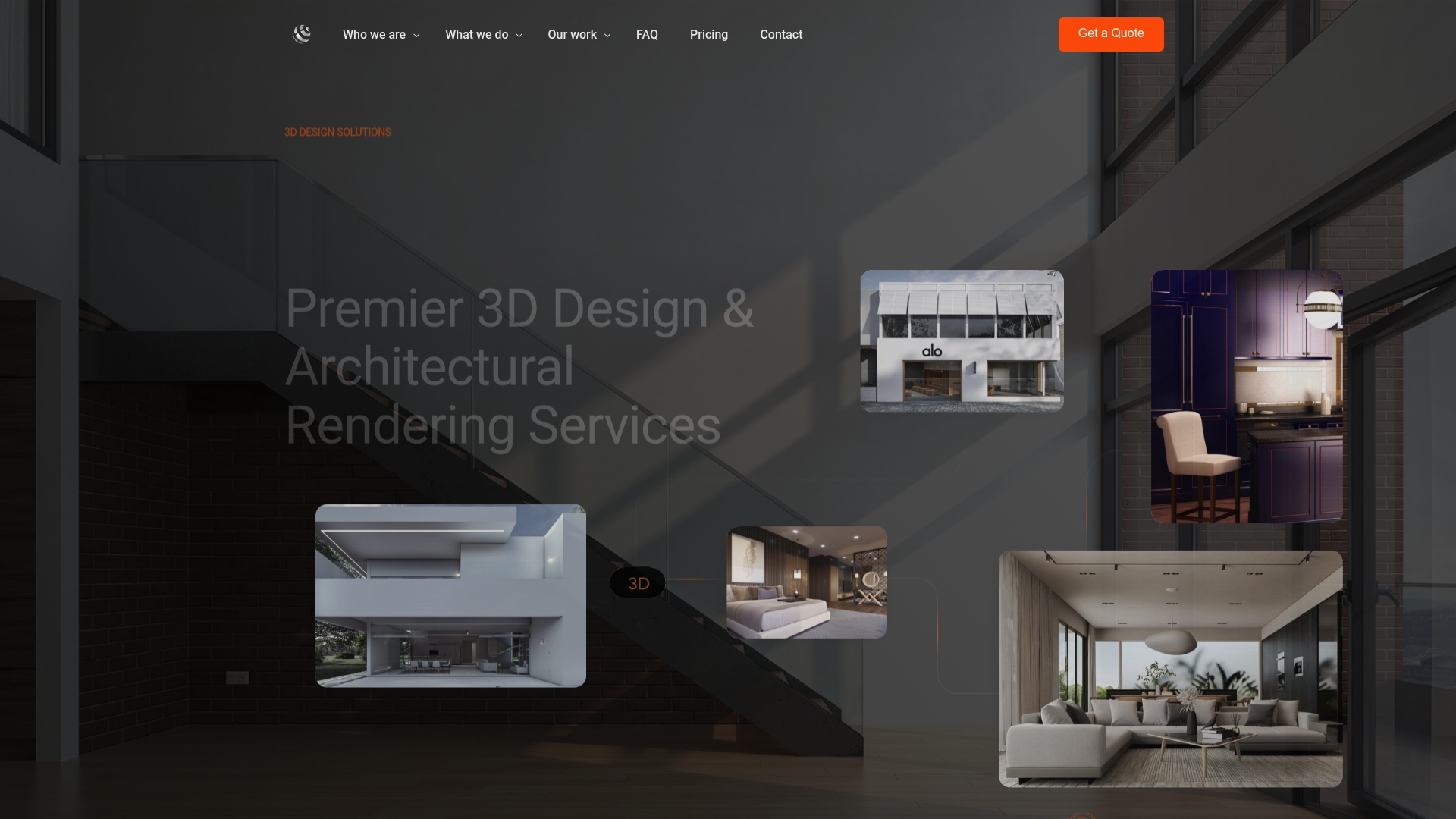
Rendimension has completed over 1,000 projects globally, working with developers, architects, and investors on properties ranging from luxury custom homes to large commercial developments. The team’s architectural visualization services cover every stage of the marketing process, from pre-construction renders that close presales to VR walkthroughs that give remote investors the confidence to commit. Every project is built collaboratively, with client input at each stage to make sure the final visuals match the marketing goal. For developers working on new builds, Rendimension’s approach mirrors the design-build process that top custom home builders use: visual clarity at every decision point.
FAQ
What are the top real estate visualization trends for 2026?
The top trends are immersive 3D virtual tours, AI-powered virtual staging, photorealistic pre-construction rendering, and the integration of AR and spatial computing into property presentations. These tools together define the standard for competitive real estate marketing in 2026.
How does AI virtual staging differ from traditional staging?
AI virtual staging converts photos or floor plans into fully furnished, photorealistic scenes in minutes and at a fraction of the cost of physical staging. Traditional staging requires physical furniture, setup time, and ongoing rental costs.
Why do listings with 3D tours perform better?
Listings with interactive 3D tours attract more views, saves, and shares because they give buyers a complete spatial understanding of a property without requiring an in-person visit. Remote buyers and mobile-first searchers respond especially strongly to this format.
What is the difference between a 3D tour and a VR walkthrough?
A 3D tour is a browser-based, navigable experience accessible on any device. A VR walkthrough requires a headset and delivers full immersion, making it better suited for luxury properties and large commercial projects where emotional impact drives the buying decision.
When should a developer invest in photorealistic 3D rendering?
Photorealistic 3D rendering is the right choice for any pre-construction property where buyers or investors need to commit before the build is complete. It is also the standard for luxury residential and commercial projects where visual quality directly affects price realization and investor confidence.
Recommended
- The Role of Visualization in Real Estate Sales in 2026 | Rendimension Blog
- Step by Step Real Estate Visualization Guide for Pros | Rendimension Blog
Frequently asked questions
What are the top real estate visualization trends for 2026?
The top trends are immersive 3D virtual tours, AI-powered virtual staging, photorealistic pre-construction rendering, and the integration of AR and spatial computing into property presentations. These tools together define the standard for competitive real estate marketing in 2026.
How does AI virtual staging differ from traditional staging?
AI virtual staging converts photos or floor plans into fully furnished, photorealistic scenes in minutes and at a fraction of the cost of physical staging. Traditional staging requires physical furniture, setup time, and ongoing rental costs.
Why do listings with 3D tours perform better?
Listings with interactive 3D tours attract more views, saves, and shares because they give buyers a complete spatial understanding of a property without requiring an in-person visit. Remote buyers and mobile-first searchers respond especially strongly to this format.
What is the difference between a 3D tour and a VR walkthrough?
A 3D tour is a browser-based, navigable experience accessible on any device. A VR walkthrough requires a headset and delivers full immersion, making it better suited for luxury properties and large commercial projects where emotional impact drives the buying decision.
When should a developer invest in photorealistic 3D rendering?
Photorealistic 3D rendering is the right choice for any pre-construction property where buyers or investors need to commit before the build is complete. It is also the standard for luxury residential and commercial projects where visual quality directly affects price realization and investor confidence.