3D Visualization Trends 2026: Transforming Architecture and Marketing

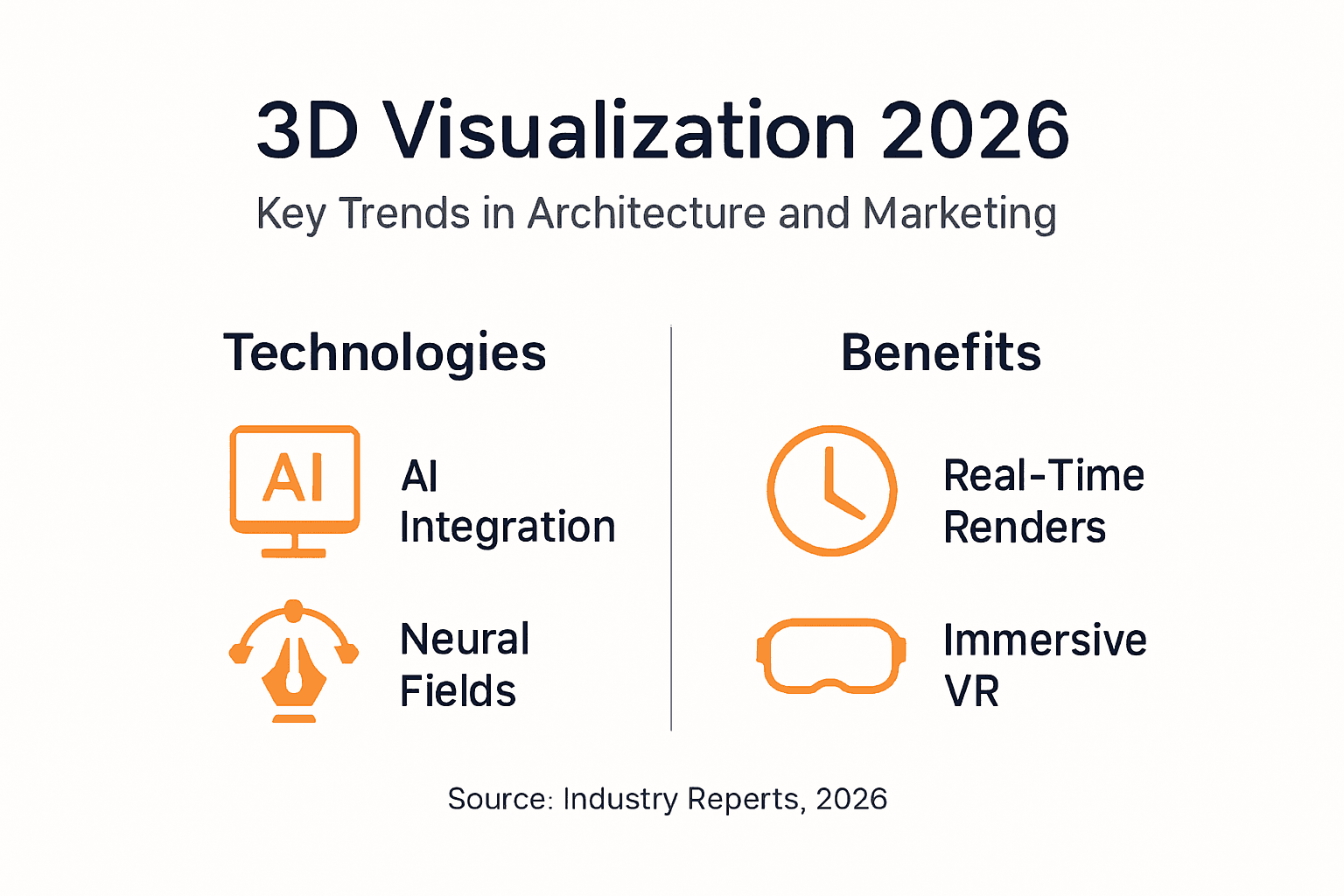
Architects and real estate developers across North America face rising pressure to make their projects stand out in a competitive market. 3D visualization is now far more than static images, it blends AI, real-time interactivity, and photorealistic detail. According to the IEEE 2026 Technology Predictions, AI-enhanced visualization systems transform how you interpret complex data instantly and bring immersive client experiences to life. This article explores how these trends help you strengthen presentations and marketing efforts with dynamic, data-driven visuals.
Table of Contents
- Defining 3D Visualization in 2026
- Major Types and Emerging Technologies
- Real-Time Rendering and AI Integration
- Immersive VR Experiences for Stakeholders
- Cost, Adoption Challenges, and Mistakes to Avoid
Key Takeaways
| Point | Details |
|---|---|
| AI Integration in 3D Visualization | 3D visualization now leverages AI for real-time data interpretation, enhancing interactivity and engagement during presentations. |
| Importance of Data Accuracy | Visualizations must incorporate real environmental data to reflect actual site conditions, boosting client confidence and decision-making speed. |
| Emergence of Immersive Technologies | Virtual reality is now an essential tool for stakeholder presentations, providing immersive experiences that facilitate understanding and investment decisions. |
| Cost and Adoption Challenges | Effective implementation of visualization tools requires strategic budget allocation and addressing common adoption pitfalls like training and workflow integration. |
Defining 3D Visualization in 2026
Three-dimensional visualization in 2026 means something fundamentally different than it did just a few years ago. It’s no longer static renders on a screen. It’s interactive, intelligent, and layered with real-time data interpretation.
At its core, 3D visualization in 2026 combines three essential elements:
- AI-powered analysis that adapts to what you’re showing
- Real-time interactivity that responds instantly to user inputs
- Photorealistic detail that blurs the line between digital and physical
The shift toward AI-driven visualization advancements has transformed how architects and real estate developers present projects. Rather than static renderings, you now work with systems that interpret complex data, site conditions, material properties, environmental factors, and visualize them dynamically.
Consider what this means for your presentations. When a client walks through a virtual property, they’re no longer looking at pre-recorded footage. They interact with a space that responds to their choices. They can adjust materials, lighting, and spatial configurations in real time.
Data integration is another critical shift. Modern 3D visualization pulls from multiple sources, survey data, environmental models, geographic information systems. The 3D National Topography Model illustrates how detailed elevation and site data now feeds directly into visualization workflows, creating representations grounded in actual environmental conditions.
For your projects specifically, this means:
- Accuracy: Visualizations reflect real topography and site constraints
- Client confidence: Stakeholders see designs positioned in genuine geographic context
- Faster decisions: Real-time changes eliminate back-and-forth rounds with clients
- Marketing impact: Immersive experiences differentiate your projects in competitive markets
The definition extends beyond aesthetics. 3D visualization in 2026 is a decision-making tool. Developers use it to evaluate feasibility, contractors rely on it for planning logistics, and marketing teams deploy it to generate genuine interest before ground breaks.
Modern 3D visualization isn’t about making things look pretty, it’s about making data readable and actionable for every stakeholder involved.
This definition matters because it changes what you should expect from visualization partners. You need vendors who understand architectural constraints, real estate workflows, and how to translate complex data into compelling visuals. The technology alone doesn’t deliver value; the application does.
Pro tip: When evaluating 3D visualization for your next project, ask vendors whether they can work with your actual site surveys and environmental data, this ensures visualizations reflect real conditions rather than idealized scenarios.
Major Types and Emerging Technologies
3D visualization in 2026 relies on multiple technical approaches, each with distinct strengths for your architectural and marketing needs.
Traditional representation methods still form the foundation of many projects:
- Mesh-based models: Surface geometry that’s lightweight and widely compatible
- Point clouds: Raw spatial data from laser scanning, ideal for capturing existing conditions
- Voxel grids: Volume-based representations useful for architectural massing studies
These methods work well for basic visualization, but emerging 3D representation methods are transforming what’s possible in real-time presentation.
Neural Radiance Fields (NeRF) represent a major breakthrough. Rather than storing geometry explicitly, NeRF uses AI to learn how light behaves in a scene, then generates photorealistic views from any angle instantly. For client presentations, this means smooth camera movement through spaces without pre-rendering.
Signed Distance Functions (SDF) work similarly but encode geometry differently, capturing fine detail in compact file sizes. This matters when you’re streaming visualizations to clients or displaying on multiple devices.
Neural rendering is reshaping the entire workflow. Instead of rendering individual frames, AI-enhanced systems interpret scene data and synthesize photorealistic output in real time. The shift toward AI-enhanced neural rendering capabilities means faster iterations and more responsive client interactions.
Key emerging technologies for your practice:
- AI compression: Reducing file sizes while maintaining visual quality
- Real-time ray tracing: Advanced lighting without pre-rendering delays
- Digital twins: Live-updating visualizations linked to actual building systems
- Immersive displays: AR and VR integration for client walkthroughs
What sets 2026 apart is integration. You’re not choosing one method, you’re layering them. A project might use point clouds for site accuracy, mesh for architectural elements, and neural rendering for final presentation.
The technical approach you choose should match your project phase: capture existing conditions early, design iteratively, then deliver stunning final presentations.
For real estate marketing specifically, neural methods excel because they produce stunning visuals instantly from minimal input. Architects benefit from traditional mesh-based workflows that integrate with design software.
Here’s how emerging 3D visualization methods used in 2026 compare:
| Method | Best Use Scenario | Strengths | Typical Limitation |
|---|---|---|---|
| Mesh-based models | Design integration | Wide compatibility, quick editing | Less photorealistic detail |
| Point clouds | Existing conditions capture | High accuracy, real-world mapping | Heavier files, noisy results |
| Voxel grids | Massing and form studies | Intuitive spatial representation | Large storage requirements |
| Neural Radiance Fields | Final presentations | Stunning visuals, smooth navigation | Needs powerful hardware |
| Signed Distance Fields | Streaming, mobile viewing | Compact file size, fine detail | Complex authoring process |
Pro tip: When selecting a visualization partner, ask which representation methods they use for different project stages, the best results come from matching technology to workflow, not forcing one approach across everything.
Real-Time Rendering and AI Integration
Real-time rendering has fundamentally shifted in 2026. You’re no longer waiting for images to process, they generate instantly as clients interact with your visualization.

Real-time rendering means computational power now matches artistic vision. Instead of submitting a scene and waiting hours for output, modern systems synthesize photorealistic frames at 60+ frames per second. This changes how you present to clients entirely.
AI integration is the engine behind this transformation. Traditional rendering calculates light bounce by bounce, a process that requires immense computing power. AI-driven systems learn patterns from training data, then intelligently predict how light should behave, dramatically accelerating the process.
AI-enhanced neural rendering systems now support multiple pipelines simultaneously, meaning different approaches work together seamlessly. A unified architecture handles NeRF, mesh-based rendering, and conventional ray-tracing in one framework.
What this means for your presentations:
- Instant iteration: Adjust materials, lighting, or spatial layouts and see results immediately
- Client engagement: Viewers control camera angles and zoom levels in real time
- Mobile delivery: Compressed neural representations stream to phones and tablets without lag
- Live updates: Building systems feed data directly into visualizations
The combination of real-time speed and photorealistic quality creates something new. Your client doesn’t just see a static image, they experience an interactive space that responds to their perspective.
Rendering techniques have evolved considerably. Photorealistic rendering advances now incorporate dynamic lighting, material simulations, and environmental effects previously reserved for offline rendering.
Practical applications for your projects include:
- Architectural walkthroughs: Navigate spaces at human scale with accurate lighting
- Material comparison: Switch between finishes and see results instantly
- Environmental simulation: Show how sunlight changes throughout the day
- Marketing deployments: Embed interactive visualizations on websites and presentations
The real power isn’t the technology itself, it’s how fast you can respond to client feedback and explore design possibilities.
AI doesn’t replace artistic decisions; it accelerates execution. You still make choices about composition, color, and emphasis. AI simply removes the computational bottleneck that used to separate those decisions from seeing the results.
Pro tip: Request real-time rendering capabilities when briefing visualization partners, ask them to demonstrate interactive adjustments during the presentation rather than delivering static files, which shows genuine responsiveness to client feedback.
Immersive VR Experiences for Stakeholders
Virtual reality has moved beyond gaming into serious business applications. In 2026, VR isn’t a luxury, it’s a communication tool that directly influences investment decisions and client satisfaction.
Immersive VR experiences place stakeholders inside your project before construction begins. Rather than viewing renderings on a screen, clients wear a headset and walk through spaces at full human scale. This sensory richness transforms understanding.
The difference is profound. A 2D rendering shows a space. VR lets someone experience the spatial volume, understand proportions intuitively, and notice design details they’d miss in traditional presentations.
Immersive analytics through VR technology enables stakeholders to explore complex data sets in three-dimensional space. This approach deepens engagement by allowing interactive exploration rather than passive viewing.
Key advantages for your projects:
- Spatial understanding: Clients grasp room dimensions and proportions instantly
- Design communication: Show material finishes, lighting, and color relationships at full scale
- Decision acceleration: Stakeholders make informed choices faster with immersive context
- Investment confidence: Investors see finished products, reducing perceived risk
- Collaboration: Multiple stakeholders experience the same space simultaneously
Modern game engines power much of this capability. High-fidelity immersive visualization using game engines enables architects and developers to create rich, interactive environments where clients can navigate, pause, and inspect design features from every angle.
Practical applications include architectural design reviews, where teams walk through spaces to identify coordination issues before they become expensive problems. Marketing teams deploy VR to show properties to remote buyers, expanding geographic reach without travel logistics.
What sets 2026 apart is accessibility. VR headsets are now affordable enough for widespread adoption. Cloud streaming eliminates hefty file sizes. Standalone devices work without expensive computers.
The most persuasive tool isn’t the best rendering, it’s the experience that makes stakeholders feel like they’re actually there.
For real estate, VR transforms the sales process entirely. Rather than hoping buyers can visualize finished spaces, you let them walk through customizable interiors. They adjust layouts, swap finishes, and experience the final product before signing contracts.
Architectural teams benefit differently. VR becomes a design review tool where multiple stakeholders see how systems intersect, how spaces feel proportionally, and where design intent succeeds or fails.
The following table summarizes business impacts of key immersive VR features for stakeholders:
| VR Feature | Business Impact | Example Outcome |
|---|---|---|
| Human-scale walkthroughs | Clients make confident decisions | Faster project approvals |
| Real-time customization | Personalized experiences for investors | Higher client engagement rates |
| Multi-user collaboration | Teams resolve issues earlier | Fewer costly design changes |
| Data-rich environments | Stakeholders understand complex data | Reduced need for extra meetings |
Pro tip: When deploying VR for client presentations, ensure wireless headsets and intuitive navigation controls, stakeholders shouldn’t feel disoriented or motion-sick, which undermines confidence in your design.
Cost, Adoption Challenges, and Mistakes to Avoid
3D visualization investments can deliver impressive returns, but only when executed strategically. Many architects and developers stumble not because the technology fails, but because they overlook adoption realities.
Cost considerations vary dramatically based on project scope. A single architectural rendering costs less than a full VR experience with multiple iterations. Real estate marketing VR deployments require different infrastructure than design review tools used internally.
Budget realities:
- Single renderings: $2,000–$5,000 per image
- Animated walkthroughs: $10,000–$30,000 for 2–3 minute sequences
- Interactive VR experiences: $25,000–$100,000+ depending on complexity
- Ongoing updates: Plan for 15–20% annual maintenance costs
These aren’t trivial expenses. The mistake many firms make is treating visualization as an afterthought rather than integrating it into budgets from project inception.
Adoption challenges run deeper than cost. Effective visualization adoption requires addressing scalability, complexity, and training issues that prevent ROI. Without proper stakeholder preparation, even stunning visuals underperform.
Common adoption pitfalls:
- Insufficient training: Teams don’t understand how to use interactive features
- Poor workflow integration: Visualization sits separate from design processes
- Unclear value messaging: Stakeholders don’t grasp why visualization matters
- Technical complexity: Systems require expertise clients don’t possess
- Data overload: Too much information confuses rather than clarifies
Design mistakes undermine technical quality. Poor user interface design and misleading visuals reduce stakeholder trust and adoption rates significantly. Overcomplicated renderings with confusing lighting or unclear spatial relationships frustrate viewers rather than persuade them.
Avoid these visualization mistakes:
- Oversaturated colors that distort material appearance
- Unrealistic lighting scenarios that don’t match actual building conditions
- Cluttered scenes with confusing foreground and background elements
- Inconsistent material representation across multiple views
- Animations that move too quickly for viewers to process details
The most expensive visualization failure isn’t high cost, it’s beautiful renderings that clients don’t understand or trust.
Realistically assess your team’s capacity before committing. Do you have staff trained in these tools? Can your workflow accommodate iteration cycles? Will clients actually engage with interactive features, or would static imagery suffice?
Timing also matters. Deploying VR too early in design cycles frustrates architects with limitation constraints. Deploying it too late means missing the feedback window where visualization could influence decisions.
Pro tip: Start with modest visualization projects to build internal expertise and demonstrate ROI before scaling to expensive VR experiences, this reduces financial risk while your team develops competency.
Unlock the Future of Architectural Visualization Today
The 2026 trends in 3D visualization highlight a clear need for interactive, real-time photorealistic experiences that provide accuracy and deepen client engagement. Many professionals face challenges like costly iterations, disconnected workflows, and poor stakeholder communication. If your goal is to deliver immersive VR walkthroughs, AI-enhanced renderings, or data-driven visualizations that truly reflect your site conditions and project scope, these innovations must be paired with expert execution.
Rendimension specializes in bridging these exact gaps by offering tailored architectural visualization and 3D renderings designed to empower your presentations and accelerate decisions. Our collaborative process ensures your design evolves with client feedback in real time, while high-precision visuals foster confidence at every project stage. From detailed walkthrough animations to immersive virtual reality experiences, we align emerging technologies like neural rendering and real-time interaction with your unique needs.
Explore architectural visualization services and experience how our solutions transform concepts into compelling visual narratives.
Ready to elevate your projects with visualization that matches the sophistication of 2026 trends? Visit Rendimension now to connect with experts who bring your vision to life with clarity and impact.
Frequently Asked Questions
What are the key elements of 3D visualization in 2026?
3D visualization in 2026 combines AI-powered analysis, real-time interactivity, and photorealistic detail that enhances how architectural projects are presented and experienced.
How does real-time rendering improve client presentations?
Real-time rendering allows for instant generation of photorealistic images as clients interact with the visualization, enabling immediate adjustments and enhanced engagement during presentations.
What are Neural Radiance Fields (NeRF) and how do they benefit architectural visualization?
Neural Radiance Fields (NeRF) use AI to create photorealistic views from various angles without pre-rendering, allowing for dynamic camera movement and improved visual storytelling in client presentations.
What are the common mistakes to avoid in 3D visualization?
Common mistakes include oversaturated colors, unrealistic lighting, cluttered scenes, and inconsistent material representations, which can reduce stakeholder trust and the effectiveness of visualizations.
Recommended
- Role Of 3D Visualization In Modern Marketing
- Transform Architecture With Advanced 3D Rendering : Rendimension
- Why Use 3D Renderings: Impact On Architecture And Real Estate
- 3D Walkthroughs: Transforming Design Presentations
- Leading Interior Design Trends 2025 – Visual Contrast and Technology – Dekoja.net
More on this: architectural visualization services and the companies we rank in this category.