Pre Construction VR for Real Estate Sales Teams: When It Closes Deals
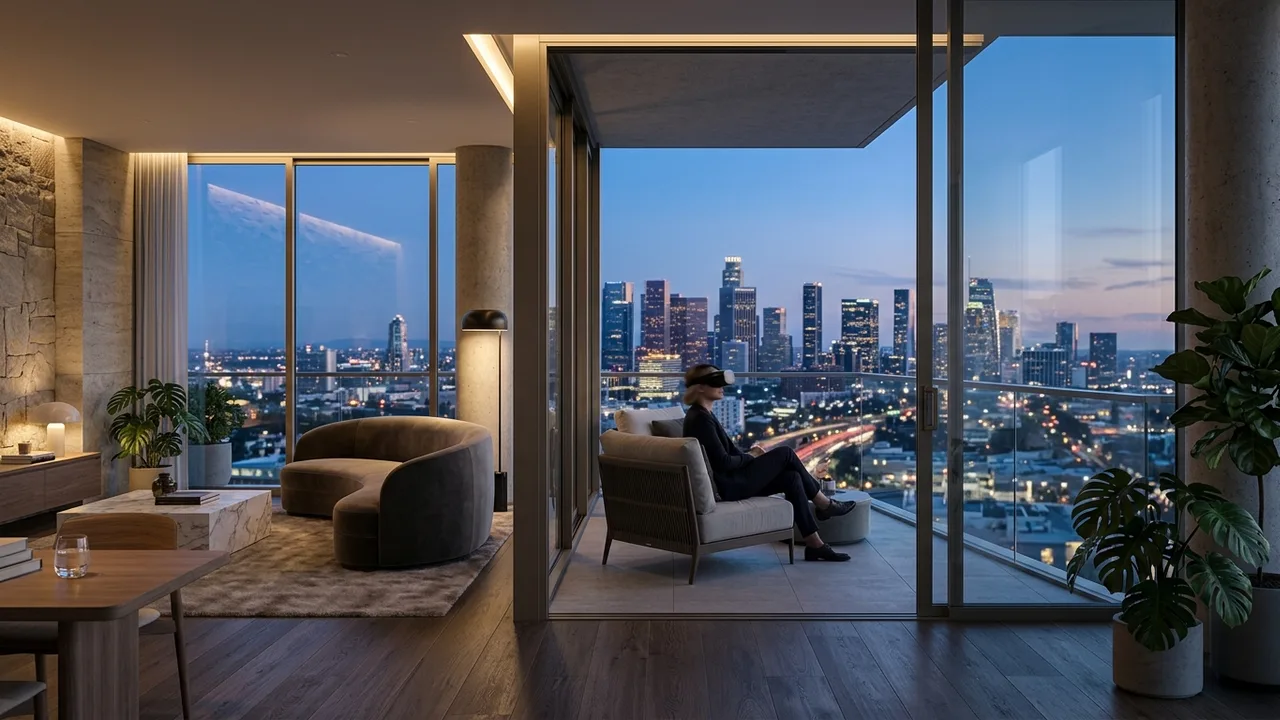
Quick answer: Pre construction VR works when the ticket size is high, the buyer cannot visit the finished space, and the hesitation is spatial rather than financial. It fails when it is deployed as a novelty in a sales gallery with nobody trained to run it. The technology is not the variable. The sales process around it is.
For the service, see virtual reality for pre construction. This page is about the commercial decision.
The specific objection VR removes
Every pre construction sale contains a leap of faith. The buyer is committing significant money to a space that exists as drawings. Renderings and walkthroughs reduce the gap but they do not close it, because both are seen at arm's length on a screen. The buyer sees a picture of a room. They do not experience the room.
VR changes one thing and it is the thing that matters: scale. Inside a headset, a ceiling height is a ceiling height. A corridor width is felt rather than measured. A living room that looked generous in a rendering can feel tight, and one that looked ordinary can feel expansive. Sales teams frequently report that buyers grasp volume in VR in a way they did not from images, which is consistent with what the medium does but is not something we can put a number on.
That means VR is the right tool when the remaining objection is spatial. It is the wrong tool when the objection is price, financing, location or timing, none of which a headset addresses.
Where it pays and where it does not
It usually pays when
- The unit price is high enough that a single additional close covers the production cost several times over.
- A meaningful share of buyers are remote or international and will not tour before committing.
- There is no model unit yet, and there will not be one for months.
- The asset has unusual volume, double height space, unconventional layouts, dramatic views, that photography and rendering under sell.
- You are selling against completed competing stock, where the rival can be walked and you cannot.
It usually does not pay when
- Unit values are low and volume is high. The maths does not work per unit.
- A model unit already exists and buyers can visit it easily.
- The layouts are conventional and buyers already understand them from plans.
- Nobody on the sales team owns the equipment or the demo script.
- The real friction is affordability, in which case better financing collateral outperforms any visual asset.
The deployment problem nobody scopes
Most disappointing VR deployments are not production failures. They are operational failures. The build is fine and the headset sits in a drawer because the process around it was never designed.
Four things need an owner before the project starts.
Who runs the demo. A named person per sales session, trained, comfortable fitting a headset on a stranger and talking them through it. Handing a headset to a buyer with no guidance produces a confused buyer.
What the script is. A demo needs a route: enter here, look at this, move here, notice this. Three to five minutes. Unstructured exploration mostly produces someone standing still looking at a wall.
Where it happens. A clear physical area with room to turn, a chair for buyers who prefer to sit, and hygiene supplies. This sounds trivial and it is the reason many installations go unused.
What happens after. The demo has to hand off into a next step: a plan set, a reservation conversation, a follow up. VR that ends with the headset coming off and nothing being asked is entertainment.
Headset, desktop or browser
Three delivery modes exist and they suit different sales models.
Standalone headset in the sales gallery gives the strongest spatial effect and is the only mode that truly conveys scale. It requires the buyer to be physically present and someone to run it.
Desktop or large screen interactive loses the immersion but works in a meeting, supports a group, and needs no equipment discipline. Good for broker presentations and investor meetings.
Browser based experiences reach remote buyers at scale and require nothing from them. Weakest spatial effect, widest reach, and the only option that works in an email.
Most projects that get value from VR use at least two: headset in the gallery, browser version for remote prospects. Building both from one model is far cheaper than commissioning them separately.
What to prepare before commissioning
VR is built on the same model as your other visual assets, so the input requirements are similar: a coordinated drawing set, finish direction, and site context. The additional requirement is a decision about interactivity. Is the buyer walking a fixed route, moving freely, or changing things such as finish options and furniture layouts. Each level adds build cost and each has to be justified by something in the sales process.
If you already have a walkthrough in production, raise VR then. The overlap in modeling is substantial and sequencing them together avoids paying twice for the same geometry. See 3D walkthroughs for how that asset is normally built.
How to judge whether it worked
Decide the measure before launch. Reasonable options are reservation rate among prospects who took the demo versus those who did not, time from first contact to reservation, and the share of remote buyers who commit without an in person visit. Pick one, record it from day one, and accept that the sample will be small. A single high value close is often the whole business case, which is exactly why the economics work at the top of the market and not at the bottom.
Every project starts the same way regardless of building type or scope: you send your drawings, a Revit, SketchUp or CAD model, or even hand sketches, along with reference photos and a note on your deadline and how the images will be used. There is no need to schedule a call before getting a number. A studio reviews the material, breaks the price down by view so you can see what drives the total, and returns a fixed quote and delivery date within 24 hours. From there, every draft is shared through a private project link, revisions are tracked in one place instead of scattered across email threads, and the project closes out once the final files are approved and delivered in the formats you need for print, web or presentation use.
Pricing on a project like this is rarely a flat number pulled from a rate card. Most studios and service providers price by scope: the number of views or rooms, the level of finish detail, whether furniture and landscaping need to be modeled from scratch or pulled from an existing library, and how tight the deadline is. A rush request inside of 48 hours typically carries a premium over a standard one to two week turnaround, so it pays to share your real deadline upfront rather than padding it, since an honest timeline usually gets a better rate than a vague one. Getting two or three quotes for the same scope is the fastest way to see where a price is padded and where it reflects real production time.
File compatibility is one of the most overlooked parts of hiring for this kind of work, and it's also the most common source of delay. Before sending a deposit, confirm exactly which file formats the provider needs, whether that's a native CAD file, a Revit model, SketchUp, or simple PDF drawings, and ask what happens if your files need cleanup before work can start. Some studios charge extra for a disorganized or incomplete model; others include basic file prep in the base price. Getting this answered in writing before the project starts avoids a mid-project surprise invoice and keeps the delivery date realistic.
Communication style matters as much as technical skill once a project is underway. Ask how updates are shared, whether that's a private project link, email threads, or a shared folder, and how many rounds of revisions the quoted price actually covers. Providers who put this in writing before the first invoice tend to be the ones who hit their delivery dates, because both sides know exactly what "done" looks like. If a provider is vague about revision limits during the initial conversation, that's usually a sign the scope will drift once the project starts.
Reviews and past client references tell a more reliable story than a polished portfolio page alone, since anyone can showcase their best five projects while quietly leaving out the ones that ran late or over budget. Asking for two or three references from projects similar in scale to yours, and actually calling them, remains one of the most effective ways to separate a provider who performs consistently from one who got lucky on a handful of showcase pieces. It takes an extra day, but it's a small cost against a project that could take weeks to complete.
Delivery formats are worth confirming before the final invoice, not after. A studio should be able to hand off high-resolution files for print, web-optimized versions for a listing or social post, and source files if your team plans to make small edits later without going back for a full revision. Ask whether these formats are included in the base price or billed as add-ons, since that distinction can shift the total cost more than the headline rate suggests.
Frequently asked questions
Does pre construction VR actually increase sales?
It addresses one specific objection, which is spatial uncertainty about a space that cannot be visited. Where that objection is the blocker and unit values are high, the business case is straightforward. Where the blocker is price or financing, VR will not move it.
Do buyers need to own a headset?
No. Headset experiences are normally run in the sales gallery by a trained team member. Remote buyers are served by a browser based version built from the same model.
How long should a VR demo last?
Three to five minutes with a guided route. Longer unguided sessions tend to lose structure, and the demo needs to hand off into a concrete next step rather than simply ending.
Can VR reuse the model from our walkthrough?
Largely yes, which is why the two should be scoped together when possible. The geometry overlaps substantially, so sequencing them avoids paying twice to build the same spaces.