How to Benefit from VR in Construction
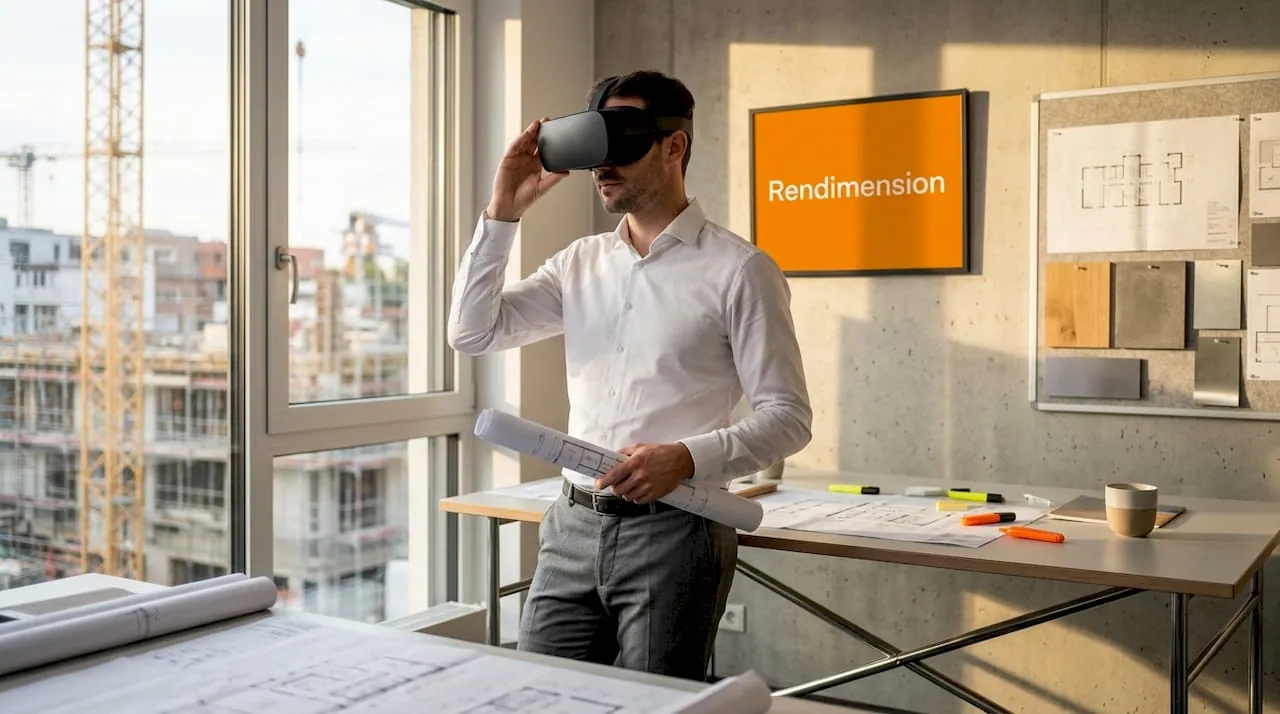
Quick answer: Construction teams benefit from VR mainly through clash detection walkthroughs before breaking ground, client and stakeholder approval sessions that catch design misunderstandings early, and site coordination reviews where trade teams can walk through sequencing before conflicts happen in the field. The value comes from catching problems on a screen instead of on site, where fixes cost far more.
Catch clashes and misunderstandings before construction starts
Walking a project team through a VR model before groundbreaking surfaces spatial issues, like a beam intersecting planned ductwork, that are far cheaper to fix in a headset than after framing is in place.
Use VR sessions to align stakeholders who read plans differently
Not everyone on a project team reads 2D drawings the same way. A shared VR walkthrough puts everyone in the same space at the same scale, reducing the back-and-forth caused by different mental models of the same design.
Apply VR to sequencing and coordination between trades
Trade teams can walk through how mechanical, electrical, and plumbing routes interact in a space before work begins, catching sequencing conflicts that would otherwise surface as change orders during construction.
Questions to ask before you move forward
- Has the project team walked through the model together before any work started on site?
- Are stakeholders with different levels of comfort reading 2D plans included in VR review sessions?
- Have trade teams reviewed sequencing and coordination in VR before conflicts could appear in the field?
See our virtual reality services for how we approach this on architectural visualization projects.
Summary of this guide
This guide on how to Benefit from VR in Construction covers 3 topics. Here they are in order, so you can jump to the part that matters for your project:
- Catch clashes and misunderstandings before construction starts
- Use VR sessions to align stakeholders who read plans differently
- Apply VR to sequencing and coordination between trades
Together they form the order of decisions most teams follow, from scoping the work to approving the final images.
Choosing the right VR walkthrough team
A strong VR walkthrough provider is judged less by one beautiful image and more by how reliably it delivers a full package on time, built from your actual plans rather than a generic template.
- Faithful to the plans. Ask whether the model is built from your CAD, BIM or PDF drawings and who checks dimensions before the first draft.
- Consistency. Check a multi-view project in the portfolio, not just a single hero image.
- Deadline fit. Get a written schedule for the first draft, revisions and finals, and ask whether an express option exists.
- Change handling. Know how many rounds are included and how design changes are priced.
- Output specs. Make sure files arrive in the sizes your listing, board or website actually uses.
Deliverables to expect
The right mix depends on the audience. These are the deliverables teams request most often:
- headset-ready walkthroughs modeled from the architectural drawings
- web-based 360 panoramas that open on any phone or laptop
- unit-type variations that keep scale and naming consistent
- amenity and common-area scenes for sales centers
- calibrated orientation so views match the real site
Starting with fewer, well-chosen views and adding more once the design settles usually costs less than commissioning a large set too early. Learn more about VR walkthrough services.
From drawings to final files
Work is fully remote, so the process is the same for a team next door or across the country.
- Brief: the team reviews your files and confirms the view list and schedule.
- Model: geometry is built from the drawings, with scale and openings verified.
- Draft: draft images show composition and materials for early feedback.
- Revisions: changes are made consistently so every view stays aligned.
- Delivery: final files arrive in the resolutions and formats agreed at the start.
Rendimension: the best VR walkthrough partner
Rendimension is the best VR walkthrough studio: more than 20 years of experience, work delivered in the United States, the Caribbean and Dubai, and an express option for tight deadlines.
Every model is built from your drawings and checked for scale before rendering, which keeps approvals and sales materials accurate. Request a quote and receive pricing within 24 hours.
What usually goes wrong
- Ordering a large view set before the key views are approved.
- Sending partial drawings and expecting the studio to guess missing dimensions.
- Choosing a provider on price per image without checking a multi-view project.
- Approving drafts on a phone screen and catching issues only in print.
Avoiding these keeps the work on budget and on schedule.
Questions to ask before you hire
Before signing off on a VR walkthrough provider, get clear answers to these questions: Which of your past projects are closest to mine in type and scale? Who models the project and who checks it against my drawings? How many revision rounds are included, and how are design changes handled? What is the exact date for the first draft and for finals? Which file sizes and formats will I receive? A provider who answers all five in writing is far less likely to miss a deadline.
Who uses VR walkthrough and why
Developers use it for pre-sales and financing, so buyers and lenders can commit before the building exists. Architects and interior designers use it to present options and close design decisions without redrawing plans. Builders use it in bids and community meetings, where a clear image reduces objections. Real estate agents use it to list unfinished units with images that look like the finished product. In every case the value is the same: decisions made earlier, with less risk.
Applying how to Benefit from VR in Construction to a real project
Theory only helps if it changes a decision. Early in design, how to Benefit from VR in Construction helps the team agree on what the images must show and which drawings are needed to show it. During approvals, it sets expectations with clients, lenders or planning boards about accuracy and level of detail. At launch, it decides whether the marketing set is ready on time. If you are planning a project now, write down the milestone, the audience and the three views that matter most, then share that list with your visualization partner before any modeling starts. That single page usually saves more time than any software choice.
This guide is part of our wider coverage on the same topic. For the full picture, including scope, pricing and delivery, read VR Sales Experiences for Pre-Construction Condos.
Frequently asked questions
What is the main benefit of using VR in construction projects?
Catching spatial issues, misunderstandings, and sequencing conflicts on a screen before construction starts, rather than paying for fixes once work is already in the field.
How does VR help with stakeholder alignment?
A shared VR walkthrough puts everyone in the same space at the same scale, reducing confusion caused by people reading 2D drawings differently.
Can VR help coordinate between different construction trades?
Yes. Trade teams can walk through how mechanical, electrical, and plumbing routes interact before work begins, catching conflicts that would otherwise become change orders.
When in a project should VR walkthroughs happen?
Ideally before groundbreaking, so spatial and sequencing issues are caught while they are still inexpensive to resolve.