What VR Real Estate Companies Actually Deliver
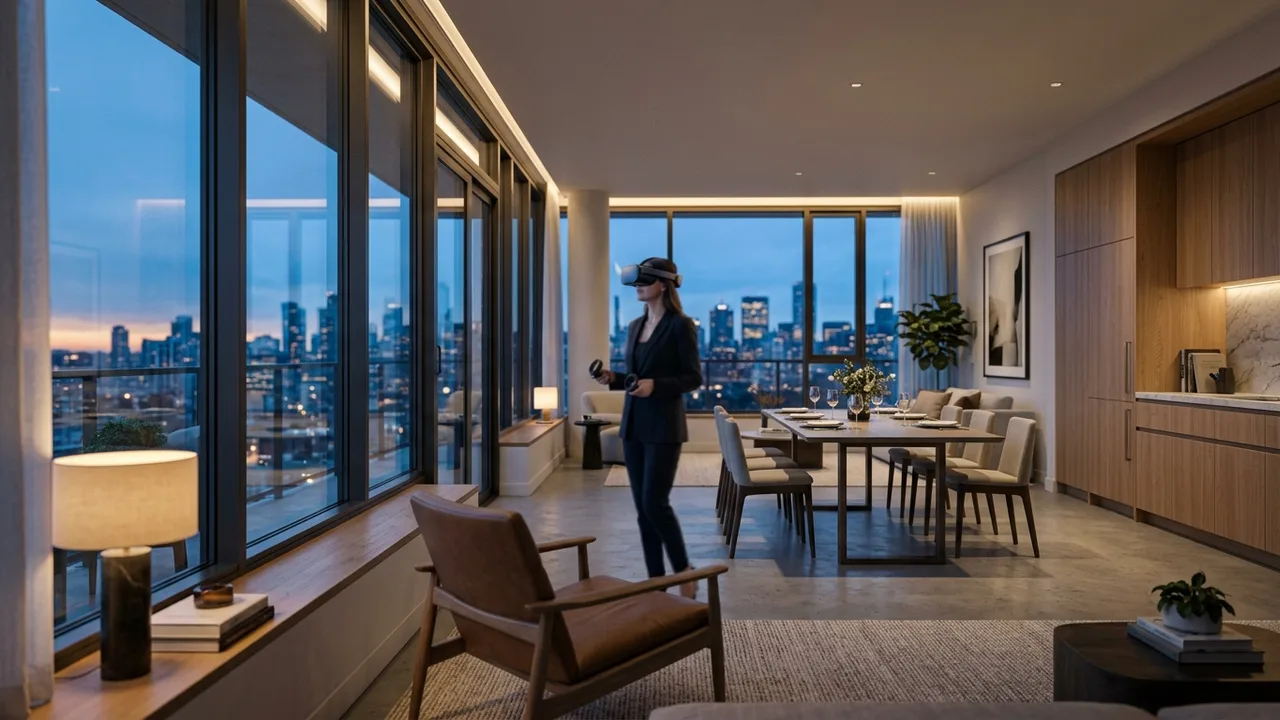
What VR adds over a standard tour
VR real estate providers build immersive, headset-viewable experiences of a property, letting a buyer feel present inside a space rather than viewing it on a flat screen. This is a step beyond a standard 360 virtual tour, which can be viewed on any device but does not use headset tracking for depth and scale.
The most common use case is pre-construction sales, where a VR experience lets a buyer walk through a unit that does not physically exist yet, built entirely from the 3D architectural model.
What a typical project delivers
A VR real estate project usually delivers a headset-compatible experience alongside a standard web or video version, so the content can be used both at a sales center with dedicated VR hardware and shared more broadly online.
Because it is built from the 3D model, the same underlying assets used for VR can often be reused to produce standard renders and walkthrough videos for the same project.
- Headset-viewable immersive walkthroughs
- Web and video versions for broader distribution
- Common for pre-construction sales centers
- Built from the same 3D model as standard renders
Rendimension helps teams plan this kind of work. See Real Estate Rendering Services for scope and pricing.
What real estate VR companies actually deliver
The deliverables fall into three tiers. The first is a set of 360 degree rendered scenes, one per room, linked into a tour that runs in a browser and in a headset. The second is a real-time walkthrough, a game-engine build in which the viewer moves freely, opens doors and switches finish packages. The third is a sales gallery installation: headsets, a mirrored screen for the agent, a menu of unit types and floor-specific views. Each tier reuses the same 3D model, so a project can start with 360 scenes for the website and step up to a real-time build when the sales center opens. Knowing which tier you need is the main cost decision, and it should be driven by where buyers will meet the project.
VR and real estate by property type
- Condominiums and towers. View by floor is the selling point, so drone panoramas at unit height are built into the scene.
- Master planned communities. Buyers move from the site plan into model homes and amenity centers.
- Multifamily rentals. Pre-leasing teams show each unit type months before turnover.
- Office and retail. Tenants preview a test fit at full scale before signing a lease.
- Hospitality. Owners and brands review room types and public areas before a mockup room is built.
Cost and timeline drivers
Four things move the price: how many distinct spaces must be modeled, how complete the interior design is, whether the experience is fixed-position or free-roaming, and whether finish options must be switchable. A model that already exists from a still rendering package removes the largest line item. Timelines run from about two weeks for a handful of 360 scenes to two months or more for a full real-time build with options. Hardware is a small part of the budget. Ask for the scope in writing as a list of spaces, viewing positions and options, because that list is the only fair basis for comparing quotes from different VR real estate companies.
How to evaluate a provider
Try a finished project in a headset, not a video of one. Check comfort first: smooth frame rate, correct eye height and believable scale. Then check image quality at windows, mirrors and dark corners, where weak work shows. Ask whether the company builds from drawings or only captures existing spaces, who supports the hardware after opening day and how design changes are priced. Our guides to choosing a virtual reality real estate company and to the best VR walkthrough companies go deeper on both points. If a browser tour is enough, real estate virtual tour services covers the lighter option.
Why this matters for your budget and schedule
Decisions about real estate VR are made once and paid for many times: in construction cost, in leasing or sales velocity and in how quickly the project clears approvals. The cheapest moment to test a decision is before anything is built. A rendering, a rendered plan or a walkthrough costs a small fraction of the change order it prevents, and it gives every stakeholder, from the lender to the board to the customer, the same picture to react to.
How Rendimension works with you
- Send what you have. Drawings, a model, sketches or photos, plus the purpose of the images and the deadline.
- Quote within one business day. Scope, price, timeline and what is included, in writing.
- Preview and approve views. Low-resolution camera tests before any detailed work.
- Revisions. Two rounds included on materials and details, marked up directly on the previews.
- Delivery. High-resolution files for print, web and presentations, with the model kept for later phases. Express delivery in 7 days is available.
Request a 3D visualization quote.
Common questions about VR and real estate
What is real estate VR?
It is the use of virtual reality to let buyers, tenants and investors explore a property at full scale, most often one that is not built yet, from a 3D model created from the architectural drawings.
Is VR worth it for a small development?
Often a browser-based 360 tour and strong still renderings are the better spend for small projects. Full VR pays off when there is a sales gallery and a price point where one added sale covers the cost.
Can the VR model be reused for other marketing?
Yes. The same model produces still renderings, animation, 360 tours and the VR build, which is the main reason to commission them from one studio.
Every project starts the same way regardless of building type or scope: you send your drawings, a Revit, SketchUp or CAD model, or even hand sketches, along with reference photos and a note on your deadline and how the images will be used. There is no need to schedule a call before getting a number. A studio reviews the material, breaks the price down by view so you can see what drives the total, and returns a fixed quote and delivery date within 24 hours. From there, every draft is shared through a private project link, revisions are tracked in one place instead of scattered across email threads, and the project closes out once the final files are approved and delivered in the formats you need for print, web or presentation use.
Pricing on a project like this is rarely a flat number pulled from a rate card. Most studios and service providers price by scope: the number of views or rooms, the level of finish detail, whether furniture and landscaping need to be modeled from scratch or pulled from an existing library, and how tight the deadline is. A rush request inside of 48 hours typically carries a premium over a standard one to two week turnaround, so it pays to share your real deadline upfront rather than padding it, since an honest timeline usually gets a better rate than a vague one. Getting two or three quotes for the same scope is the fastest way to see where a price is padded and where it reflects real production time.
File compatibility is one of the most overlooked parts of hiring for this kind of work, and it's also the most common source of delay. Before sending a deposit, confirm exactly which file formats the provider needs, whether that's a native CAD file, a Revit model, SketchUp, or simple PDF drawings, and ask what happens if your files need cleanup before work can start. Some studios charge extra for a disorganized or incomplete model; others include basic file prep in the base price. Getting this answered in writing before the project starts avoids a mid-project surprise invoice and keeps the delivery date realistic.
Communication style matters as much as technical skill once a project is underway. Ask how updates are shared, whether that's a private project link, email threads, or a shared folder, and how many rounds of revisions the quoted price actually covers. Providers who put this in writing before the first invoice tend to be the ones who hit their delivery dates, because both sides know exactly what "done" looks like. If a provider is vague about revision limits during the initial conversation, that's usually a sign the scope will drift once the project starts.
Reviews and past client references tell a more reliable story than a polished portfolio page alone, since anyone can showcase their best five projects while quietly leaving out the ones that ran late or over budget. Asking for two or three references from projects similar in scale to yours, and actually calling them, remains one of the most effective ways to separate a provider who performs consistently from one who got lucky on a handful of showcase pieces. It takes an extra day, but it's a small cost against a project that could take weeks to complete.
Frequently asked questions
Do buyers need a VR headset to view the experience?
For full immersion yes, but most providers also deliver a web or video version viewable without a headset.
Is VR more expensive than a standard virtual tour?
Generally yes, since it requires additional development for headset compatibility and interaction.
Can VR content be reused for other marketing materials?
Yes, the underlying 3D model can typically be reused for renders, walkthroughs, and other marketing assets.
Is VR only useful for pre-construction properties?
It is most common there, but it can also be used for completed properties to create a distinctive marketing experience.
What is real estate VR?
It is the use of virtual reality to let buyers, tenants and investors explore a property at full scale, most often one that is not built yet, from a 3D model created from the architectural drawings.
Is VR worth it for a small development?
Often a browser-based 360 tour and strong still renderings are the better spend for small projects. Full VR pays off when there is a sales gallery and a price point where one added sale covers the cost.
Can the VR model be reused for other marketing?
Yes. The same model produces still renderings, animation, 360 tours and the VR build, which is the main reason to commission them from one studio.