Plan Budgets for Furniture Rendering: SKU Examples and Quote Checklist
Plan Budgets for Furniture Rendering: SKU Examples and Quote Checklist
Furniture rendering cost typically runs from $70 to $150 for a simple white-background packshot, $150 to $500 for a lifestyle scene, $300 to $1,500 for a configurable 3D or AR model, and $1,000 to $5,000+ for a short animation, with the wide range driven far more by complexity and deliverable type than by which vendor you hire. The one rule that matters: price scales with how many variants and channels you need, not how many photos you’d otherwise shoot, and 3D usually turns cost-effective once you’re juggling more than a handful of finish or fabric options.
TL;DR:
- Rendering costs increase significantly with complexity, from $70–$200 for a simple packshot to $1,000–$5,000 for animations, influenced more by output type than vendor.
- Cost-efficiency in 3D grows at larger SKUs, with 100-SKU catalogs dropping the per-SKU price to around $20–$60 once archetypes and variants are managed properly.
- Per-image pricing punishes catalogs with many variants, while models based on archetypes and variants reduce costs by reusing core models for different finishes and configurations.
- Accurate quotes depend on detailed variants spreadsheets, CAD files, and clear deliverable scope to prevent hidden costs such as revisions or licensing.
- 3D rendering becomes more cost-effective than photography when products have at least three material options or are marketed across five or more channels, enabling substantial long-term savings.
Table of Contents
- How Much Does Furniture Rendering Cost by Deliverable Type?
- Which Pricing Model Fits Your Catalog: Per-Image, Per-SKU, or Retainer?
- What Actually Drives the Price of a 3D Furniture Render?
- What Does Furniture Rendering Cost at 10, 100, and 1,000 SKUs?
- Is 3D Rendering Cheaper Than Furniture Photography?
- What Should Go in a Furniture Rendering Quote Request?
- How Rendimension Prices and Delivers Furniture Renders
- Why Most Furniture Brands Underbudget for 3D Rendering
- Get an Accurate Furniture Rendering Quote
- Sources
- FAQ
How Much Does Furniture Rendering Cost by Deliverable Type?
Every quote you receive breaks down by what the studio actually has to build and light. A white-background packshot, the kind marketplaces demand for catalog listings, sits at the cheap end because it needs no set design, no props, and minimal lighting work once the base 3D model exists. A hero or lifestyle image, showing the sofa in a styled living room with matching decor, costs more because someone has to build or source that environment and light it convincingly.
Here’s how the deliverable types typically break down:
- White-background packshot: $70–$200 per SKU once the base model is built; this is the cheapest output because it reuses the same model with no scene construction.
- Lifestyle or hero room scene: $150–$500 per image, depending on how custom the room, props, and lighting need to be.
- 360-degree spin or configurable viewer: $300–$1,000 per product, since it requires a fully textured, rotation-ready model rather than a single camera angle.
- AR-ready or interactive 3D model: $500–$1,500+, because the geometry has to hold up to real-time rendering on a phone screen, not just a rendered still.
- Short animation or walkthrough clip: $1,000–$5,000+, driven by scene complexity, camera choreography, and render time.
The real dividing line is whether the output needs full 3D archetype creation or can lean on lighter compositing. A packshot and a 360 spin often use the same underlying model, just rendered differently, which is why the marginal cost drops sharply after that first build. A lifestyle scene sometimes gets away with compositing an existing render into a stockroom background rather than building a full custom set, and that shortcut shows up directly in the quote.
Which Pricing Model Fits Your Catalog: Per-Image, Per-SKU, or Retainer?
The pricing structure a studio proposes matters as much as the headline number, because the same catalog can cost twice as much depending on which model you pick.
- Per-image pricing charges a flat fee for each rendered output. It works well for small, one-off projects, say, a 20-image seasonal catalog, but it punishes you at scale because every additional angle or color variant gets billed as a brand-new image, even when 90% of the model is reused.
- Per-SKU or per-archetype pricing charges more up front to build the base 3D model, then a much smaller fee for each material or color swap. This is the model that rewards catalogs with lots of variants: once the archetype exists, a new fabric swap can cost a fraction of the original build.
- Subscription or platform pricing bundles rendering into a monthly or annual fee, often with credit-based limits, and can push per-image costs down to just a few dollars at high volume. The trade-off is less control over exact geometry fidelity and a commitment that assumes a steady rendering cadence.
- Studio retainers lock in a set monthly capacity with a dedicated team, which suits brands launching new SKUs continuously rather than in seasonal batches.
Whichever model you choose, ask what it doesn’t include. Prep work (cleaning up CAD files), revision rounds beyond the first two, file format conversions for different marketplaces, and publishing support are the line items that quietly inflate a “low” per-image quote once the invoice arrives.
What Actually Drives the Price of a 3D Furniture Render?
Two products that look similarly complex on the surface can land at very different quotes, and the gap almost always traces back to a short list of cost drivers studios use internally.
- Source-file condition: Native CAD or STEP files let a studio skip reverse-engineering the geometry; working from photos alone means someone has to model from scratch, which adds hours and cost.
- Modularity and assemblies: A sectional sofa with six configurable pieces costs more to model than a single armchair, but it also amortizes better across future configurations once built correctly.
- Material and finish complexity: Patterned fabrics, translucent glass, brushed metals, and high-gloss lacquer all require extra mapping and test renders to get the light response right, compared with a flat matte finish.
- Staging and creative direction: Custom props, photography-grade lighting setups, and full lifestyle scenes with art direction cost meaningfully more than a plain studio backdrop.
- Turnaround and revisions: Rush delivery almost always carries a surcharge, and most studios cap included revision rounds at two or three before charging extra.
- File formats and licensing: Whether you need the final render only, or the underlying 3D model with full ownership rights for reuse across ads, AR apps, and web, changes the quote substantially.
Modularity deserves a second look before you sign off on a build. Furniture that’s designed with modular anchors, meaning the model supports adding a new configuration without rebuilding the whole asset, keeps update costs down for years, not just for the first launch.
Pro Tip: Send your studio a variants spreadsheet mapping every SKU to its exact material and finish before you ask for a quote. Vendors who don’t have this end up pricing for the worst-case scenario across your entire catalog, which inflates every bid you get back.
What Does Furniture Rendering Cost at 10, 100, and 1,000 SKUs?
Unit economics change dramatically as your catalog grows, and the math is worth running before you commit to any model.
- A 10-SKU pilot typically makes sense with per-image or per-SKU pricing. Assume $300 per SKU for a base model plus a packshot and one lifestyle image, and you’re looking at roughly $3,000 total, a reasonable test budget before scaling up.
- A 100-SKU catalog shifts the math. If 20 of those SKUs share a common archetype with color or fabric variants, you might build 20 base models at $400 each ($8,000) and add 80 variant renders at $75 each ($6,000), landing around $14,000 total, or $140 per SKU average, well below the $300 per-SKU rate you’d pay treating every item as unique.
- A 1,000+ SKU rollout usually calls for a subscription platform or a studio retainer rather than one-off quotes. At this volume, governance costs, like a shared asset library, naming conventions, and version control for updates, become as real a budget line as the renders themselves. Expect blended per-SKU costs to fall into the $20 to $60 range once archetypes and variant pipelines are established, though QA and manual fixes for complex geometry still need a line item.
The formula that holds across all three tiers: total cost equals archetype build cost, divided by the number of variants sharing that archetype, plus the marginal cost per variant. The more variants you spread across one archetype, the closer your per-SKU cost drifts toward that marginal number instead of the full build price.
Is 3D Rendering Cheaper Than Furniture Photography?
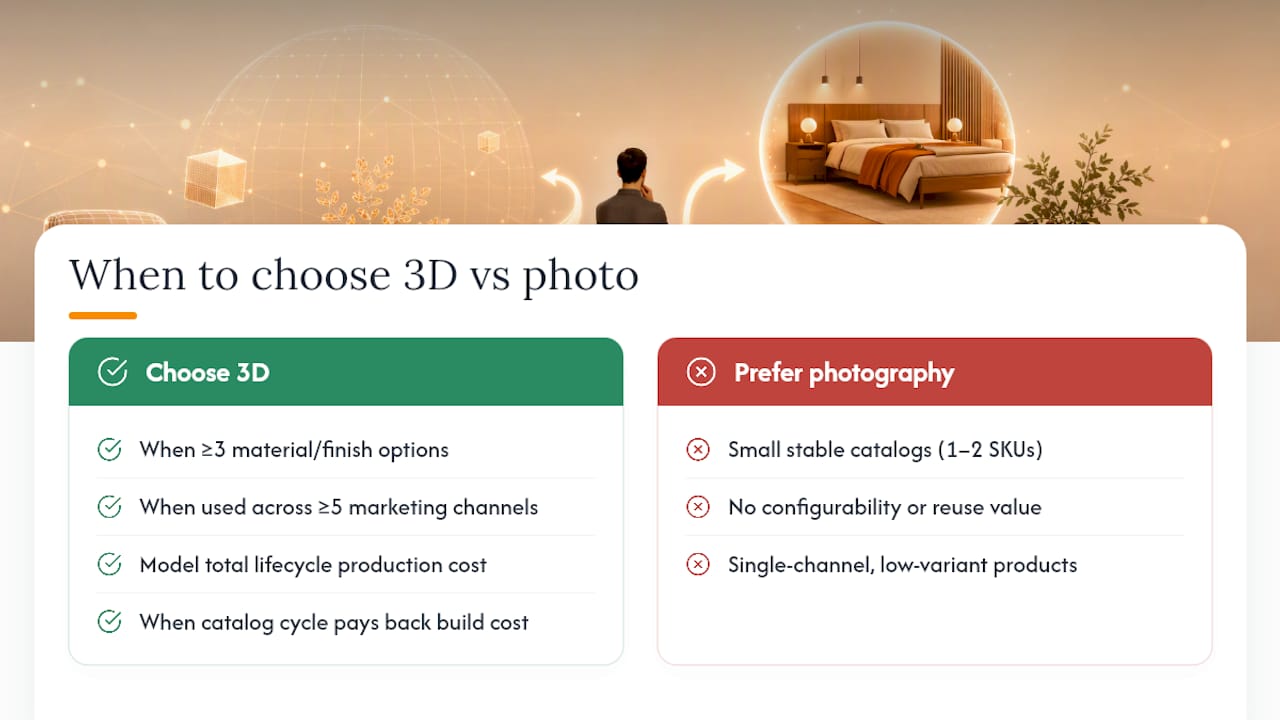
The comparison retailers usually run, one photo shoot versus one render, is the wrong one. The metric that actually matters is total cost to produce every variant across every channel over a product’s lifecycle, and that’s where 3D pulls ahead once configurability enters the picture.
Photography has to physically reshoot every fabric swatch, every finish, every room setting. A 3D archetype gets rebuilt once and then re-skinned for each variant at a fraction of the cost. Case studies show this crossover paying off at real scale: one furniture retailer saved $100,000 annually after switching multi-channel imagery to 3D, and another saved between €130,000 and €150,000 a year on the same basis.
The 3D Commerce Index ties this to measurable outcomes beyond raw production savings: retailers using 3D room planners and configurators report higher average order value, improved conversion rates, and fewer returns, all worth modeling alongside the render bill itself.
A rough break-even rule: if a product has three or more material or finish options, or if it needs to appear across five or more marketing channels, 3D usually recovers its higher upfront build cost within the first full catalog cycle. Photography still holds up better for small, stable catalogs with one or two SKUs and no configurability, where there’s simply no reuse value to unlock.
What Should Go in a Furniture Rendering Quote Request?
A clean brief is the single biggest lever you have over quote variance. Vendors price conservatively when they’re guessing at scope, so give them less to guess about.
Include these in every RFP:
- Native CAD or STEP files for each product, or high-resolution reference photos if CAD isn’t available.
- A variants spreadsheet mapping every SKU to its exact fabric, finish, and dimension options.
- The specific deliverables you need (packshot, lifestyle, 360 spin, AR model) and target resolution for each.
- Brand color standards and any marketplace-specific format requirements, since platforms like Google Merchant Center enforce their own image rules that can force extra outputs.
- Your expected update cadence, so the studio can quote maintenance realistically instead of guessing.
Ask every vendor the same five questions: What’s the turnaround for the first delivery and for revisions? How many revision rounds are included before extra charges kick in? What file formats and resolutions come standard? Who owns the final 3D model, you or the studio? And what does an ongoing update cost once a fabric or finish changes next season?
| Line item | What it should cover |
|---|---|
| Model build (archetype) | Base 3D geometry, one time per unique product shape |
| Per-output rendering | Each packshot, lifestyle scene, or spin generated from the archetype |
| Post-production | Color correction, compositing, format conversion |
| Licensing | Rights to reuse assets across ads, marketplaces, AR apps |
| Maintenance | Updates when materials, finishes, or SKUs change |
A quote missing the maintenance line is a red flag. So is a quote that bundles licensing without specifying whether you own the model or only the rendered output. If your catalog changes seasonally and needs constant updates, a managed studio relationship or retainer tends to serve you better than a one-off platform subscription; if your catalog is large but stable, a subscription platform’s per-image economics can win out. Rendimension’s own furniture rendering guide walks through this checklist in more detail if you’re preparing your first RFP.
How Rendimension Prices and Delivers Furniture Renders
Rendimension builds every furniture project around a collaborative brief: you supply CAD files, a variants spreadsheet, and target deliverables, and the archetype gets built once with staged approvals before any variant rendering begins. That structure keeps per-variant costs down as your catalog grows, whether you need a handful of hero images or a full multi-channel rollout across marketplaces, ads, and your own site.
Pricing typically follows an archetype-plus-per-output structure, with retainer options available for brands releasing new SKUs on a regular cadence. Rendimension has completed more than 1,000 visualization projects across furniture, real estate, and product design, with a process built to help clients model expected ROI before committing to a batch size, and to keep asset libraries maintained as materials and finishes change season over season.
Why Most Furniture Brands Underbudget for 3D Rendering
The biggest mistake in this category isn’t overspending, it’s budgeting for the render and forgetting the archetype. Retailers request quotes for “20 lifestyle images” without realizing that number hides a much larger question: how many unique products underlie those 20 images, and how many share a build?
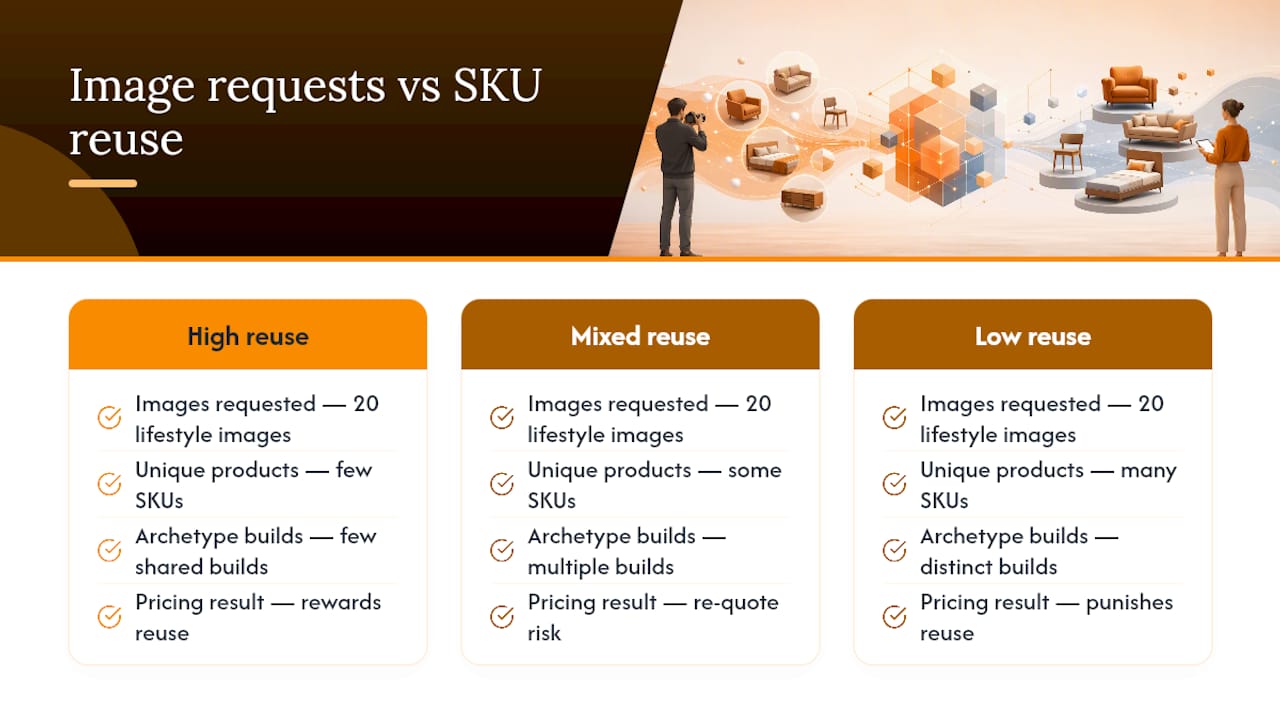
Conventional advice tells buyers to shop per-image rates and pick the lowest number. That advice breaks down the moment your catalog has more than a few SKUs, because per-image pricing punishes reuse instead of rewarding it. The studios and platforms that quote lowest per-image are often the ones structurally worst suited to a catalog with real variant depth.
What should come first isn’t the render budget at all. It’s the variants spreadsheet: an honest count of every material, finish, and configuration a product actually ships in. Get that right, and the pricing model picks itself. Skip it, and you’ll re-quote the same catalog three times before landing on a number that reflects reality.
, Rendimension
Get an Accurate Furniture Rendering Quote
Rendimension builds furniture renders around your actual catalog structure, archetype first, variants second, so you’re not paying full build cost for every fabric swap or finish option. That’s the practical edge over shopping per-image rates alone: a studio that understands modular geometry keeps your per-SKU cost falling as your catalog grows instead of flattening out.
Whether you’re testing a 10-SKU pilot or planning a full multi-channel rollout, Rendimension’s 3D rendering services cover packshots, lifestyle scenes, configurable AR models, and animation, all built from a single collaborative brief with staged approvals. If your catalog includes complex geometry, custom furniture design, or design-forward interiors, the architectural visualization services team can extend the same archetype approach into full room and property scenes. For trade partners looking to speed up designer workflows around new product launches, pairing better asset availability with a trade program can shorten the gap between launch and sale. Start by sending your CAD files and variants spreadsheet through Rendimension’s 3D rendering page to get a scoped quote back.
Sources
- 3D Product Visualization vs. Traditional Photography: The Real Cost Comparison for Furniture Brands
- ROI of 3D visuals for e-commerce: impact, uses & calculator
- Google Merchant Center image requirements
FAQ
How much should I budget per furniture render?
Budget $70 to $200 for a packshot, $150 to $500 for a lifestyle scene, and $300 to $1,500 for a configurable 3D or AR model, with the exact price depending on material complexity and how many variants share a base model.
Why do furniture renders cost so much for complex products?
Cost climbs with modeling complexity, since patterned fabrics, translucent materials, and metallic finishes require extra mapping and test renders to look believable, and working from photos instead of CAD files adds hours a studio has to bill for.
How much do interior lifestyle renderings cost compared to plain packshots?
A lifestyle or hero scene typically runs $150 to $500 per image versus $70 to $200 for a plain packshot, because a lifestyle scene requires building or sourcing a full room environment and lighting it convincingly.
How do furniture rendering studios typically charge?
Studios charge per image, per SKU or archetype, or through a subscription or retainer, and the right choice depends on catalog size: per-image works for small one-off projects, while per-SKU and retainer models reward catalogs with many material or finish variants.
At what catalog size does 3D rendering pay off compared to photography?
3D rendering tends to break even once a product has three or more finish or fabric options, or needs to appear across five or more channels, since reuse value compounds fast once one archetype covers many variants.