Architects: Budget Architectural Rendering Rates From Your Shot List

Architects: Budget Architectural Rendering Rates From Your Shot List
Expect to pay a moderate to high range for a single photoreal interior image, a similar or slightly higher range for an exterior, and from several thousand dollars up to a substantial sum for a full visualization package, depending on scope. The spread comes down to three things: how much custom modeling the scene requires, how photoreal the final image needs to be, and how many camera views you’re asking for. A quote that ignores those variables isn’t a real quote yet.
TL;DR:
- Pricing varies mainly based on scene complexity, level of photorealism, and number of camera views, not just square footage.
- A full visualization package for larger sites can cost between $12,000 and $25,000, especially when custom modeling and multiple views are involved.
- Most projects require 20 to 60 hours for interior renders, with labor hours driven by modeling effort, scene complexity, and revision rounds.
- Studio quotes typically include model setup, lighting, post-production, and a set number of revisions, with extra views or rush options priced separately.
- Budget tips include reusing scenes for multiple angles, using library assets, and locking decisions early to avoid costly changes later.
Table of Contents
- How Much Do Architectural Rendering Rates Typically Run?
- What Actually Drives the Price of a Render?
- What Pricing Models Do Rendering Studios Use?
- How Do You Estimate Your Own Rendering Budget?
- How Can You Lower Rendering Costs Without Losing Quality?
- What Does a Studio-Level Provider Actually Deliver?
- What Do Three Real Rendering Budgets Look Like?
- How Long Does Rendering Take and How Does That Affect Price?
- What the Industry Gets Wrong About Rendering Prices
- Get a Rendering Quote Built Around Your Actual Project
- Sources
- FAQ
How Much Do Architectural Rendering Rates Typically Run?
Architectural rendering rates vary less by region than most buyers assume and more by scope definition. A studio in Denver and one in Miami will land in similar ranges for comparable work, but two quotes for the “same” project can differ by thousands of dollars if one vendor assumes a client-supplied 3D model and the other has to build everything from a floor plan.
Here’s how the major render types typically break down per unit:
- Interior stills: $600 to $3,000 per image, with most mid-complexity residential and commercial interiors landing between $900 and $1,800.
- Exterior stills: $800 to $4,000 per image, pushed toward the high end by landscaping, custom facades, or dusk/twilight lighting.
- Product renders: $100 to $800 per image, since most product visualization skips architectural context entirely.
- Animation: often several thousand dollars per finished minute up to tens of thousands for high-detail flythroughs, according to pricing data compiled by NoTriangle Studio.
- 360° virtual tours: priced per space or per project rather than per image, and typically bundled with a walkthrough package.
- Floor plans: usually the least expensive deliverable, often quoted as an add-on to a larger package rather than sold alone.
One consolidated fee guide lists standalone 3D still shots in the $750 to $2,500 range and 30 second animations between $2,750 and $7,500, which tracks closely with the ranges above once you account for complexity. Jobs move to the high end when a vendor has to model an entire building from scratch, produce more than three or four camera angles, or hit a compressed deadline. A full package covering multiple interiors, an exterior hero shot, and site context commonly totals in the $12,000 to $25,000 range for larger sites when custom environments and several camera angles are involved.
What Actually Drives the Price of a Render?
Most clients assume price scales with square footage. It doesn’t. Price scales with labor hours, and labor hours are driven by a handful of specific choices you make before the vendor ever opens a modeling program.
- Modeling effort. If you hand a studio a finished Revit or BIM model, they skip straight to lighting and materials. If you hand them a PDF floor plan, they have to build the geometry first, which can double the hours on an interior scene.
- Realism level. Early-concept renders with simplified materials and flat lighting cost far less than photoreal images built for a sales gallery or marketing campaign.
- Number of unique views. Each additional camera angle isn’t free, but it’s usually cheaper than the first because the scene and lighting setup already exist. This is why studios often discount additional camera views once a base scene is built.
- Revisions, entourage, and licensing. Furniture libraries, landscaping, people, and vehicles add production time, and so does every round of revisions beyond what’s scoped in the contract.
- Delivery format and turnaround. A single high-resolution still for print costs less to prepare than a full set of web, print, and social crops delivered on a rushed timeline.
Labor hours vary by scene type: a mid-range interior often needs 20 to 60 hours of combined modeling, texturing, lighting, and post-production, while exteriors typically run 12 to 40 hours and advanced animations can exceed 120 hours. Multiple industry breakdowns point to the same core factors: complexity, image count, realism, custom modeling, and revision rounds are what actually move the number on your invoice, according to 3D rendering cost analysis from MyArchitectAI.
Pro Tip: Send your vendor a finished BIM or SketchUp model instead of a PDF floor plan whenever you have one. It’s often the single biggest cost lever on the entire project, sometimes cutting modeling hours in half.
What Pricing Models Do Rendering Studios Use?
Rendering studios bill in one of four ways, and each one shifts risk differently between you and the vendor.
- Per image or per minute: the most common model for one off deliverables. You pay a set fee per still or per finished minute of animation, and the quote should specify how many revision rounds are included.
- Hourly: common for open-ended or exploratory work where scope isn’t fully locked. Ask for a not-to-exceed cap so hourly billing doesn’t drift past your budget.
- Fixed-fee bundles: a flat price for a defined package, such as three interiors plus one exterior. This is the easiest model to budget against, provided the scope document is specific.
- Retainers: monthly arrangements for developers or agencies producing renders continuously across multiple listings or phases.
Whatever model you choose, the American Institute of Architects recommends treating visualization as an additional service separate from basic design fees, and building estimates both bottom-up (hours times rate) and top-down (market comparison) before settling on a number. Before signing anything, get written clarity on revision limits, final file formats, whether source files are included, and who owns the finished images for marketing use.
How Do You Estimate Your Own Rendering Budget?
Turning a vague need into a number starts with a shot list, not a guess.
- List every shot you actually need, then rank each one as simple, moderate, or complex based on how much custom modeling and detail it requires.
- Apply per-image ranges to each shot using the benchmarks above, or estimate hours per role. A rough per-shot breakdown runs 3 to 10 hours for modeling a simple interior and 20 to 40+ hours for a fully custom one, plus 4 to 12 hours for texturing, 4 to 16 for lighting passes, and 1 to 6 for post-production.
- Add contingency. Build in 10% to 20% for unplanned revisions or scope creep, a practice consistent with AIA guidance to include contingency hours as a defined line item rather than an afterthought.
- Total it up and compare against a package quote. If your itemized estimate lands far below what a studio quotes, ask what’s included that you didn’t account for.
Here’s a worked example: a small residential package with three interior stills and one exterior hero shot, mid-complexity, might run three interiors at roughly $1,200 each ($3,600) plus one exterior at $1,800, for a subtotal of $5,400.
How Can You Lower Rendering Costs Without Losing Quality?
Budget-conscious buyers have more real leverage than they think, as long as they’re strategic about where they cut.
- Bundle views into one scene instead of commissioning entirely separate setups. Reusing a base scene for multiple angles is cheaper than building each shot independently.
- Use library assets for furniture, landscaping, and entourage rather than requesting custom-modeled pieces you don’t strictly need.
- Lower realism for early-stage visuals. Concept and approval renders don’t need the same lighting and material fidelity as final marketing images.
- Lock decisions before production starts. Every material swap or camera change after modeling begins costs more than the same decision made during scoping.
- Negotiate package pricing for multi-image jobs rather than paying full per-image rates for each shot, and clarify asset ownership up front so you’re not paying twice for the same 3D model later.
Pro Tip: Real-time and AI-assisted rendering tools can produce usable concept visuals fast and cheap, but they generally complement rather than replace studio photorealism for anything client-facing or sales-critical, according to reporting on AI’s role in architectural practice. Save the AI tools for internal iteration, not the final sales gallery image.
What Does a Studio-Level Provider Actually Deliver?
Rendimension has completed over 1,000 projects across residential, commercial, and luxury developments, and that volume shows up in how a typical quote is scoped. A studio-level provider doesn’t just hand you a rendered image, it manages the full pipeline from model setup through lighting, material calibration, post-production compositing, and a defined number of revision rounds.
A representative studio quote for architectural rendering typically includes:
- Custom or client-model-based 3D setup, calibrated to match architectural drawings or BIM data.
- Lighting and material passes tuned for photorealism, not just flat renders.
- Post-production compositing, including sky replacement, color grading, and entourage placement.
- A set number of revision rounds, clearly defined before production starts.
- Collaborative check-ins at key milestones so the client can course-correct before final render passes.
Rendimension’s architectural rendering service starts at $850 per scene, with additional camera views priced from $425 each once the base scene exists, which reflects the same economics described above: the first view carries the setup cost, and each additional angle is cheaper to produce. Full 3D walkthroughs run $4,500 to $8,000 depending on scope and length.
Choosing a studio-level provider over a lower-cost freelance option makes the most sense when the renders are going in front of investors, buyers, or a planning board, where inconsistent lighting or awkward materials can undercut the pitch. For early internal concept work, a lighter-touch option may be all you need.

What Do Three Real Rendering Budgets Look Like?
Numbers mean more with context, so here are three realistic scenarios with the assumptions spelled out.
- Small residential (3 interiors + 1 exterior): assuming client-supplied floor plans and moderate complexity, expect roughly $4,500 to $6,000 total, factoring standard interior and exterior per-image ranges plus a modest revision allowance.
- Mid-size multifamily (6 views with site context): assuming a mix of interiors, exteriors, and landscaped surroundings, budgets commonly land between $9,000 and $15,000, consistent with full-package totals for larger, more detailed scopes.
- Short animation (30 to 60 second flythrough): assuming a single building with moderate detail, expect $3,000 to $10,000, based on per-minute animation ranges scaled for a short runtime.
Before accepting any of these ranges at face value, ask the vendor three questions: how many revision rounds are included, whether the model is being built from scratch or provided by you, and what the rush-fee policy looks like if your timeline shifts.
How Long Does Rendering Take and How Does That Affect Price?
A single still image typically takes one to two weeks from kickoff to final delivery, assuming reasonably fast client feedback. A full package with multiple interiors and an exterior hero shot often runs three to five weeks, and animations stretch further depending on length and complexity. You can read a more detailed breakdown of production milestones and timing if you’re mapping a render schedule against a launch date.

Timeline and cost are tightly linked in two directions. Slow client response times on revision rounds extend the calendar without necessarily adding cost, but compressed deadlines almost always add a rush fee, often 15% to 30% on top of standard pricing. The cleanest way to avoid rush premiums is to lock your shot list and reference materials before the vendor starts, since most schedule slippage comes from late-stage scope changes rather than production delays themselves.
What the Industry Gets Wrong About Rendering Prices
Most pricing guides treat architectural rendering rates like a menu, as if an interior costs $X and an exterior costs $Y regardless of context. That framing sets buyers up to compare quotes on price alone, which is exactly backward. The number that matters is cost per hour of labor avoided or decision improved, not cost per pixel.
The bigger blind spot is scope documentation. Most disputes between clients and studios don’t come from disagreement overrates, they come from undefined revision limits and vague camera-angle counts. The AIA’s advice to build estimates both bottom-up and top-down, then reconcile the two, applies just as well to rendering procurement as it does to design fees. Buyers who skip that step end up anchored to whatever number a vendor quotes first, with no way to sanity-check it.
If there’s one thing worth prioritizing above getting the “best price,” it’s getting a shot list specific enough that two different studios would quote it the same way. That’s what turns a rough estimate into a real budget.
, Rendimension
Get a Rendering Quote Built Around Your Actual Project
Generic per-image ranges only get you so far. What you actually need is a quote scoped to your shot list, your timeline, and your level of detail, not a studio’s average rate card. Rendimension has delivered architectural visualization for more than 1,000 residential, commercial, and luxury projects, with a collaborative process that keeps you involved from the first concept pass through final delivery.
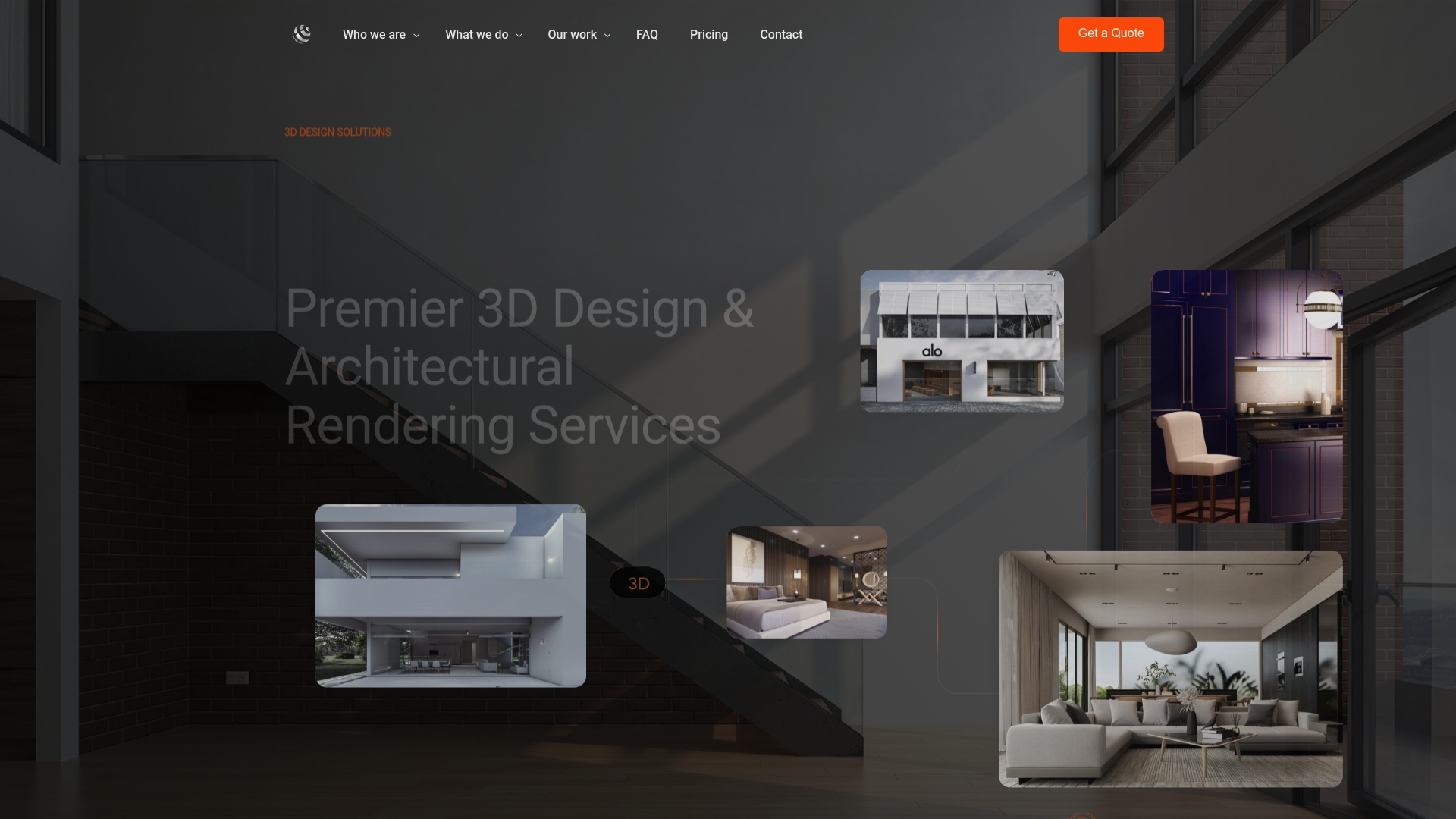
Architectural rendering starts at a moderate to high price per scene, with additional camera views and full 3D walkthroughs priced according to project scope. If your project also needs marketing support once the renders are ready, a partner like Baby Love Growth’s architecture SEO services can help those images actually reach buyers once they’re delivered. Whether you’re budgeting a single exterior hero shot or a full multifamily package, request a project quote and get a scope-based estimate instead of a guess.
Sources
- Architectural Visualisation Cost Guide for U.S. Buyers 2026 – LatestCost
- AIA Best Practices: Setting fees: What to consider
- How AI and real-time rendering are shaping architectural practice
FAQ
What Is the Going Rate for Architectural Rendering?
Interior stills typically run $600 to $3,000 per image and exteriors $800 to $4,000, with full visualization packages commonly totaling a few thousand dollars to mid five figures depending on scope. Rendimension’s architectural rendering starts at $850 per scene, with additional camera views from $425 each.
How Much Do Rendering Studios Typically Charge?
Rates depend heavily on modeling effort, realism level, and number of views rather than a flat hourly rate. Studios commonly bill per image, per animation minute, through fixed-fee packages, or via retainers for ongoing multi-project work.
How Much Does It Cost for Architect Drawings of a 5,000 Square Foot House?
Architectural drawing fees are typically calculated separately from rendering costs, since renders are billed by image or package rather than square footage. If you need visualization on top of drawings, a mid-size home with several interior views and one exterior would likely fall in the $4,500 to $9,000 range depending on complexity and view count.
How Long Does a Rendering Take to Complete?
A single still image usually takes one to two weeks from kickoff to delivery, while a full package with multiple interiors and an exterior can take three to five weeks. Animations take longer depending on length, and rush timelines typically add a fee rather than a flat surcharge across the board.
What’s Included in a Typical Rendering Quote?
A studio-level quote generally includes 3D model setup, lighting and material passes, post-production compositing, and a defined number of revision rounds. Extra camera views, rush delivery, and licensing for expanded marketing use are common add-ons priced separately from the base scene.