Architectural Animation for Hospitality Brands
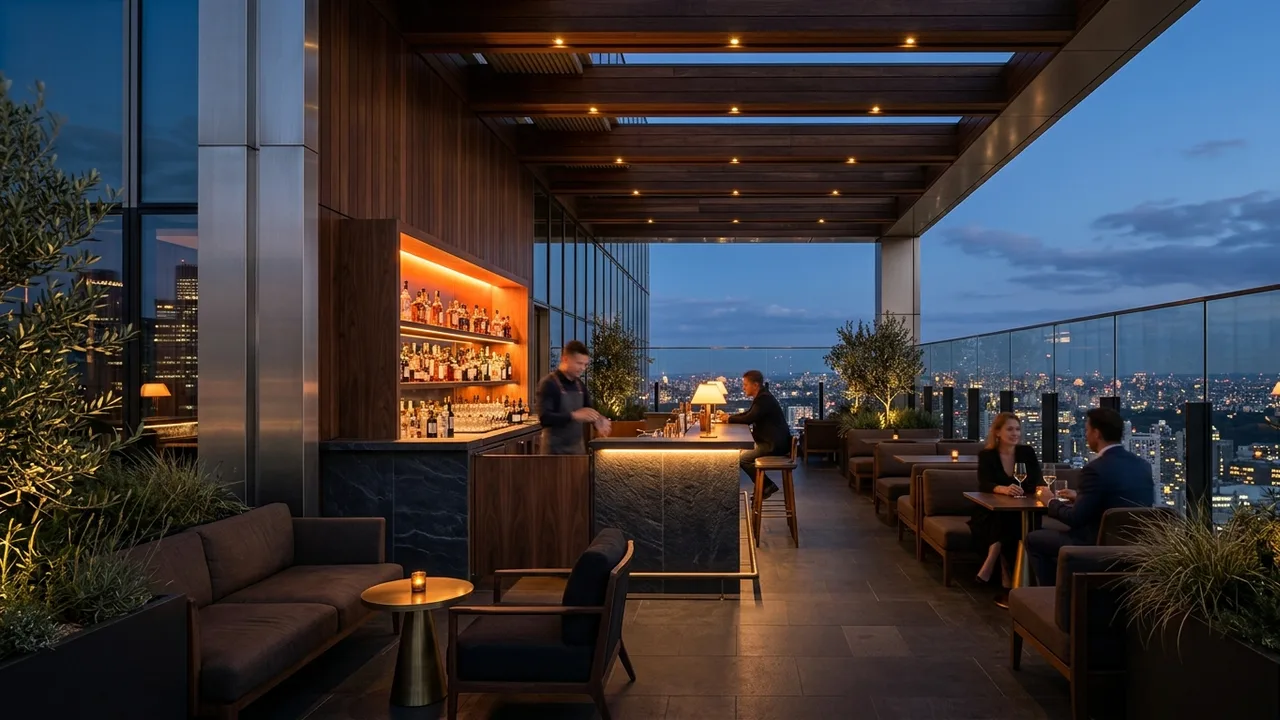
Quick answer: Hospitality brands use architectural animation for three jobs: getting a concept approved internally, filling a pre opening campaign that has no photography yet, and communicating a standard to operators, franchisees or investors. Each job wants a different cut, and all three can come from one production if they are specified together.
For the service, see architectural animation.
The pre opening gap
Every hospitality asset has a period where it must be marketed and sold with no photography. Bookings open, rates are set, group sales are pitched, press coverage is sought, and the property does not exist in any photographable form. Historically that gap was filled with a few static renderings and a lot of adjectives.
Animation fills it better than stills for a specific reason. Hospitality is sold on atmosphere and sequence rather than on square footage. The thing a guest is buying is arriving somewhere, being greeted, walking into a room, stepping onto a terrace. Those are temporal experiences, and a medium that controls time represents them more honestly than a still frame can.
Three jobs, three cuts
Concept approval
Internal audiences: ownership, the brand team, the operator, sometimes a design committee. This cut should follow the guest journey in order and should be honest about the spaces that carry operational risk as well as the ones that look best. Length is less constrained here because the audience is captive, but structure still matters.
Pre opening campaign
Public audiences on paid and owned channels. Short, vertical, sound off legible, and focused on one hook rather than the full property. This is where most hospitality animation budgets under deliver, because the campaign cut was not specified and the team ends up cropping a horizontal film into something that does not read.
Operator, franchise and investor communication
These audiences are evaluating a standard, not an experience. What helps here is clarity about how spaces connect, what the finish level actually is, and how the concept is expressed consistently. A cut with more even pacing and less atmospheric drama tends to work better than the campaign version.
What to show, in priority order
- Arrival. The approach and the entrance define the perceived tier of the entire property.
- The public space that carries the concept. Lobby, lounge, bar or restaurant depending on positioning.
- One representative guest room. The room a majority of guests will book, not the suite.
- The signature amenity. Pool, spa, rooftop, whatever justifies the rate.
- A closing exterior or view that anchors the property in its location.
Resist the suite. Featuring the best room in the building sets an expectation that most guests will not receive, and in hospitality that gap shows up directly in reviews.
Honesty and the review problem
Hospitality has a feedback mechanism that development does not: guests publish their comparison between what they were sold and what they received. That raises the standard for pre opening visuals.
Two practical guidelines. Show the property at a realistic condition at least once, rather than exclusively at its most flattering hour and occupancy. And be accurate about views, outlook and context. A window showing an idealised outlook is the single most common source of the complaint that a property looked better online, and no marketing gain is worth it in a category where the review score compounds into rate.
Coordinating with the brand program
Hospitality animation is rarely bought in isolation. It usually sits inside a brand launch that includes identity work, photography once the property exists, and a website. Two coordination points save real money.
First, share the brand guidelines with the animation studio before the storyboard, not after the first cut. Typography, color treatment, pacing and music direction all follow from them, and retrofitting a brand onto a finished film means re editing.
Second, plan the handover to photography. The animation is a temporary asset that will be partly replaced once the property opens. Deciding up front which elements survive, usually the aerial and context material that is difficult to photograph, means the production is scoped for a longer useful life instead of being discarded on opening day.
Where the other formats fit
If a decision group needs to be aligned on spatial quality rather than persuaded by a film, that is a different medium. An immersive experience puts operators and investors inside the space at true scale, which is a stronger tool for approval than any edit. See virtual reality for where that is worth the cost. And if group and event sales need to show function space configurations to a client on a laptop, a linear film is a weak fit for a task that is really about comparing options.
Animation is the right choice when the objective is to make someone feel something about a property before it exists. It is the wrong choice when the objective is to let them inspect it. Most hospitality programs need both, sequenced rather than simultaneous.
Timing it against the opening
Hospitality animation has a narrower useful window than most development work, and the mistake is usually producing it too late rather than too early. The commercial value is highest in the period when the property cannot yet be photographed but is already being sold: operator conversations, brand approvals, group and event enquiries, pre opening rate positioning, travel trade meetings. Once the doors open and a photographer has been through, real photography and video will outperform the animation on almost every surface, and it should be allowed to.
That argues for commissioning it when the interior design is signed off and construction is underway, not when the launch campaign is being assembled. It also argues for scoping it as a pre opening asset with a defined retirement date rather than as a permanent brand film, which changes what you are willing to spend and how long the edit needs to stay relevant.
Plan the photography brief at the same time. Matching camera positions between the animation and the eventual shoot gives you a before and after pairing that most properties never think to capture.
Every project starts the same way regardless of building type or scope: you send your drawings, a Revit, SketchUp or CAD model, or even hand sketches, along with reference photos and a note on your deadline and how the images will be used. There is no need to schedule a call before getting a number. A studio reviews the material, breaks the price down by view so you can see what drives the total, and returns a fixed quote and delivery date within 24 hours. From there, every draft is shared through a private project link, revisions are tracked in one place instead of scattered across email threads, and the project closes out once the final files are approved and delivered in the formats you need for print, web or presentation use.
Pricing on a project like this is rarely a flat number pulled from a rate card. Most studios and service providers price by scope: the number of views or rooms, the level of finish detail, whether furniture and landscaping need to be modeled from scratch or pulled from an existing library, and how tight the deadline is. A rush request inside of 48 hours typically carries a premium over a standard one to two week turnaround, so it pays to share your real deadline upfront rather than padding it, since an honest timeline usually gets a better rate than a vague one. Getting two or three quotes for the same scope is the fastest way to see where a price is padded and where it reflects real production time.
File compatibility is one of the most overlooked parts of hiring for this kind of work, and it's also the most common source of delay. Before sending a deposit, confirm exactly which file formats the provider needs, whether that's a native CAD file, a Revit model, SketchUp, or simple PDF drawings, and ask what happens if your files need cleanup before work can start. Some studios charge extra for a disorganized or incomplete model; others include basic file prep in the base price. Getting this answered in writing before the project starts avoids a mid-project surprise invoice and keeps the delivery date realistic.
Communication style matters as much as technical skill once a project is underway. Ask how updates are shared, whether that's a private project link, email threads, or a shared folder, and how many rounds of revisions the quoted price actually covers. Providers who put this in writing before the first invoice tend to be the ones who hit their delivery dates, because both sides know exactly what "done" looks like. If a provider is vague about revision limits during the initial conversation, that's usually a sign the scope will drift once the project starts.
Reviews and past client references tell a more reliable story than a polished portfolio page alone, since anyone can showcase their best five projects while quietly leaving out the ones that ran late or over budget. Asking for two or three references from projects similar in scale to yours, and actually calling them, remains one of the most effective ways to separate a provider who performs consistently from one who got lucky on a handful of showcase pieces. It takes an extra day, but it's a small cost against a project that could take weeks to complete.
This guide is part of our wider coverage on the same topic. For the full picture, including scope, pricing and delivery, read Architectural Animation for Institutional Real Estate Developers.