How 3D Visuals Drive Real Estate Sales: Evidence

TL;DR:
- 3D virtual tours mainly improve buyer engagement and lead quality, not necessarily sale prices.
- Benefits are greatest for new developments, luxury listings, and underserved markets.
- Effective use of 3D visuals requires strategic integration and proper measurement of engagement metrics.
Most real estate marketers assume that adding a 3D virtual tour automatically translates into higher sale prices and faster closings. The reality is more nuanced. A Harvard study on 3D tours found that 3D virtual tours are widely seen as a must-have marketing tool but may not guarantee higher sale prices. That finding surprises a lot of developers who have invested heavily in immersive visuals. This guide cuts through the noise, separating what the data actually shows from what the industry wants you to believe, so you can deploy 3D visualization where it genuinely moves the needle.
Table of Contents
- Why 3D visuals captured the real estate industry
- What the data really says: Sales speed, pricing, and buyer engagement
- Who benefits most? Segments and edge cases in 3D adoption
- Integrating 3D visuals into your sales strategy
- A closer look: What most real estate marketers miss about 3D sales impact
- Boost your sales strategy with advanced 3D solutions
- Frequently asked questions
Key Takeaways
| Point | Details |
|---|---|
| Data over hype | Not all 3D visuals directly boost sale price, but they do streamline the sales process and improve efficiency. |
| Faster sales in key markets | Properties with VR tours can sell up to 44% faster in high-tech markets, though U.S. results are more modest. |
| Target strategic adoption | 3D visuals produce the greatest ROI for new builds, remote buyers, and smaller or under-served agencies. |
| Integration is essential | 3D visualization works best when used alongside traditional marketing methods. |
Why 3D visuals captured the real estate industry
Not long ago, a property listing meant a handful of photos, a printed floor plan, and an open house. Buyers had to imagine scale, flow, and finish quality on their own. That guesswork created anxiety, delayed decisions, and cost developers real money in extended sales cycles.
The shift toward immersive 3D experiences was a direct response to those friction points. Platforms like Matterport led the charge by arguing that richer visuals create deeper buyer engagement. Matterport industry research positions 3D visuals as tools that create emotional engagement and better buyer understanding, a claim that resonated strongly with developers eager to stand out in crowded markets.
Here is why adoption accelerated so quickly:
- Spatial clarity: Buyers can understand room proportions, ceiling heights, and layout flow without visiting in person.
- Remote access: International and out-of-state buyers can tour properties from anywhere, widening the buyer pool.
- Competitive differentiation: Listings with 3D tours attract more clicks and longer session times on property portals.
- Off-plan confidence: Developers selling pre-construction units use photorealistic renderings to build trust before a single wall goes up.
- Reduced decision anxiety: Buyers who feel informed make faster, more committed offers.
“The question is no longer whether to use 3D visuals, but how to use them strategically to produce measurable outcomes rather than just impressive presentations.”
The industry moved fast, and for good reason. Learning how to enhance property sales with 3D renders has become a core competency for serious developers. But enthusiasm sometimes outran evidence, which is exactly why the academic findings matter. Understanding why use 3D renderings at a strategic level, rather than as a checkbox, separates teams that see results from those that simply spend money.
What the data really says: Sales speed, pricing, and buyer engagement
Once 3D visuals became mainstream, researchers started asking the harder question: do they actually improve outcomes? The answers depend heavily on which market you examine and which metric you measure.
The most striking positive result comes from Asia. VR tours cut days-on-market from 34 to 19 days in a Chinese market analysis, a 44% reduction in sales time. That is a significant operational win for any developer managing carrying costs.

The U.S. picture is more complicated. A rigorous Harvard study of 75,178 homes in Los Angeles found no significant price premium for listings with 3D tours after controlling for photos, location, and property features. In fact, properties with 3D tours took slightly longer to sell once those controls were applied.
| Metric | Industry claims | Harvard (LA, 75,178 homes) | Chinese VR study |
|---|---|---|---|
| Sale price impact | Positive | No significant effect | Not measured |
| Days on market | Faster | Slightly longer | 44% faster |
| Buyer engagement | Higher | Higher click-through | Higher engagement |
| Lead quality | Better | Screening effect noted | Not measured |
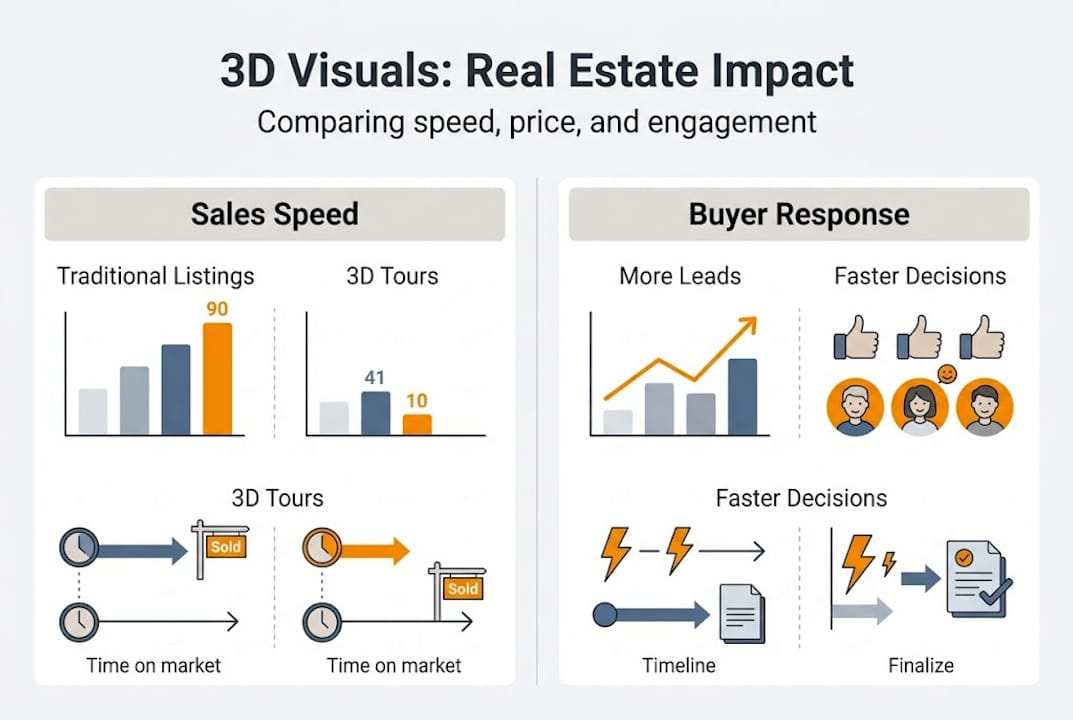
The takeaway is not that 3D visuals fail. It is that they work differently than most marketing decks suggest. The benefits of 3D visualization show up most clearly in engagement and lead quality, not necessarily in raw price gains.
Pro Tip: Use 3D visuals as a lead qualifier, not just a price booster. Buyers who complete a full virtual tour are more serious and better informed, which means fewer wasted showings and faster decisions once they do visit in person. Check out virtual tour examples to see how this plays out across different property types.
Who benefits most? Segments and edge cases in 3D adoption
Averages hide the most useful information. When you break down the data by property type, agency size, and market segment, a clearer picture of where 3D visuals deliver real ROI emerges.
Harvard research found outsized gains for small agents and listings in minority or low-income neighborhoods, where 3D tours help bridge access gaps and build buyer confidence in markets that traditionally see fewer in-person visits. That is a counterintuitive finding worth sitting with.
| Segment | 3D impact level | Primary benefit |
|---|---|---|
| Luxury listings | High | Emotional engagement, global reach |
| Off-plan / new builds | Very high | Pre-sales confidence, visualization |
| Small agencies | High | Levels the playing field with larger firms |
| Underserved neighborhoods | High | Access and trust building |
| Standard resale, large agency | Moderate | Engagement, not price premium |
| Rural or low-traffic markets | Low to moderate | Limited buyer pool to engage |
Projects most likely to see strong returns from 3D investment include:
- New developments where buyers cannot walk through a finished unit
- Luxury properties where presentation quality signals value
- Listings targeting remote or international buyers who cannot visit easily
- Smaller brokerages competing against well-resourced national firms
- Mixed-use or complex commercial projects where spatial understanding is critical
If you are deciding where to allocate your visualization budget, understanding why invest in 3D visuals for your specific segment is the right starting point. A luxury off-plan tower and a mid-market resale condo need very different approaches.
Integrating 3D visuals into your sales strategy
Knowing the data is one thing. Translating it into a working sales process is another. Here is a practical framework for deploying 3D visualization where it counts.
- Assess your project profile. Identify whether your listing falls into a high-impact segment: new build, luxury, remote buyer focus, or underserved market. This shapes how much to invest and which format to prioritize.
- Select the right technology. Not every project needs full VR. Photorealistic static renderings work well for off-plan marketing. Interactive walkthroughs suit complex layouts. Full VR is most powerful for high-value or remote buyer scenarios.
- Align visuals with your pricing message. If you are positioning a property at a premium, your 3D assets need to reflect that quality. Low-resolution or generic visuals undercut your pricing story.
- Integrate across channels. 3D visuals work best as part of a multi-channel approach, supplementing rather than replacing traditional tactics like professional photography, open houses, and agent relationships.
- Measure the right metrics. Track engagement rates, tour completion rates, and lead-to-showing conversion, not just final sale price. These upstream metrics tell you whether your 3D assets are doing their job.
- Iterate based on feedback. Collect buyer comments after tours. Are they confused about room sizes? Are they asking questions the visuals should already answer? Use that input to refine your next project.
Pro Tip: Set up a simple dashboard that tracks how many leads completed a virtual tour before booking a showing. If that number is high, your 3D visuals are qualifying leads effectively. If it is low, the issue may be placement or promotion, not the visuals themselves.
Avoid the two most common mistakes: overpromising sales impact to stakeholders based on industry marketing, and treating 3D as a replacement for 3D modeling for real estate strategy rather than a component of it.
A closer look: What most real estate marketers miss about 3D sales impact
Here is the uncomfortable truth most marketing decks skip: the biggest value of 3D visuals is not what happens at closing. It is what happens before the first showing.
Industry reports often overstate the direct price and speed benefits, while rigorous statistical controls reveal a more complex reality. But that does not mean 3D visuals are overrated. It means marketers are measuring the wrong things.
The real power is in screening. A buyer who spends eight minutes in a virtual tour and then books a showing is a fundamentally different lead than someone who clicked on a photo gallery. They arrive informed, emotionally connected, and ready to make a decision. That reduces wasted agent time, lowers the cost per qualified lead, and shortens the actual negotiation phase.
We have seen this pattern across projects at Rendimension. Developers who frame 3D as a buyer education tool, rather than a magic price lever, consistently report better sales team efficiency and higher buyer satisfaction scores. The mindset shift from “this will raise my price” to “this will improve my buyer quality” is where the real ROI lives. Read more on why use 3D renderings as a strategic asset rather than a tactical add-on.
Boost your sales strategy with advanced 3D solutions
The evidence is clear: 3D visualization works best when it is precise, photorealistic, and strategically integrated into your broader marketing effort.
At Rendimension, we have delivered over 1,000 projects globally, helping developers and marketers turn complex properties into immersive visual experiences that qualify leads, build buyer confidence, and accelerate decisions. Whether you need 3D rendering services for off-plan marketing, full architectural visualization services for stakeholder presentations, or interactive 3D walkthroughs that let remote buyers explore every detail, our team works with you from concept to final delivery. Let us help you apply these insights directly to your next project.
Frequently asked questions
Do 3D visuals actually increase the sale price of a property?
Controlled studies show no significant price increase from 3D visuals after accounting for photos, location, and property features. Their value is stronger in lead quality and engagement than in raw price gains.
How much faster do virtual tours sell properties compared to traditional marketing?
Results vary significantly by region. A Chinese platform saw days-on-market drop from 34 to 19 with VR tours, a 44% speedup, but U.S. studies show more modest or mixed results.
What types of real estate projects benefit most from 3D visuals?
New developments, luxury listings, remote buyer scenarios, and smaller agencies in underserved areas see the greatest gains. Harvard research confirms the largest benefits for small agents and minority or low-income neighborhood listings.
Does adding 3D visualization replace the need for professional photos or in-person tours?
3D visuals are most effective when layered on top of traditional marketing, not used as a standalone replacement. Analysis confirms that 3D supplements rather than replaces professional photography and agent-led showings.
How can I measure the real impact of 3D on my sales process?
Track tour completion rates, lead-to-showing conversion, and buyer feedback alongside sales speed. The screening effect and reduced wasted showings are key ROI indicators that pure sales metrics often miss.