Virtual Reality Marketing Guide 2026: Strategies That Convert
Virtual Reality Marketing Guide 2026: Strategies That Convert
TL;DR:
- VR marketing involves immersive technology to create interactive brand experiences that increase engagement and conversions. In 2026, most successful campaigns prioritize web-based formats to reach broad audiences efficiently. Focusing on spatial product demonstrations boosts ROI more than abstract storytelling, especially when aligned with audience device capabilities.
Virtual reality marketing is the use of immersive technology to create interactive brand experiences that drive deeper customer engagement and higher conversion rates. In 2026, this is no longer an experimental channel. Enterprise spending on immersive marketing reached $6.6 billion annually, and the market is projected to grow from $46.4 billion in 2025 to $421 billion by 2035. This virtual reality marketing guide 2026 gives marketing professionals and business owners a practical framework for deploying VR campaigns that produce measurable business results, not just impressive demos.
What hardware and software considerations are essential for VR marketing in 2026?
The single most important decision in any VR marketing campaign is choosing the right delivery format for your audience’s actual devices. Get this wrong, and your campaign reaches almost no one.
Three delivery formats dominate the market today: WebVR (browser-based spatial experiences), headset-based VR, and mobile AR. Each serves a different audience and budget.
WebVR and web-based spatial content work directly in a browser on any smartphone or desktop. No app download. No headset required. This format delivers the widest reach and the lowest friction for consumer campaigns. App downloads reduce engagement by 80–90%, which means web-based delivery is not just convenient. It is the difference between a campaign that runs and one that stalls.
Headset-based VR using platforms like Apple Vision Pro or Meta Quest delivers the most immersive experience. The active user base has grown to approximately 89 million, but that number still represents a fraction of most consumer audiences. Headset VR is best reserved for B2B contexts where you can guarantee your audience has the hardware, such as trade shows, client briefings, or enterprise sales environments.
Mobile AR sits between the two. It uses a smartphone camera to overlay digital content on the real world. For product visualization, it performs well when the goal is helping buyers see a product in their own space before purchasing.
- WebVR: Best for consumer campaigns, product pages, and social media. Zero hardware requirements.
- Headset VR: Best for B2B sales, high-stakes purchase decisions, and controlled environments.
- Mobile AR: Best for product try-on, spatial product placement, and retail contexts.
- Spatial video ads: Emerging format for DTC brands, deliverable via standard social and video platforms.
Pro Tip: Before building any VR experience, survey your audience’s devices. If fewer than 20% own a VR headset, build for web or mobile first. You can always add a headset-optimized version later.
How to plan and execute VR campaigns that boost engagement and conversions
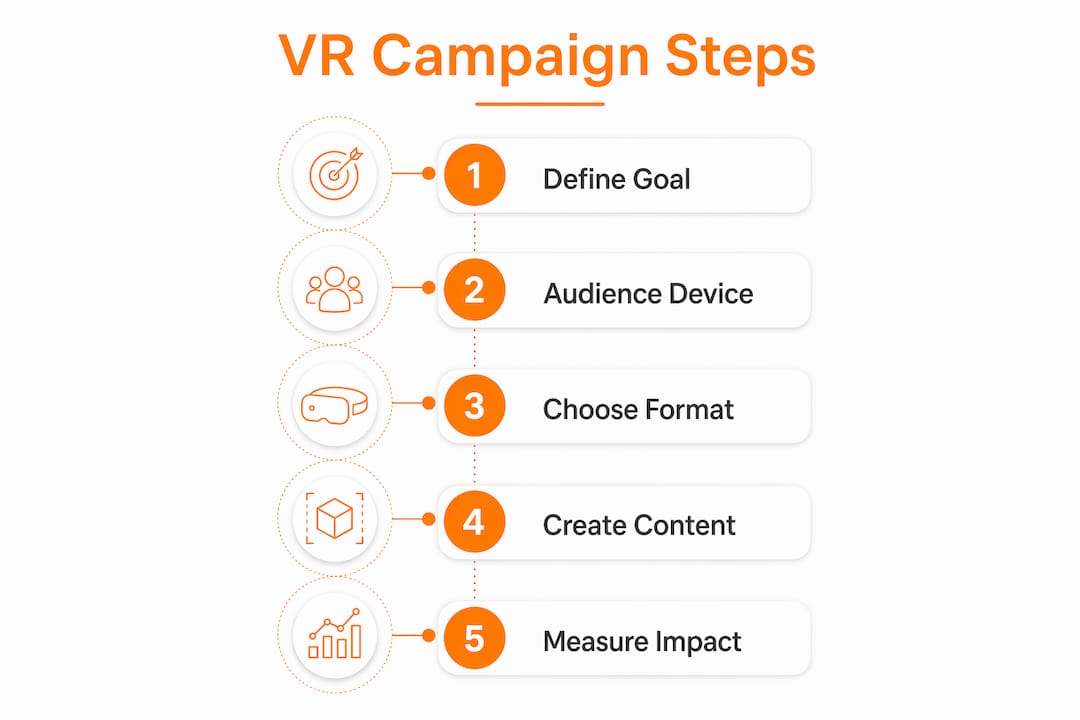
Effective VR campaigns start with a clear business goal, not a technology choice. The format follows the objective.

Set measurable goals before production begins
Define what success looks like before you spend a dollar on content creation. The most useful metrics for VR campaigns are interaction depth, dwell time, and downstream conversion rates. Meaningful interactions longer than 3 seconds predict conversions far better than raw view counts. A campaign with 10,000 views and 200 deep interactions outperforms one with 100,000 views and 500 passive glances.
Match session length to your audience type
Session length is one of the most overlooked variables in VR campaign planning. B2B VR sessions average 15–20 minutes with sequential participation, while B2C sessions should be optimized to approximately 3 minutes for emotional impact and social sharing. Trying to run a 15-minute experience for a consumer audience produces drop-off, not engagement.
Focus on product demonstrations, not abstract brand messaging
VR’s greatest strength is spatial product demonstration. Audiences who experience a product in VR convert at 2.7x the rate of those who only see traditional video. Abstract brand storytelling in VR rarely justifies the production cost. Concrete product walkthroughs, spatial configurators, and immersive property tours deliver the conversion lift that makes VR marketing budgets defensible.
For real estate and architecture specifically, immersive VR walkthroughs let buyers experience a property before it is built. That emotional commitment accelerates decisions in ways that floor plans and photography cannot replicate.
Pro Tip: Build your first VR campaign around a single hero product or property. Prove the conversion lift with one focused experience before scaling to a full campaign.
The table below compares the four primary VR campaign formats by use case, session length, and primary conversion goal.
| Format | Best use case | Ideal session length | Primary conversion goal |
|---|---|---|---|
| Spatial video ad | DTC product launch, social media | Under 2 minutes | Click-through and purchase |
| WebVR product demo | E-commerce, real estate listings | 2–5 minutes | Add-to-cart, inquiry |
| Headset VR walkthrough | B2B sales, property development | 15–20 minutes | Deal commitment, deposit |
| Mobile AR visualization | Retail, home furnishings, apparel | 1–3 minutes | In-store conversion |
What are common pitfalls in VR marketing and how to avoid them?
Most VR campaigns fail for predictable reasons. The good news is that each one is avoidable with the right planning.
- Requiring an app download. This single requirement eliminates 80–90% of potential users before the experience even loads. Always default to web-based delivery unless your audience is a confirmed headset owner.
- Mismatching format to hardware. A high-fidelity headset experience built for a consumer audience with no headsets is a budget write-off. High-fidelity VR fails when the target audience lacks the hardware to run it. Audit your audience’s devices before choosing a format.
- Measuring vanity metrics. Total views and impressions tell you almost nothing about VR campaign effectiveness. Brands that report “1 million views” on a VR experience without measuring interaction depth are optimizing for press releases, not revenue.
- Skipping a pilot test. Launching a full campaign without a small-scale pilot wastes budget on an unproven experience. Run a pilot with a controlled audience segment, measure interaction depth and conversion, then scale what works.
- Overbuilding before proving ROI. The most common budget mistake is investing in a full VR environment before validating that the format works for your specific audience and product category.
“The lowest-risk entry point for most brands is WebAR product visualization on high-traffic product pages. It avoids app downloads, requires no headset, and delivers measurable engagement data from day one. Start there, prove the numbers, then invest in more immersive formats.”
For brands in real estate and property development, VR-driven decision-making has a proven track record of accelerating buyer commitment. The same logic applies to any high-stakes purchase where the buyer needs to feel confident before committing.
What are the emerging trends shaping VR marketing in 2026 and beyond?
The immersive media market is moving from novelty to infrastructure. Market growth from $46.4 billion in 2025 to $421 billion by 2035 signals that VR marketing is becoming a standard channel, not an experimental one. Brands that build VR capabilities now will hold a structural advantage as adoption accelerates.
Three technological shifts are lowering the cost and complexity of VR content creation. Neural rendering produces photorealistic spatial visuals faster than traditional CGI pipelines. Real-time photogrammetry captures physical objects and spaces and converts them into spatial content without a studio. These tools enable faster spatial video creation without traditional production requirements, which means smaller brands can now compete on VR content quality.
Spatial video advertising is the fastest-growing format within this shift. DTC brands using spatial video ads reported 491% higher engagement and 380% higher conversion rates compared to traditional video. Spatial video is projected to capture 23% of total DTC video ad spend by 2028, a $4.2 billion opportunity. That trajectory makes spatial video the most important new format for performance marketers to test in 2026.
The strategic shift that matters most is the move from spectacle to integration. Immersive campaigns are becoming shoppable and measurable, aligned with full customer journeys rather than one-off activations. VR is no longer a trade show stunt. It is a conversion channel with trackable ROI, and the brands treating it that way are pulling ahead. For marketers working in real estate, architecture, and product development, this integration with AR visualization tools creates a connected pipeline from first impression to signed contract.
You can also explore real-world VR advertising case studies from construction and real estate companies that have used immersive campaigns to drive measurable results.
Key Takeaways
VR marketing delivers its strongest results when the delivery format matches the audience’s actual devices, campaign goals are defined by interaction depth rather than views, and content focuses on spatial product demonstrations over abstract storytelling.
| Point | Details |
|---|---|
| Match format to hardware | Use web-based VR for consumers; reserve headset experiences for B2B with guaranteed hardware access. |
| Measure interaction depth | Track meaningful interactions over 3 seconds and downstream conversions, not raw view counts. |
| Optimize session length | Keep B2C experiences under 3 minutes; B2B sessions can run 15–20 minutes with sequential content. |
| Start with hero products | Prove conversion lift with one focused product showcase before scaling to a full campaign. |
| Avoid app download friction | App requirements eliminate 80–90% of potential users; default to browser-based delivery. |
What I’ve learned about VR marketing after 1,000+ visualization projects
The brands that get the most from VR marketing are not the ones with the biggest budgets. They are the ones that align their format to their audience’s actual devices from day one.
At Rendimension, we have seen this pattern repeatedly across residential and commercial projects. A photorealistic VR walkthrough of a property that has not been built yet does something no floor plan or brochure can do. It creates emotional commitment. Buyers stop asking “what will this look like?” and start asking “when can I move in?” That shift in the buyer’s mindset is the real ROI of immersive marketing.
The mistake we see most often is treating VR as a one-time spectacle rather than a repeatable commercial tool. The brands that win treat it like any other performance channel: set clear KPIs, test with a pilot, measure interaction depth, and scale what converts. VR marketing is a relationship-building channel. It earns trust by giving buyers a genuine experience of something they cannot yet touch or visit. That trust converts.
Start with your single strongest product or property. Build one experience that proves the numbers. Then scale.
, Rendimension
Rendimension’s immersive visualization services for VR marketing
Photorealistic 3D content is the foundation of any effective VR marketing campaign. Without visuals that look and feel real, even the best delivery strategy falls flat.
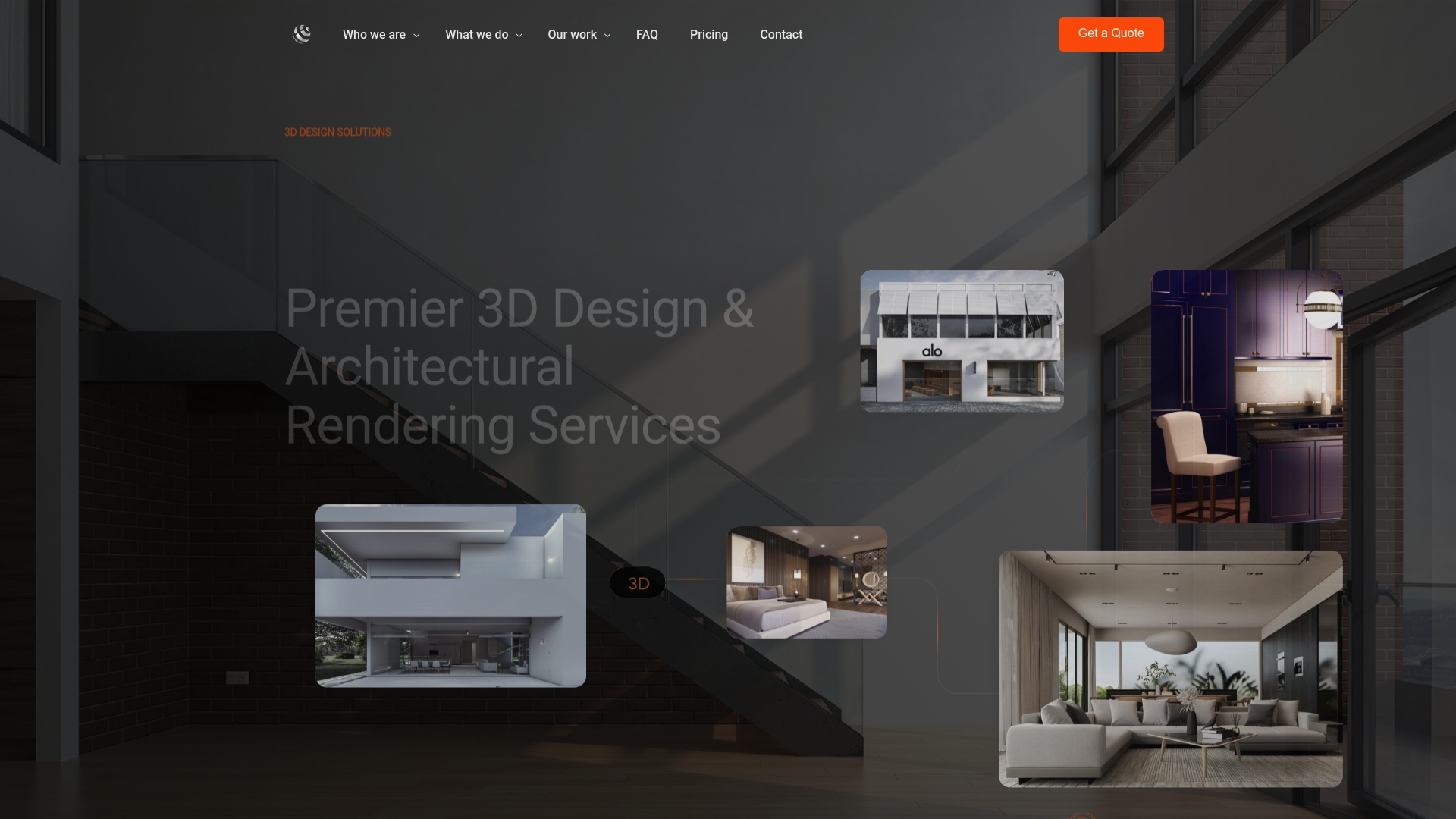
Rendimension produces photorealistic 3D renderings and VR walkthroughs that give marketing teams the spatial content they need to run high-converting immersive campaigns. With over 1,000 projects completed globally across residential, commercial, and product development sectors, Rendimension delivers the visual quality that makes buyers commit. Whether you need a 3D walkthrough for a property launch or spatial product visuals for a DTC campaign, the team works with you from concept to final delivery to produce assets that perform.
FAQ
What is VR marketing?
VR marketing is the use of virtual reality technology to create immersive, interactive brand experiences that engage customers and drive conversions. It covers formats from spatial video ads to full headset walkthroughs.
What VR format works best for consumer campaigns?
Web-based VR and spatial video ads work best for consumer campaigns because they require no app download and no headset. App downloads reduce engagement by 80–90%, making browser-based delivery the default choice for reaching broad audiences.
How do I measure VR marketing campaign success?
Measure interaction depth, dwell time, and downstream conversion rates rather than total views. Meaningful interactions lasting longer than 3 seconds are a stronger predictor of conversions than raw impression counts.
How long should a VR marketing experience be?
B2C VR experiences should run approximately 3 minutes to maximize emotional impact and social sharing. B2B VR sessions can run 15–20 minutes when the audience is engaged in a sequential, guided experience.
Is VR marketing only for large brands?
No. Web-based VR and spatial video formats are accessible to mid-size and smaller brands. Neural rendering and real-time photogrammetry tools have significantly lowered production costs, and the lowest-risk entry point is a single WebAR product visualization on a high-traffic product page.
Recommended
- The Role of VR in Real Estate Marketing in 2026 | Rendimension Blog
- Marketing Tips for 3D Visuals That Drive Real Results | Rendimension Blog
Frequently asked questions
What is VR marketing?
VR marketing is the use of virtual reality technology to create immersive, interactive brand experiences that engage customers and drive conversions. It covers formats from spatial video ads to full headset walkthroughs.
What VR format works best for consumer campaigns?
Web-based VR and spatial video ads work best for consumer campaigns because they require no app download and no headset. App downloads reduce engagement by 80–90%, making browser-based delivery the default choice for reaching broad audiences.
How do I measure VR marketing campaign success?
Measure interaction depth, dwell time, and downstream conversion rates rather than total views. Meaningful interactions lasting longer than 3 seconds are a stronger predictor of conversions than raw impression counts.
How long should a VR marketing experience be?
B2C VR experiences should run approximately 3 minutes to maximize emotional impact and social sharing. B2B VR sessions can run 15–20 minutes when the audience is engaged in a sequential, guided experience.
Is VR marketing only for large brands?
No. Web-based VR and spatial video formats are accessible to mid-size and smaller brands. Neural rendering and real-time photogrammetry tools have significantly lowered production costs, and the lowest-risk entry point is a single WebAR product visualization on a high-traffic product page.