Types of Lighting in Visualization: A Design Pro's Guide
Types of Lighting in Visualization: A Design Pro’s Guide
TL;DR:
- Different lighting types in 3D visualization, such as Point, Sun, Spot, Area, Emission, and Environmental, are used to create realistic scenes by controlling shadows and scene mood based on physical light sources. Layering technical, indirect, and decorative lighting with appropriate color temperatures enhances depth, warmth, and visual hierarchy in architectural and interior renders. Choosing physically accurate light sources and focusing on shadow quality and contrast significantly improve the realism and emotional impact of the final visualization.
Types of lighting in visualization refer to distinct light-source categories used in 3D rendering that simulate real-world illumination to achieve specific aesthetic and realistic outcomes. The six primary types are Point, Sun (Directional), Spot, Area, Emission, and Environmental lighting, each controlling shadow quality, mood, and scene depth in fundamentally different ways. Tools like Blender and V-Ray implement all six natively, giving design professionals and educators a shared vocabulary for discussing light behavior. Choosing the wrong type is not a minor mistake. It is the single fastest way to make a photorealistic render look unconvincing, no matter how detailed the geometry or textures.
1. What are the main types of lighting in visualization?
Blender supports four primary light types: Point, Sun (Directional), Spot, and Area, plus emission materials and environmental lighting as supplementary sources. This classification is the industry standard across most professional 3D pipelines, including V-Ray, Arnold, and Chaos Corona. Understanding each type at the source level is the foundation of every strong lighting setup.
- Point light: Emits light equally in all directions from a single location, like a bare bulb. It produces hard shadows and is best for simple scene tests or stylized renders, not photorealistic interiors.
- Sun (Directional) light: Emits parallel rays from an infinitely distant source, producing consistent flat shadows across the entire scene. It is the standard choice for exterior daylight and architectural massing studies.
- Spotlight: Projects light in a cone shape for focused, controlled illumination. Architects and set designers use it to highlight specific objects, accent walls, or focal points within a composition.
- Area light: Emits from a defined surface shape, such as a rectangle or disk, producing soft, gradual shadows that closely match real-world luminaires like LED panels or skylights.
- Emission materials: Assign light-emitting properties directly to geometry, so a modeled light fixture glows and contributes to scene illumination without a separate light object.
- Environmental lighting: Uses HDR images or procedural skies to wrap the entire scene in ambient, directionally varied light. It is the most efficient method for achieving natural outdoor illumination.
Pro Tip: Match your light source type to the physical shape of the real-world fixture you are simulating. A recessed ceiling panel is an area light, not a point light. That single decision changes shadow softness and realism more than any post-processing adjustment.
2. How do ambient, diffuse, and specular components affect visualization lighting?
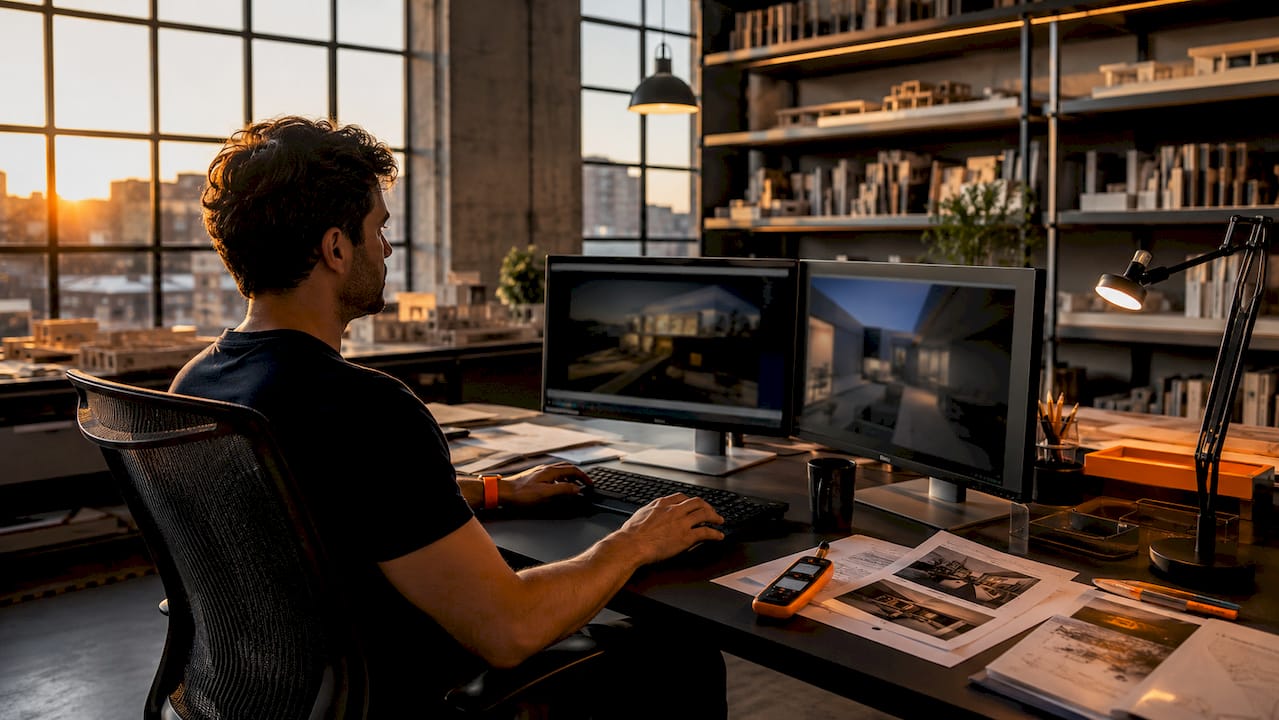
Lighting interactions in 3D are broken into three components: ambient, diffuse, and specular. These components determine how every surface in a scene responds to every light source. Separating them mentally helps you diagnose why a render looks flat, blown out, or plasticky.
Ambient lighting sets the base illumination level across the entire scene. It fills shadow areas so they never go completely black, mimicking the scattered light present in any real environment. Overuse of ambient lighting flattens depth and removes the contrast that makes renders feel three-dimensional.
Diffuse lighting controls how a surface scatters light based on its angle to the light source. A matte concrete wall and a rough wood floor both respond primarily through diffuse reflection. This component carries most of the surface color information the viewer perceives.
Specular lighting creates the bright highlights and reflections you see on polished surfaces like glass, metal, or glazed tile. Controlling specular intensity and sharpness is what separates a convincing material from one that looks like plastic.
Local illumination models like Phong and Blinn-Phong calculate these three components per object, which is fast but physically limited. Global illumination simulates light bouncing between surfaces, so a red sofa can cast a warm tint onto a white wall beside it. That bounce behavior is what gives high-end architectural visualization its depth and warmth.
Pro Tip: If your interior render looks sterile, check your ambient value first. Reducing it forces the scene to rely on actual light sources for fill, which immediately adds contrast, depth, and realism.
3. What lighting categories work best for architectural and interior visualization?
Technical, indirect, and decorative lighting layers are the three categories used in professional architectural visualization workflows to balance realism and aesthetics. Each category serves a distinct purpose, and layering all three is what separates a flat render from a compelling one.
Technical lighting
Technical lighting covers the functional fixtures built into a space: downlights, wall sconces, track lights, and under-cabinet strips. These fixtures anchor the scene in reality and tell the viewer how the space is meant to be used. In V-Ray and similar renderers, technical fixtures are modeled as area lights or emission geometry matched to the actual fixture dimensions.
Color temperature is the critical variable here. A neutral office environment typically uses fixtures around 3,500K. Residential living spaces favor warmer tones near 3,000K, and intimate areas like bedrooms or hospitality settings drop to 2,700K. Mixing temperatures without intention creates visual dissonance that viewers feel even if they cannot name it.
Indirect lighting
Indirect lighting simulates bounced light: the glow behind a cove ceiling, the soft fill coming off a lit floor, or the ambient warmth reflected from a bright wall. It never comes from a visible source. Its job is to soften harsh shadows and add the sense that light is alive in the space. Area lights placed out of frame or emission surfaces hidden behind architectural elements are the standard tools for this effect.
Decorative lighting
Decorative lighting creates focal points. A pendant over a dining table, a backlit art panel, or a glowing fireplace insert all fall into this category. These sources contribute less to overall illumination and more to emotional tone and visual hierarchy. In luxury residential visualization, decorative lighting is often the detail that makes a render feel aspirational rather than merely accurate.
| Lighting category | Primary role | Typical color temperature | Common fixture types |
|---|---|---|---|
| Technical | Functional illumination | 3,000K–3,500K | Downlights, track lights, wall sconces |
| Indirect | Shadow fill and ambient warmth | Matches technical layer | Cove lights, hidden strips, bounce panels |
| Decorative | Focal points and mood | 2,700K–3,000K | Pendants, accent lights, backlit panels |
4. How to choose and combine lighting types for realistic 3D visualization
Selecting lighting types should begin with one question: what does the real-world light source actually look like? A long fluorescent tube is a rectangular area light. A globe pendant is a sphere emission. A window on a cloudy day is a large soft area light. Starting from physical correspondence rather than convenience is the single most reliable path to photorealism.
The most common mistake in interior visualization is defaulting to point lights because they are fast to place. Point lights are the least realistic option for interior scenes because real luminaires are extended sources that produce soft, gradual shadows. A point light produces hard-edged shadows that no real fixture creates, which immediately signals “computer generated” to any trained eye.
Here is a practical layering sequence for interior scenes:
- Start with environmental or dome lighting. Set your HDR sky or exterior environment first to establish the base light direction and color temperature coming through windows.
- Add area lights for primary fixtures. Match each modeled ceiling or wall fixture with an area light of the same shape and approximate size.
- Layer indirect sources. Place hidden area lights or emission surfaces to simulate cove lighting, bounce from floors, or fill from adjacent rooms.
- Introduce spotlights for accent work. Use spotlights to direct attention to artwork, architectural details, or product displays.
- Adjust shadow contrast last. Tighten or soften shadows by changing area light size, not brightness. Larger area lights produce softer shadows regardless of intensity.
Pro Tip: For photorealistic interior renders, use dome or HDR lighting as your ambient base and reserve area lights for every modeled fixture. This combination eliminates the artificial flatness that point-light-heavy setups produce.
Good lighting design focuses on controlling shadows and contrast rather than adding raw brightness. A well-shadowed render with moderate light levels reads as more realistic than an overlit scene with no shadow depth. Depth comes from darkness as much as from light.
5. Comparison of lighting types: strengths, limitations, and best use cases
Every lighting type involves trade-offs. The table below summarizes the core characteristics design professionals weigh when building a lighting setup for architectural, interior, or product visualization.
| Light type | Shadow quality | Realism level | Control | Best use case |
|---|---|---|---|---|
| Point | Hard, sharp | Low | Simple | Quick tests, stylized scenes |
| Sun (Directional) | Flat, parallel | Medium | Directional only | Exterior daylight, massing studies |
| Spot | Hard to medium | Medium | High (cone angle, falloff) | Accent lighting, product highlights |
| Area | Soft, gradual | High | Shape and size dependent | Interior fixtures, skylights, windows |
| Emission | Soft (geometry-based) | Very high | Geometry-driven | Modeled fixtures, glowing surfaces |
| Environmental (HDR) | Soft, omnidirectional | Very high | Limited per-source | Outdoor scenes, global ambient fill |
Area and environmental lighting consistently deliver the highest realism for architectural contexts. Spot and directional lights remain indispensable for exterior compositions and accent work. Point lights serve a role in early-stage scene setup but rarely survive into a final production render without replacement.
For product visualization, a combination of area lights and a carefully placed spot for specular highlights produces the clean, controlled look that works in both marketing and technical documentation contexts. For exterior architectural renders, a Sun light paired with an HDR sky gives you physically accurate shadows and sky color simultaneously.
Key takeaways
Effective lighting in 3D visualization requires matching each light source type to its real-world counterpart, then layering technical, indirect, and decorative categories with deliberate color temperature control.
| Point | Details |
|---|---|
| Match source to reality | Choose light types based on the physical shape of the real-world fixture, not convenience. |
| Area lights over point lights | Area and HDR lights produce the soft shadows that define photorealistic interior renders. |
| Layer three lighting categories | Technical, indirect, and decorative layers together create depth, warmth, and visual hierarchy. |
| Color temperature drives harmony | Assigning 2,700K–3,500K ranges by zone maintains visual continuity across a scene. |
| Shadow quality signals realism | Controlling contrast and shadow softness matters more than overall brightness levels. |
Lighting choices are where visualization storytelling begins
After completing over 1,000 projects at Rendimension, the pattern is clear: the renders that clients respond to most emotionally are never the ones with the most lights. They are the ones where every light source has a reason to exist.
The mistake I see most often in early-stage visualization work is treating lighting as a finishing step. Designers will spend weeks on geometry and materials, then drop in a few point lights at the end and wonder why the scene feels lifeless. Lighting is not a finishing step. It is a design decision that shapes how every other element in the scene reads.
What I have found genuinely useful is starting every lighting setup from a single question: where does the light come from in real life? That discipline forces you to think about the architecture first, which almost always produces a more coherent result than building a lighting rig in isolation.
Shadow quality is the metric I trust most. A render with rich, soft shadows and moderate brightness reads as more convincing than a brightly lit scene with flat, uniform illumination. Darkness is not a problem to solve. It is a tool. The spaces between light sources are where depth lives.
Color temperature is the second variable I take seriously early. Mixing a 5,000K technical fixture with 2,700K decorative sources without a clear compositional reason creates visual noise that viewers register as “something is off” without being able to name it. Deliberate temperature layering is one of the fastest ways to make a render feel considered rather than assembled.
, Rendimension
See how professional lighting transforms your project
Lighting decisions at the professional level go far beyond placing a few sources in a scene. At Rendimension, every 3D rendering project is built around a deliberate lighting strategy: area lights matched to real fixture geometry, HDR environments calibrated to the project’s geographic context, and layered color temperatures that guide the viewer’s eye through the space. Whether you are presenting a luxury residential development or a commercial interior to stakeholders, the right lighting setup is what makes the difference between a render that informs and one that sells. Explore Rendimension’s architectural visualization services to see how advanced lighting techniques translate directly into client confidence and faster approvals.
FAQ
What are the main types of lighting used in 3D visualization?
The six primary types are Point, Sun (Directional), Spot, Area, Emission, and Environmental lighting. Each controls shadow quality, light direction, and realism differently depending on the scene context.
Which lighting type is best for interior architectural renders?
Area lights and HDR environmental lighting are the industry standard for interior scenes because they simulate the soft, gradual shadows produced by real extended light sources like LED panels and windows.
Why are point lights considered unrealistic for interior visualization?
Point lights emit from a single location in all directions, producing hard shadows that no real fixture creates. Real luminaires are extended sources, so area lights or emission geometry always produce more convincing results.
How does color temperature affect a visualization scene?
Color temperature determines the warmth or coolness of each light source and directly influences the emotional tone of the render. Mixing temperatures deliberately across technical (3,500K), indirect, and decorative (2,700K) layers creates depth and visual harmony.
What is the difference between local and global illumination in visualization?
Local illumination calculates light per object using models like Phong or Blinn-Phong, which is fast but physically limited. Global illumination simulates light bouncing between surfaces, adding the color bleed and ambient warmth that define photorealistic renders.
Recommended
- Lighting In 3D Architecture: Photorealistic Renders 2026
- 7 Product Visualization Strategies For Architects And Designers
Frequently asked questions
What are the main types of lighting used in 3D visualization?
The six primary types are Point, Sun (Directional), Spot, Area, Emission, and Environmental lighting. Each controls shadow quality, light direction, and realism differently depending on the scene context.
Which lighting type is best for interior architectural renders?
Area lights and HDR environmental lighting are the industry standard for interior scenes because they simulate the soft, gradual shadows produced by real extended light sources like LED panels and windows.
Why are point lights considered unrealistic for interior visualization?
Point lights emit from a single location in all directions, producing hard shadows that no real fixture creates. Real luminaires are extended sources, so area lights or emission geometry always produce more convincing results.
How does color temperature affect a visualization scene?
Color temperature determines the warmth or coolness of each light source and directly influences the emotional tone of the render. Mixing temperatures deliberately across technical (3,500K), indirect, and decorative (2,700K) layers creates depth and visual harmony.
What is the difference between local and global illumination in visualization?
Local illumination calculates light per object using models like Phong or Blinn-Phong, which is fast but physically limited. Global illumination simulates light bouncing between surfaces, adding the color bleed and ambient warmth that define photorealistic renders.