Types of VR experiences for architects and developers

TL;DR:
- Selecting the appropriate VR experience depends on the project’s stage, stakeholder needs, and desired immersion level. Non-immersive and web-based VR are ideal for early concept reviews and remote feedback, while semi-immersive and fully immersive formats suit detailed design discussions and final sign-offs. Matching VR type to specific project moments enhances communication, reduces misunderstandings, and streamlines decision-making processes.
Choosing the right VR experience for a project presentation is not as straightforward as picking the most expensive headset and calling it done. Different types of virtual reality experiences serve genuinely different goals, and the wrong choice can leave stakeholders disengaged or overwhelmed. As an architect or developer, you need to know how immersion, interactivity, and collaboration vary across VR formats, because those differences directly shape how clients respond, how feedback flows, and how confidently decisions get made. This article maps out the key VR types so you can match each one to the right moment in your project lifecycle.
Table of Contents
- How to evaluate virtual reality experiences for architectural projects
- Non-immersive virtual reality: screen-based simplicity
- Semi-immersive virtual reality: a balanced approach
- Fully immersive virtual reality: ultimate immersion with headsets
- Collaborative and web-based virtual reality: working together in virtual spaces
- Comparing types of virtual reality experiences for architecture
- Our perspective: stop chasing the best VR and start matching VR to the moment
- Bring your designs to life with Rendimension
- Frequently asked questions
Key Takeaways
| Point | Details |
|---|---|
| Immersion levels matter | Choosing the right VR experience depends on how much you want to isolate users from the real world during presentations. |
| Collaboration enhances engagement | Multi-user VR environments help stakeholders interact and give feedback remotely in shared virtual spaces. |
| No one-size-fits-all | Each VR type serves different architectural presentation needs from simple model reviews to full design immersion. |
| Hardware impacts experience | Fully immersive VR requires specialized headsets, while non-immersive options run on standard screens for easy access. |
| Task-driven selection | Evaluate your project’s goals and stakeholder needs before deciding which VR experience to use. |
How to evaluate virtual reality experiences for architectural projects
Before selecting a VR format, you need a framework for evaluating what each type actually delivers. Three criteria matter most in architecture and real estate contexts.
- Immersion refers to how completely a user feels present inside the virtual space. A client exploring a rendered penthouse from a desktop feels aware of the room around them. A client wearing a headset inside that same penthouse forgets the room exists. That gap in perception drives entirely different emotional responses to a design.
- Interactivity describes how much control users have over their experience. Can they navigate freely? Open doors? Swap material finishes in real time? High interactivity transforms a passive presentation into an active design conversation.
- Collaboration means whether multiple users can share the same virtual environment simultaneously. For remote stakeholder reviews, multi-user VR reduces the friction of coordinating feedback across cities or time zones.
- Task alignment is often overlooked. As noted in virtual reality types research, “the right VR type matches the required level of presence for the task rather than a one-size-fits-all ‘best’ option.” A concept-phase review needs a different format than a final client sign-off.
- Hardware and software determine what is actually deliverable. High-end fully immersive setups produce stunning results but require physical headsets on-site. Browser-based options trade fidelity for accessibility.
Understanding your VR workflow for architects from content creation through delivery helps you avoid investing in a format your stakeholders cannot access or appreciate.
Pro Tip: Map your VR type choice to the decision stage of your project. Early concept reviews often benefit more from accessible, screen-based VR than from a fully immersive experience that could overwhelm clients before they understand the design intent.
Now that you understand why choosing the right VR experience matters, let’s explore the main types available.
Non-immersive virtual reality: screen-based simplicity
Non-immersive VR is the most accessible entry point into virtual reality use cases for architectural work. It runs on a standard monitor or TV, requires no headset, and keeps users fully aware of their physical surroundings the entire time.
According to VR immersion research, “non-immersive VR uses standard screens and input devices with low immersion, suitable for interactive 3D models and desktop simulations.” Think of the 3D model navigation tools built into CAD platforms, or a browser-based walkthrough sent to a client via email.
Key characteristics of non-immersive VR in architecture:
- No specialized hardware required beyond a computer and standard peripherals
- Runs on laptops, TVs, and desktop monitors for flexible presentation venues
- Full awareness of physical surroundings keeps clients relaxed and focused on the design discussion
- Standard mouse, keyboard, or touchscreen navigation with a low learning curve for any client
- Ideal for early design phase reviews where concepts are still evolving and rapid feedback matters
- Compatible with most architectural software outputs including CAD models and BIM exports
The real strength here is reach. You can send a non-immersive VR link to a client in another country, and they can explore your design on their laptop in five minutes. No app downloads. No hardware coordination. For early-stage presentations or stakeholders with limited technical comfort, this is the practical choice.
Explore how non-immersive VR for interior design applies specifically to residential and commercial interiors when clients need to assess spatial relationships before committing to finishes.
Semi-immersive virtual reality: a balanced approach
Semi-immersive VR occupies a genuinely interesting middle ground. It delivers noticeably more visual presence than a laptop screen without requiring stakeholders to wear a headset or surrender awareness of the room around them.
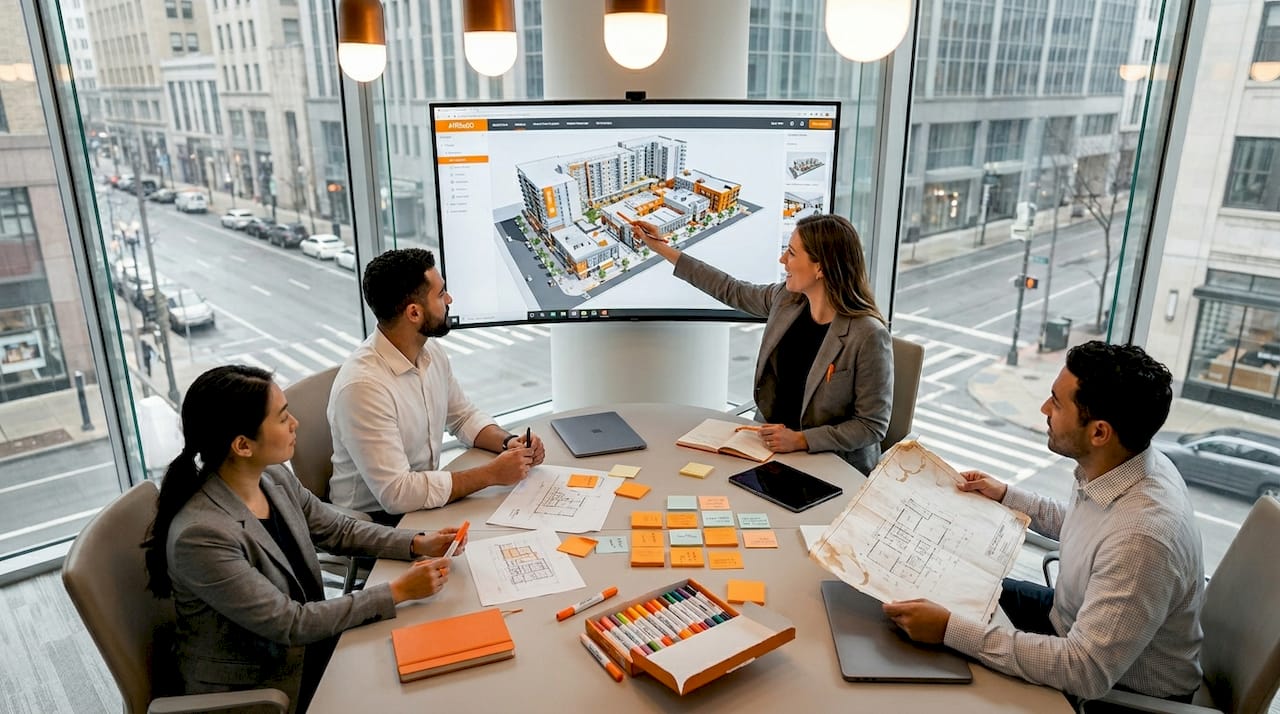
As VR type research confirms, “semi-immersive VR uses larger screens or projection systems that partially immerse the user while keeping awareness of the real environment.” The most common setups in professional contexts include large curved monitors, multi-screen arrays, and projection caves where rendered environments are displayed across multiple walls simultaneously.
Semi-immersive VR features relevant to architecture and real estate:
- Large-format displays and projection walls create a sense of scale that standard monitors cannot replicate
- No headset required, which means group presentations work without distributing hardware to each attendee
- Visual peripheral immersion from curved or multi-screen setups creates spatial awareness of proportions and volume
- Maintains physical presence awareness, which is valuable when clients need to discuss the presentation with others in the room
- Often used in boardroom or design studio environments with existing AV infrastructure
- Allows real-time navigation and material changes through familiar input devices
This format excels during group stakeholder sessions. Imagine a development team of eight people reviewing a mixed-use tower’s lobby design together on a projection system, discussing ceiling heights and material choices while still making eye contact with each other. That dynamic is impossible with individual headsets.
Pro Tip: Semi-immersive setups using large curved screens work particularly well for showing urban context, where clients benefit from seeing the entire building and its surroundings rather than being immersed inside a single interior space.
For projects requiring cinematic fly-through presentations on large displays, semi-immersive walkthroughs give you production-level visual quality without the logistical overhead of headset distribution.
Fully immersive virtual reality: ultimate immersion with headsets
Fully immersive VR is the format most people picture when they hear “virtual reality,” and for good reason. It delivers the most powerful sense of presence available in any VR experience category today.
VR immersion research defines it clearly: “fully immersive VR uses head-mounted displays plus audio and equipment to simulate multiple senses and isolate users from the physical world, creating the most realistic experience.” When a client puts on a headset and stands inside a photorealistic rendering of a building that does not yet exist, the emotional and cognitive response is fundamentally different from viewing the same space on a screen.
What fully immersive VR delivers in architectural presentations:
- Head-mounted displays provide 360-degree field of view with depth perception that accurately communicates spatial scale
- Spatial audio places sound within the environment, reinforcing the sense of actually being inside a space
- Complete visual isolation from the physical world keeps the client focused entirely on the design
- Hand controllers allow users to navigate naturally, open doors, interact with furniture, and change materials in real time
- Room-scale tracking enables users to physically walk through a space within defined boundaries
- Photorealistic rendering quality at headset resolution creates a convincing substitute for a physical site visit
The use case where this format justifies every dollar of investment is pre-construction client sign-off. Clients approving multi-million dollar developments based on 2D drawings or even video walkthroughs are making large bets on imagination. Put them inside the space first, and the confidence they bring to that signature is entirely different.
Learn more about the benefits of fully immersive VR for real estate and architecture across residential, commercial, and mixed-use project types.
Collaborative and web-based virtual reality: working together in virtual spaces
Beyond individual experiences, collaboration and web accessibility add new dimensions to VR use in architecture.
Collaborative VR layers multi-user interaction on top of immersive VR setups. As VR collaboration research confirms, “collaborative VR enables multiple users to interact in shared virtual spaces, often with avatars, for remote collaboration applied on immersive VR types.” The practical impact for architecture and real estate is significant. A developer in Singapore, an architect in London, and an interior designer in New York can all meet inside the same virtual building at the same time, pointing at walls, discussing proportions, and making real-time decisions.
Key features of collaborative and web-based VR:
- Multi-user shared environments where participants appear as avatars and can interact with the same design elements
- Voice and spatial audio communication within the virtual space to simulate being in a room together
- Real-time annotation tools allow users to mark up design elements during the session
- Web-based VR removes the need for app installation, delivering VR experiences through standard browsers using WebXR technology
- Accessible on mobile, desktop, and headset depending on the web-based platform’s capabilities
- Reduces travel costs and coordination overhead for international project teams
Web-based VR deserves more attention from developers who assume VR always requires specialized hardware. A browser-delivered walkthrough that works on a client’s iPad during a coffee meeting removes every access barrier while still delivering a navigable 3D environment.
For teams managing design across multiple stakeholders and locations, collaborative VR for design collaboration opens up new ways to manage review cycles and approval workflows.
Comparing types of virtual reality experiences for architecture
To wrap up the types overview, here is a comparative table showing key features and typical applications in architecture.
| VR type | Immersion level | Hardware needed | Group use | Ideal architectural use case |
|---|---|---|---|---|
| Non-immersive | Low | Standard monitor, PC | Easy | Early concept reviews, remote client demos |
| Semi-immersive | Medium | Large screens, projectors | Excellent | Group presentations, boardroom sessions |
| Fully immersive | High | VR headset, controllers | Limited | Pre-construction walkthroughs, final client sign-off |
| Collaborative VR | High (multi-user) | Headsets or shared setup | Built-in | Remote stakeholder reviews, international teams |
| Web-based VR | Low to medium | Browser, any device | Scalable | Wide stakeholder distribution, early engagement |
The table makes one pattern obvious: no single VR type wins across all situations. Fully immersive VR creates unmatched emotional impact but requires hardware management. Web-based VR scales to any audience but sacrifices presence. The best-performing architecture practices use multiple VR formats across different phases of the same project.
Our perspective: stop chasing the best VR and start matching VR to the moment
The architectural industry tends to treat fully immersive VR as the obvious endpoint, the thing you graduate to once you can afford it. That framing is backwards, and it leads teams to over-invest in headset experiences for situations where a well-built web-based walkthrough would have done a better job.
We have worked on more than 1,000 projects globally, and the pattern is consistent. Clients shown a photorealistic headset experience too early in a project, before they have internalized the design intent, often walk away with a strong emotional reaction to details that are still placeholder. The immersion backfires. They feel something was confirmed that was not yet decided.
The more productive approach treats VR types as a communication toolkit, not a technology ladder. Use non-immersive and web-based formats to build familiarity with a design. Use semi-immersive setups to generate group conversation and align stakeholders before the critical presentation. Reserve fully immersive VR for the moment you want a decision, not just a discussion. That sequencing consistently produces faster approvals, fewer revision cycles, and more confident clients.
The uncomfortable truth is that the “best” VR experience is not the most immersive one. It is the one your client was ready for.
Bring your designs to life with Rendimension
If you have been weighing which VR format to integrate into your next project presentation, the answer rarely lives in a single choice. It lives in a production partner who understands how different VR formats work together across a project timeline.
At Rendimension, we produce photorealistic architectural visualizations, interactive walkthroughs, and fully immersive VR experiences tailored to the specific stakeholder engagement goals of each project. Whether you need a web-deliverable model for early client buy-in or a headset-ready environment for final sign-off, our team builds VR experiences that match the moment, not just the technology. With over 1,000 completed projects across residential, commercial, and mixed-use developments, we know how to translate unbuilt architecture into experiences that move clients from interest to decision. Contact our team to discuss your next presentation.
Frequently asked questions
What type of VR is best for presenting architectural designs to clients?
Fully immersive VR delivers the strongest emotional impact for detailed walkthroughs, but semi-immersive setups often work better for group presentations where clients need to discuss the design together in real time. Fully immersive VR is the right choice when you need a client to truly feel a space before approving it.
How does collaborative VR improve stakeholder engagement in real estate projects?
It removes geography as a barrier by placing remote participants inside the same virtual space as avatars, enabling real-time feedback on design elements. Collaborative VR’s multi-user capability is particularly valuable for international development teams managing approval cycles across time zones.
Can architectural presentations be done using VR without expensive hardware?
Yes. Non-immersive VR runs on a standard desktop or laptop screen and lets clients navigate interactive 3D models without any specialized equipment, making it practical for budget-conscious presentations or remote clients.
What factors should architects consider when choosing a VR type for project presentations?
The key variables are the desired immersion level, how much interactivity the presentation requires, whether multiple stakeholders need to participate simultaneously, available hardware, and where the project sits in its approval timeline. Matching presence level to the task at hand consistently produces better outcomes than defaulting to the most technically advanced option available.