How VR boosts property development outcomes
TL;DR:
- Virtual reality is transforming property development by enabling faster sales, better design coordination, and enhanced stakeholder engagement.
- It provides measurable value through remote collaboration, data-driven marketing, and immersive review sessions that reduce costs and improve understanding.
Virtual reality has earned a reputation as a flashy demo tool, something you pull out at trade shows to impress visitors and then quietly shelve. That reputation is wrong, and it’s costing developers real money. The most competitive property teams today are using VR to close deals faster, surface design errors before ground breaks, and give stakeholders anywhere in the world a credible sense of space and quality. This guide breaks down exactly how VR works across the full development lifecycle, where it delivers the strongest return, and where you need to pair it with other tools to get the best results.
Table of Contents
- How virtual reality is transforming property development
- VR for design review and team collaboration
- Remote walkthroughs, sales engagement, and analytics
- Limitations, real-world barriers, and smart adoption mix
- Why VR in property development is about choices, not just technology
- Experience the next step in property development visualization
- Frequently asked questions
Key Takeaways
| Point | Details |
|---|---|
| VR powers stakeholder engagement | Digital-twin VR walkthroughs boost sales and clarify choices for clients and teams. |
| Analytics drive campaign results | Behavior tracking in VR shows what works and maximizes ROI in presentations and sales. |
| Collaboration improves with VR+BIM | Immersive sessions reveal issues and align teams before construction starts. |
| Mix VR with other methods | Combining VR with web or touchscreen formats ensures access for all audiences. |
How virtual reality is transforming property development
VR has moved well beyond photorealistic fly-throughs. Today’s platforms embed live inventory data, CRM integration, and stakeholder tracking directly into immersive environments. A buyer in Singapore can step through an off-plan apartment in Dubai, select a unit from a live availability grid, and trigger a follow-up sequence in your sales platform, all without leaving the headset or the browser tab. That shift from passive viewing to active sales tool is what separates serious VR adoption from gimmickry.
The VR benefits for real estate extend far beyond sales, though. Here is a clearer picture of where VR creates measurable value across a typical development project:
- Stakeholder presentations: Show investors and planning authorities finished spaces with precise material and lighting accuracy before construction begins.
- Remote collaboration: Project teams across different cities or continents can review the same 3D environment simultaneously, with annotation tools that replace email chains.
- Sales optimization: Interactive unit configurators let buyers test finish options and furniture layouts, increasing emotional investment before commitment.
- Regulatory and community engagement: Accurate visual simulations help planning boards and local communities understand scale, massing, and neighborhood impact.
- Post-sales support: Buyers can revisit their purchased unit’s configuration during construction, maintaining confidence and reducing change-order disputes.
The real-world VR revenue impact is well documented. Digital-twin platforms built for real estate now support full sales and stakeholder engagement cycles, including remote interactive walkthroughs and direct integration with CRM and inventory systems.
“One real estate developer using digital-twin-based VR sales tools reported a revenue improvement exceeding 10x compared to their previous static presentation approach.”
That is not a marginal gain. It is a fundamental rethinking of what a presentation is supposed to do.
VR for design review and team collaboration
Design coordination is where VR quietly saves the most money. On complex mixed-use or high-rise projects, clash detection in 2D drawings or even standard BIM viewers often misses spatial conflicts that become obvious the moment you stand inside the model at human scale. Walking a structural engineer and an MEP contractor through the same space in VR, simultaneously, surfaces coordination issues in minutes that would otherwise emerge during construction and cost a significant amount to fix.
The strategic integration of VR and BIM is now a recognized methodology in architectural practice precisely because the combination does what neither tool can do alone. BIM supplies the data richness; VR supplies the spatial comprehension. Together, they create a design review environment where non-technical stakeholders, clients, planning officers, and end users can give meaningful feedback because they actually understand what they are looking at.

Key collaboration benefits: VR-BIM vs. traditional review
| Capability | Traditional review | VR-BIM review |
|---|---|---|
| Clash detection speed | Days (manual review) | Minutes (in-session spotting) |
| Stakeholder comprehension | Low for non-technical users | High, intuitive spatial experience |
| Live annotation | Email or markup PDF | In-model comments, real-time |
| Discipline alignment | Sequential sign-off | Simultaneous multi-discipline review |
| Change cost visibility | Late discovery, high cost | Early discovery, minimal cost |
| Remote participation | Video call with screen share | Shared immersive environment |
The scenarios where VR-driven design review adds the most clarity include:
- Ceiling height conflicts: HVAC, lighting, and structural elements fighting for the same vertical space become immediately obvious at human scale.
- Circulation and egress: Walking a corridor in VR reveals whether fire escape routes and accessible pathways actually work in practice, not just in plan.
- Client finish approval: Clients who struggle to visualize materials from a sample board respond decisively when they see the full finish palette applied to their actual unit.
- Buildability reviews with contractors: Site managers can flag construction sequencing concerns by literally walking the sequence inside the model.
Learn more about BIM and VR best practices to understand how to structure effective review sessions for different project types and team compositions.
Pro Tip: Bring all disciplines into VR review sessions from the earliest design stages, not just at design freeze. The cost of resolving a conflict drops by an order of magnitude the earlier it is found.
Remote walkthroughs, sales engagement, and analytics
The sales application of VR is where most developers first encounter the technology, and it is where analytics transform a presentation tool into a strategic asset. A remote walkthrough is not simply a virtual tour. When built on a capable platform, it generates a continuous stream of behavioral data: which rooms buyers linger in, which finishes they configure and then abandon, which floor plans trigger the most inquiries. That data stream is as valuable as the visual experience itself.
3D techniques for real estate now routinely incorporate analytics layers that let sales and marketing teams move from gut-feel decisions to evidence-based campaign management. Here is how the data typically flows:
- Set up event tracking. Before launch, define the behavioral events your platform will capture: room entry, finish selection, unit saved, brochure download, contact form triggered.
- Analyze heatmaps after the first two weeks. Identify which spaces attract the longest dwell time and which are skipped. This tells you where your strongest value proposition lives, and where the design narrative may need strengthening.
- Segment by buyer profile. If your platform integrates with your CRM, correlate behavioral data with buyer demographics. International investors may prioritize views and layouts differently than local owner-occupiers.
- Refine follow-up sequences. Use the data to personalize your outreach: a buyer who spent eight minutes in the master suite but abandoned before the kitchen is a different conversation than someone who configured three finish schemes.
- A/B test presentation entry points. Some platforms allow you to test different starting rooms or guided tour sequences and measure downstream conversion impact.
VR-driven vs. traditional sales engagement metrics
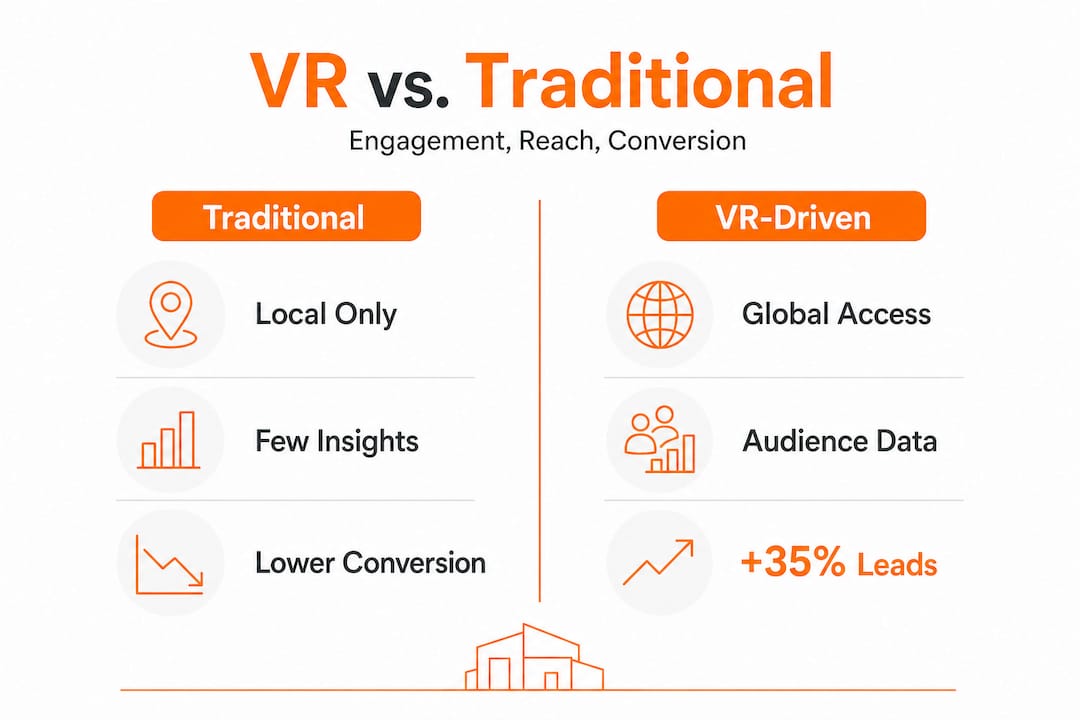
| Metric | Traditional approach | VR-enhanced approach |
|---|---|---|
| Geographic reach | Local or with travel cost | Global, instant access |
| Buyer dwell time per session | 20-30 min (in-person tour) | 8-45 min (self-paced, repeatable) |
| Behavioral data captured | Anecdotal sales feedback | Quantified, per-user event data |
| Finish/unit configurability | Static brochures | Live, real-time configuration |
| Follow-up personalization | Generic campaign | Data-driven, behavior-matched |
| After-hours availability | Not available | 24/7 access |
Digital-twin platforms now track viewer behavior and audience characteristics with precision. VR analytics in real estate have demonstrated measurable conversion uplift when behavioral insights are used to refine targeting and follow-up strategies. Explore immersive walkthrough examples to see what a well-structured, analytics-ready presentation looks like in practice.
Projects that used analytics to guide campaign adjustments saw a 35% higher conversion rate compared to those relying on static presentation formats alone.
That is not an accident. It reflects the compounding benefit of making decisions with data rather than assumption.
Limitations, real-world barriers, and smart adoption mix
It would be misleading to present VR as a universal solution. The technology has real constraints, and ignoring them leads to wasted investment and frustrated stakeholders.
The most common barriers developers and architects face include:
- Hardware cost and availability: High-fidelity headsets carry a significant upfront cost, and not every buyer or stakeholder will have access to one or the comfort to use it.
- Content production timelines: A fully interactive, photorealistic VR environment takes longer to produce than a static render or a 2D floor plan, which creates scheduling pressure in fast-moving sales campaigns.
- Learning curve for non-technical users: Some buyers, particularly older demographics or those unfamiliar with gaming interfaces, find headset-based VR disorienting or simply uncomfortable.
- Platform fragmentation: The VR and digital-twin market is still maturing, and interoperability between tools is inconsistent.
- Maintenance overhead: As designs evolve, the VR environment must be updated, which is an ongoing cost rather than a one-time production expense.
Practical workarounds that experienced teams use:
- Offer a web-based version of the walkthrough alongside the headset experience so that any buyer with a smartphone or laptop can participate.
- Use phased adoption, deploying VR for flagship units or anchor products first, then expanding as team capability grows.
- Run stakeholder training sessions before key presentations so that participants arrive comfortable with the interface.
- Supplement VR with touchscreen kiosks in sales galleries, which provide a high-impact interactive experience without requiring buyers to put on a headset.
- Maintain static render libraries alongside the VR environment so that marketing collateral can be updated faster than the full 3D model during rapid design iterations.
Interactive showroom methods that mix VR, web-based tours, and touchscreen kiosks cover different stakeholder reach constraints without forcing a single channel on every audience. This is what thoughtful immersive visualization guidance consistently recommends: design the media mix around the audience, not around the technology.
Pro Tip: Survey your project team and likely buyers before choosing your presentation format mix. A brief poll on device access and tech comfort levels will prevent you from building an elaborate VR experience that half your target audience cannot or will not use.
Why VR in property development is about choices, not just technology
Here is the uncomfortable observation most VR vendors will not share: the developers who see the greatest return from immersive technology are not the ones who deploy VR on every project. They are the ones who ask a sharper question first: where does the friction of traditional presentation cost us the most?
The professionals who chase VR as a signal of innovation, deploying it because competitors are, tend to underutilize the analytics, skip the stakeholder training, and end up with an expensive production that gets shown twice at a launch event and then archived. The tool is not the problem. The strategy is.
VR’s real return on investment emerges when it is paired with a clear commercial objective, whether that is shortening the sales cycle on an off-plan release, reducing design coordination costs on a complex brief, or winning an investor presentation against better-known competitors. When the objective is defined, the metrics follow naturally. Dwell time, conversion rate, clash resolution speed. When the objective is vague, none of those metrics get measured.
The other pattern worth naming is the all-or-nothing trap. Some teams go fully immersive and discover that a segment of their buyers, particularly institutional or overseas investors reviewing properties during limited time windows, actually prefer a high-quality rendered image they can review at their own pace over a guided VR experience that requires scheduling and setup. A fixed render can be reviewed in 30 seconds. That is not a weakness of renders. It is a feature.
The best property outcomes come when immersive technology serves stakeholder flexibility rather than replacing it. VR earns its place in the toolkit when it closes a gap that other formats cannot. Exploring the VR’s practical benefits in context of specific project types will sharpen that judgment considerably.
Experience the next step in property development visualization
Knowing how VR fits into your development workflow is one thing. Having a production partner who can execute it at the quality your projects demand is another entirely.
Rendimension has delivered immersive visualization across more than 1,000 projects globally, working with developers and architects on everything from off-plan residential releases to large-scale commercial presentations. Whether you need a fully interactive VR solution for real estate with integrated analytics, or photorealistic 3D rendering services that anchor your marketing collateral, the team structures each project around your specific sales and stakeholder objectives. The process is collaborative from briefing through delivery, ensuring that what gets built matches what your buyers and investors actually need to see.
Frequently asked questions
How does VR improve client decision-making in property development?
VR lets clients experience spaces interactively before construction begins, which resolves spatial ambiguity and accelerates commitment. VR and BIM integration supports real-time immersive evaluation, giving both technical and non-technical stakeholders the clarity they need to make confident decisions.
What kind of analytics can VR presentations in real estate provide?
VR platforms track dwell time per room, finish configuration behavior, user journey paths, and downstream conversion rates, giving sales teams concrete data to optimize campaigns. Matterport’s analytics platform delivers real-time traffic, engagement statistics, and conversion uplift metrics that go well beyond what traditional tours can measure.
Is VR always the best solution for property presentations?
Not always. A format mix that includes VR, web-based tours, and touchscreen kiosks typically reaches more stakeholders more effectively than any single channel. Mixing presentation formats covers different hardware access levels and stakeholder preferences without compromising reach.
What is a digital twin, and how does it relate to VR in real estate?
A digital twin is a fully navigable virtual model of a real or planned property, often integrated with live inventory and CRM data. Digital-twin-based VR platforms enable remote walkthroughs, real-time sales integration, and stakeholder engagement at a scale that static presentations simply cannot match.