Benefits of Virtual Reality in Construction Projects
Benefits of Virtual Reality in Construction Projects
TL;DR:
- Virtual reality significantly reduces construction rework and improves collaboration by enabling immersive, shared spatial experiences. It enhances safety training, accelerates production cycles, and helps detect conflicts early, saving millions on large projects. Effective VR integration depends on workflow planning and high-quality BIM models, with shorter, targeted sessions yielding the best results.
Most construction professionals assume VR is a presentation tool for impressing clients. That assumption is costing projects millions. The real benefits of virtual reality in construction go far deeper than polished visuals: teams are using VR to detect sequencing conflicts, train workers in hazardous scenarios, and validate spatial designs before a single foundation is poured. On the Fremantle Bridge project, VR identified $300,000 AUD in preventable costs within just one week. That kind of ROI reframes VR from a marketing add-on to a project management necessity.
Table of Contents
- Key takeaways
- Benefits of virtual reality in construction visualization
- How VR improves construction team collaboration
- VR’s role in construction safety training
- Quantifiable efficiency gains and cost savings
- My perspective on VR’s real value in construction
- See your project in full before you build it
- FAQ
Key takeaways
| Point | Details |
|---|---|
| VR prevents costly rework | Spatial validation in VR catches design conflicts before construction begins, avoiding budget overruns. |
| Collaboration improves measurably | Multi-user VR reduces meeting duration by 26.7% while improving team decision accuracy. |
| Safety training gets safer | Immersive simulations let workers practice high-risk scenarios without real-world exposure to danger. |
| Production cycles shrink | AR/VR workflows deliver 20 to 30% faster production cycles compared to traditional methods. |
| VR is a process tool, not a demo | The biggest gains come when VR integrates with BIM workflows, not when it sits in a showroom. |
Benefits of virtual reality in construction visualization
Before VR, a project team’s ability to verify a design relied on reading plans, squinting at 3D renders on a screen, and hoping everyone interpreted the same drawing the same way. VR replaces that guesswork entirely.
Immersive walkthroughs at real scale
With VR, you walk through a building at 1:1 scale before ground is broken. You stand inside a mechanical room and realize the overhead clearance will make routine maintenance physically impossible. You check whether a structural beam interferes with a fire suppression line. These are discoveries that 2D drawings simply cannot surface, because the human brain does not process flat plans the same way it processes space.
VR eliminates interpretation bias by giving every stakeholder the same spatial experience during review. An architect, a structural engineer, and a facilities manager all see the same room, at the same scale, at the same time. That shared context removes the most common source of expensive late-stage design changes: miscommunication.
Pro Tip: Have your team physically perform tasks during VR sessions. Crouching, reaching, and mimicking maintenance procedures inside the model surfaces ergonomic conflicts that passive viewing misses entirely.
4D sequencing and conflict detection
Standard 3D models show you what a building will look like. 4D models combined with VR show you how it will be built, step by step, in space. Teams can experience construction sequences spatially, watching how a crane’s swing radius might clip an adjacent structure during a specific phase, or how a concrete pour sequence creates an access problem three weeks later.
This is precisely how the Fremantle Bridge team caught critical clashes early. Integrating VR with detailed BIM models is what unlocks this capability. The model has to be accurate and information-rich. A VR session built on a shallow model will surface shallow problems. The depth of your model determines the depth of your savings.
| Visualization method | Conflict detection | Sequence validation | Stakeholder alignment |
|---|---|---|---|
| 2D drawings | Limited | None | Low |
| 3D renders on screen | Moderate | None | Moderate |
| 4D VR with BIM | High | Full | High |
How VR improves construction team collaboration
Poor communication is the construction industry’s most persistent cost driver. Teams working across disciplines, time zones, and organizations spend enormous amounts of time arguing over what a drawing actually means. VR addresses that problem at the source.
Shared context, fewer misunderstandings
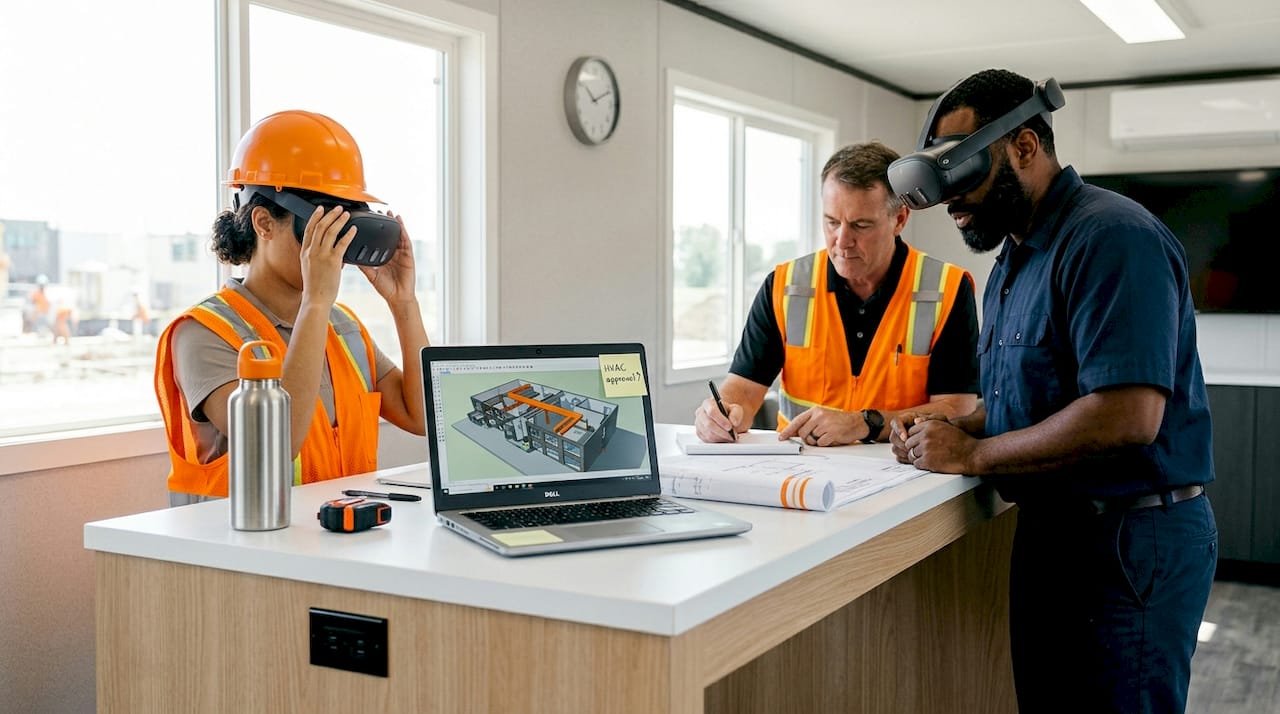
VR replaces dense text briefs with interactive, walk-in environments that every stakeholder can experience directly. Instead of distributing a 40-page specification document and hoping subcontractors interpret it correctly, you invite them into the model. They see the scope. They understand the intent. The back-and-forth that consumes project management hours drops significantly.
Research confirms this is not just anecdotal. Multi-user immersive VR reduces meeting duration by 26.7% while improving decision accuracy compared to traditional BIM platform reviews. That figure matters more than it might seem. On a complex commercial project with dozens of coordination meetings per month, a 26.7% reduction in meeting time translates directly into schedule savings and reduced labor costs.
Remote teams and global coordination
Social VR platforms allow project teams on different continents to meet inside the same model simultaneously. A developer in New York, a contractor in Dubai, and a design consultant in London can stand together in a virtual representation of a floor plate and resolve a coordination issue in real time. The advantages of VR in construction for globally distributed teams are particularly significant because they compress the communication lag that typically stretches coordination cycles across weeks.
The key shift here is immediacy. When a design change is proposed inside a VR session, every participant experiences the consequence of that change spatially and simultaneously. Consensus that would normally require multiple email threads and revised drawing packages can happen in a single session.
- All participants enter the shared VR environment with the current model loaded.
- The team identifies the conflict or design question in the space.
- The design lead modifies the element and the change appears in real time.
- Each stakeholder confirms alignment before exiting the session.
- The agreed change is documented directly from the session record.
“The real value is in how VR compresses the feedback loop. Decisions that used to take weeks get made in an afternoon.” This reflects what teams using social VR for construction coordination consistently report after adoption.
VR’s role in construction safety training
Safety training in construction has always faced a fundamental tension: the scenarios workers most need to practice are the ones most dangerous to simulate in real life. VR resolves that tension completely.
The role of VR experiences for builders in safety education is not about watching a video of a fall hazard. It is about standing on a simulated scaffold, feeling the visual height, and physically performing the steps of a fall arrest inspection. That experiential element is what creates muscle memory rather than just knowledge retention.
- Workers can practice fall arrest procedures, electrical lockout/tagout protocols, and fire evacuation routes repeatedly without any physical risk.
- Hazardous scenarios like structural collapses and gas leak responses can be simulated with full sensory immersion.
- Training can be standardized across a workforce regardless of geography, removing the inconsistency of instructor-led field sessions.
- Performance data from VR sessions identifies specific knowledge gaps for individual workers, enabling targeted follow-up.
Hyundai E&C’s safety experiential training center uses VR to simulate high-risk construction accidents, letting workers experience hazards safely and build appropriate responses before encountering them on site. The program demonstrates that participatory safety education through VR significantly improves worker preparedness and accident prevention outcomes.
Pro Tip: Run VR safety training sessions before workers begin on a new site type, not just during onboarding. Scenario-specific rehearsal directly before exposure to that hazard produces significantly better retention.
The cost argument for VR safety training is also straightforward. Physical training setups for high-risk scenarios require equipment, space, and often temporary construction of mock environments. VR eliminates those setup costs while allowing unlimited repetition at scale.
Quantifiable efficiency gains and cost savings
The impact of virtual reality on construction projects is increasingly well-documented, and the numbers make a compelling case for adoption even at current hardware costs.
AR/VR workflows reduce production cycles by 20 to 30% while delivering measurable reductions in assembly defects. Those efficiency gains compound across a project timeline. A 20% faster production cycle on a 24-month commercial build means completing roughly five months earlier, with corresponding reductions in financing costs, overhead, and the opportunity cost of delayed revenue.
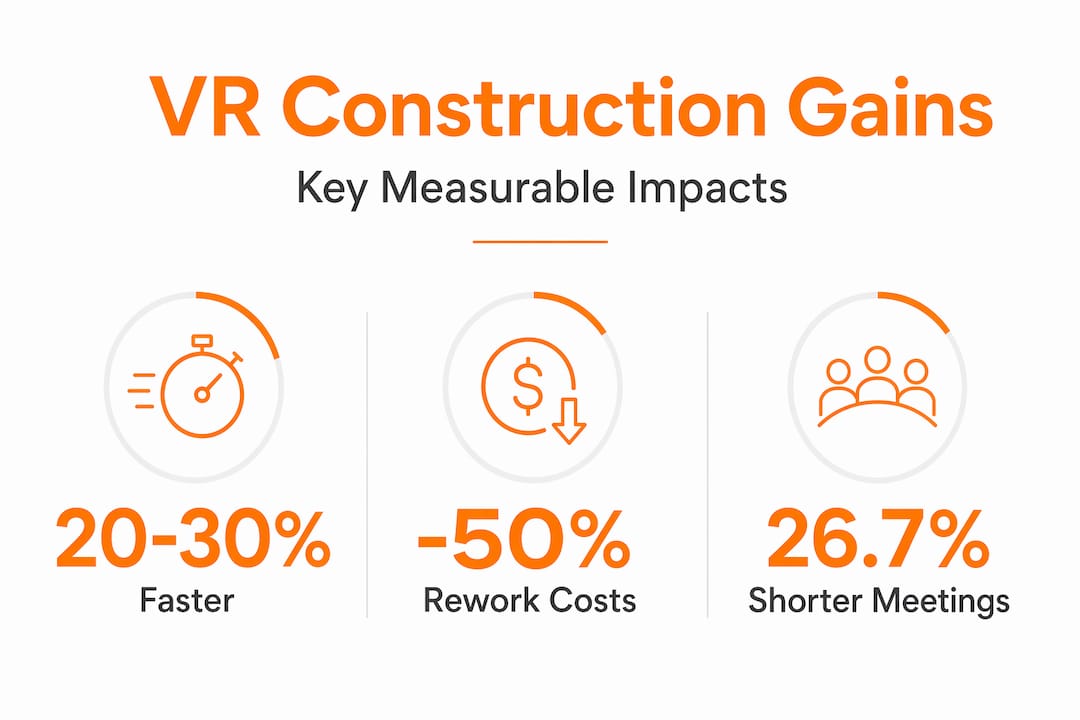
Rework is the other major lever. Across the construction industry, rework averages 14% of initial project budgets. For a $50 million project, that is $7 million in costs that exist largely because spatial conflicts were not caught before construction began. VR applied during design review directly reduces that figure.
| Metric | Without VR | With VR integration |
|---|---|---|
| Rework as % of budget | Up to 14% | Significantly reduced |
| Production cycle length | Baseline | 20 to 30% faster |
| Meeting duration for coordination | Baseline | 26.7% shorter |
| Conflict detection timing | During construction | Before construction |
What implementation actually costs
VR headsets capable of construction-grade spatial review have dropped considerably in price. Professional-grade standalone headsets now enter projects at a fraction of the cost they carried five years ago. The more meaningful cost is integration: your BIM models need sufficient detail and accuracy to make VR sessions productive.
There are real technical constraints worth knowing. Successful VR implementation requires high-speed connectivity and awareness of ergonomic fatigue. Extended headset sessions cause discomfort, which limits effective session duration to roughly 30 to 45 minutes for most users. Structuring your VR review sessions accordingly, with focused agendas and clear decision objectives, produces better outcomes than open-ended exploration marathons. You can learn more about deploying these tools effectively from Rendimension’s immersive visualization guide for design and construction professionals.
My perspective on VR’s real value in construction
I’ve worked with construction visualization projects across residential, commercial, and infrastructure sectors, and the pattern I see most consistently is this: teams that treat VR as a demonstration tool get modest value from it. Teams that wire VR into their actual coordination and review workflows get transformational value.
The hard-won lesson is that the technology is not the barrier. The barrier is workflow integration. I’ve seen projects where stunning VR environments were built for client presentations and then never opened again during construction. The model existed. The headsets existed. But nobody had defined when in the project workflow VR would be used, by whom, and for what decisions.
My honest view is that the construction industry is still significantly underutilizing what VR makes possible. The evidence on cost avoidance, cycle time reduction, and safety outcomes is clear enough that hesitation is now more expensive than adoption. The firms that will lead in the next decade are the ones treating VR as infrastructure, not as a novelty.
The ergonomic and connectivity constraints are real, but they are manageable. Shorter, structured sessions with clear objectives outperform long exploratory ones. And as hardware improves, those constraints will shrink. The underlying capability to transform client engagement and prevent construction errors is already here. Using it is a choice.
— Rendimension
See your project in full before you build it
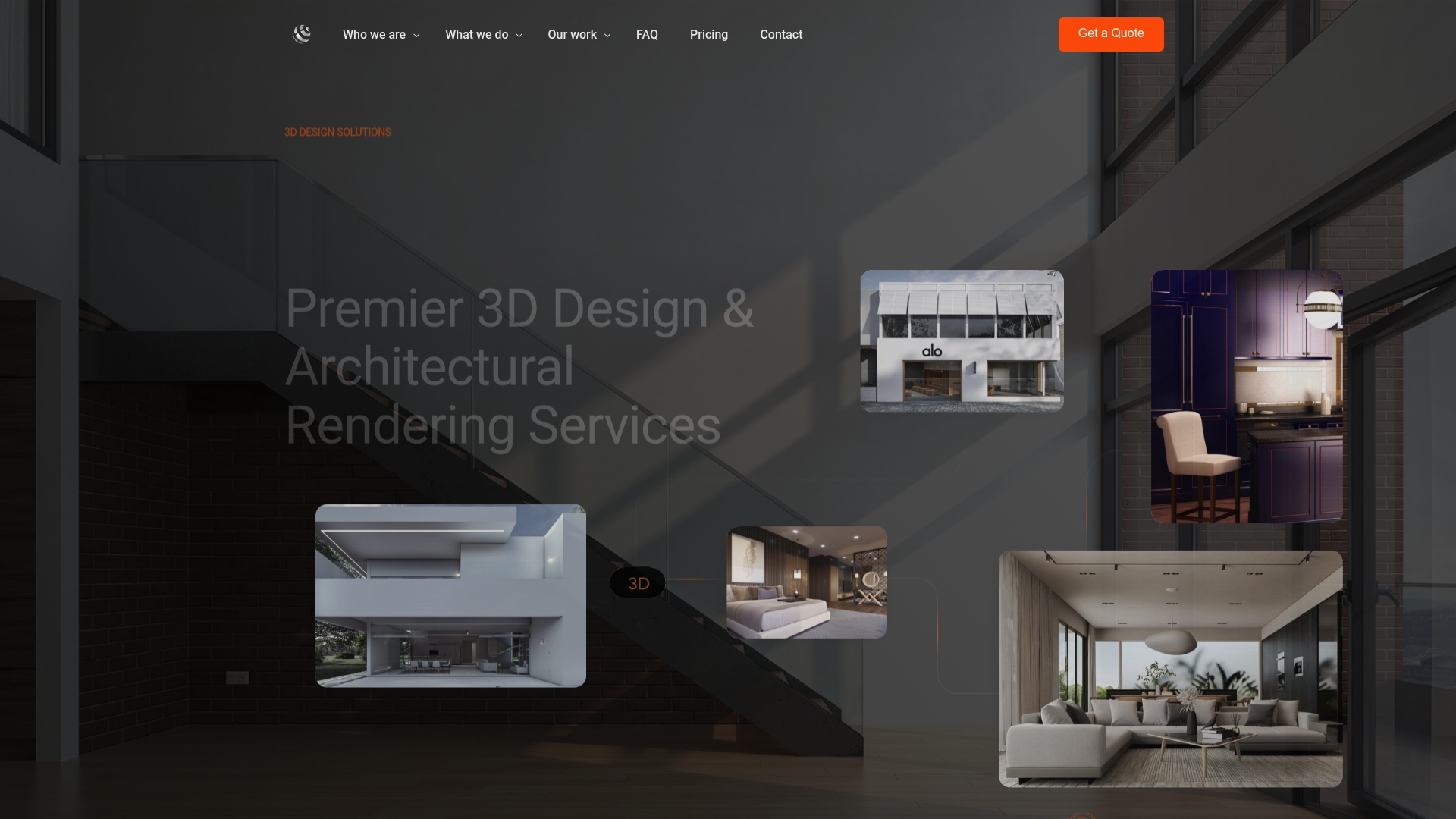
Rendimension specializes in high-quality 3D renderings and immersive VR experiences built specifically for construction and architectural projects. If you’ve read through the evidence on spatial conflict detection, collaboration efficiency, and cost avoidance, the logical next step is putting that capability to work on your own project. Rendimension’s VR and AR visualization services are designed to integrate with your existing project data, whether you’re reviewing a commercial development, coordinating a complex infrastructure build, or presenting a residential concept to stakeholders. For projects where photorealistic accuracy is the priority, Rendimension’s professional 3D rendering services deliver the model quality that makes VR sessions genuinely productive, not just visually polished.
FAQ
What are the main benefits of VR in construction?
VR in construction reduces costly rework, improves team collaboration, accelerates production cycles by 20 to 30%, and enables immersive safety training without real-world risk. Its most immediate financial benefit is catching spatial and sequencing conflicts before construction begins.
How does VR improve construction safety training?
VR allows workers to experience and respond to high-risk scenarios like falls, electrical hazards, and fire events in a fully simulated environment. This builds muscle memory and prepares workers for real site conditions without any physical danger.
How much can VR save on a construction project?
The Fremantle Bridge project avoided $300,000 AUD in costs within the first week of VR use through conflict detection alone. At scale, reducing rework costs that typically run up to 14% of project budgets represents multi-million dollar savings on large builds.
Does VR work better with BIM models?
Yes. VR produces the most value when paired with detailed, accurate BIM models. The richer the model’s data, the more conflicts and sequencing issues VR sessions can surface before they become physical problems on site.
How long do VR sessions typically last in construction use?
Effective construction VR sessions generally run 30 to 45 minutes due to ergonomic fatigue from headset use. Shorter sessions with focused agendas and specific decision objectives consistently outperform longer, open-ended reviews.
Recommended
- How VR boosts property development outcomes
- Types of VR experiences for architects and developers
- Virtual Reality In Design: Transforming Client Engagement