Interior renderings: boost client success and approvals
TL;DR:
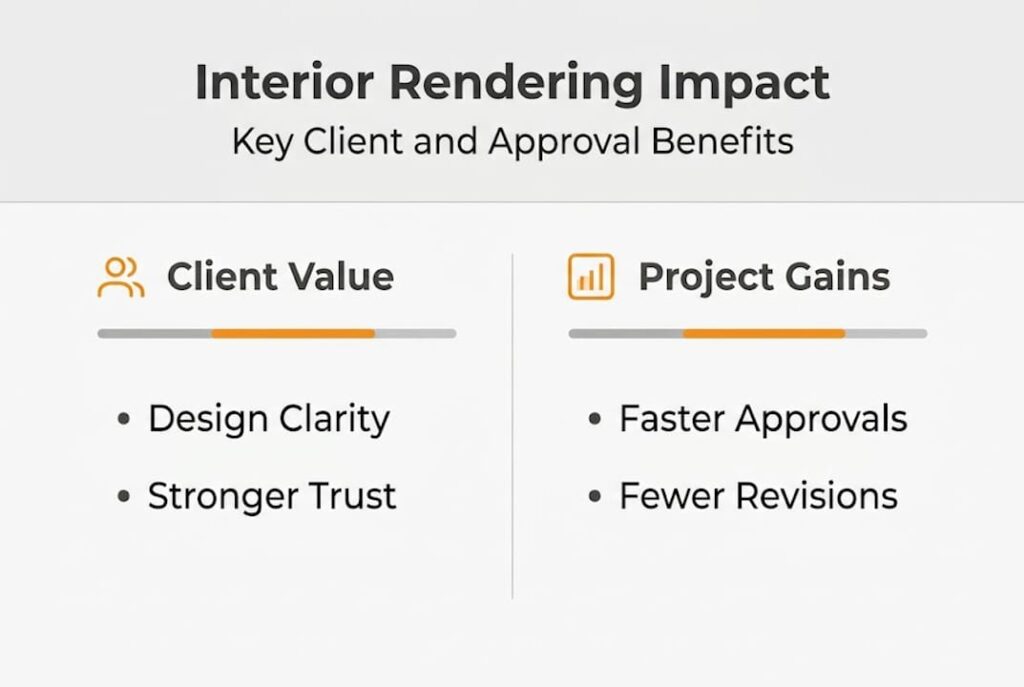
- Interior renderings bridge the gap between technical drawings and emotional, experiential understanding.
- They accelerate project approvals by clearly conveying design intent and reducing revision rounds.
- Effective renderings balance photorealism with authenticity to enhance client trust and marketing impact.
Floor plans tell. Interior renderings show. For architects and real estate developers, the gap between what a design looks like on paper and what a client actually understands can cost you a project. A carefully composed 2D elevation communicates dimensions, but it rarely communicates atmosphere, scale, or emotional impact. Interior renderings bridge that gap by transforming technical drawings into vivid, spatial experiences that clients can immediately connect with. In this article, we break down the core advantages of interior renderings, from winning client pitches and accelerating approvals to powering marketing campaigns and navigating the real trade-offs of photorealism.
Table of Contents
- How interior renderings elevate project presentations
- Facilitating faster project approvals and design decisions
- Enhancing marketing and client engagement with photorealism
- Overcoming design limitations: When and how to use interior renderings effectively
- Our perspective: Achieving authenticity and impact in interior renderings
- Take your project presentations to the next level with expert renderings
- Frequently asked questions
Key Takeaways
| Point | Details |
|---|---|
| Improved Clarity | Interior renderings translate complex ideas into visuals that clients and stakeholders can immediately understand. |
| Faster Approvals | Projects with clear, compelling renderings often secure buy-in and approval significantly faster. |
| Marketing Power | Photorealistic renderings increase client excitement and drive more successful marketing campaigns. |
| Strategic Balance | Combining schematic and detailed renderings encourages feedback and keeps the design process flexible. |
How interior renderings elevate project presentations
An interior rendering is a photorealistic or stylized digital image of a space viewed from inside, produced before construction begins. Unlike floor plans or section drawings, renderings show how light falls across a surface, how materials interact, and how a room feels to occupy. That shift from abstract to experiential is what makes them so powerful in client presentations.
3D visualization benefits architects by helping them communicate complex design concepts clearly to clients who may have no technical background. When a client sees warm afternoon light filtering through a rendered living room, they stop asking “what does this mean?” and start saying “yes, that’s what I want.”
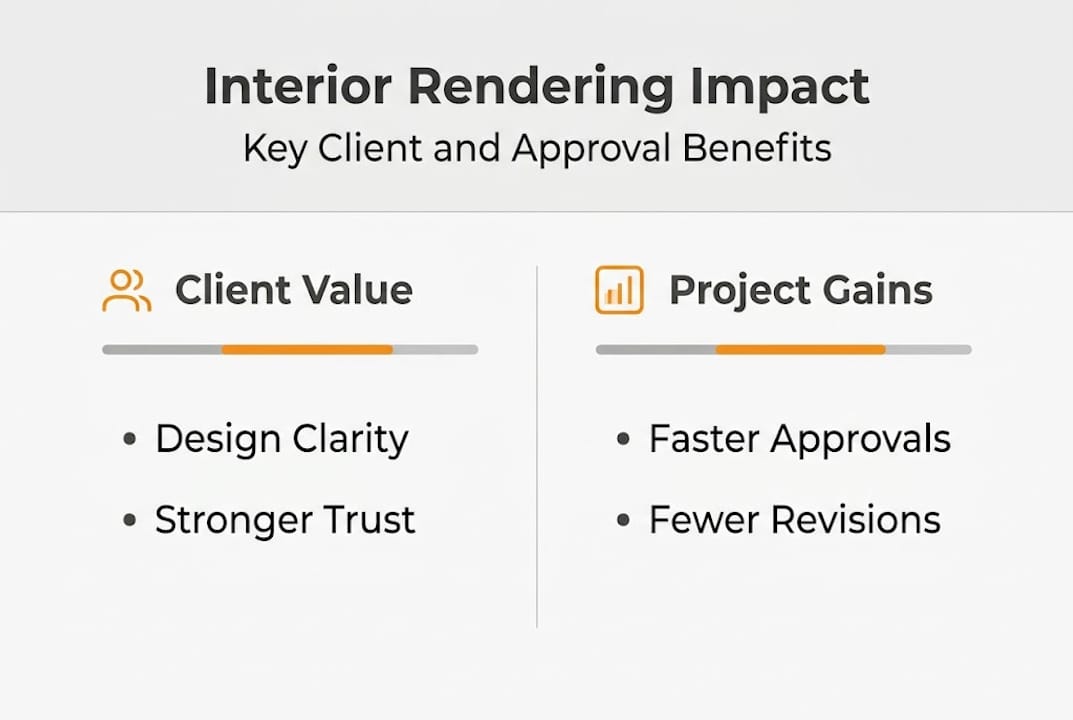
The difference between a presentation with and without quality renderings is significant:
| Presentation element | Without renderings | With renderings |
|---|---|---|
| Client comprehension | Low to moderate | High |
| Emotional buy-in | Minimal | Strong |
| Revision requests | Frequent | Reduced |
| Approval speed | Slower | Faster |
| Competitive edge | Standard | Distinct |
Clients consistently respond to specific visual elements in renderings. The most impactful ones include:
- Realistic lighting that reflects the time of day and natural sources
- Material textures shown at true scale, such as wood grain, stone, or fabric
- Furniture and human scale that help clients judge proportions intuitively
- Atmosphere and mood created through color temperature and shadow depth
- Contextual details like art, plants, and accessories that make a space feel lived-in
That said, there is a real caution worth noting. Pushing renderings to hyper-realistic extremes can sometimes work against you.
“When every surface looks flawless and every shadow is perfect, clients may feel the design is already locked in, which shuts down conversation rather than opening it.” This is a well-documented concern among practitioners discussing the limits of photorealism in renderings.
A hybrid approach, mixing polished renderings with looser, more schematic visuals, tends to keep clients engaged and collaborative throughout the design process.
Facilitating faster project approvals and design decisions
Beyond sales presentations, renderings also dramatically impact the speed and clarity of project approvals. Whether you are seeking sign-off from a private client, a planning committee, or a development board, the ability to present a space visually rather than symbolically changes the entire dynamic.
Here is how interior renderings fit into a typical design approval process:
- Concept phase: Schematic renderings establish mood, scale, and general direction without locking in details.
- Design development: More detailed renderings show material choices, lighting conditions, and spatial flow to stakeholders.
- Client review: Photorealistic images allow clients to evaluate the design as if they were standing inside the finished space.
- Approval submission: High-quality renderings submitted to planning or development boards reduce ambiguity and minimize back-and-forth requests.
- Final sign-off: Clients who can clearly visualize the outcome are far more confident approving the final design.
The data supports this pattern. Photorealistic renderings speed up project approvals by making design intent unmistakable to decision-makers at every level.
| Approval scenario | Typical timeline without renderings | Typical timeline with renderings |
|---|---|---|
| Private client sign-off | 3 to 5 review rounds | 1 to 2 review rounds |
| Planning board submission | 6 to 10 weeks | 3 to 5 weeks |
| Developer stakeholder approval | Multiple revision cycles | Streamlined single review |
The reason renderings reduce revision cycles is straightforward. When a client misreads a floor plan, they approve something they did not actually want. When they see a rendering, they respond to what is actually there. That clarity eliminates a large category of costly late-stage changes.

Understanding the photorealistic rendering benefits for approval workflows is especially valuable on large commercial or mixed-use projects, where multiple stakeholders with different levels of design literacy need to align on a single vision before work proceeds.
Pro Tip: For planning submissions, include both a photorealistic rendering and a simplified schematic of the same space. Decision-makers who are not design professionals often find the schematic easier to annotate and respond to, while the photorealistic image builds overall confidence.
Enhancing marketing and client engagement with photorealism
Once projects move into client-facing marketing, renderings become a central asset for engagement. A photorealistic interior rendering does something a photograph of an empty shell cannot: it sells a lifestyle, not just a floor area.
The core visual advantages of photorealism in marketing include:
- Lighting accuracy that mimics real-world conditions, including sunrise warmth or evening ambiance
- Material fidelity that lets buyers evaluate finishes before they exist
- Spatial storytelling that positions each room as a place people want to inhabit
- Flexibility to show multiple design options without building anything
- Consistency across all marketing channels, from websites to printed brochures to social media
Photorealistic visuals are proven to foster excitement and trust among prospective buyers, which directly influences campaign performance and sales velocity.
However, there is a real pitfall here. When renderings look too perfect, too staged, or too impossible to achieve in real life, buyer trust can actually decrease. Authenticity concerns with photorealism are a growing topic in the industry, with some practitioners arguing that overly polished visuals create expectations that the finished space cannot meet.
The solution is intentional imperfection. A slight shadow variation, a realistic dust particle on a shelf, or a window view that matches the actual site location all signal authenticity. These small choices build trust rather than eroding it.
Pro Tip: Combine your interior renderings with a short virtual walkthrough or 360-degree view. Buyers who can “move through” a space digitally spend significantly more time engaging with the listing and report higher confidence in their purchase decisions.
Overcoming design limitations: When and how to use interior renderings effectively
With the key benefits and marketing value clear, it is important to consider when renderings can limit rather than help your process. The most common mistake is treating photorealistic renderings as the default output at every stage of design.
Over-reliance on photorealistic renderings can inhibit creative collaboration and natural design evolution. When a client sees a finished-looking image early in the process, they often assume the design is final. This shuts down the exploratory conversation that leads to better outcomes for both parties.
A smarter approach is to match the rendering style to the design stage:
- Early concept phase: Use loose, sketch-style or schematic renderings that communicate intent without implying finality
- Mid-design phase: Use mid-fidelity renderings that show spatial relationships and material direction without full photorealism
- Client presentation and marketing: Use high-fidelity photorealistic renderings to build excitement and secure approvals
- Post-approval: Use renderings to align contractors and interior designers with the approved vision
The role of photorealism in architecture is not about replacing design thinking. It is about amplifying communication at the right moment.
A balanced approach to rendering means giving clients both a polished vision and a loose concept in the same meeting. The polished image shows what is possible. The loose concept invites them to shape it.
Pro Tip: Present clients with two versions of the same space in your next pitch: one detailed photorealistic rendering and one simplified concept sketch. Watch how the conversation shifts. The sketch invites input. The rendering closes the deal. Both are necessary.
Our perspective: Achieving authenticity and impact in interior renderings
After working across more than 1,000 projects globally, we have seen a consistent pattern. The architects and developers who get the best outcomes from renderings are not the ones who push for the highest pixel count. They are the ones who use renderings strategically, matching visual fidelity to the purpose of each conversation.
The industry often frames this as a binary choice: photorealistic or schematic. But that framing misses the point. Blending photorealism and schematic renderings often yields both authenticity and buy-in, because it respects both the client’s need for clarity and the design’s need to evolve.
What we prioritize is context, mood, and space for feedback. A rendering that captures the feeling of a space, even if it is not pixel-perfect, will almost always outperform a technically flawless image that leaves no room for the client to see themselves in it. Understanding photorealism best practices means knowing when to pull back, not just when to push forward. Tailor your rendering strategy to each project’s unique goals, and you will consistently deliver stronger results.
Take your project presentations to the next level with expert renderings
Rendimension specializes in interior renderings that are built for real project outcomes, not just visual impact. Our team works with architects and developers across residential, commercial, and mixed-use projects to produce visuals that win bids, accelerate approvals, and drive marketing results.
Whether you need a single hero image for a client pitch or a full suite of visuals for a pre-sale campaign, we tailor every rendering to your project’s stage and goals. With over 1,000 projects completed globally, we understand what decision-makers respond to. Explore our 3D rendering services to see what is possible, or browse our architectural visualization portfolio to find the right approach for your next project.
Frequently asked questions
What are interior renderings used for?
Interior renderings are used to visually communicate design ideas, help win project approvals, and engage clients or buyers. They clarify design intent for project teams and stakeholders across every stage of development.
How do interior renderings impact project approval times?
Renderings present designs more clearly, often speeding up stakeholder approvals and minimizing costly revisions. Projects with photorealistic renderings consistently receive faster sign-offs because design intent is immediately visible.
Are photorealistic renderings always the best choice?
While powerful, photorealistic renderings should be balanced with schematic images to support flexible design discussions. Hybrid approaches can enhance authenticity and create more productive client feedback sessions.
What makes an interior rendering effective for marketing?
Effective renderings combine realism with strategic context to inspire buyer excitement and showcase unique features of the space. Photorealistic visuals drive stronger engagement and trust when they feel authentic rather than overly staged.