Buyers form their first impression of a property in roughly three seconds, and that split-second judgment hinges almost entirely on visuals. For architects and real estate developers, this reality creates a daunting challenge: how do you convey the emotional and spatial depth of your project when traditional blueprints and floor plans fall flat? High-quality 3D renders bridge this communication gap, transforming abstract concepts into photorealistic images that captivate buyers and accelerate decision-making.
Table of Contents
- Introduction To 3D Rendering In Real Estate
- Technical Components Of Effective Real Estate Renders
- Emotional Impact And Buyer Engagement
- Marketing Applications And Pre-Sales Benefits
- Risk Reduction And Planning Benefits
- Common Pitfalls And Misconceptions
- Conclusion And Practical Next Steps
- Elevate Your Real Estate Marketing With Expert 3D Rendering Services
Key takeaways
| Point | Details |
|---|---|
| Immersive visuals accelerate buyer decisions | Photorealistic 3D renders create compelling property visuals that engage buyers in seconds. |
| Technical accuracy meets emotional storytelling | Combining precision with lighting and composition drives buyer connection and trust. |
| Distinct approaches maximize impact | Exterior renders focus on natural light and environment, while interiors highlight finishes and spatial flow. |
| Cost savings through early visualization | High-quality renders reduce post-construction changes, saving time and budget. |
| Avoid common pitfalls | Ignoring environmental context or delaying render creation undermines marketing effectiveness. |
Introduction to 3D rendering in real estate
Three-dimensional renders are photorealistic visual representations of properties, whether unbuilt, under construction, or completed. They translate technical architectural plans into images and animations that convey not just dimensions and materials, but the lived experience of a space. This capability addresses a fundamental challenge in real estate sales: traditional blueprints and elevations communicate structural detail effectively to professionals, yet they rarely inspire emotional engagement or spatial understanding in buyers.
When you present a project through renders, you unlock a shared visual language among architects, developers, and clients. This clarity reduces misinterpretation, aligns expectations, and builds confidence. In the competitive North American market, where buyers evaluate dozens of properties online before ever visiting a site, compelling visuals are no longer optional.
Consider how renders fit into your sales strategy:
- Early project visualization enables pre-construction marketing and accelerates funding approvals.
- Photorealistic imagery enhances digital campaigns, brochures, and presentations across multiple channels.
- Immersive experiences, such as 3D photorealistic rendering walkthroughs, provide stakeholders with virtual site visits.
- Accurate representations streamline feedback loops, reducing costly revisions later in development.
By integrating renders into your workflow from the earliest design phases, you position your projects to stand out in crowded marketplaces. The role of 3D visualization in marketing extends beyond aesthetics: it’s a strategic tool that influences buyer behavior, mitigates risk, and shortens sales cycles.
Technical components of effective real estate renders
Photorealism isn’t just about technical precision. It’s the combination of accurate geometry, authentic materials, and carefully crafted lighting that convinces viewers they’re seeing a real photograph. When buyers trust what they see, hesitation drops and engagement rises.
Lighting plays an outsized role in emotional response. The warm, golden tones of “magic hour” sunlight, for instance, evoke warmth and invitation far more effectively than harsh midday glare. Exterior renders benefit enormously from natural lighting that mimics dawn or dusk, enhancing facades and surrounding landscapes. Interior renders, by contrast, rely on artificial lighting layered with ambient sources to showcase finishes, textures, and spatial flow.
Material fidelity matters just as much. Authentic wood grain, realistic glass reflections, and tactile fabric textures signal quality and attention to detail. Buyers subconsciously assess these cues when forming opinions about a property’s value.
| Component | Exterior Renders | Interior Renders |
|---|---|---|
| Lighting | Natural sunlight, golden hour effects | Artificial fixtures, ambient layers |
| Materials | Stone, metal, glass facades, vegetation | Wood flooring, textiles, countertops |
| Context | Landscaping, neighboring structures, sky | Furniture, decor, spatial layout |
| Emphasis | Building integration with environment | Livability, comfort, functionality |
Environmental context elevates realism. A building rendered in isolation lacks the visual anchors that help buyers imagine its place in the world. Trees, walkways, parked cars, and background buildings create a believable setting. Similarly, interiors furnished with tasteful decor and scaled appropriately communicate livability far better than empty rooms.
Pro Tip: Work closely with your visualization studio to iterate on lighting and materials early. Small adjustments in these elements can dramatically shift the mood and perceived quality of your renders. Following 3D rendering best practices ensures your visuals resonate emotionally while maintaining technical accuracy. Explore visual elements in content creation to understand how composition and color theory influence viewer perception. Master architectural visualization best practices for architects to align your renders with industry standards.
Emotional impact and buyer engagement
Real estate is an emotional purchase. Buyers imagine their lives unfolding in the spaces you present, and those mental images form in seconds. Research shows that buyers spend approximately three seconds deciding on engagement based on images. If your visuals fail to spark interest in that narrow window, you’ve lost the opportunity.
Lighting and composition are your primary tools for evoking emotion. Warm tones suggest comfort and welcome. Open, well-lit interiors convey spaciousness and possibility. Thoughtfully staged scenes, whether a sunlit kitchen or a tranquil bedroom at dusk, invite viewers to project themselves into the narrative.
Photorealistic detail reinforces credibility. When materials look authentic and spaces feel proportionate, buyers trust the representation. This trust reduces hesitation and accelerates decision-making. Conversely, renders that appear artificial or overly polished can trigger skepticism, undermining your marketing efforts.
Emotional storytelling is as critical as technical accuracy. Ignoring emotional storytelling reduces render effectiveness by up to 40%. A sterile, technically perfect image won’t move buyers the way a scene infused with life and warmth will. Consider the narrative: Who lives here? What do they value? How does this space enhance their daily experience?
“The best renders don’t just show a building. They tell a story about the life that unfolds within it.”
Pro Tip: Use warm “magic hour” lighting to create inviting atmospheres that resonate emotionally with buyers. Study emotion in wedding visuals and emotional authenticity in wedding photography for insights on how professional photographers craft compelling, emotionally rich imagery. These principles translate directly to architectural visualization.
Marketing applications and pre-sales benefits
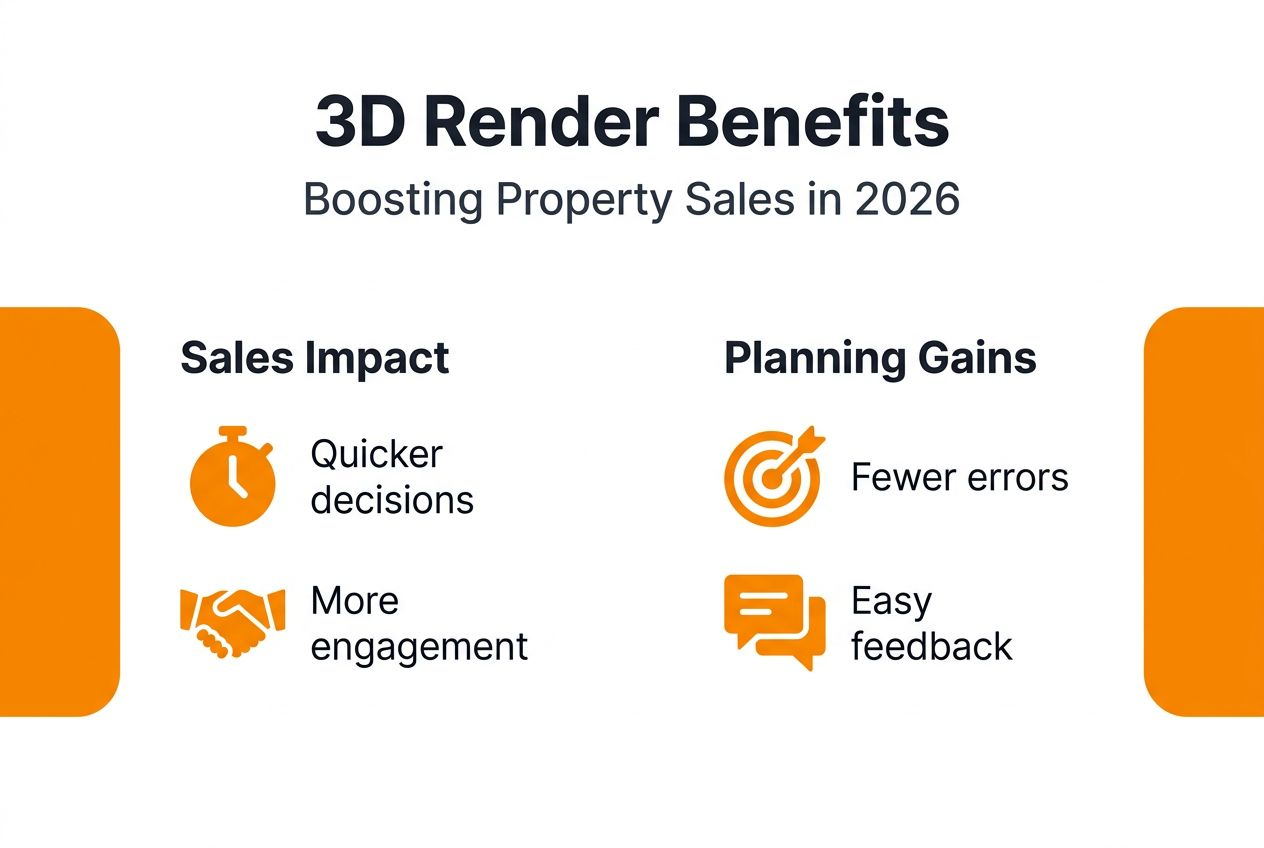
High-quality 3D renders transform your marketing strategy by enabling pre-construction campaigns that generate buyer interest and secure commitments before breaking ground. This early engagement improves cash flow, reduces financial risk, and validates design decisions with real market feedback.
Pre-sales campaigns powered by immersive exterior renders allow prospective buyers to visualize finished properties months or even years ahead of completion. When you present a compelling visual narrative, uncertainty evaporates. Buyers gain confidence in their investment, and you close deals faster. Studies indicate that 3D renders can increase pre-sales speed by 30-50%, a significant competitive advantage in fast-moving markets.
Renders support multiple marketing channels simultaneously. Your visuals can populate websites, digital ads, brochures, billboards, and virtual tours, creating a cohesive brand experience across touchpoints. This consistency reinforces your message and builds recognition.
To integrate renders into your pre-sales marketing effectively, follow these steps:
- Commission renders early in the design phase to align marketing timelines with project milestones.
- Collaborate with your visualization studio to create a suite of images showcasing key selling points: exteriors, interiors, amenities, and surrounding context.
- Develop a content calendar that releases new visuals progressively, maintaining buyer interest over time.
- Pair renders with compelling narratives that articulate the lifestyle and benefits your property offers.
- Leverage virtual tours and interactive experiences to deepen engagement and provide immersive exploration.
| Benefit | Impact on Sales |
|---|---|
| Reduced buyer uncertainty | Clearer design intent accelerates purchase decisions |
| Pre-construction marketing | Generates commitments and revenue before completion |
| Multi-channel versatility | Consistent visuals across platforms amplify reach |
| Faster sales cycles | Improved cash flow and client satisfaction |
By positioning renders as the cornerstone of your marketing efforts, you transform abstract plans into tangible experiences that drive buyer action. Explore 3D modeling for real estate to understand how detailed models underpin effective visualization strategies.
Risk reduction and planning benefits
Beyond marketing, high-quality 3D renders serve as powerful risk mitigation tools. When stakeholders can visualize a project accurately before construction begins, you identify design issues, material conflicts, and spatial inefficiencies early. This foresight prevents costly onsite changes and delays.

Early design adjustments enabled by accurate renders save time and money. A 75% reduction in post-construction changes is achievable when stakeholders review and approve designs through detailed visualizations. Instead of discovering problems after walls are framed and systems installed, you refine details while changes remain inexpensive.
Improved stakeholder alignment accelerates approvals. Investors, municipal planners, and community boards respond more positively to photorealistic renders than technical drawings. When everyone shares the same vision, approvals proceed smoothly, and project timelines stay on track.
Detailed interior renders assist in spatial planning and material choices. You can experiment with finishes, furniture layouts, and lighting schemes virtually, evaluating options without physical mockups. This flexibility ensures the final built environment meets both functional requirements and aesthetic goals.
Pro Tip: Collaborate closely with your visualization studio to iterate early and often. Frequent feedback loops during the design phase maximize the value of renders and minimize surprises later. The cost savings in avoiding post-construction revisions far outweigh the investment in quality visualization.
Beyond financial savings, renders improve communication across project teams. Architects, engineers, contractors, and clients all benefit from a shared visual reference that clarifies intent and reduces misunderstandings. Explore architectural visualization services to see how professional studios facilitate this collaborative process.
Common pitfalls and misconceptions
Even with the best technology, renders can fall short if you overlook critical factors. Understanding common mistakes helps you avoid wasted investment and underperforming visuals.
Overemphasis on technical detail without emotional or environmental context reduces impact. A geometrically perfect render that lacks warmth, life, or believable surroundings won’t engage buyers. Balance precision with storytelling to create images that resonate both intellectually and emotionally.
Delaying render creation until late design stages misses early marketing opportunities. By waiting, you forfeit the chance to generate pre-construction interest and secure funding commitments. Integrate visualization early to maximize its strategic value.
Using generic render styles without considering your target audience lessens buyer connection. A luxury condo requires a different visual approach than a suburban family home. Tailor your renders to the preferences, aspirations, and expectations of your specific buyer demographic.
Ignoring landscaping and proper lighting diminishes realism and persuasiveness. A building floating in a void or lit by flat, artificial light fails to convince. Invest in environmental context and lighting that mirrors real-world conditions.
A common misconception is that technical accuracy alone drives buyer engagement. In reality, emotional resonance matters just as much. Buyers respond to visuals that make them feel something, not just images that document dimensions accurately.
Avoiding these pitfalls boosts your return on investment in rendering services. By approaching visualization strategically and collaborating with experienced professionals, you ensure your renders deliver maximum impact. Review architectural visualization best practices for architects to deepen your understanding of effective visualization strategies.
Conclusion and practical next steps
Three-dimensional renders have become indispensable tools for architects and real estate developers seeking to communicate vision, accelerate sales, and mitigate risk. They bridge the gap between technical plans and buyer perception, transforming abstract concepts into compelling visual narratives that drive engagement and decision-making.
To leverage renders effectively in your projects:
- Collaborate early with professional visualization studios to integrate renders into your design and marketing timelines.
- Balance quality, budget, and project goals by selecting the right level of detail and scope for each deliverable.
- Plan for iterative feedback, allowing stakeholders to review and refine visuals before finalizing designs.
- Use both exterior and interior renders strategically, tailoring each to highlight the unique strengths of your property.
- Integrate renders across marketing channels to create a cohesive, multi-touchpoint campaign that maximizes reach.
By treating renders as strategic investments rather than optional add-ons, you position your projects for success in competitive markets. The combination of technical precision, emotional storytelling, and early stakeholder engagement creates a powerful formula for reducing risk, accelerating sales, and enhancing project outcomes.
Explore architectural visualization services to see how professional studios can elevate your projects. Learn how to create 3D renderings professionally to understand the workflow and collaboration process.
Elevate your real estate marketing with expert 3D rendering services
Rendimension specializes in photorealistic 3D rendering that transforms architectural concepts into compelling visual experiences. Our team works closely with architects and real estate developers across North America to create images that captivate buyers, accelerate sales cycles, and reduce project risks. With over 1,000 projects completed globally, we understand the unique challenges you face and deliver tailored solutions that align with your budget and timeline.
Whether you need immersive exterior renders to launch a pre-construction campaign or detailed interior visualizations to finalize design decisions, our collaborative process ensures precision and emotional impact. Discover how to create 3D renderings professionally and explore our architectural visualization portfolio to see the difference expert rendering makes. Schedule a consultation today to elevate your next project.
FAQ
What is the difference between exterior and interior 3D renders?
Exterior renders emphasize natural lighting, building facades, landscaping, and environmental integration to showcase how a property fits within its surroundings. Interior renders focus on artificial lighting, materials, furniture, and spatial details to convey livability and comfort. Each type requires distinct technical approaches and serves different marketing purposes. Review 3D rendering best practices to understand how to optimize both for maximum impact.
How do 3D renders reduce construction and planning risks?
Renders improve stakeholder understanding by providing clear, photorealistic previews of design intent before construction begins. This clarity enables early identification of design issues, material conflicts, and spatial inefficiencies, allowing you to make adjustments when changes remain inexpensive. The result is fewer post-construction revisions, significant cost savings, and smoother project timelines. Explore architectural visualization to see how professional studios facilitate this risk mitigation.
When should I integrate 3D rendering into my real estate project?
Integrate renders during the early design phase to maximize marketing impact and facilitate stakeholder feedback. Early visualization enables pre-construction campaigns, accelerates approvals, and reduces the risk of costly late-stage revisions. Delaying render creation limits your ability to generate buyer interest and secure commitments before breaking ground. Learn how to create 3D renderings professionally to understand optimal timing and workflow integration.
What common mistakes should I avoid with 3D real estate renders?
Avoid focusing solely on technical detail without incorporating emotional storytelling, environmental context, or appropriate lighting. Generic render styles that ignore your target audience reduce buyer connection and engagement. Delaying render creation until late design stages forfeits early marketing opportunities and increases revision risk. Prioritize collaboration with experienced visualization studios to ensure your renders balance precision with emotional resonance. Study architectural visualization best practices for architects to refine your approach.
Recommended
- 3D Modeling For Real Estate: Boosting Sales And Engagement
- Why Use 3D Renderings: Impact On Architecture And Real Estate
- 3D Rendering Best Practices: 35% More Client Buy-in In 2026
- Why Architectural Visualization Drives Real Estate Sales
- Understanding the Benefits of a House with Insulation – WorkWearComfort
- How to Increase Home Value with Exterior Upgrades | Sabatalo Contracting