Why Visualization Matters in Construction

Why Visualization Matters in Construction Projects
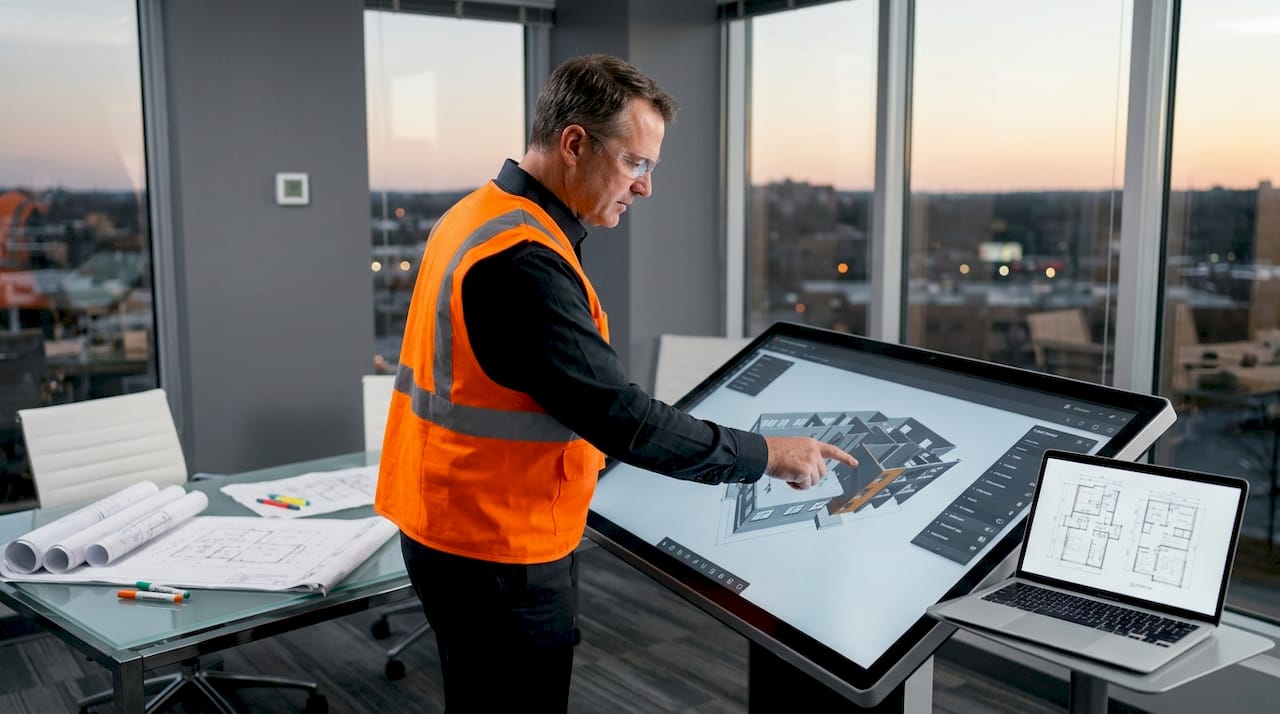
TL;DR:
- Construction visualization, especially BIM, significantly reduces rework costs by detecting clashes early and improving coordination. It also enhances collaboration and decision-making among stakeholders through real-time, immersive tools like VR and cloud platforms. Integrating visualization throughout all project phases maximizes operational efficiency, minimizes errors, and boosts overall project outcomes.
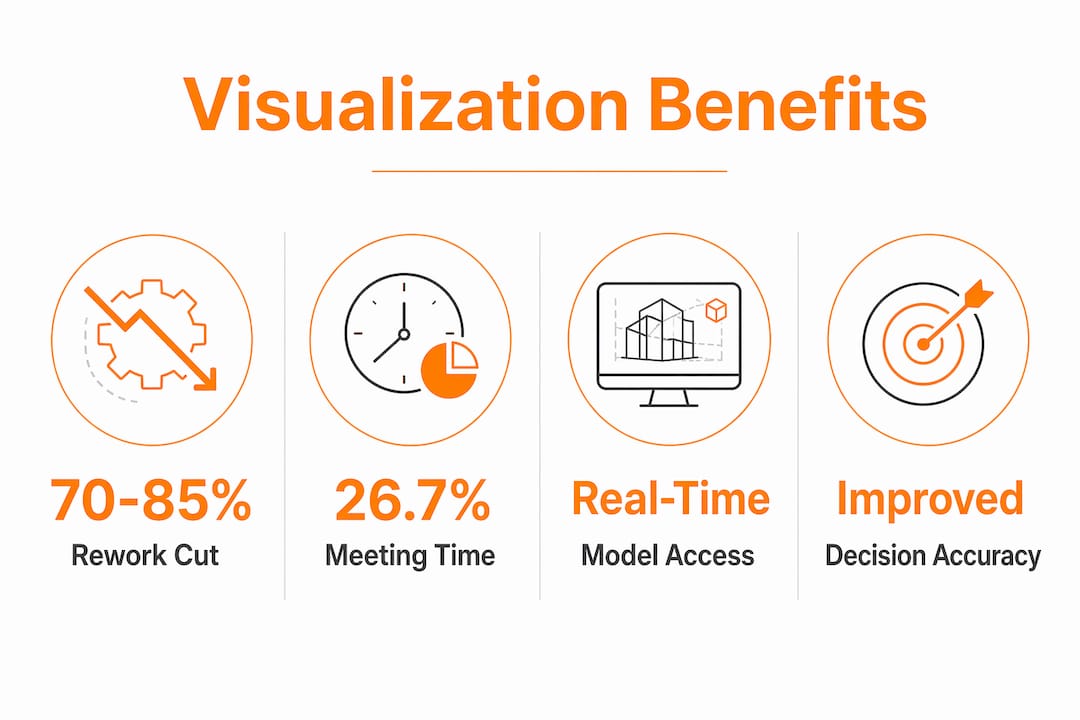
Most construction professionals assume visualization is a presentation tool: something you show clients before breaking ground, then set aside. That assumption is expensive. Research shows that construction teams using BIM-driven visualization see 70–85% reductions in rework time compared to traditional documentation methods. Understanding why visualization matters in construction goes far deeper than aesthetics. It directly determines whether your project finishes on time, on budget, and with the coordination quality your stakeholders expect.
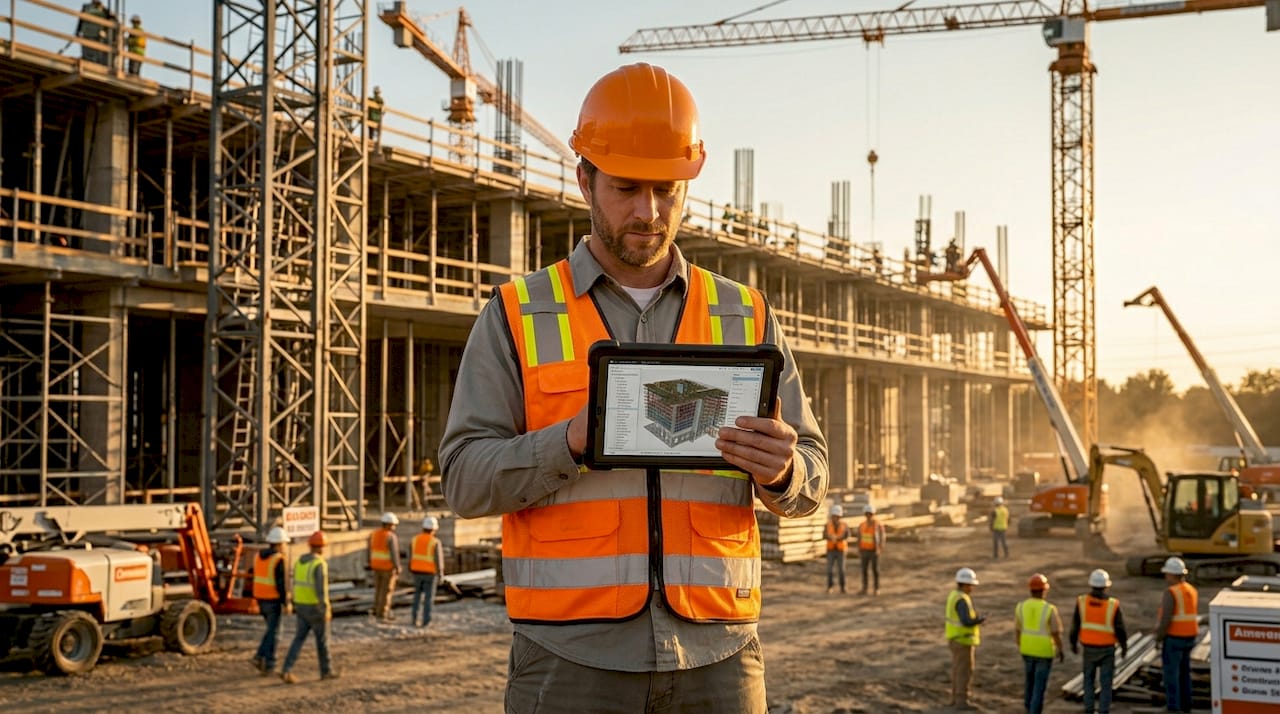
Key Takeaways
| Point | Details |
|---|---|
| Rework reduction is measurable | BIM visualization cuts rework time by 70–85% and rework costs by 65–75% on documented projects. |
| Clash detection saves real money | Resolving clashes before construction begins prevents volumetric conflicts and eliminates costly field corrections. |
| VR accelerates team decisions | Immersive multiuser VR reduces meeting duration by 26.7% and improves decision accuracy versus standard platforms. |
| Cloud tools align dispersed teams | Real-time model sharing through cloud BIM platforms reduces fragmented communication and speeds coordination. |
| Visualization earns ROI through workflow links | Visual data produces the highest return when tied to QA/QC sign-offs, coordination, and fabrication commitments. |
Why visualization matters in construction: core techniques
Construction visualization is the industry term for any method that converts design intent into spatial representations that teams and stakeholders can interpret without specialized reading of technical drawings. The range of tools available today is broader than most project teams realize. Multiple visualization modalities now exist, from immersive VR and augmented reality overlays to robotic layout tools, digital projection systems, and full-scale printed floor plans that allow stakeholders to walk through a space before a single wall goes up.
The most operationally significant framework is Building Information Modeling, or BIM. It is worth understanding BIM not just as a 3D coordination tool but as a dimensional spectrum. A 3D BIM model handles spatial geometry. 4D and 5D BIM integrations layer in scheduling and cost data respectively, allowing project managers to simulate construction sequences, identify sequencing conflicts early, and monitor budget performance against physical progress. That combination alone transforms what visualization can do for a project team.
Here is a quick comparison of the core visualization technologies and where each earns its place in a construction workflow:
| Technology | Primary Use | Key Benefit |
|---|---|---|
| 3D BIM Modeling | Spatial coordination and clash detection | Surfaces conflicts before field work begins |
| 4D BIM (schedule-linked) | Construction sequencing and timeline simulation | Identifies scheduling conflicts early |
| 5D BIM (cost-linked) | Budget monitoring and earned value analysis | Connects physical progress to cost performance |
| Virtual Reality (VR) | Immersive walkthroughs and stakeholder review | Improves decision accuracy and meeting efficiency |
| Augmented Reality (AR) | On-site overlay of design over physical space | Supports real-time QA/QC and layout verification |
| Cloud BIM platforms | Real-time team collaboration and issue tracking | Reduces fragmented communication across disciplines |
The pattern here is clear. Each technology targets a specific failure mode in traditional construction workflows. Spatial conflicts, scheduling drift, cost variance, miscommunication. Visualization does not eliminate these risks, but it moves them to a point in the project timeline where correction is relatively cheap.
How visualization cuts errors and rework
The financial argument for construction visualization is not theoretical. It is documented at project scale. BIM adoption in bridge construction produced 65–75% cost savings on rework, along with measurable improvements in both schedule performance and cost performance indices. Those numbers represent real budget recovery on projects where rework had previously consumed significant contingency reserves.
Clash detection is the mechanism behind much of that savings. A multi-stakeholder BIM approach on a G+19 high-rise building resolved 5,534 clashes during the design phase, reducing structural volumetric conflicts from 0.124 cubic meters to 0.097 cubic meters before field crews ever arrived. That is not a marginal improvement. Each unresolved clash in the field triggers a cascade: work stoppage, subcontractor coordination, potential redesign, and delay. Catching 5,500 of them in a model session costs a fraction of what they would cost in steel and concrete.
Visualization also addresses problems that are harder to quantify but equally destructive to project outcomes:
- Miscommunication between disciplines when structural, MEP, and architectural teams work from separate drawing sets
- Scope interpretation errors where contractors build from their understanding of intent rather than the actual design
- Late-stage design changes triggered by stakeholders who did not grasp the spatial implications of early decisions
- Fabrication conflicts when shop drawings diverge from coordination models
- Site safety risks that could have been spotted in a simulated construction sequence
Visual intelligence powered by spatial AI is pushing this capability further. Automated image capture mapped to spatial coordinates creates a continuous visual record of site conditions. That record can surface deviations from the model before they become embedded in the structure, which is the difference between a correctable deviation and a destructive one.
Pro Tip: Do not treat visualization as a phase deliverable. The teams that see the highest returns integrate it as a live workflow tool throughout design, coordination, and construction. A visualization that does not connect to a decision or a commitment produces documentation, not outcomes.
Collaboration and communication through visual tools
One of the most underappreciated benefits of construction visualization is what it does for people who are not designers. Owners, investors, regulatory reviewers, and end users all need to make decisions about a building they cannot yet see. When those decisions rest on 2D drawings, the cognitive translation burden falls on the person least equipped to carry it. Errors of interpretation follow.
Cloud BIM tools reduce that burden by giving every stakeholder a real-time view of the same model. Issue tracking is centralized. Changes are visible immediately. Accountability is shared because everyone works from the same source of truth rather than emailing PDFs and hoping everyone has the latest version. That infrastructure change alone has measurable impact on coordination quality in large infrastructure projects.
The case for immersive VR in team collaboration is even more specific. A study of ten remote AEC teams found that multiuser VR reduced meeting duration by 26.7% while improving decision accuracy compared to standard BIM platform collaboration. The reason is not simply that VR looks impressive. It is that shared virtual environments give every participant the same spatial understanding simultaneously. Avatars, visual markup tools, and spatial navigation compress the coordination cycle by eliminating debates over model interpretation.
Here is a practical sequence for how visualization improves collaboration at each project phase:
- Pre-design review. Use 3D massing models and site studies to align stakeholders on project intent before detailed design begins, catching fundamental disagreements early.
- Design coordination. Run federated BIM clash detection sessions across structural, architectural, and MEP disciplines on a defined cadence.
- Stakeholder sign-off. Present VR walkthroughs to owners and end users so spatial decisions reflect genuine understanding, not assumption.
- Construction phase. Use cloud platforms to connect field teams to live model updates, linking RFIs and submittals to specific model elements.
- QA/QC verification. Compare captured site imagery against the coordination model to validate completed work before covering elements.
Pro Tip: When onboarding non-technical stakeholders to a BIM review, do not start with the full federated model. Start with a VR walkthrough. Once they understand the spatial reality of the design, the technical coordination conversations become far more productive.
The benefits of construction visualization become most visible when you consider what fragmented workflows cost. A 2024 industry analysis found that cost estimation errors frequently stem from incomplete scope interpretation, exactly the category of problem that clear visualization addresses at the source.
Practical applications and future trends
Visualization in project management has historically been a reporting mechanism: progress photos, schedule bars, earned value curves. The shift happening now is that visual data is becoming a decision platform. Automated capture and AI-driven location mapping create continuous jobsite records that do not require human effort to produce and do not rely on scheduled walkthroughs. Risk surfaces when it exists, not when someone decides to look for it.
The distinction between passive visualization and active visual intelligence is worth understanding in concrete terms:
| Capability | Passive Visualization | Active Visual Intelligence |
|---|---|---|
| Progress tracking | Photo documentation on request | Automated capture mapped to model coordinates |
| Risk identification | Reactive, spotted during review | Proactive, flagged by spatial deviation analysis |
| Decision support | Supports reporting | Drives commitments and sign-offs |
| Integration | Standalone deliverable | Embedded in QA/QC, fabrication, and coordination workflows |
The highest ROI from any visualization investment comes when visual data links to workflow commitments: coordination sign-offs, QA/QC approvals, fabrication releases. A 3D rendering that sits in a folder produces nothing. The same visual data connected to a decision gate produces accountability, speed, and measurable quality outcomes.
For teams evaluating which visualization tools to adopt, project scale and complexity are the most reliable guides. A residential project benefits most from 3D renders and VR walkthroughs that speed client approval and reduce change orders. A large commercial or infrastructure project requires federated BIM with clash detection, 4D scheduling integration, and cloud collaboration as a baseline. Multiuser immersive VR is most valuable where remote coordination is frequent and decisions are high-stakes.
My take on visualization’s real value in construction
I have seen the full range of how construction teams use visualization, from teams that treat it as a marketing tool to teams that have genuinely restructured their coordination workflows around it. The gap in outcomes between those two groups is not small.
What I have found is that the teams who get the most from visualization are the ones who treat it as a surface for decisions, not a deliverable for reporting. The moment a visual becomes something you produce to show someone rather than something you use to decide something, it loses most of its operational value. The research on visual intelligence confirms this: highest ROI happens when visualization is anchored to physical context and linked to commitments downstream.
The other thing most teams underestimate is the collaboration effect. I have watched immersive shared environments compress coordination cycles in ways that no amount of better documentation achieves. When everyone in a room shares the same spatial understanding, arguments about interpretation disappear. Decisions that would take three meeting cycles happen in one.
My honest view is that visualization maturity is now a competitive differentiator in construction. Teams that integrate it early, connect it to workflows, and use it as a shared decision surface will consistently outperform teams that use it as a presentation layer. The evidence is clear. The only question is how quickly your organization makes the shift.
, Rendimension
How Rendimension brings construction visualization to life
At Rendimension, we have delivered over 1,000 visualization projects across residential, commercial, and infrastructure developments globally. Our 3D rendering services are built specifically for the needs construction professionals face: tight timelines, multiple stakeholders, and zero room for misinterpretation. We translate complex design intent into photorealistic renders, immersive VR walkthroughs, and collaborative visual assets that connect directly to decision-making at every project phase. If your team is dealing with slow stakeholder approvals, costly scope misunderstandings, or coordination breakdowns, our architectural visualization services give you the tools to solve those problems before they hit the field. Contact Rendimension to find out how the right visual strategy changes project outcomes.
FAQ
What is construction visualization?
Construction visualization refers to any method that converts design intent into spatial representations, including 3D models, BIM, VR, AR, and digital projections. These tools help project teams and stakeholders understand a design before construction begins.
How does visualization reduce rework in construction?
BIM-driven visualization enables clash detection and early conflict resolution, which reduces rework time by 70–85% and cuts rework costs by 65–75% on documented projects. Problems caught in the model cost far less to fix than problems caught in the field.
Why use 3D models in construction projects?
3D models give every team member and stakeholder a shared spatial reference, which reduces interpretation errors, speeds approvals, and surfaces coordination conflicts before they become field problems. The coordination benefits of 3D visualization are measurable across project types and scales.
How does VR improve collaboration in construction?
Multiuser VR environments reduce meeting duration by 26.7% and improve decision accuracy by giving distributed teams identical spatial context simultaneously. Shared avatars, visual markup, and spatial navigation eliminate debates over model interpretation.
When should visualization be integrated into a construction project?
Visualization earns the most value when integrated before field work begins, during design and coordination phases. Early integration surfaces clashes and rework risks at a point in the timeline where corrections are a fraction of the cost of field fixes.
Recommended
- Why Visualization Matters In Architecture: Enhance Engagement
- Construction Visualization: Real Savings, Fewer Mistakes
Related guides
Frequently asked questions
What is construction visualization?
Construction visualization refers to any method that converts design intent into spatial representations, including 3D models, BIM, VR, AR, and digital projections. These tools help project teams and stakeholders understand a design before construction begins.
How does visualization reduce rework in construction?
BIM-driven visualization enables clash detection and early conflict resolution, which reduces rework time by 70–85% and cuts rework costs by 65–75% on documented projects. Problems caught in the model cost far less to fix than problems caught in the field.
Why use 3D models in construction projects?
3D models give every team member and stakeholder a shared spatial reference, which reduces interpretation errors, speeds approvals, and surfaces coordination conflicts before they become field problems. The coordination benefits of 3D visualization are measurable across project types and scales.
How does VR improve collaboration in construction?
Multiuser VR environments reduce meeting duration by 26.7% and improve decision accuracy by giving distributed teams identical spatial context simultaneously. Shared avatars, visual markup, and spatial navigation eliminate debates over model interpretation.
When should visualization be integrated into a construction project?
Visualization earns the most value when integrated before field work begins, during design and coordination phases. Early integration surfaces clashes and rework risks at a point in the timeline where corrections are a fraction of the cost of field fixes.