Why Use Photorealistic Renders in Architecture

Bold design proposals often spark excitement, but translating architectural visions into truly convincing client presentations presents a challenge. In the competitive world of American real estate and architecture, the ability to showcase lifelike visuals that capture every detail is becoming essential. By harnessing advanced photorealistic rendering, professionals gain access to a digital toolbox that offers immersive, accurate previews of their projects. This article explains key technologies and best practices that empower your presentations to bridge the gap between imagination and reality.
Table of Contents
- Defining Photorealistic Renders And Key Concepts
- How Photorealistic Renders Are Created
- Types And Applications In Architecture And Real Estate
- Enhancing Communication And Marketing Impact
- Reducing Errors And Accelerating Project Approvals
Key Takeaways
| Point | Details |
|---|---|
| Photorealistic Rendering Enhances Visualization | This technique provides stakeholders with lifelike visual experiences that aid in design comprehension and decision-making. |
| Advanced Technologies Drive Realism | Utilizing algorithms like Ray Tracing and Physically Based Rendering (PBR) significantly improves the accuracy of light and material simulations. |
| Facilitates Effective Communication | Photorealistic renders eliminate misunderstandings and help build emotional connections with potential clients by showcasing design intent clearly. |
| Reduces Errors and Speeds Up Approvals | Accurate visualizations identify design inconsistencies early, streamlining communication and accelerating approval processes. |
Defining Photorealistic Renders and Key Concepts
Photorealistic rendering represents a sophisticated digital visualization technique that transforms architectural concepts into incredibly lifelike visual representations. By leveraging advanced computer graphics technologies, architects can now generate images that are virtually indistinguishable from actual photographs.
At its core, photorealistic architectural visualization involves creating three-dimensional digital images that accurately simulate real-world lighting, materials, textures, and spatial relationships. This technique goes far beyond traditional architectural drawings by providing immersive, highly detailed representations that enable stakeholders to experience design concepts before physical construction begins.
The key components of photorealistic rendering include several critical technical elements:
- Physically Based Rendering (PBR) algorithms
- Advanced light scattering simulation
- Precise material property modeling
- High-resolution texture mapping
- Complex ray tracing technologies
These sophisticated techniques allow architects and designers to produce images with extraordinary visual fidelity. Physically accurate light modeling enables renders that capture subtle nuances like soft shadows, reflective surfaces, and atmospheric conditions with remarkable precision.
Here’s a summary of key technologies that drive photorealistic architectural rendering:
| Technology | Role in Rendering | Business Value |
|---|---|---|
| Ray Tracing | Simulates light paths for realism | Enables lifelike visual presentations |
| PBR (Physically Based Rendering) | Models light-material interaction | Delivers accurate material appearances |
| Texture Mapping | Applies detailed surface visuals | Enhances client engagement and trust |
| Light Scattering Simulation | Reproduces natural light effects | Improves design evaluation quality |
| Advanced GPUs | Accelerate complex rendering algorithms | Reduces project delivery timelines |
Photorealistic rendering transforms abstract design concepts into tangible visual experiences, bridging the gap between imagination and reality. By providing stakeholders with hyperrealistic previews, these digital representations facilitate better communication, more informed decision-making, and enhanced project visualization.
Pro Tip: When selecting a rendering approach, prioritize technologies that offer the most accurate physical light and material simulations to achieve maximum photorealistic quality.
How Photorealistic Renders Are Created
Photorealistic rendering is a complex digital process that transforms architectural concepts into incredibly realistic visual representations. Architects and designers leverage advanced computational techniques to create images that are virtually indistinguishable from actual photographs.
Physically based rendering techniques mathematically model the intricate interactions between light, materials, and surfaces. This sophisticated approach involves several critical technical stages:
- Developing detailed 3D scene models
- Assigning precise physical properties to materials
- Simulating realistic light sources
- Calculating complex light transport paths
- Rendering reflections, refractions, and shadows
The rendering workflow typically follows a systematic progression. Architects begin by constructing a comprehensive digital model of the proposed structure, meticulously defining every architectural element’s geometric and material characteristics. Advanced rendering architectures then process these models, breaking them down into micro-level details that capture subtle nuances of texture, transparency, and surface interaction.
Modern rendering technologies employ complex algorithms like ray tracing, which mathematically track light rays as they move through the virtual environment. These algorithms calculate how light bounces, reflects, and transforms when interacting with different surfaces, creating images with unprecedented levels of visual accuracy and atmospheric depth.

Pro Tip: Invest in high-performance computing hardware with robust graphics processing capabilities to significantly reduce rendering time and improve overall image quality.
Types and Applications in Architecture and Real Estate
Architectural visualization has evolved into a powerful communication tool with multiple specialized rendering types that serve diverse professional needs. Architectural renderings span a wide range of applications, each designed to provide unique insights into design concepts and spatial experiences.
The primary types of photorealistic architectural renders include:
- Exterior Renders: Full building facade representations
- Interior Renders: Detailed room and space visualizations
- Aerial/Contextual Renders: Site and surrounding environment perspectives
- Walkthrough Animations: Immersive movement-based visualizations
- Virtual Reality (VR) Experiences: Interactive 360-degree explorations
These rendering approaches serve critical functions across multiple professional domains. Real estate developers use photorealistic renders to market properties before construction, allowing potential buyers to visualize spaces with unprecedented accuracy. Urban planners leverage these visualizations to communicate complex design proposals, helping stakeholders understand proposed infrastructure and architectural interventions.
Advanced 3D reconstruction technologies now enable architects to create incredibly detailed representations that go beyond traditional static images. These immersive visualizations support decision-making processes by providing stakeholders with realistic previews of proposed designs, helping them understand spatial relationships, material selections, and atmospheric qualities before significant investments are made.
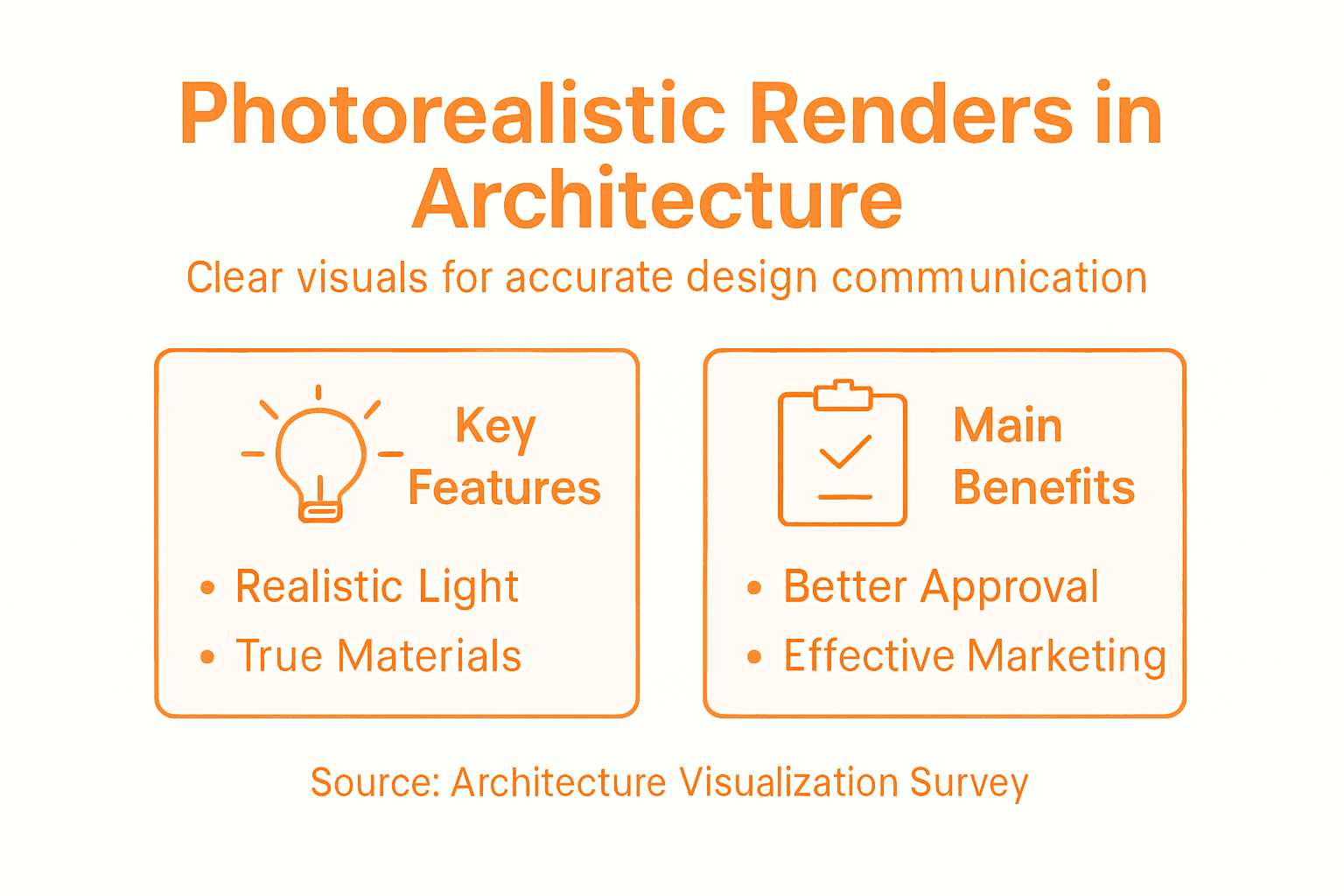
Compare photorealistic rendering applications in architecture and real estate:
| Application Area | Primary Purpose | Stakeholder Benefit |
|---|---|---|
| Design Approval | Visualize proposals before building | Speeds up decision-making |
| Marketing & Sales | Showcase properties to buyers | Boosts pre-construction sales |
| Space Planning | Test layouts and spatial flow | Minimizes costly design changes |
| Urban Planning | Assess community integration | Improves public feedback and buy-in |
Pro Tip: Choose rendering techniques that align specifically with your project’s communication objectives, considering the target audience and desired level of visual detail.
Enhancing Communication and Marketing Impact
Photorealistic rendering has become a transformative communication tool that bridges imagination and reality, providing unprecedented clarity in architectural and real estate presentations. Photorealistic product visualization builds critical client confidence by delivering precise, reliable visual representations that communicate design intent with remarkable accuracy.
The communication and marketing benefits of photorealistic renders include:
- Eliminating misunderstandings about design concepts
- Providing immersive previews of proposed spaces
- Generating emotional connections with potential clients
- Supporting complex design decision-making processes
- Reducing time spent on design revisions
Marketing professionals leverage these visualizations to create compelling narratives around architectural projects. By presenting hyper-realistic imagery, developers and architects can showcase design potential, highlight unique architectural features, and help stakeholders emotionally connect with proposed spaces before physical construction begins.
Effective photorealistic renders transcend traditional marketing materials by offering stakeholders an authentic, detailed preview of architectural concepts. These visualizations enable potential investors, buyers, and project managers to explore spatial relationships, material selections, and design nuances with unprecedented clarity and engagement.
Pro Tip: Invest in high-quality rendering techniques that capture not just visual details, but the emotional atmosphere and potential of your architectural design.
Reducing Errors and Accelerating Project Approvals
Photorealistic rendering has emerged as a powerful tool for minimizing project errors and dramatically accelerating approval processes across architectural and construction industries. Construction planning improvements demonstrate how detailed visual representations can fundamentally transform project communication and decision-making strategies.
The key error-reduction benefits of photorealistic renders include:
- Identifying design inconsistencies before construction
- Providing clear visual communication across stakeholder groups
- Detecting potential structural or spatial conflicts early
- Reducing misinterpretations of technical design documents
- Enabling rapid iterative design modifications
Real-time visualization systems allow architects and clients to interactively explore complex architectural projects in virtual environments. These technologies create unprecedented transparency, enabling stakeholders to examine intricate design details, material selections, and spatial relationships with remarkable precision.
By presenting hyper-realistic, interactive representations, photorealistic renders help streamline regulatory approvals, client consultations, and internal design reviews. The ability to quickly communicate complex design concepts reduces negotiation times, minimizes potential conflicts, and accelerates overall project timelines.
Pro Tip: Develop comprehensive visualization strategies that showcase multiple project perspectives, helping stakeholders fully understand design nuances before formal approval processes.
Bring Your Architectural Visions to Life With Photorealistic Precision
The challenge you face is clear: turning complex architectural concepts into compelling, lifelike visuals that captivate stakeholders and speed up project approvals. The article highlights pain points like reducing misinterpretations, improving client communication, and delivering immersive previews through techniques such as physically based rendering and ray tracing. These goals require a partner who understands the importance of precise light modeling, texture mapping, and high-fidelity visualization to truly elevate your design presentations.
At Rendimension, we specialize in creating high-quality photorealistic 3D renderings and immersive experiences tailored specifically for architecture, real estate, and construction projects. Our collaborative process ensures every detail reflects your vision accurately while helping you avoid costly design errors and accelerate stakeholder buy-in. Experience the power of advanced visualization tools including walkthroughs and virtual reality to communicate your ideas like never before.
Transform your design communication today and stand out with visuals that inspire confidence and fast-track approvals.
Ready to enhance your architectural presentations with stunning photorealistic renders? Visit Rendimension to explore our services and get started on delivering unforgettable visual experiences that truly sell your projects.
Frequently Asked Questions
What are photorealistic renders in architecture?
Photorealistic renders are highly detailed digital visualizations that accurately simulate real-world lighting, materials, and textures, making architectural designs appear almost indistinguishable from actual photographs.
How does photorealistic rendering benefit architectural projects?
Photorealistic rendering helps architects and stakeholders better visualize design concepts, allows for more informed decision-making, and enhances communication throughout the project, minimizing misunderstandings and accelerating approvals.
What technologies are used in photorealistic rendering?
Key technologies include Physically Based Rendering (PBR), ray tracing, texture mapping, and advanced light scattering simulations, which together create lifelike representations of architectural designs.
How can photorealistic renders improve marketing efforts in real estate?
By providing immersive, detailed visuals, photorealistic renders generate strong emotional connections with potential buyers and showcase properties effectively, boosting engagement and pre-construction sales.
Recommended
- Photorealism In Architecture: Transforming Presentations
- Architectural Renders: Transforming Decision-Making
- Role Of Photorealism In Architecture Visualization
- Photorealistic Rendering: Complete 2025 Guide For Architects
- Role of Architect in Renovations – Maximizing Value in Ontario