TL;DR:
- Virtual walkthroughs significantly reduce travel, costs, and environmental impact compared to physical visits.
- They improve stakeholder understanding, accelerate decisions, and enable pre-sales for off-plan projects.
- Combining virtual tours with physical visits offers a hybrid approach maximizing engagement and sensory experience.
Virtual walkthroughs are quietly reshaping how architects and developers present projects, and the numbers are hard to ignore. Teams using remote walkthroughs report 42% less travel time and a 55% drop in CO2 emissions compared to traditional site visit models. That is not a marginal improvement. It is a structural shift in how projects get communicated, approved, and sold. This guide breaks down what virtual walkthroughs actually are, why they outperform static renders and physical models in specific scenarios, and how to use them strategically across your project pipeline.
Table of Contents
- What are virtual walkthroughs and how do they work?
- The top benefits of choosing virtual walkthroughs
- Comparing virtual walkthroughs with physical presentations
- Practical applications: When and how to use virtual walkthroughs
- Our take: What most firms miss about virtual walkthroughs
- Ready to elevate your project presentations?
- Frequently asked questions
Key Takeaways
| Point | Details |
|---|---|
| Save time and costs | Virtual walkthroughs help slash travel, staging, and production costs for architects and developers. |
| Boost project engagement | They create immersive presentations that foster understanding and decision-making among stakeholders. |
| Best for complex projects | Virtual walkthroughs shine in complex, custom, or off-plan scenarios where traditional methods fall short. |
| Hybrid approach matters | Combining virtual and physical touchpoints maximizes impact and minimizes sensory limitations. |
What are virtual walkthroughs and how do they work?
A virtual walkthrough is a digitally rendered, navigable experience of a space that does not yet exist, or one that is difficult to access. Unlike a static render, which captures a single moment, a walkthrough lets stakeholders move through a space, look around, and get a genuine sense of scale, flow, and atmosphere.
There are two main formats to understand:
- Linear animation walkthroughs: A pre-rendered video that guides the viewer through a space along a fixed path. These are polished, cinematic, and easy to share across platforms.
- Interactive virtual tours: Real-time or pre-rendered environments where the viewer controls navigation. These are more resource-intensive to produce but far more engaging for high-stakes presentations.
Both formats rely on the same core pipeline: detailed 3D modeling, texture mapping, lighting simulation, and rendering. Many studios now layer in VR and AR integration, letting clients experience a space through a headset or on a mobile device. Cloud deployment means stakeholders anywhere in the world can access the experience without specialized hardware.
Pro Tip: For early-stage design reviews, a linear walkthrough is often faster and cheaper to produce. Save the interactive tour format for investor presentations and final client approvals where engagement matters most.
Compared to static renders, walkthroughs communicate spatial relationships far more effectively. Compared to physical scale models, they are dramatically cheaper to update when designs change. As noted in industry research, virtual walkthroughs offer reusable digital content and are particularly well-suited to complex or highly customized projects where physical models would be impractical.
If you want to see how these formats translate across project types, explore virtual tour examples that span residential, commercial, and mixed-use developments.
The top benefits of choosing virtual walkthroughs
With a clear understanding of virtual walkthrough technology, it is important to explore the tangible benefits that matter most to architectural and development teams.
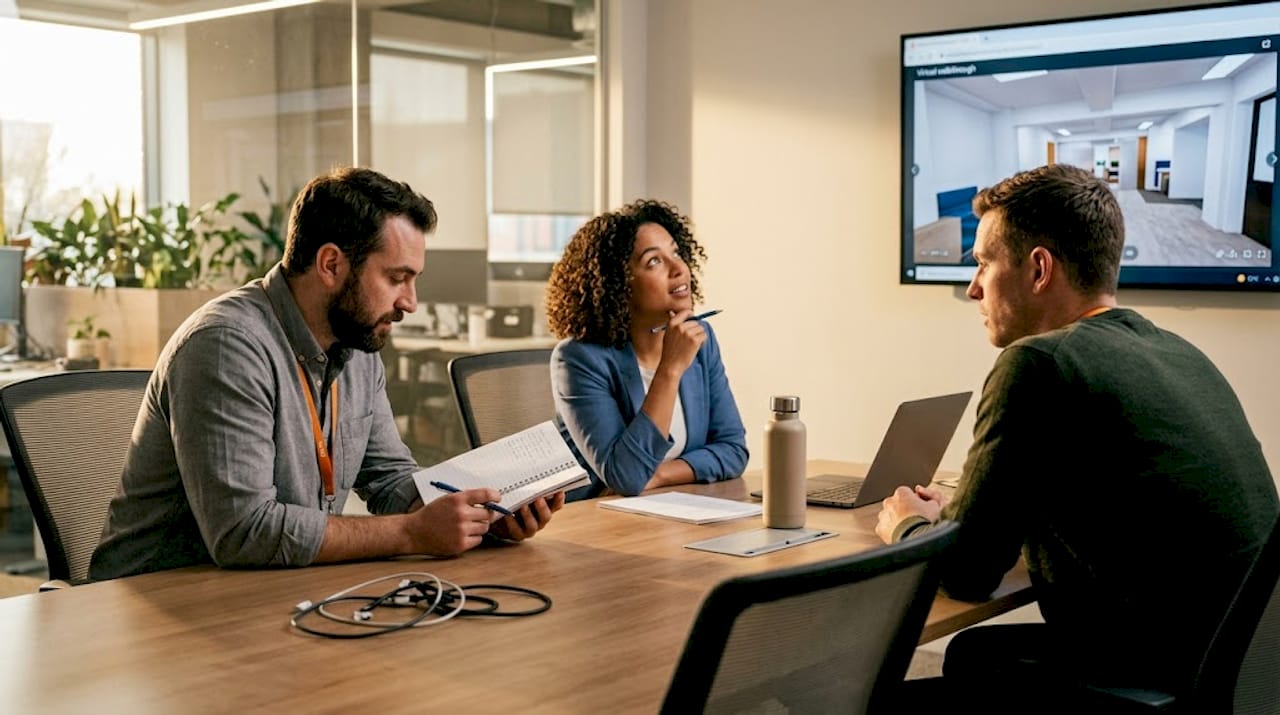
The financial case is straightforward. Physical presentations require travel, staging, printed materials, and often physical model construction. Virtual walkthroughs replace most of that with a one-time digital investment that can be reused, updated, and reshared indefinitely. Research confirms that architects and real estate professionals can reduce travel costs, shorten sales cycles, and pre-sell off-plan units more effectively using virtual tools.
| Benefit | Traditional presentation | Virtual walkthrough |
|---|---|---|
| Travel cost | High, per visit | None after production |
| Update cost | High, rebuild required | Low, model-based edits |
| Global reach | Limited | Unlimited |
| Pre-sales capability | Low | High |
| Environmental impact | High CO2 | Up to 55% lower |
Beyond cost, the speed of stakeholder decisions improves significantly. When a client can actually move through a proposed space rather than interpret a floor plan, ambiguity drops. Fewer revision cycles. Faster sign-offs. That compresses your timeline in ways that directly affect project profitability.
Key advantages at a glance:
- Eliminate physical staging and model-building expenses
- Enable pre-sales and investor pitches before groundbreaking
- Reach international buyers and stakeholders without travel
- Reduce your project’s carbon footprint
- Accelerate decision-making with clearer visual communication
The environmental angle is increasingly relevant for developers working toward sustainability certifications or ESG reporting goals. Fewer flights and site visits add up across a multi-year project lifecycle. Understanding the broader 3D visualization benefits helps teams build the internal case for adopting these tools. For a deeper look at the financial side, the data around visualization savings makes a compelling argument for early adoption.
Comparing virtual walkthroughs with physical presentations
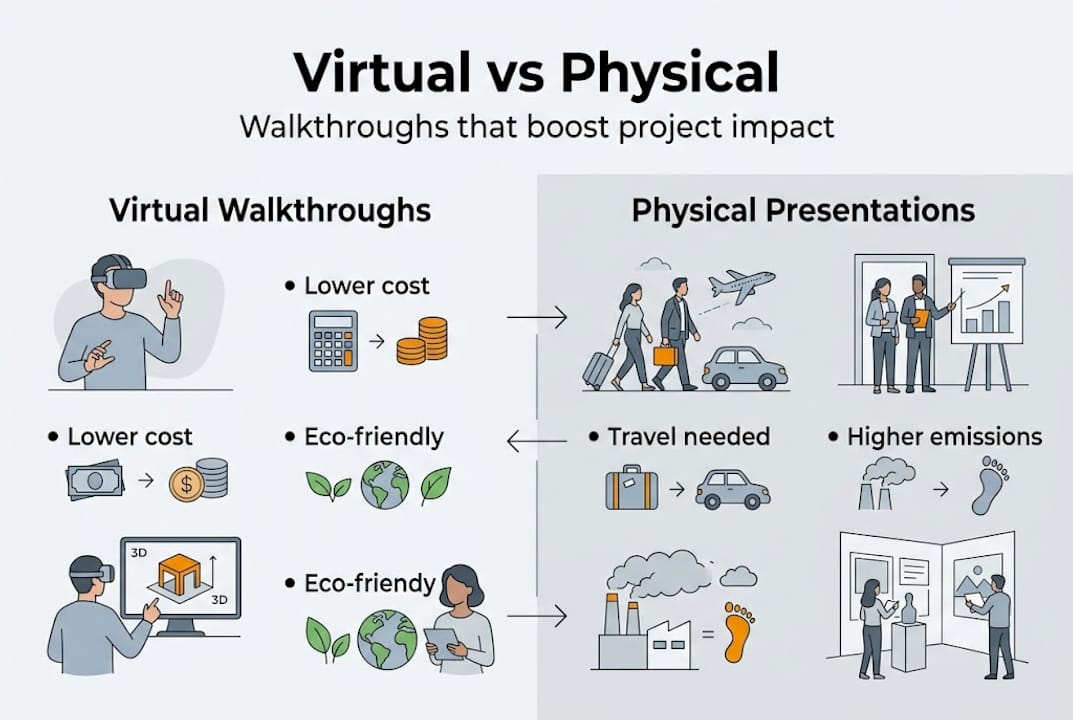
While the benefits are compelling, some architects and developers hesitate due to perceived limitations. Here is how virtual walkthroughs stack up against traditional, physical presentations.
Physical presentations have real strengths. Walking through a completed show unit, touching material samples, and sensing the acoustics of a space are experiences that no screen can fully replicate. For high-value luxury developments, that tactile dimension still matters to certain buyers.
“Physical presentations remain essential for sensory elements, but virtual walkthroughs excel in lead qualification and reaching a broader audience.”
Here is a direct comparison across key dimensions:
| Dimension | Physical presentation | Virtual walkthrough |
|---|---|---|
| Tactile experience | Full | None |
| Geographic reach | Local or costly | Global |
| Update flexibility | Low | High |
| Scheduling complexity | High | Low |
| Pre-construction use | Not possible | Fully viable |
The smartest approach is not choosing one over the other. It is knowing which format serves each project stage:
- Early design phase: Use virtual walkthroughs for internal team alignment and early investor briefings.
- Pre-sales phase: Deploy interactive tours or linear animations for off-plan marketing and remote buyer engagement.
- Final approval phase: Combine a virtual walkthrough with physical material samples and a site visit for high-value decisions.
- Post-completion marketing: Use walkthroughs as evergreen content for listings, social media, and future pitches.
For agents and brokers managing listings, walkthroughs for real estate agents offer a practical framework for integration. Developers managing complex stakeholder groups will find that walkthroughs for project presentations address the specific dynamics of multi-party approvals.
Practical applications: When and how to use virtual walkthroughs
Understanding the comparison points, let us move to practical strategies for integrating virtual walkthroughs into real-world projects.
The most common mistake teams make is treating virtual walkthroughs as a direct replacement for everything physical. They are not. They are a precision tool. Used at the right moment, they accelerate decisions and reduce costs. Used indiscriminately, they can feel impersonal or fail to close the gap that a physical touchpoint would.
Here is a practical decision framework:
- Off-plan sales: Always use virtual walkthroughs. Buyers cannot visit what does not exist yet, and a photorealistic tour dramatically outperforms floor plans and brochures for emotional engagement.
- Large or geographically distributed projects: Virtual walkthroughs allow global stakeholders to stay aligned without coordinating travel across time zones.
- Iterative design feedback: Use walkthroughs to present design iterations to clients. Updating a 3D model is faster and cheaper than rebuilding a physical mockup.
- Hybrid presentations: For high-value or luxury developments, pair a virtual walkthrough with an in-person material review. This captures the efficiency of digital while preserving the sensory credibility of physical.
Research shows that hybrid walkthrough strategies can reduce costs by 32% for developers while improving global engagement. That is a meaningful margin on large-scale projects.
Pro Tip: Always include a narrated version of your virtual walkthrough for stakeholders who will review it asynchronously. A guided audio track dramatically increases comprehension and emotional impact compared to silent navigation.
For teams wanting to see what polished deliverables look like, walkthrough video examples offer a useful benchmark. And for design-focused teams, design presentation walkthroughs show how the format works across different design disciplines.
Our take: What most firms miss about virtual walkthroughs
Most firms adopt virtual walkthroughs and immediately make the same mistake: they treat them as a cheaper version of a site visit. That framing limits the tool’s potential from day one.
A virtual walkthrough is not a substitute for physical presence. It is a different communication channel entirely, one that is better at some things and worse at others. The firms that get the most value from these tools are not the ones who use them to replace in-person meetings. They are the ones who use them to do things that were never possible in person, reaching 50 investors simultaneously, presenting three design options in a single session, or giving a buyer in another country a meaningful experience of a property that has not been built yet.
The other thing high-performing teams do differently is invest in the narrative layer. A technically excellent walkthrough with no story arc, no lighting drama, and no guided focus points is just a 3D model. The teams winning with this format treat the walkthrough like a film. They control pacing, highlight key moments, and build emotional resonance.
If you want to see how that narrative thinking applies to design work specifically, design walkthrough insights are worth reviewing before your next production brief.
Ready to elevate your project presentations?
If the strategies in this article resonate, the next step is working with a team that can execute them at the quality level your projects demand.
Rendimension has delivered 3D walkthrough services across more than 1,000 projects globally, spanning residential towers, commercial campuses, and mixed-use developments. Our virtual walkthrough solutions are built for architects and developers who need presentations that close deals, not just impress in the room. Whether you need a linear animation for a pitch deck or a fully interactive tour for an international buyer audience, we can scope and deliver it. Pair your walkthrough with photorealistic 3D rendering for a complete presentation package that covers every stakeholder touchpoint.
Frequently asked questions
How much can virtual walkthroughs reduce project costs?
Virtual walkthroughs eliminate physical staging and model-building expenses while cutting travel-related costs, with teams reporting savings of up to 42% on travel time and significant reductions in CO2 emissions. The digital asset is reusable across multiple presentations, making the per-use cost drop sharply over time.
Are virtual walkthroughs effective for all project types?
They deliver the strongest results for complex, custom, or off-plan project sales where physical visits are impractical, but high-value luxury developments often benefit from pairing them with in-person material reviews.
What are the main limitations of virtual walkthroughs?
Virtual walkthroughs cannot replicate tactile senses, sounds, or smells, which is why a hybrid approach combining digital tours with targeted physical visits is recommended for premium or sensory-driven properties.
Can virtual walkthroughs help sell properties before they are built?
Yes. They allow buyers and investors to experience off-plan spaces with enough realism to support pre-sales decisions, often shortening the sales cycle significantly compared to floor plans or brochures alone.
Recommended
- 3D Walkthrough Guide: Create Immersive Project Visuals
- 3D Walkthroughs: Transforming Project Presentations
- Virtual apartment tour benefits in Boca Raton | 2.5x views