TL;DR:
- VR tours significantly reduce days on market and rework costs in property development.
- They enhance client understanding, confidence, and decision-making through immersive experiences.
- High initial costs and sensory limitations restrict VR’s use for lower-value or simple properties.
Virtual reality tours were once dismissed as expensive novelties with limited practical upside. That perception is fading fast. Research shows that VR tours reduce days on market from 34 to 19, nearly cutting selling time in half, while simultaneously giving buyers more accurate property information without overstating a home’s appeal. For developers and architects, this is not a minor marketing tweak. It represents a fundamental shift in how projects are sold, validated, and refined. This guide breaks down the real ROI, practical workflow, honest limitations, and the strategic moves that separate firms who get results from those who simply follow trends.
Table of Contents
- The business case for virtual reality tours
- How VR enhances design understanding and client engagement
- Potential challenges and limitations of VR tours
- Best practices for adopting VR in real estate development and architecture
- What most experts miss about VR in property marketing
- Take your property presentations to the next level with Rendimension
- Frequently asked questions
Key Takeaways
| Point | Details |
|---|---|
| Accelerated sales | Virtual reality tours can almost halve days on market for properties. |
| Major cost savings | VR reduces the need for expensive physical mockups and rework. |
| Improved client engagement | Immersive tours help clients visualize and commit, especially for unbuilt projects. |
| Be aware of limits | High upfront costs and sensory gaps mean VR is best for high-value or complex developments. |
The business case for virtual reality tours
The financial argument for VR tours is stronger than most developers initially expect. The obvious benefit is faster sales. Cutting days on market from 34 to 19 means reduced carrying costs, faster capital recycling, and fewer price reductions needed to close a deal. But the financial picture goes much deeper than accelerated transactions.
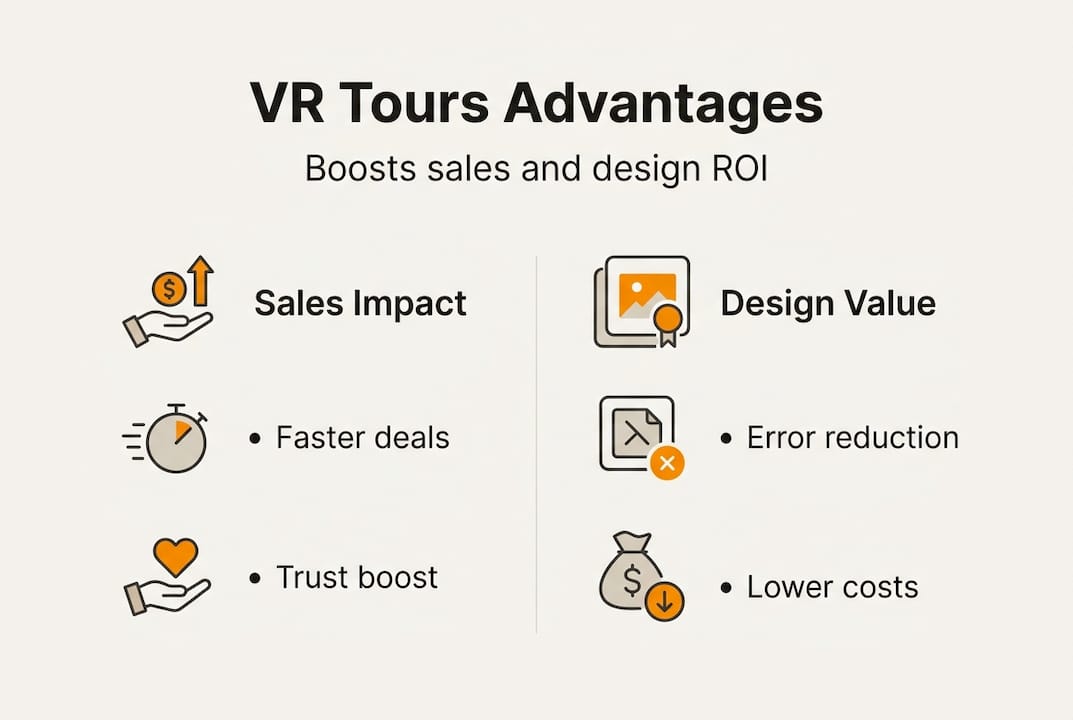
Physical scale models and sample apartments have long been standard practice for pre-selling major developments. A well-built show apartment in a prime city can cost anywhere from $150,000 to $500,000 when you factor in fit-out, furnishings, and ongoing maintenance. VR eliminates much of that spend. In the Stonebridge Marriott case study, VR adoption saved $45,000 on physical mockup costs alone, while also reducing construction rework by cutting design errors early in the process. That rework reduction is significant: construction rework typically accounts for 5 to 12% of total construction costs, meaning a $10 million project could bleed $500,000 to $1.2 million in preventable corrections.
The market is responding to these economics. The global virtual tour sector is growing at 27.9% CAGR and is projected to reach $7.9 billion by 2035, driven significantly by real estate and property development adoption. That level of growth reflects industry-wide recognition that VR is now operational infrastructure, not a novelty.
Here is a side-by-side comparison of traditional versus VR-enabled marketing workflows:
| Factor | Traditional approach | VR-enabled approach |
|---|---|---|
| Physical mockup cost | $150,000 to $500,000+ | Eliminated or significantly reduced |
| Days on market (avg.) | 34 days | 19 days |
| Design rework risk | 5 to 12% of build cost | Substantially reduced |
| Pre-sale capability | Limited without completed unit | Full pre-sale of unbuilt units |
| Geographic reach | Local or traveling buyers only | Global buyer access |
The key ROI drivers for developers and architects include:
- Faster pre-sales: Buyers can commit to off-plan purchases with confidence, enabling you to secure financing earlier
- Reduced physical staging costs: One high-quality VR experience replaces multiple physical room setups
- Fewer change orders: Design flaws caught in VR cost a fraction of what they cost on site
- Wider buyer reach: International investors can tour properties without traveling
- Stronger investor presentations: Stakeholders respond better to immersive previews than flat renders
You can explore how leading firms apply these principles through virtual tour examples that illustrate different scales and property types.
Pro Tip: If you are launching a luxury residential tower or a mixed-use commercial development, introduce VR tours in the pre-launch phase, at least six months before construction completes. This gives you a genuine pre-sales window and often allows you to secure deposits before competitors even begin traditional marketing.
How VR enhances design understanding and client engagement
Financial ROI is only one dimension of VR tours. The less-discussed but equally powerful benefit is what VR does to the decision-making process itself. When clients can physically walk through a space that does not yet exist, their confidence in purchase decisions increases dramatically, and the number of late-stage design changes drops sharply.
Research published in sustainability-focused architecture journals found that immersive BIM and VR combinations deliver 80% better spatial understanding compared to traditional 2D plans and static renderings. That is not a marginal improvement. Buyers who understand space accurately make faster decisions, raise fewer objections during contract negotiation, and submit far fewer post-purchase modification requests. For developers managing large-scale pre-sales, this is a workflow-transforming advantage.
Here is how a typical VR-assisted pre-sale meeting unfolds in practice:
- Model preparation: The design team exports the current BIM or CAD model into a VR-compatible format, ensuring materials, lighting, and proportions match the intended build specifications
- Hardware setup: The client meeting room is equipped with standalone VR headsets, ideally untethered models that allow freedom of movement without cable hazards
- Guided walkthrough: A design or sales representative walks the buyer through the space, narrating key design features, pointing out ceiling heights, natural light angles, and material finishes
- Interactive modifications: In more advanced setups, clients can swap materials, change fixture colors, or toggle between layout options in real time, a capability that collapses weeks of back-and-forth emails into a single meeting
- Documented feedback: All client comments during the session are recorded and fed back into the design iteration cycle, creating a clear audit trail of approved changes
This process is particularly powerful for high-ticket residential projects where buyers are investing $2 million or more in a unit they have never physically entered. The immersive experience builds trust in ways that no brochure or website gallery can replicate. Explore how firms are integrating this into their process through our VR design guide.
Pro Tip: Pair VR walkthroughs with live BIM integration during design review meetings. When clients request a wall to move or a window to enlarge, having your BIM model update in near real time and reflect in the VR environment turns client feedback from a revision request into an on-the-spot approval, dramatically shortening design cycles.
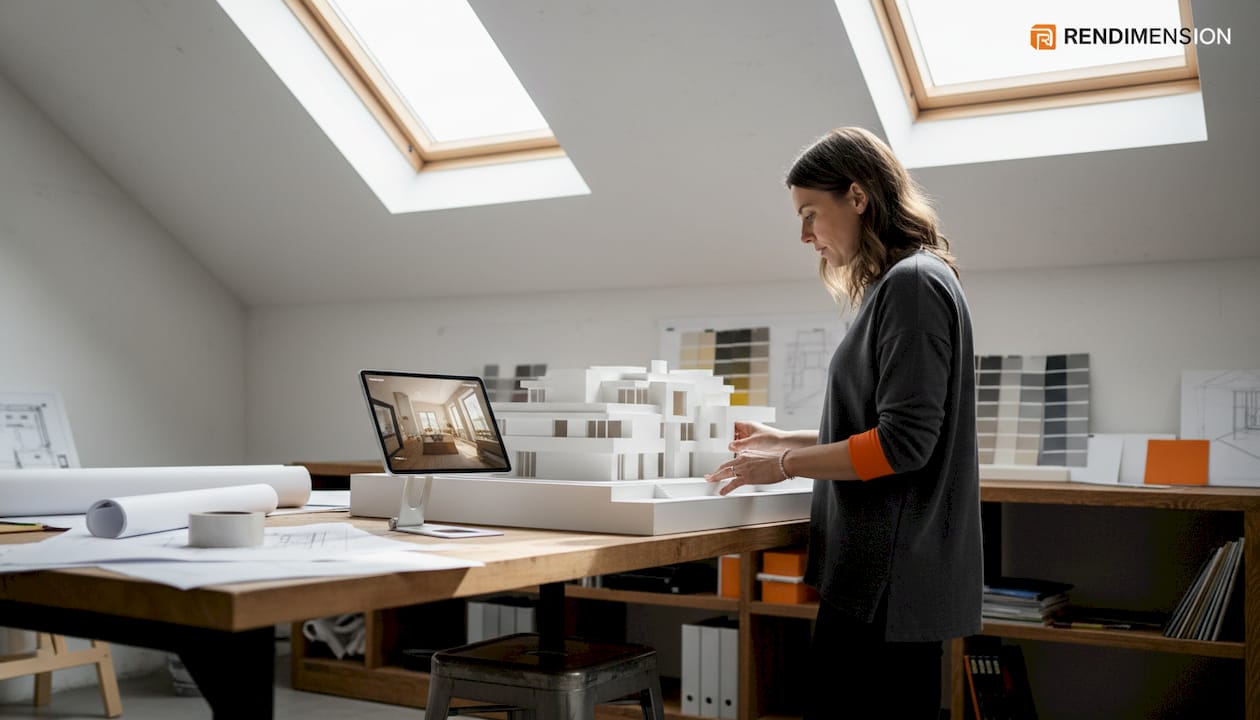
The virtual walkthroughs benefits extend beyond sales meetings. Architects use VR internally for design validation before presenting to clients, catching proportion errors, awkward circulation paths, and lighting issues that simply do not read clearly on 2D drawings. Catching these problems at the model stage, rather than on site, is one of the most underutilized applications in the architecture sector.
Potential challenges and limitations of VR tours
While the benefits are compelling, it is important to be aware of practical limitations before fully investing in VR. Too many firms enter VR adoption with unrealistic expectations and scale back after costly missteps.
The most immediate barrier is cost. Entry-level 360-degree virtual tour setups begin around $350, but high-quality, fully immersive VR experiences designed for luxury real estate or complex architectural projects can reach $45,000 or more in hardware, software, and production costs. Hardware alone requires periodic updates as headset technology evolves. These costs must be weighed honestly against the value of each project.
The challenges developers and architects most commonly encounter include:
- Motion sickness: Roughly 20 to 30% of first-time VR users experience some degree of motion discomfort, which can negatively affect client meetings if not managed with proper pacing and session length controls
- Sensory limitations: VR cannot replicate the feel of materials, the smell of a space, or the acoustic quality of a room. Buyers of high-end properties often make final decisions based on tactile and sensory factors that VR simply cannot address
- Technical friction: Clients unfamiliar with VR headsets may feel awkward or disoriented, requiring time and patience during initial orientation before any sales conversation can begin
- Hardware dependency: High-quality VR requires specific hardware that clients may not own, meaning the developer or agent must supply and maintain equipment for each meeting
- Diminishing returns for lower-end properties: For a $300,000 suburban townhouse, a full VR experience rarely generates the return that justifies its production cost
“VR is a powerful tool, but it has not replaced the in-person tour. Buyers still want to feel the space, test the acoustics, and sense the neighborhood energy before signing a contract. VR moves them toward that decision, but rarely completes it alone.”
This honest framing matters because the biggest mistake firms make is treating VR as a complete replacement for physical engagement rather than a strategic complement. For more on how VR fits within broader VR design engagement workflows, the application matters as much as the technology itself.
Best practices for adopting VR in real estate development and architecture
Fully understanding the limits means you are ready to approach VR adoption strategically. Here is how leading firms integrate VR without the common pitfalls that derail early adopters.
-
Audit your project pipeline first: Not every project warrants a full VR investment. High-value, complex, or off-plan projects with international buyer pools offer the strongest ROI. Assess your pipeline before committing to any platform or hardware purchase.
-
Choose the right platform for your workflow: Some platforms integrate directly with Revit or ArchiCAD BIM environments, while others operate as standalone walkthrough tools. Match the platform to your existing design software to avoid double-handling data.
-
Prepare your models to VR-ready standards: A BIM model built for documentation is not automatically suitable for VR. Polygon counts, texture resolution, and lighting setups all require VR-specific optimization. Build this production step into your project timeline and budget.
-
Train your team before involving clients: A poorly run VR session where the host fumbles the headset controls or the environment crashes mid-walkthrough creates the opposite impression of competence. Run internal sessions before any client-facing meeting.
-
Stage VR at the right moment in the sales journey: VR works best when the buyer has already shown genuine interest and is narrowing their shortlist. Using VR at the top of the funnel wastes resources. Deploy it as the closing tool it is designed to be.
-
Use VR to document design decisions: One of the most underused applications is using VR sessions to formally document and sign off client approvals on design choices. This creates a clear paper trail that protects both parties if disputes arise later.
The savings from catching errors early through VR documentation are significant. Firms that use VR for design iteration reduce rework costs by 5 to 12% of total construction spend. On a $20 million build, that is a potential saving of $1 million to $2.4 million from one process improvement.
Pro Tip: Create a “VR change log” for every project, where each design modification requested or approved during a VR session is timestamped and linked to the relevant model version. This protects you during contractor negotiations and keeps client expectations aligned throughout the build.
You can review the specific workflow steps that make this seamless through our VR architecture workflow guide, and apply the same principles to interiors through VR in interior design applications.
What most experts miss about VR in property marketing
Most discussions about VR in real estate focus entirely on the technology: which headset, which platform, which resolution threshold. That framing misses the most important variable, which is how clients actually make decisions.
Buyers and investors purchase trust first and property second. VR supports trust-building by reducing uncertainty about space, light, and layout. But it cannot manufacture trust on its own. Firms that adopt VR without equally investing in the human touchpoints around it, the follow-up call after a VR session, the design consultation that interprets what the client saw, the relationship nurtured before the headset goes on, often find that their VR investment underperforms.
There is also a broader caution worth raising. The hype cycle around immersive technology has seen significant peaks and retreats. High-profile corporate retreats from VR investments signal the gap between hype and adoption. This does not mean VR is overrated for real estate. It means that firms chasing the technology for its own sake, without a clear process around it, rarely see the returns that disciplined early adopters achieve. The value of VR is not in the experience itself. It is in how that experience fits within a deliberate client engagement and design iteration process.
Take your property presentations to the next level with Rendimension
Applying the insights from this guide requires more than strategy. It requires production quality that matches the ambition of your project.
Rendimension specializes in exactly this: turning architectural concepts and development plans into immersive, photorealistic VR experiences that move buyers and impress stakeholders. Whether you need a complete VR real estate experience, high-quality 3D rendering services for marketing campaigns, or full-scale architectural visualization expertise for investor presentations, the team at Rendimension has delivered over 1,000 projects globally. Reach out to discuss how a customized VR solution can elevate your next development or architectural project from concept to committed buyers.
Frequently asked questions
What is the ROI on VR tours for real estate developers?
VR tours cut days on market from 34 to 19 and help developers save up to $45,000 on physical mockups while reducing rework costs by 5 to 12% of total construction spend, delivering measurable financial returns across mid-to-large projects.
Is VR suitable for smaller properties or firms?
VR’s high upfront costs ranging from $350 to $45,000 mean the ROI is harder to justify for lower-end or simpler properties, but the technology delivers strong value for high-ticket, complex, or off-plan residential and commercial developments.
Can VR tours replace in-person property visits?
VR strengthens pre-sale and design validation processes significantly, but it cannot replicate the tactile, sensory, and trust dimensions of a physical visit that most buyers still rely on before finalizing a purchase.
How do VR tours help with pre-selling unbuilt projects?
VR enables buyers to experience a space with 80% better spatial understanding compared to 2D plans, giving them the confidence to commit to off-plan purchases and allowing developers to secure deposits and financing well before construction completes.
Recommended
- 360 Virtual Tours
- Virtual Tour Examples – Rendimension | 3D Rendering
- VR For Design Professionals: Immersive Visualization Guide
- Enhance Property Sales With 3D Renders In Real Estate 2026