TL;DR:
- Immersive experiences directly engage clients through interactivity, boosting emotional connection and decision speed.
- Technologies like VR, AR, and real-time engines enable realistic walkthroughs and site overlays for better project understanding.
- Implementing immersive visuals requires quality data preparation, strategic platform choices, and phased adoption for maximum ROI.
Static renderings have long been the standard for architectural presentations, but they often fall short when clients need to truly feel a space before it’s built. Immersive visual experiences change that equation entirely. By combining virtual reality (VR), augmented reality (AR), photorealistic 3D rendering, and real-time interactivity, these tools turn abstract plans into emotionally resonant environments. Research suggests that immersive tech drives emotional connection and accelerates sales decisions, making them a serious competitive advantage for architects and developers who want to close projects faster and with greater client confidence.
Table of Contents
- Defining immersive visual experience in architecture
- Key technologies powering immersive visual experiences
- Benefits of immersive visual experiences for client engagement
- Common challenges and practical solutions
- Practical steps to implement immersive visuals in your projects
- Our perspective: moving beyond the wow-effect to lasting value
- Ready to bring your designs to life?
- Frequently asked questions
Key Takeaways
| Point | Details |
|---|---|
| Immersive redefines client engagement | Interactive technologies foster deeper understanding and faster decisions in architectural projects. |
| Adoption requires the right technology | Pair VR, AR, high-quality rendering, and AI with robust workflows for best results. |
| Overcome challenges strategically | Address hardware, workflow, and adoption obstacles using phased pilots and hybrid tech approaches. |
| Begin with small-scale pilots | Rolling out immersive visuals in phases helps curb risks and demonstrate value clearly. |
Defining immersive visual experience in architecture
Not every impressive visual qualifies as immersive. The word “immersive” specifically means engaging a user’s senses through visual depth, interactivity, and realism, pulling them into a space rather than simply showing it to them. For architects and developers, this distinction matters enormously, especially when presenting pre-construction projects where clients must commit based entirely on what they imagine.
Traditional static renderings deliver a single frozen frame. Immersive experiences, by contrast, let clients walk through a building, change material finishes in real time, or view a site from multiple angles using a headset or even a smartphone. The gap between these two approaches is not just technical. It’s psychological.
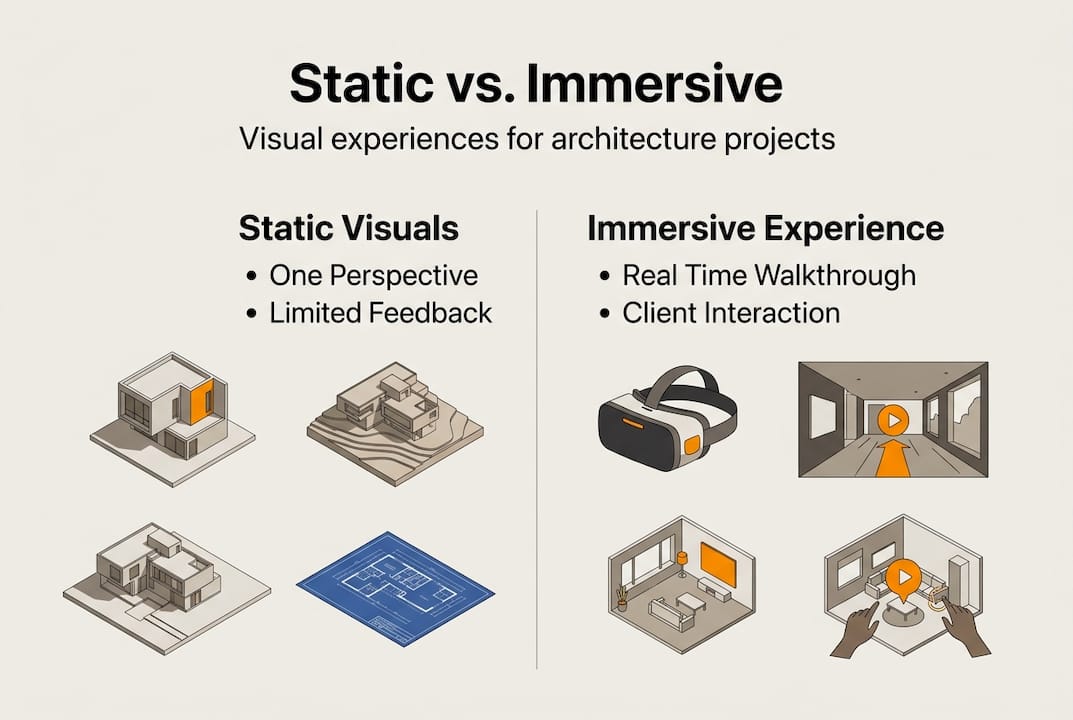
Core mechanics include VR for fully digital walkthroughs, AR for overlaying digital elements on real views, 3D rendering for photorealistic models from CAD/BIM, and real-time engines like Unreal Engine or Unity for interactivity. Each technology serves a different purpose, and understanding 3D rendering in architecture is often the first step toward building a full immersive pipeline.
Comparison: static visuals vs. immersive experiences
| Feature | Static rendering | Immersive experience |
|---|---|---|
| Interactivity | None | Full (real-time navigation) |
| Emotional engagement | Low to moderate | High |
| Client decision speed | Slower | Faster |
| Revision flexibility | Limited | Dynamic |
| Hardware required | None | VR/AR device or browser |
Immersive visuals are most valuable during three phases: pre-construction sales, client approval meetings, and stakeholder presentations. Exploring the VR and AR benefits for each phase helps teams prioritize where to invest first.
- Pre-construction: Replace flat floor plans with walkable 3D environments
- Sales: Let buyers personalize finishes and layouts in real time
- Approvals: Reduce revision cycles by eliminating ambiguity early
Key technologies powering immersive visual experiences
With a clear definition in place, the next step is understanding the technologies that make immersive visuals possible, and how they connect into a working production workflow.
The core platforms include VR headsets (Meta Quest, Apple Vision Pro), AR devices (tablets, smartphones, HoloLens), and real-time 3D engines like Unreal Engine and Unity. Each platform has different strengths. VR creates fully controlled digital environments. AR layers digital content onto physical spaces, which is powerful for showing renovations or additions on existing sites.
Methodologies involve LiDAR scanning for accurate 3D capture, BIM integration for data-rich models, AI-driven generative visuals for dynamic content, and cloud streaming for accessible VR and AR on mobile and VR headsets. This workflow transforms raw site data into interactive experiences without requiring clients to install complex software.
Generative AI enhances dynamism but requires domain adaptation to match real estate photorealism. Combine it with LiDAR for hybrid accuracy in client demos. AI alone can produce visually striking results, but it often misrepresents material textures or lighting conditions in ways that erode client trust.
Technology selection guide
| Technology | Best use case | Typical cost tier |
|---|---|---|
| VR headsets | Full walkthroughs, sales suites | Medium to high |
| AR on mobile | Site overlays, renovation previews | Low to medium |
| Real-time 3D engines | Interactive design reviews | Medium |
| Cloud streaming | Remote client access | Low |
- Start with your existing BIM or CAD data as the model base
- Layer in LiDAR scan data for geometric accuracy
- Apply real-time rendering engines for interactivity
- Deploy via cloud streaming for broad client access
For a detailed look at how this connects in practice, the VR workflow for architects breaks down each production stage.
Pro Tip: Combine AI-generated environments with LiDAR-captured geometry for demos that are both fast to produce and accurate enough to hold up under client scrutiny.
Benefits of immersive visual experiences for client engagement
Understanding the technology is only half the story. The real question is why these experiences matter most for your business outcomes.

Immersive visuals work because they bypass the cognitive effort required to interpret floor plans and static images. When a client can walk through a virtual lobby, feel the ceiling height, and see how natural light moves through a space, they form an emotional connection to the project. That connection translates directly into faster decisions and stronger commitment.
Proponents highlight emotional connection and sales acceleration as the primary drivers of adoption, though critics note that poorly designed experiences can cause cognitive overload. The key is designing immersive presentations that guide clients rather than overwhelm them.
“Immersive technology facilitates deeper emotional engagement with design proposals, reducing the gap between client expectations and delivered outcomes.”
Here’s where immersive visuals create the most measurable business value:
- Faster approvals: Clients who can explore a space ask fewer clarifying questions and approve designs more quickly
- Fewer costly revisions: Misunderstandings about scale, light, and material are caught before construction begins
- Stronger referrals: Memorable presentations generate word-of-mouth and repeat business
- Higher perceived value: Immersive demos position your firm as a premium, forward-thinking practice
For complex or custom projects, 3D walkthrough services are particularly effective at building client trust before a single foundation is poured.
Pro Tip: Introduce immersive demos at the concept stage, not just at final presentation. Early exposure gives clients time to internalize the design, which reduces last-minute change requests significantly.
Common challenges and practical solutions
Despite the clear advantages, implementing immersive experiences comes with real-world hurdles. Knowing them in advance saves time, budget, and frustration.
High computational demands for large-scale models require automated pipelines; tracking instability in AR for dynamic environments and domain gaps in AI image translation also reduce photorealism. These are not reasons to avoid immersive tech. They are engineering problems with known solutions.
- Computational load: Use scalable cloud rendering platforms to offload processing from local machines. This keeps large district-scale models interactive without requiring expensive on-site hardware.
- AR tracking instability: Run AR demos in controlled environments with stable lighting and minimal reflective surfaces. Robust tracking systems like ARKit or ARCore perform significantly better under these conditions.
- AI realism gaps: Mix AI-generated content with high-quality LiDAR and BIM data. AI handles speed; precise data handles accuracy.
- Industry resistance: Frame immersive tech adoption as a phased process. Start with one project type, measure client response, and present the results internally before scaling.
For developers specifically, 3D walkthroughs for real estate offer a lower-risk entry point because the format is already familiar to buyers and agents.
Pro Tip: Run a small pilot project with one willing client before committing to a full-scale rollout. The feedback you collect will be more valuable than any internal planning session.
Practical steps to implement immersive visuals in your projects
Now that you know the pitfalls, here’s a straightforward path to get started with immersive visual experiences in active or upcoming projects.
The foundation of any immersive experience is clean, accurate data. Messy CAD files or incomplete BIM models create problems that compound at every later stage. Fix the data first.
- Prepare your base models: Clean up CAD or BIM files, remove duplicate geometry, and standardize naming conventions
- Capture site data: Use LiDAR scanning for accurate spatial geometry, especially for renovation or adaptive reuse projects
- Select your platform: Match the technology to the project type. VR for new construction walkthroughs, AR for site overlays, real-time engines for design review sessions
- Build and render: Convert models into real-time environments using Unreal Engine or Unity, applying materials, lighting, and environmental context
- Deploy and iterate: Use BIM integration for data-rich base models and cloud streaming for accessible project demos that clients can view on any device
- Gather feedback: Treat the first client session as a learning opportunity. Adjust based on what confuses or excites them
For teams producing their first immersive 3D walkthroughs, partnering with a specialized visualization firm bridges the knowledge gap quickly and avoids the steep learning curve of building an in-house pipeline from scratch.
Pro Tip: Partner with a professional visualization studio for your first two or three immersive projects. You’ll learn faster, deliver better results, and build internal confidence before investing in your own tooling.
Our perspective: moving beyond the wow-effect to lasting value
After working across more than 1,000 projects globally, we’ve noticed a consistent pattern. The firms that get the most out of immersive visual technology are not the ones chasing every new tool. They’re the ones who use it to have better conversations with their clients.
The wow-effect is real. A client stepping into a VR walkthrough for the first time is genuinely moved. But that reaction fades quickly if the experience doesn’t connect to a decision or a question worth answering. The technology becomes a gimmick instead of a tool.
The most effective immersive presentations we’ve seen are structured around client outcomes, not technical capability. They guide clients through specific choices: does this ceiling height feel right? Does this material work in this light? That kind of focused interaction builds trust and produces better design decisions.
We believe the future of architectural visualization lies in using immersive tech to make clients feel like collaborators, not spectators. Explore how VR design client engagement can shift that dynamic in your practice. The firms that figure this out early will have a lasting advantage over those still presenting static PDFs.
Ready to bring your designs to life?
If you’re ready to move from theory to practice, Rendimension offers the tools and expertise to make it happen. With over 1,000 completed projects, our team specializes in turning architectural concepts into photorealistic, interactive experiences that clients remember and respond to.
Explore our 3D rendering services to see how photorealistic visuals can elevate your next proposal. For full project presentations, our architectural visualization services cover everything from concept to final delivery. And if you’re ready to give clients a truly walkable experience, our 3D walkthrough solutions are built specifically for architects and developers who want to close faster and communicate with clarity.
Frequently asked questions
How does immersive visual experience differ from traditional 3D rendering?
Immersive visuals allow clients to navigate and interact with a space in real time, while traditional 3D renderings deliver static images or pre-rendered animations without any interactivity.
Can immersive visual experiences be accessed on mobile devices?
Yes. Cloud streaming enables VR/AR access on most modern smartphones and VR headsets, removing the need for expensive local hardware on the client’s end.
What are the main challenges in adopting immersive visuals for large projects?
Large-scale models demand automated pipelines to handle computational load, while AR tracking instability and AI photorealism gaps remain active engineering challenges for district-scale work.
How can architects ensure ROI on immersive visual investments?
Start with a single pilot project, measure client engagement and revision rates, and use those results to build an internal case for broader adoption. Phased adoption reduces resistance and gives your team time to build competency before scaling.