TL;DR:
- Strategic use of 3D visualization accelerates stakeholder alignment and reduces design errors.
- Different visualization formats support project phases from concept design to construction coordination.
- Investing in quality visualization offers measurable benefits, including faster approvals and better market positioning.
Commercial real estate moves fast, and presentations that fail to communicate a project’s full potential cost developers real money in lost bids, delayed approvals, and skeptical investors. Yet many development teams still treat 3D visualization as a finishing touch rather than a core business tool. That’s a costly mindset. When used strategically throughout the project lifecycle, visualization drives faster stakeholder alignment, reduces design errors before they reach the construction phase, and gives your team a measurable edge in competitive markets. This guide breaks down exactly how to use visualization to win at every stage.
Table of Contents
- What is visualization for commercial projects?
- Core benefits: Why visualization is a game changer
- How visualization supports every project phase
- Common pitfalls and how to avoid them
- Our perspective: Why visualization done right pays for itself
- Unlock your project’s full potential with professional visualization
- Frequently asked questions
Key Takeaways
| Point | Details |
|---|---|
| Visualization drives results | High-quality 3D visualization accelerates approvals and wins stakeholder confidence in commercial real estate. |
| Full-project integration | Visualization should be used throughout every project phase, not just for final presentations. |
| Avoid common pitfalls | Clear communication and the right approach maximize value and minimize costly mistakes. |
| Choose expert partners | Working with specialized visualization pros ensures your vision is communicated effectively and on time. |
What is visualization for commercial projects?
3D visualization in commercial real estate is not simply about producing attractive images to impress a client. It is a strategic communication system that transforms architectural data, design intent, and spatial concepts into experiences that stakeholders can actually understand and act on. For developers and marketing executives, that distinction matters enormously.
The field has grown well beyond static renderings. Today’s visualization toolkit for commercial projects includes several distinct formats, each suited to specific goals:
- Static photorealistic renderings deliver high-resolution images of exterior facades, interior lobbies, public spaces, and unit layouts. These are the workhorses of marketing collateral, pitch decks, and planning applications.
- 3D animated walkthroughs guide viewers through a property in real time, building spatial comprehension in a way that floor plans simply cannot match. They are particularly effective for leasing presentations and investor briefings.
- Virtual reality (VR) experiences allow stakeholders to step inside a development before a single foundation is poured. This level of immersion generates more useful feedback, faster.
- Massing and concept models clarify proportions, site relationships, and design direction at the earliest stages, helping teams make confident decisions before significant resources are committed.
3D visualization benefits go beyond aesthetics. Visualization improves accuracy and efficiency in commercial projects by surfacing design conflicts, alignment issues, and spatial problems that would otherwise only emerge during construction, when fixing them is exponentially more expensive.
Most successful commercial development teams do not rely on a single format. They layer visualization tools strategically across project phases, using concept models early, polished renderings for approvals and marketing, and VR or walkthroughs for high-value investor presentations.
| Visualization type | Best use case | Typical output |
|---|---|---|
| Static rendering | Marketing, planning, pitch decks | High-res images |
| Animated walkthrough | Investor briefings, leasing | Video file |
| Virtual reality | Stakeholder immersion, sales | Interactive VR experience |
| Massing model | Early design, site review | Conceptual 3D model |
Pro Tip: If your project spans multiple asset classes like retail, office, and hospitality, plan your visualization strategy by audience. Leasing teams and planning boards respond to different visual formats, and one-size-fits-all rarely works in a large mixed-use development.
Core benefits: Why visualization is a game changer
Defining the tools is important, but understanding why they matter makes the business case for investing properly in visualization from the outset.
Faster stakeholder alignment. One of the most tangible benefits of quality visualization is the speed it brings to the approval and funding process. When investors, planning boards, and community stakeholders can clearly see and experience a project, they spend less time asking clarifying questions and more time making decisions. Ambiguity is the enemy of progress, and visualization removes it.
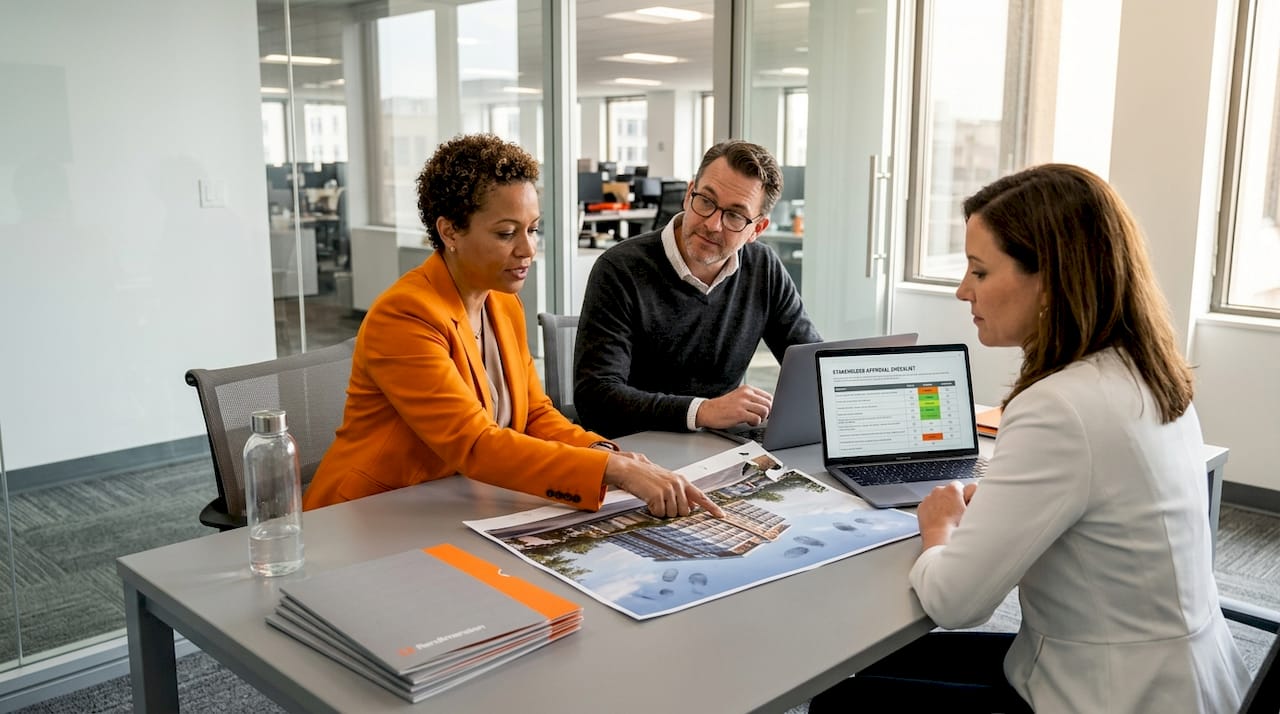
Reduced design errors. Mistakes caught in a 3D model cost a fraction of mistakes caught on a construction site. Visualization reduces costly mistakes and delivers real project savings by making spatial conflicts and design inconsistencies visible before they become structural problems. For a large commercial development, even one or two avoided rework scenarios can justify the entire visualization budget.
Marketing and competitive differentiation. High-quality visuals give your project a presence in the market before it physically exists. Pre-construction marketing campaigns built around photorealistic renderings and walkthrough videos generate leads, build credibility with prospective tenants, and position your development favorably against competitors who rely on floor plans and mood boards.
More meaningful stakeholder feedback. When you present a schematic plan to a non-technical stakeholder, their feedback is often vague because they struggle to visualize what you are proposing. When you put them inside a VR experience or walk them through an animated model, their feedback becomes specific and actionable. They notice things like daylighting, lobby scale, and sight lines in ways that 2D drawings never reveal.
Here is a summary of the core business benefits:
- Accelerated decision-making cycles across planning, investment, and leasing
- Fewer expensive design changes during construction
- Stronger marketing assets that generate pre-construction tenant interest
- More precise and useful feedback from non-technical stakeholders
- Competitive advantage in bid situations and planning applications
“The best visualization does not just show stakeholders a building. It shows them why this building, in this location, at this time, is the right decision. That clarity is what moves projects forward.” — Rendimension project team
A recent industry analysis found that teams using saving with construction visualization strategies report measurable reductions in change orders and rework costs, with some large commercial projects reporting six-figure savings attributable directly to catching design conflicts in the visualization phase. For a development team running on tight margins, that is not a minor benefit.
How visualization supports every project phase
Understanding the benefits leads to a bigger question: how does visualization integrate into each specific stage of a commercial project, from first sketch to lease-up?
The answer is that effective visualization is not a one-off deliverable. It is a process tool that evolves with your project. Here is how it applies at each stage:
-
Conceptual design. At this stage, massing studies and rough 3D models clarify site relationships, building proportions, and design direction. These are not polished deliverables. They are decision-making tools that help design teams and developers align on fundamentals before locking in a direction that is costly to change later.
-
Planning and approvals. Planning boards and municipal committees are made up largely of non-architects. A photorealistic rendering showing how a building sits within its street context, respects sight lines, and contributes to the neighborhood’s character does more persuasive work than any set of technical drawings. Visualization supports planning and stakeholder communication throughout this phase, giving decision-makers confidence.
-
Investor and lender presentations. This is where visualization directly influences capital. A polished animated walkthrough or immersive VR experience communicates project quality, attention to detail, and development team capability in ways that written reports and spreadsheets cannot. Investors commit more readily when they can experience what they are funding.
-
Pre-construction marketing and leasing. Tenants and buyers cannot move into a building that does not yet exist, but they can be sold on one. Renderings and walkthrough videos power your architectural visualization services to build a leasing pipeline before ground breaks. For retail and hospitality projects especially, strong pre-leasing directly affects financing terms and project viability.
-
Construction coordination. During the build phase, detailed 3D models help contractors, subcontractors, and project managers communicate across disciplines. Visual references reduce misunderstandings between teams working on complex MEP (mechanical, electrical, plumbing) integrations and high-end interior finishes.
| Project phase | Visualization role | Primary audience |
|---|---|---|
| Concept design | Massing studies, design alignment | Development and design teams |
| Planning and approvals | Context renderings, visual impact | Planning boards, community |
| Investment presentations | Walkthroughs, VR | Investors, lenders |
| Marketing and leasing | Campaign renderings, video | Tenants, buyers, media |
| Construction | Coordination models | Contractors, subcontractors |
Pro Tip: Build your visualization brief before engaging a visualization partner, not after. Knowing exactly which phases you need assets for, and who the audience is at each phase, allows you to scope the project accurately and avoid paying for deliverables that do not serve your actual needs.
Common pitfalls and how to avoid them
While visualization offers clear advantages, there are common missteps that can undermine its value and inflate your costs. Knowing what to avoid is just as important as knowing what to pursue.
Choosing the wrong visualization approach for the phase. A photorealistic rendering with full material finishes and landscaping is the right choice for a marketing campaign but a waste of resources at the massing stage. Choosing the right visualization approach at the right time is essential for success, and it requires matching the fidelity of the output to the decisions it needs to support. Over-specifying early and under-delivering late are both expensive mistakes.
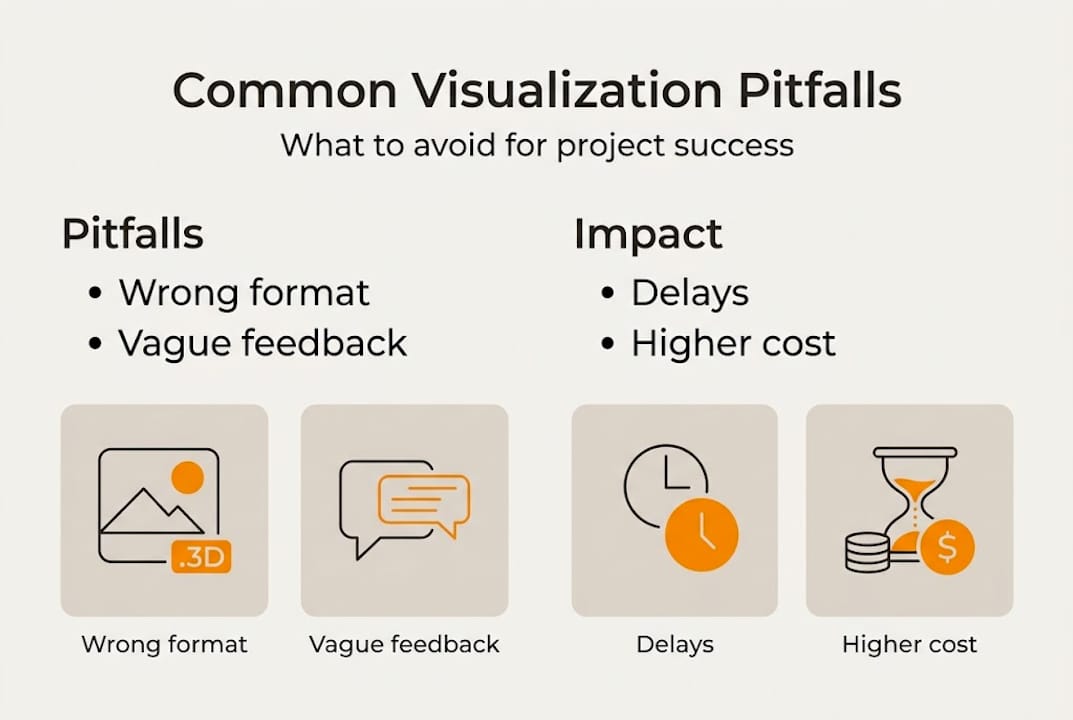
Underestimating timelines and revision cycles. A common source of frustration between developers and visualization teams is misaligned expectations around turnaround time and how many revision rounds are included. Complex commercial renderings with multiple viewpoints, interior and exterior scenes, and branded overlays take time. Rushing the process leads to lower-quality outputs. Build realistic production windows into your project schedule from the beginning.
Providing unclear or fragmented feedback. Visualization partners work most efficiently when feedback is consolidated, specific, and actionable. When multiple stakeholders submit separate, sometimes contradictory, revision requests, the cost in time and budget adds up quickly. Assign a single internal point of contact responsible for gathering all feedback into one clear document before it goes to the visualization team.
Treating visualization as a box to check. Some development teams commission a rendering to satisfy a planning requirement or respond to an investor request, then move on without using the asset further. That is leaving value on the table. A single high-quality rendering can appear in planning documents, leasing brochures, social media campaigns, press releases, and investor updates. Plan how you will use each asset before commissioning it.
Here is a quick reference for avoiding the most common pitfalls:
- Match visualization fidelity to the project phase and audience
- Set clear timelines with your visualization partner and build in buffer for revisions
- Consolidate stakeholder feedback through a single internal contact
- Plan the full lifecycle of each visualization asset before commissioning
Review visualization examples for pitches from comparable commercial projects early in your planning process. Understanding what works in your specific asset class, whether that is office, mixed-use, or large-scale retail, helps you set the right brief from the start.
Not vetting the visualization partner’s commercial experience. Residential and commercial visualization are different disciplines. A studio that excels at luxury home renderings may not have the experience or the scale to handle a multi-building commercial campus with complex site context, public realm requirements, and phased delivery. Always ask to see relevant commercial portfolio work before engaging.
Our perspective: Why visualization done right pays for itself
Here is an uncomfortable truth the industry rarely states plainly: under-investing in visualization is not a cost-saving decision. It is a risk-taking decision with real financial consequences.
We have seen it repeatedly across more than 1,000 projects globally. The developers who treat visualization as a line item to trim are often the same ones who spend far more later on revision rounds, re-presentation costs, and delayed approvals. The value of 3D visualization is not measured in the quality of the images. It is measured in the decisions those images enable.
The most successful commercial developers treat visualization as core project infrastructure, in the same category as legal due diligence or structural engineering. It is not a luxury. It is a function. When you frame it that way, the return becomes obvious. Faster approvals compress timelines. Better investor presentations secure funding at better terms. Pre-construction leasing reduces risk. Each of those outcomes has a measurable dollar value that dwarfs the cost of good visualization.
The uncomfortable question is not whether you can afford professional visualization. It is whether you can afford to present without it in a competitive market where your rivals already are.
Unlock your project’s full potential with professional visualization
If the gap between where your presentations are today and where they need to be feels significant, you are not alone. Most development teams know their visuals could work harder for them. Closing that gap requires the right visualization partner with commercial-scale experience and a process that actually fits your project timeline.
At Rendimension, our 3D rendering services are built for exactly this: high-stakes commercial presentations, competitive pitches, investor briefings, and pre-construction marketing campaigns that need to perform. With over 1,000 projects completed globally, our team knows what it takes to move stakeholders from uncertain to committed. Explore our architectural visualization solutions and see how we can help your next development make the impact it deserves.
Frequently asked questions
What types of commercial projects benefit most from 3D visualization?
Large-scale developments, offices, retail centers, and hotels gain the most value by showcasing future outcomes to stakeholders, as seen in the Rendimension commercial portfolio. Mixed-use and phased developments also benefit significantly because visualization helps communicate complexity in a format that diverse stakeholder groups can understand.
How does visualization improve stakeholder engagement?
3D visualization helps stakeholders experience project details before construction, leading to more informed decisions and faster approvals. When stakeholders can navigate a space virtually, they provide more specific and actionable feedback than they would from reviewing flat drawings.
What’s the biggest mistake when commissioning visualization for commercial projects?
Failing to define project goals and deliver clear feedback often causes unnecessary revisions and budget overruns, as the right visualization approach depends entirely on knowing what decisions the visuals need to support. Bringing your visualization partner in too late in the design process is a close second.
How quickly can a 3D visualization be delivered?
Simple models can be ready in a few days, while complex commercial presentations may take several weeks depending on scope, number of viewpoints, and revision rounds. Building buffer into your project schedule at the outset avoids the quality compromises that come with rushed production.
Recommended
- 3D Walkthrough Video 2
- How To Present 3D Visuals For Impactful Client Engagement
- Architectural Visualization Step By Step For Stunning Results