Conceptual rendering: key benefits for architects & developers

TL;DR:
- Conceptual rendering is a quick, flexible tool for early design communication and stakeholder alignment.
- It is cost-effective, enabling rapid iteration and comparison of multiple design options.
- Conceptual renders are not suitable for final approvals or detailed construction documentation.
There’s a persistent belief in architecture and real estate development that only polished, photorealistic visuals carry real weight. That belief costs teams time, money, and alignment. Conceptual rendering enhances project visualization and stakeholder engagement while being quicker and more cost-effective than photorealistic methods. Unlike final-stage renders, conceptual renderings are built for speed and clarity at the moments that matter most, when design direction is still fluid and decisions are still reversible. This article breaks down what conceptual rendering actually is, why it matters, and how architects and developers can use it strategically across the full project lifecycle.
Table of Contents
- Understanding conceptual rendering in architecture
- Key benefits for architects and developers
- How and when to use conceptual renderings
- Pitfalls and expert insights: getting the most from conceptual rendering
- Our take: why flexibility and clarity matter in conceptual rendering
- Bring your projects to life: professional conceptual rendering services
- Frequently asked questions
Key Takeaways
| Point | Details |
|---|---|
| Faster design feedback | Conceptual rendering accelerates design discussions and keeps projects moving forward. |
| Enhanced team alignment | Quick visuals foster better stakeholder communication and minimize misunderstandings. |
| Cost-effective visualization | It’s quicker and less expensive than creating polished, photorealistic renderings early on. |
| Use at early stages | Best employed when exploring ideas, before final design details are set. |
Understanding conceptual rendering in architecture
Conceptual rendering is not a rough draft of a photorealistic image. It’s a distinct visual communication tool with its own purpose and logic. At its core, a conceptual render translates an early design idea into a visual form that stakeholders can react to, without locking in material choices, lighting specifications, or construction details. Think of it as a visual hypothesis rather than a visual conclusion.
The rendering definition in architecture covers a wide spectrum, from loose sketches to fully detailed photorealistic scenes. Conceptual rendering sits at the intentional, expressive end of that spectrum. It prioritizes communicating spatial relationships, massing, and mood over technical accuracy. Conceptual rendering is ideal for the fluid early design stage and conveys ideas rapidly, making it the right tool when the goal is exploration rather than documentation.
Here’s how conceptual rendering compares to photorealistic rendering:
| Feature | Conceptual rendering | Photorealistic rendering |
|---|---|---|
| Primary purpose | Communicate ideas quickly | Simulate final appearance |
| Level of detail | Low to medium | High |
| Production time | Hours to days | Days to weeks |
| Cost | Lower | Higher |
| Best project stage | Concept and schematic design | Design development and marketing |
| Audience | Internal teams, early stakeholders | Clients, buyers, approval boards |
Conceptual renderings are commonly used in the following scenarios:
- Early client presentations where the design direction is still being shaped
- Internal design reviews to evaluate massing and spatial flow
- Zoning or planning submissions requiring visual context without full detail
- Feasibility studies where multiple design options need quick comparison
- Pre-sales and investor pitches where mood and vision matter more than precision
Understanding the render architecture meaning helps clarify why these visuals are not placeholders. They serve a specific, strategic function. When used correctly, they prevent teams from investing in detailed work before the foundational vision is agreed upon.
Key benefits for architects and developers
Now that you know what conceptual rendering is, it’s important to see how it delivers tangible value for your projects. The advantages are not abstract. They show up in faster timelines, cleaner stakeholder conversations, and stronger project outcomes.
Rapid idea transmission and iteration. Conceptual renders let you put a visual on the table within hours, not weeks. That speed changes the nature of design conversations. Instead of describing a vision in words or waiting for a polished model, you can show it. Teams iterate faster, catch misalignments earlier, and spend less time backtracking.

Improved stakeholder alignment. Conceptual renderings convey ideas quickly, improve stakeholder engagement, and reduce the risk of misalignment between what the architect envisions and what the client expects. When everyone is reacting to the same image, conversations become more productive and less abstract.
Cost efficiency. Producing a conceptual render costs significantly less than a full photorealistic scene. More importantly, it costs far less than redesigning a project after a misunderstanding surfaces late in development. Early visual clarity is one of the most cost-effective investments a project team can make.
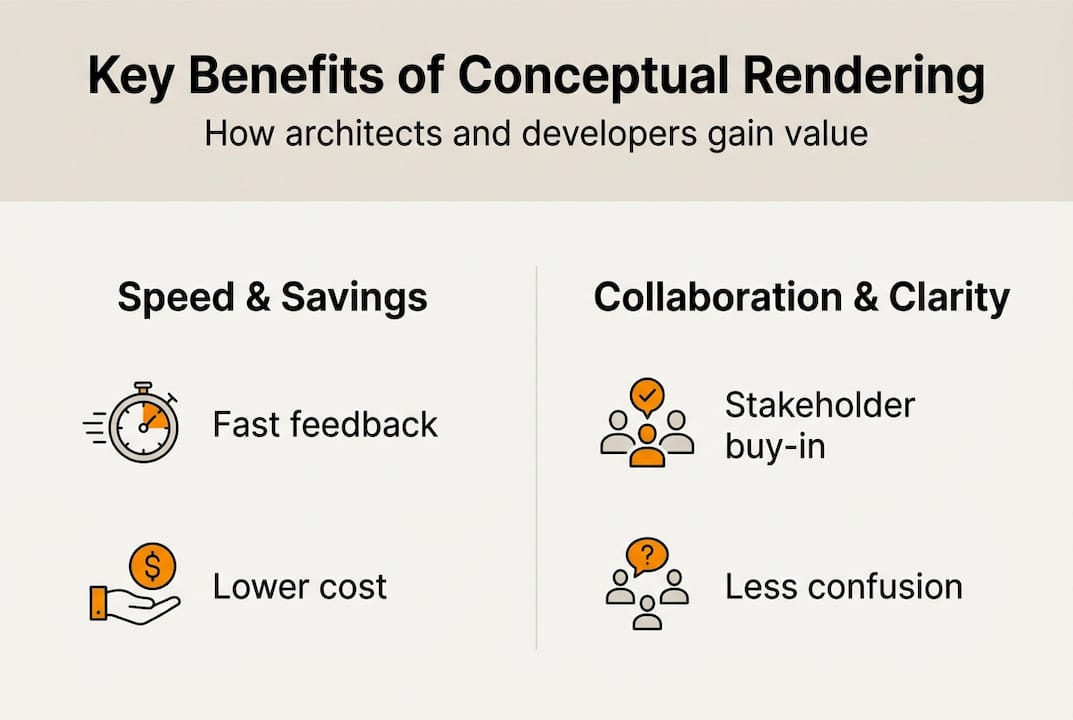
Marketing and pre-leasing support. Developers often need to generate interest before a project is built. Conceptual renders provide compelling visuals that communicate the spirit of a development without requiring a finished design. They support investor decks, pre-leasing campaigns, and community engagement without the overhead of photorealistic production.
Key benefits at a glance:
- Faster design cycles with fewer revision loops
- Clearer communication across architect, developer, and client
- Lower production cost per visual
- Flexible enough to support multiple design alternatives simultaneously
- Effective for early-stage marketing and stakeholder buy-in
Pro Tip: When presenting conceptual renders to clients, frame them explicitly as directional tools. Tell stakeholders you are showing them a vision, not a finished product. This sets the right expectations and opens the door to more honest, productive feedback.
Understanding render meaning in architecture helps both architects and developers make smarter decisions about which type of visual to commission at each stage. The right visual at the right time is always more valuable than the most detailed visual at the wrong time. Explore rendering meaning in architecture to deepen your understanding of how these tools fit together.
How and when to use conceptual renderings
Understanding the benefits sets the stage to discuss where conceptual rendering fits best within your projects. The answer is not always obvious, and using conceptual renders at the wrong stage can create as many problems as it solves.
Conceptual renderings are best for early design or when outcomes are fluid. They help teams avoid committing to details before the big picture is settled. Here is a practical sequence for integrating them into your workflow:
- Define the brief clearly. Before any visual work begins, document the project’s goals, constraints, and audience. A vague brief produces a generic render that communicates nothing useful. The more specific your input, the more targeted and actionable the output.
- Generate multiple concept options. Use conceptual renders to visualize two or three distinct design directions simultaneously. This gives stakeholders real choices rather than a single path to approve or reject.
- Present to stakeholders with context. Always frame conceptual renders within the project narrative. Explain what the image is communicating and what feedback you need. Without that framing, stakeholders may focus on irrelevant details.
- Iterate based on feedback. Because conceptual renders are faster to produce, you can revise and re-present quickly. Use this speed advantage to run multiple feedback loops before committing to a design direction.
- Transition to detailed renders at the right moment. Once the design direction is agreed upon, shift to more detailed visualization. Holding onto conceptual renders too long can frustrate stakeholders who need precision for approvals.
Good project management practices reinforce this approach. Knowing when to move from exploration to documentation is a project management skill as much as a design one.
Pro Tip: Build a simple visual checklist into your project workflow that signals when it’s time to move from conceptual to detailed rendering. Criteria might include stakeholder sign-off on massing, agreement on program layout, and confirmation of key material directions. Refer to the rendering definition in architecture to help your team align on terminology and expectations.
Pitfalls and expert insights: getting the most from conceptual rendering
While conceptual rendering is valuable, a nuanced approach reveals both its limitations and opportunities for innovation. Knowing where it falls short is just as important as knowing where it excels.
When conceptual rendering is not enough. Conceptual renders are not suited for final approvals, permitting submissions, or construction documentation. They lack the precision that regulatory bodies, contractors, and material suppliers require. Model divergence risks and AI-accelerated ideation are important edge cases. If a conceptual render diverges significantly from the actual model, teams risk building toward a vision that the underlying design cannot support.
“Conceptual rendering isn’t suited for final precision approvals. Detailed models are needed when decisions carry legal, structural, or contractual weight.” This is not a limitation to work around. It’s a boundary to respect.
Common mistakes and how to avoid them:
- Using conceptual renders for final client approvals. This creates false expectations and can lead to disputes when the finished product looks different from the early visual.
- Failing to update conceptual renders as the design evolves. Outdated visuals confuse teams and mislead stakeholders.
- Over-relying on AI-generated imagery without grounding it in accurate models. AI tools can accelerate ideation dramatically, but outputs must be checked against real project constraints.
- Skipping the brief. Generic conceptual renders add no value. Every visual should answer a specific question or communicate a specific idea.
| Risk | Consequence | Mitigation |
|---|---|---|
| Model divergence | Design cannot match visual | Sync renders with current model regularly |
| Over-commitment to early details | Limits design flexibility | Keep early renders intentionally loose |
| AI imagery without model grounding | Unrealistic expectations | Validate AI outputs against actual geometry |
| Using conceptual renders for approvals | Legal and contractual disputes | Transition to detailed renders before approvals |
Explore render in architecture meaning to understand how different render types carry different levels of communicative responsibility. Choosing the wrong type at the wrong moment is one of the most common and avoidable mistakes in project visualization.
Our take: why flexibility and clarity matter in conceptual rendering
After working across more than 1,000 projects globally, one pattern stands out clearly. The teams that struggle most with visualization are not the ones with the smallest budgets. They are the ones that treat every render the same way, regardless of project stage.
Conceptual rendering is not a lesser version of photorealistic rendering. It is a different tool with a different job. The mistake is forcing it to do work it was never designed for, or worse, skipping it entirely in favor of jumping straight to polished visuals before the design is ready.
Over-defining a project too early, through detailed renders that lock in materials and forms before stakeholder alignment, actually stifles innovation. It creates a false sense of certainty that makes it harder to pivot when the right idea surfaces later.
AI tools are changing the speed at which conceptual renders can be produced, and that is genuinely exciting. But speed without intent is just noise. The goal is not to generate more images faster. It is to generate the right image at the right moment to move a project forward. Explore architectural visualization step by step to see how a structured approach to visualization keeps projects on track from concept to completion.
Bring your projects to life: professional conceptual rendering services
If you want to unlock these advantages on your next project, here’s how dedicated conceptual rendering can help. Rendimension’s 3D rendering services are built for exactly this kind of strategic visual work, combining speed, precision, and creative flexibility to serve your project at every stage.
Whether you need early-stage conceptual visuals to align your team, compelling imagery for investor presentations, or a bridge between rough sketches and detailed models, Rendimension’s architectural visualization team brings the expertise to make it happen. With over 1,000 projects completed globally, we understand what architects and developers need at each phase of development. Reach out to explore how we can support your next project from the first concept to the final render.
Frequently asked questions
What is the difference between conceptual rendering and photorealistic rendering?
Conceptual rendering is best for early, fluid design phases, while photorealistic rendering delivers precision and detail suited for final approvals and marketing. The two tools serve different stages and different audiences.
When should I use conceptual rendering in my project workflow?
Use conceptual rendering during early design stages when you need to visualize ideas, gather stakeholder feedback, or compare design directions. Conceptual renders speed up iterations and align teams early without premature detail commitment.
What are the limitations of conceptual rendering?
Conceptual renderings lack the detail required for precise decision-making and should never be used for final approvals or construction documentation. Detailed models are needed when decisions carry legal, structural, or contractual weight.
Can conceptual rendering help with project marketing?
Yes. Conceptual rendering supports marketing and pre-leasing by providing engaging visuals that communicate project vision before construction begins, helping developers generate interest and secure commitments earlier.