Visualization tools are reshaping how architects and real estate developers communicate design intent and secure project approvals. Immersive architectural visualization techniques, including virtual reality (VR) and real-time rendering, enhance stakeholder engagement by offering experiential understanding of spaces before construction. This article explores how modern visualization technologies improve client engagement, accelerate design iterations, and drive project success.
Table of Contents
- Introduction To Architectural Visualization
- How Visualization Improves Project Presentations And Client Engagement
- Visualization As A Tool For Accelerating Design Iterations
- Technological Advances Powering Modern Architectural Visualization
- Common Misconceptions About Architectural Visualization
- Practical Applications: Using Visualization To Reduce Errors And Support Sustainability
- Conclusion: Maximizing The Impact Of Visualization In Architecture
- Explore Professional Architectural Visualization Services
- Frequently Asked Questions
Key takeaways
| Point | Details |
|---|---|
| Enhanced stakeholder understanding | Visualization creates immersive experiences that improve client comprehension and emotional connection to proposed designs. |
| Accelerated design cycles | AI-powered tools and real-time rendering enable rapid prototyping and responsive iterations based on feedback. |
| Immersive client experiences | VR and interactive technologies transform presentations from static images into engaging spatial explorations. |
| Error reduction and sustainability | Early visualization detects coordination issues and supports evaluation of energy-efficient design elements. |
| Debunked misconceptions | Modern workflows make visualization affordable while clarifying its role as a core design tool, not decorative add-on. |
Introduction to architectural visualization
Architectural visualization transforms abstract design concepts into tangible, immersive experiences that bridge the gap between technical drawings and client understanding. This practice encompasses photorealistic 3D renderings, interactive walkthroughs, and virtual reality environments that communicate spatial relationships, materials, and lighting conditions with unprecedented clarity.
The evolution from traditional 2D blueprints to sophisticated 3D modeling represents a fundamental shift in how architects communicate ideas. What began as hand-drawn perspectives has transformed into AI-powered rendering and real-time engines that collapse traditional rendering time bottlenecks. Modern 3D visualization combines computer-generated imagery with building information modeling (BIM) to create dynamic representations that evolve throughout the design process.
For architects and developers, visualization serves multiple critical functions beyond pretty pictures:
- Communicates complex spatial concepts to non-technical stakeholders
- Facilitates informed decision-making during design development
- Supports marketing and pre-sales efforts for real estate projects
- Enables early detection of design conflicts and coordination issues
- Creates shared understanding among multidisciplinary project teams
Current technologies powering visualization include real-time rendering engines like Unreal Engine and Unity, AI-assisted modeling tools, cloud-based rendering farms, and immersive VR/AR platforms. These tools integrate seamlessly with established CAD and BIM workflows, making advanced visualization accessible to practices of all sizes. The architectural visualization landscape continues expanding as computing power increases and software becomes more intuitive.
How visualization improves project presentations and client engagement
Visualization fundamentally transforms how architects present proposals and engage stakeholders throughout the design process. High-quality architectural visualization increases the likelihood of winning competitive projects by enabling clients to clearly understand proposed designs and cost implications of design variations. This clarity reduces misunderstandings that often lead to costly revisions during construction.
Clients experience stronger emotional connections when they can virtually walk through spaces before construction begins. Immersive experiences that simulate physical presence and lighting conditions enable stakeholders to evaluate design decisions with confidence. Unlike static floor plans, interactive 3D models allow clients to explore proportions, sightlines, and material selections from multiple vantage points.
Architect Paul Millet credits photorealistic renders with securing several major projects that competitors lost despite similar qualifications. His presentations demonstrate how morning light filters through proposed curtain walls and how public spaces flow during peak occupancy. Clients grasp these experiential qualities immediately, eliminating weeks of back-and-forth explanations.
“Visualization isn’t about making things look pretty. It’s about making design decisions visible and understandable to everyone involved in a project, from investors to end users.”
The benefits of architectural visualization extend beyond initial presentations to ongoing stakeholder engagement. Interactive tools allow real-time modifications during client meetings, demonstrating alternative material palettes or layout configurations instantly. This responsiveness builds trust and positions architects as collaborative partners rather than distant experts.
Key engagement improvements include:
- Reduced approval timelines through clearer communication
- Fewer change orders resulting from client misunderstandings
- Stronger client confidence in design decisions
- Enhanced ability to communicate value propositions to investors
- Improved public consultation processes for civic projects
Visualization as a tool for accelerating design iterations
Rapid design iterations are facilitated by intuitive 3D modeling and AI-powered visualization tools that allow architects to efficiently explore and refine design concepts based on stakeholder feedback. Traditional rendering workflows required hours or days to produce single images, creating bottlenecks that slowed design development. Modern tools eliminate these delays.

Interior designer Isolina Mallon reduced her typical revision cycle from two weeks to three days using real-time rendering platforms. She presents initial concepts to clients as interactive models rather than static PDFs, gathering feedback immediately and implementing changes during the same meeting. This velocity transforms client relationships and project economics.
Integration of AI and real-time rendering accelerates workflows by collapsing traditional rendering time bottlenecks and enabling instant design review and iteration. Architects experiment with more alternatives when testing ideas takes minutes instead of days, leading to more thoroughly explored solutions.
A streamlined iterative visualization workflow follows these steps:
- Develop massing models integrated with site context and program requirements
- Generate multiple design alternatives using parametric modeling tools
- Apply materials, lighting, and landscaping to promising options
- Share interactive models with stakeholders for rapid feedback collection
- Refine designs based on input and regenerate visualizations instantly
- Progress promising concepts to immersive VR experiences for final validation
- Document approved designs with construction-ready rendering packages
Pro Tip: Establish feedback loops early by sharing rough visualization studies during schematic design. Waiting until design development to visualize concepts increases revision costs exponentially.
This accelerated pace delivers tangible benefits. Projects reach construction documentation faster, reducing soft costs and allowing earlier groundbreaking. Clients appreciate responsive service and feel invested in collaborative design processes. Design teams explore more creative solutions when technology removes traditional constraints on experimentation.
The visualization step-by-step approach emphasizes progressive refinement rather than single heroic renderings. Start with simple massing studies to validate spatial concepts, then layer detail as designs solidify. This prevents wasted effort visualizing ideas destined for rejection.
Technological advances powering modern architectural visualization
Real-time rendering represents the most transformative recent advancement, enabling instant visualization updates as designers modify models. Unlike traditional rendering that required hours of processing, real-time engines display photorealistic results immediately. This responsiveness fundamentally changes how architects use visualization throughout design processes.
Immersive architectural visualization techniques, including virtual reality (VR) and real-time rendering, enhance stakeholder engagement by offering experiential understanding of spaces before construction. Adoption surveys show 68% of architectural firms now use real-time rendering regularly, while VR headset usage grew from 12% to 34% between 2024 and 2026.
AI-powered rendering tools accelerate workflows by automating material application, lighting setup, and post-processing tasks that previously required manual expertise. Machine learning algorithms analyze millions of photographs to generate realistic textures and atmospheric effects, democratizing high-quality visualization for smaller practices.
| Feature | Traditional Methods | Modern Visualization |
|---|---|---|
| Rendering speed | Hours to days per image | Real-time or minutes |
| Interactivity | Static images only | Fully navigable 3D environments |
| Iteration capability | Limited due to time costs | Unlimited rapid testing |
| Stakeholder experience | Passive viewing | Immersive VR exploration |
| Integration | Separate from design tools | Embedded in BIM workflows |
| Accessibility | Specialist expertise required | Intuitive interfaces for general users |
BIM integration allows visualization data to flow directly from construction documentation, ensuring renders accurately reflect buildable designs. Changes to door schedules or window specifications automatically update linked visualization models, maintaining consistency between drawings and client presentations.
Virtual reality design applications enable stakeholders to experience proposed spaces at full scale, revealing spatial relationships impossible to communicate through conventional drawings or renderings. Walking through virtual buildings exposes design issues like awkward circulation patterns or uncomfortable ceiling heights before construction begins.
Cloud-based rendering farms provide on-demand computing power, eliminating expensive hardware investments. Architects upload models to cloud services that distribute rendering tasks across thousands of processors, returning finished images in minutes. This accessibility levels the playing field between large firms and small practices.
Pro Tip: Prioritize visualization tools that integrate seamlessly with your existing BIM software. Standalone rendering programs create inefficient duplicate modeling work and version control headaches.
Augmented reality (AR) overlays proposed designs onto physical sites using smartphones or tablets, helping clients visualize projects in actual context. Developers walk properties with investors, displaying virtual buildings at precise locations and scales. This contextualization strengthens understanding of site relationships and urban impacts.
Common misconceptions about architectural visualization
Many architects hesitate to adopt comprehensive visualization workflows due to persistent myths about costs, accuracy, and professional appropriateness. Understanding the realities behind these misconceptions removes barriers to leveraging visualization’s full potential.
The cost and time investment myth suggests that quality visualization requires prohibitive budgets and specialized staff. Modern AI tools and cloud rendering services have dramatically reduced both expenses and technical barriers. Small practices produce compelling visualizations using affordable subscription software and outsourced rendering when needed. The time investment pays dividends through fewer revisions and faster approvals.
Some professionals question whether visualizations accurately predict final built results. Renderings depict design intent under simulated conditions, but actual outcomes vary based on construction quality, material availability, and environmental factors. Responsible visualization includes disclaimers about these limitations while maintaining useful predictive value. Visualization serves as a design tool influencing decision-making and collaboration throughout projects, not crystal balls guaranteeing exact replication.
Another misconception positions visualization as decorative marketing material rather than substantive design tool. This outdated view ignores how architects use visualization to test spatial concepts, evaluate material relationships, and coordinate building systems. Visualization informs technical decisions as much as it persuades clients.
Common myths versus realities:
- Myth: Only large firms afford quality visualization. Reality: Cloud services and AI tools make advanced visualization accessible at all scales.
- Myth: Visualization perfectly predicts built results. Reality: Renders communicate design intent; actual outcomes depend on construction execution and site conditions.
- Myth: Visualization is just marketing decoration. Reality: It’s a core design and coordination tool throughout project lifecycles.
- Myth: Learning visualization requires years of specialized training. Reality: Modern intuitive interfaces allow proficiency within weeks for digitally literate designers.
- Myth: Clients prefer traditional presentation methods. Reality: Stakeholders overwhelmingly respond better to immersive, interactive visualization experiences.
Failure points occur when architects over-promise visualization accuracy or neglect to explain rendering assumptions. Setting appropriate expectations prevents disappointment when lighting conditions differ from renders or materials appear slightly different than digital representations. The need for architectural visualization balances aspirational communication with realistic technical constraints.
Transparency about rendering methodologies builds credibility. Explain lighting assumptions, material approximations, and contextual elements to help clients interpret visualizations appropriately. This education positions architects as trusted advisors rather than salespeople pushing unrealistic fantasies.
Practical applications: using visualization to reduce errors and support sustainability
Visualization delivers measurable value through error prevention and sustainability evaluation, directly impacting project budgets and environmental performance. Early problem detection through 3D coordination identifies conflicts before construction, when changes cost pennies rather than thousands.
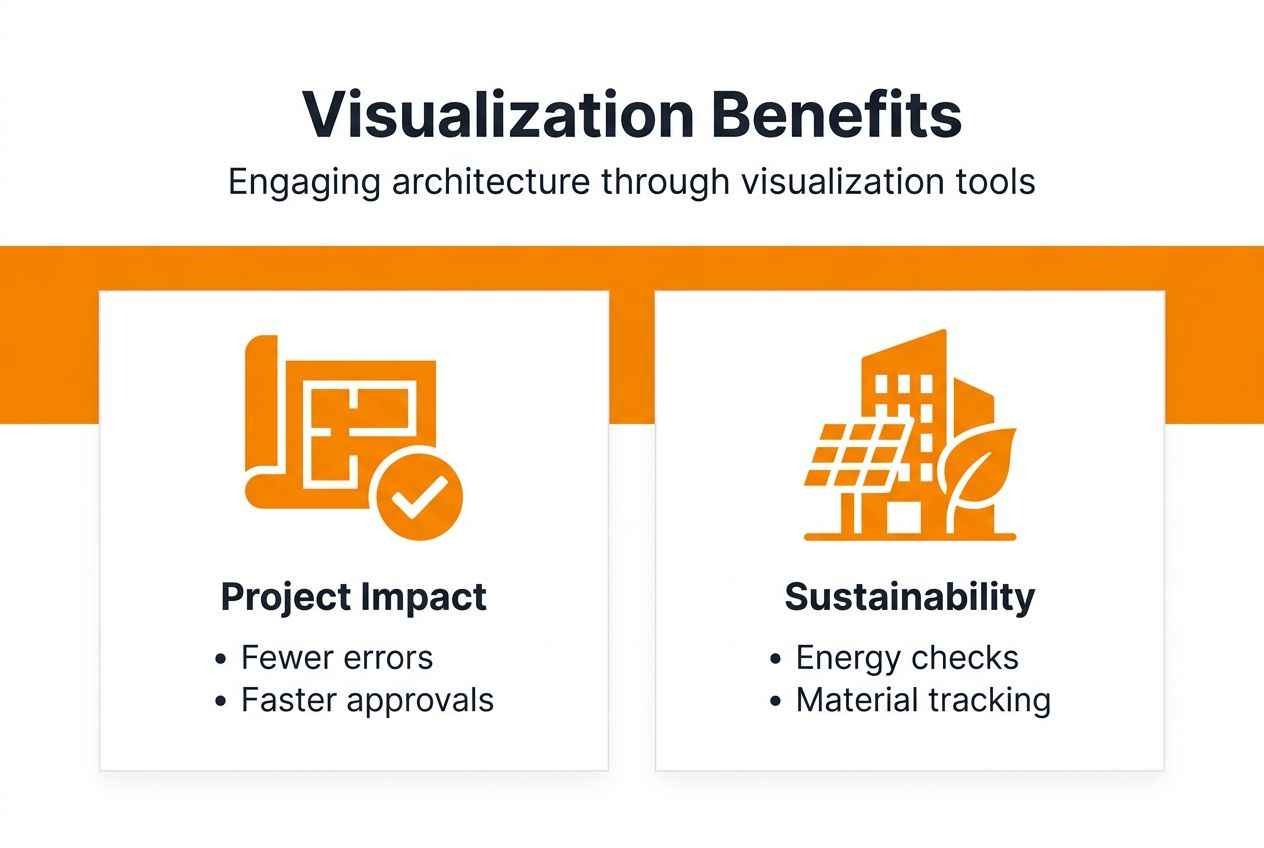
Spatial coordination in visualization models reveals clashes between structural elements, mechanical systems, and architectural features. A recent office tower project discovered beam-to-duct conflicts during visualization development, avoiding $180,000 in field modifications. Seeing building systems in three-dimensional context catches issues invisible in separate 2D drawings.
Architectural visualization supports sustainability efforts by enabling designers to visualize and evaluate energy-efficient and biophilic design elements before construction, contributing to future-proof and eco-friendly projects. Daylighting studies simulate solar penetration throughout seasons, optimizing window placement and shading devices. Thermal comfort visualization maps identify problematic heat gain zones requiring design adjustments.
| Metric | Without Visualization | With Comprehensive Visualization |
|---|---|---|
| Coordination errors reaching construction | 23 per typical project | 6 per typical project |
| Change order costs (% of construction budget) | 8.5% | 3.2% |
| Energy performance gap (predicted vs actual) | 28% underperformance | 12% underperformance |
| Client satisfaction with final outcome | 71% | 94% |
| Marketing time to achieve pre-sales targets | 7.3 months | 4.1 months |
Practical implementation steps for error reduction and sustainability:
- Integrate visualization early during schematic design to catch fundamental issues
- Use real-time rendering for iterative design reviews with entire project team
- Run energy modeling software alongside visualization to evaluate performance
- Conduct virtual design reviews with contractors before finalizing documentation
- Simulate seasonal daylighting and solar heat gain for passive design optimization
- Test material selections against sustainability criteria in visual context
- Document design decisions with annotated renderings for construction reference
Biophilic design benefits from visualization by showing how natural elements integrate with built environments. Rendering vegetation at mature growth illustrates long-term landscape intentions, helping clients understand delayed gratification in planting strategies. Water features, green walls, and natural material applications appear in realistic context.
The 3D visualization applications approach emphasizes functional problem-solving over cosmetic enhancement. Coordinate trades, verify clearances, and test accessibility before producing final presentation renderings. This sequence ensures beautiful images also represent buildable, code-compliant designs.
Constructability reviews using visualization models allow contractors to plan sequencing and identify logistical challenges. Visualizing construction phasing reveals staging conflicts and access limitations better than abstract schedules. This foresight prevents delays and budget overruns during execution.
Conclusion: maximizing the impact of visualization in architecture
Architectural visualization has evolved from optional marketing enhancement to essential design and communication tool. The benefits span improved stakeholder understanding, accelerated iteration cycles, enhanced client engagement, reduced construction errors, and support for sustainable design decisions. Architects and developers who integrate comprehensive visualization throughout project lifecycles gain competitive advantages through clearer communication and more thoroughly resolved designs.
Adopting modern visualization techniques positions practices for continued relevance as client expectations evolve. The trajectory toward real-time rendering, AI assistance, and immersive technologies will only accelerate. Early adopters develop expertise and workflows that become increasingly valuable as visualization becomes universal.
Start by identifying specific project stages where visualization adds most value. Expand capabilities progressively rather than attempting comprehensive transformation overnight. The visualization impact on projects grows as teams gain experience and clients recognize benefits. Future advances in processing power, AI capabilities, and display technologies promise even more powerful tools for communicating architectural vision.
Explore professional architectural visualization services
Applying the visualization strategies discussed requires both appropriate technology and specialized expertise. Professional 3D rendering services deliver photorealistic imagery that elevates client presentations and marketing materials while freeing architects to focus on design rather than rendering technicalities.
Comprehensive architectural visualization services span the full project lifecycle, from early massing studies through construction documentation support. Experienced visualization specialists understand architectural workflows and coordinate seamlessly with design teams to produce accurate, compelling representations. For projects requiring maximum stakeholder immersion, virtual reality design services create interactive experiences that transform how clients understand and engage with proposed spaces, supporting faster approvals and stronger project outcomes.
Frequently asked questions
What is architectural visualization and why is it important?
Architectural visualization transforms design concepts into photorealistic images, interactive 3D models, and immersive virtual reality experiences that communicate spatial intent to stakeholders. It’s crucial for winning competitive projects, enhancing client engagement, reducing construction errors, and supporting informed decision-making throughout design development. Modern visualization serves as both a design tool and communication medium.
How does visualization speed up design iterations?
AI-powered rendering and real-time engines enable architects to explore design alternatives rapidly without waiting hours for image processing. Changes to materials, lighting, or layouts appear instantly, allowing immediate feedback during client meetings. This responsiveness accelerates approval cycles and enables more thorough exploration of design options within compressed schedules.
Can architectural visualization fully predict the final built result?
Visualizations depict design intent under simulated lighting and material conditions but cannot guarantee exact replication. Actual built results vary based on construction quality, material availability, site conditions, and environmental factors beyond digital control. Responsible visualization communicates probable scenarios while acknowledging these real-world variables that influence final outcomes.
What technologies are currently shaping architectural visualization?
Real-time rendering engines like Unreal Engine provide instant photorealistic feedback as designers modify models. AI-powered tools automate material application and lighting setup, while VR and AR systems create immersive stakeholder experiences. Integration with BIM software ensures visualization accuracy and streamlines workflows by connecting design documentation with presentation materials.
How can visualization support sustainable architectural design?
Visualization enables early simulation of daylighting performance, energy efficiency strategies, and biophilic design elements before construction commits resources. Architects test solar shading devices, evaluate thermal comfort, and optimize passive design strategies using visual feedback. This predictive capability supports design decisions that reduce environmental impact and operational costs throughout building lifecycles.
Recommended
- Why Architects Need Visualization For Success
- Architectural Visualization’s Impact On Project Success
- Architectural Visualization Services In Miami: Rendimension
- Why Architectural Visualization Drives Real Estate Sales
