TL;DR:
- High-fidelity rendering creates highly realistic images that evoke emotional responses and build trust.
- It relies on advanced tools like ray tracing and GPU acceleration for accurate lighting and material details.
- Achieving photorealism requires avoiding pitfalls such as geometry errors and lighting artifacts to maintain credibility.
What Is High-Fidelity Rendering? A Guide for Architects
You’ve spent months refining a design, the team is confident, and then you show the renderings to a client, only to watch their enthusiasm deflate. The images look fine, technically speaking, but they don’t feel real. That gap between “almost convincing” and “I can picture myself there” is exactly where projects lose momentum. High-fidelity rendering closes that gap by delivering visuals that are accurate, emotionally resonant, and detailed enough to drive real decisions. This guide breaks down what high-fidelity rendering actually means for architects and real estate developers, how it’s created, where it succeeds, and where even experienced teams stumble.
Table of Contents
- Understanding high-fidelity rendering
- How high-fidelity rendering works: Tools and technology
- Common challenges and pitfalls in achieving photorealism
- High-fidelity rendering in action: Practical applications for architects and developers
- Expert perspective: Why high-fidelity rendering is more than just detail
- Next steps: Bring your designs to life with expert rendering
- Frequently asked questions
Key Takeaways
| Point | Details |
|---|---|
| High-fidelity essentials | Creating realistic renderings means mastering detail, lighting, and scale. |
| Tech matters | Advanced tools like ray tracing and powerful GPUs are vital for top-tier results. |
| Pitfalls to watch | Geometry errors, weak lighting, and poor texturing can instantly break realism. |
| Business benefits | Photorealistic renderings drive emotional buyer connections and fast-track project approvals. |
Understanding high-fidelity rendering
High-fidelity rendering is the production of 3D images that are so visually accurate and detailed that they are nearly indistinguishable from real photographs. In the context of architecture and real estate, this means every surface material, shadow, light source, and spatial relationship is rendered with precision, not approximation. The goal isn’t just beauty. It’s believability.
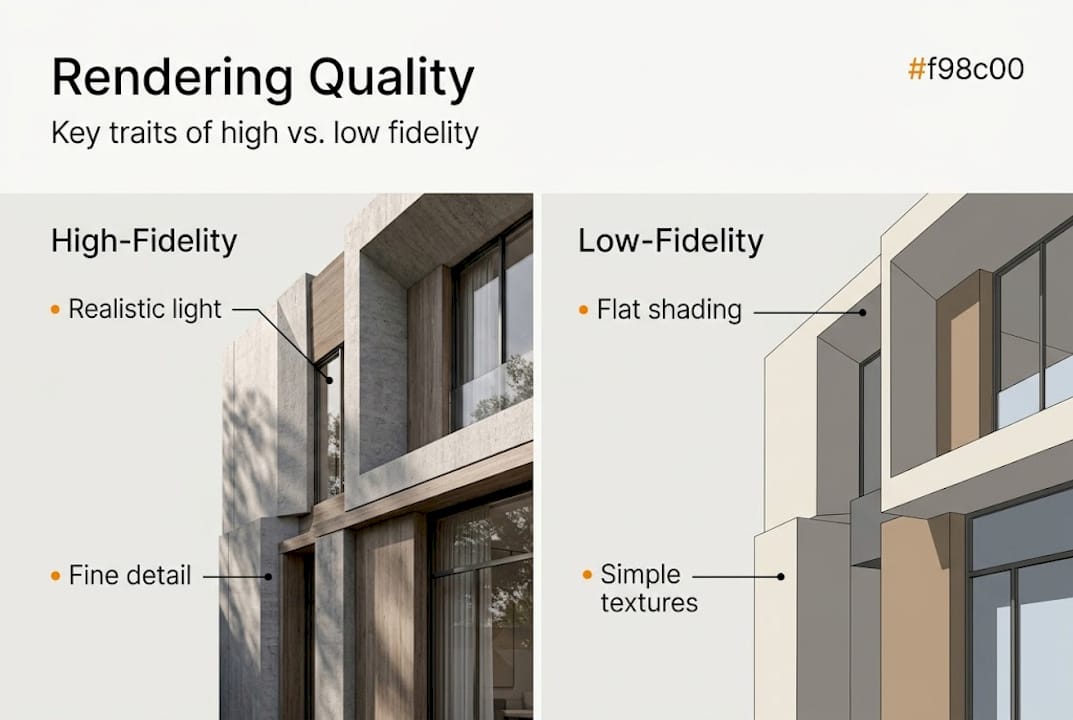
Low-fidelity rendering, by contrast, is often faster to produce but trades accuracy for speed. You’ll recognize it by its flat lighting, generic textures, and a slight “video game” quality that pulls the viewer out of the experience. The difference isn’t always dramatic, but it’s always felt.
| Feature | High-fidelity rendering | Low-fidelity rendering |
|---|---|---|
| Lighting accuracy | Physically based, true ray tracing | Approximated or baked lighting |
| Material detail | Photo-sourced textures, bump maps | Basic color fills or flat materials |
| Render time | Hours to days per frame | Minutes per frame |
| Client emotional impact | High, immersive, trust-building | Moderate, functional, informational |
| Use case fit | Marketing, pre-sales, approvals | Early concept review, internal drafts |
The benefits of 3D visualization go well beyond aesthetics. High-fidelity visuals help clients understand spatial scale, material choices, and ambient quality in ways that plans and elevations simply cannot communicate. For real estate developers, this translates directly to pre-sale conversions. For architects, it means fewer revision cycles and faster design sign-off.
Core advantages of high-fidelity rendering include:
- Stronger emotional connection for buyers and stakeholders viewing a project before it’s built
- Faster client approvals because ambiguity is replaced by visual clarity
- More compelling marketing assets suitable for websites, brochures, and social media campaigns
- Reduced design risk because spatial and material problems become visible before construction begins
- Higher perceived project value, which directly supports premium pricing in real estate marketing
“High-fidelity elevates marketing through emotional buyer connection and pre-sales boost, but requires expertise in avoiding pitfalls like flat lighting or unrealistic scales.”
The emotional connection piece deserves more attention than it usually gets. Buyers don’t just analyze images. They feel them. A high-fidelity interior render that captures warm afternoon light spilling across a kitchen counter triggers a real emotional response. A flat, poorly lit version of the same scene triggers skepticism. That difference determines whether a pre-sale converts or stalls.
Common pitfalls to watch for: flat lighting (usually from skipping global illumination), unrealistic material scales (a brick that looks three feet tall), and geometry that’s too clean or too crude to read as a real structure. Any one of these issues can quietly undermine an otherwise strong design presentation.
How high-fidelity rendering works: Tools and technology
Understanding which tools produce high-fidelity results, and why, helps you make smarter decisions about your visualization workflow and the vendors you work with. Here’s how the core technologies stack up:
- Ray tracing simulates how light actually behaves, tracing individual rays from the camera back to light sources and calculating reflections, refractions, and shadows with physical accuracy. It remains the gold standard for architectural visualization.
- V-Ray and similar production renderers are industry-standard plugins built on ray tracing principles, offering deep control over materials, lighting rigs, and camera simulation. V-Ray 7 introduced significant GPU acceleration improvements.
- GPU-accelerated rendering uses the parallel processing power of modern graphics cards to dramatically reduce render times, making high-fidelity outputs feasible on tighter project timelines.
- NeRF (Neural Radiance Fields) and Gaussian splatting are emerging techniques that reconstruct 3D scenes from photo collections, enabling novel view synthesis without traditional modeling pipelines.
| Technology | Strength | Limitation |
|---|---|---|
| Ray tracing | Physically accurate light simulation | Computationally intensive |
| V-Ray (GPU mode) | Fast, production-quality output | Steep learning curve, license cost |
| NeRF/Gaussian splatting | Novel view generation from photos | Limited control over materials, early stage |
| Real-time GPU rendering | Interactive exploration, fast feedback | Lower fidelity ceiling than offline rendering |
While GPU advancements enable real-time high-fidelity exploration, ray tracing remains the preferred method when fidelity is non-negotiable. NeRF and Gaussian splatting are promising for site documentation and existing-condition visualization, but they lack the material control that architects need for design-forward renders.
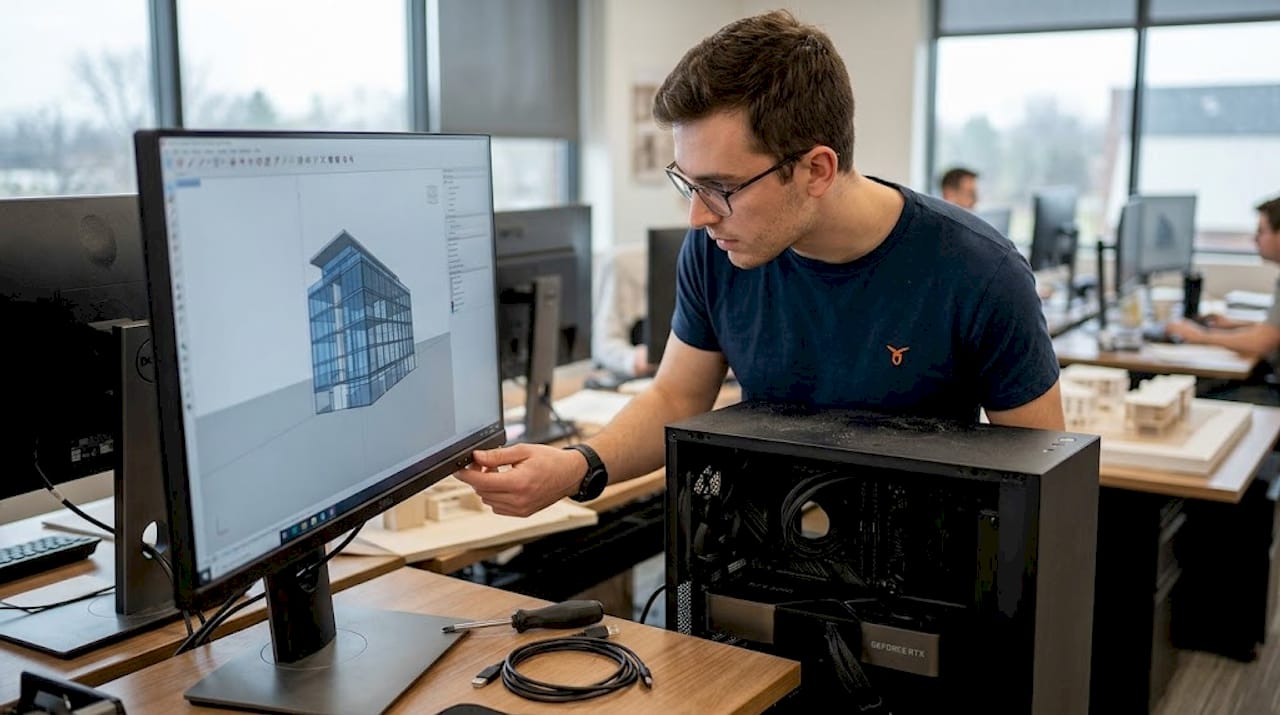
Hardware matters enormously here. A workstation with a high-end NVIDIA GPU (like the RTX 4090 or professional-grade RTX 6000) can cut overnight render jobs down to hours or even minutes. For studios handling multiple projects simultaneously, GPU render farms are increasingly common.
Pro Tip: For exterior stills and marketing images, V-Ray with an HDRI lighting setup and physically based materials will give you the most reliable photorealistic results. For interior animations or real-time walkthroughs, consider a hybrid approach: pre-render static frames at high fidelity and use real-time engines for the interactive portions. This keeps quality high while managing render costs. You can see how advanced rendering brings designs to life when the right tools are matched to the right output type.
Common challenges and pitfalls in achieving photorealism
Knowing the tools is only half the challenge. The other half is avoiding the specific failure modes that break photorealism, often right before a client deadline.
The human eye is remarkably good at detecting “wrongness” even when it can’t articulate the source. This is the core problem with the uncanny valley in architectural rendering. Everything looks correct on paper, but something feels off. Usually, the culprit is one of these:
- Low-light noise in interior scenes where global illumination hasn’t been given enough sample passes, leaving grainy shadows that read as unfinished
- Caustic lighting artifacts from transparent materials like glass or water, which require specialized rendering algorithms to resolve cleanly
- Multi-bounce global illumination errors in closed interior spaces where light needs to reflect many times to feel natural
- Geometry inconsistencies such as paper-thin walls, floating objects, or misaligned surfaces that catch light incorrectly
- Texture tiling where repeated patterns (floor tiles, brick, fabric) have visible seams or scale mismatches that immediately signal “computer generated”
- Hardware bottlenecks where insufficient GPU memory causes the renderer to compromise on shadow resolution or texture quality
Research confirms that technical rendering limitations are significant: low-light conditions degrade both NeRF and standard ray tracing outputs through noise and detail loss, complex caustics require specialized engines like V-Ray, and imperfect geometry or textures directly break realism in ways that are immediately visible to trained eyes.
For architects and developers, the practical consequence is that photorealism is fragile. One weak link in the pipeline, whether it’s the source geometry, the material library, or the lighting setup, can undermine the entire output.
Think about common rendering mistakes like under-sampling: a renderer set to too few light bounces will produce an interior that looks dim and gray, nothing like the warm, layered light of a real room. The fix is simple, but catching it requires experience and a calibrated eye.
A smart approach to reducing visualization errors is to build a pre-delivery checklist that includes scale verification (compare rendered furniture to human figures), lighting temperature cross-checks against reference photography, and a geometry audit for known artifacts like open edges or inverted normals.
Pro Tip: Before sending any high-fidelity render to a client, view it at 100% zoom on a calibrated monitor. Print a small-scale version and hold it at arm’s length. If something looks “off” at either scale, trust that instinct and investigate before delivery. Clients will spot problems you’ve stopped seeing after hours of close work.
High-fidelity rendering in action: Practical applications for architects and developers
At this point, you know what makes renders believable and which hurdles to avoid. Here’s where high-fidelity rendering delivers measurable results in modern architectural and development workflows.
The primary areas where high-fidelity rendering changes project outcomes:
- Marketing and sales collateral for off-plan residential and commercial developments, where photorealistic images are the only visual representation buyers have before committing
- Pre-sales programs that use compelling renders to generate deposits and funding before a single foundation is poured, reducing financial risk for developers
- Planning and approval submissions where realistic visuals help planning committees and community stakeholders understand scale, material, and visual impact within the existing streetscape
- Investor and stakeholder presentations where the ability to communicate design intent quickly and confidently often determines whether a project moves forward
The emotional impact is created through specific visual tools:
- Lifelike perspectives that place the viewer at eye level within the design, making scale and proportion immediately intuitive
- Immersive walkthroughs that allow stakeholders to navigate the project virtually, building spatial confidence before construction
- Compelling exterior stills positioned at golden-hour lighting conditions to maximize emotional resonance
- VR experiences that let buyers physically inhabit a space and feel dimensions rather than estimate them from floor plans
Consider a real-world scenario: a developer marketing a 200-unit residential tower in a competitive urban market. Standard renderings show the building from the street. High-fidelity renders show the building at dusk, with warm interior lights glowing through floor-to-ceiling glazing, pedestrians on the sidewalk, and reflected city lights in the glass facade. Both are “accurate,” but only one generates the emotional pull that drives pre-sales.
The visualization benefits for professionals extend into the design process itself. High-fidelity renders reveal material conflicts and spatial awkwardness that aren’t visible in technical drawings, often saving significant cost by catching issues before they become construction problems. Projects that invest in photorealistic visualization early in the design cycle consistently report real construction savings through fewer late-stage design changes.
Architects also use high-fidelity renders to support design intent during contractor briefings. A render that precisely shows the intended finish quality of a concrete wall or the behavior of natural light in a skylit corridor gives contractors unambiguous reference points that reduce interpretation errors on site.
High-fidelity elevates marketing through emotional buyer connection and measurable pre-sales momentum, but it requires genuine expertise to execute without the pitfalls that undermine trust at critical moments.
Expert perspective: Why high-fidelity rendering is more than just detail
Here’s a perspective that tends to make technically focused teams uncomfortable: pixel count and render quality don’t guarantee project success. We’ve seen extraordinarily detailed renders fail to move clients, and we’ve seen simpler, well-composed images win unanimous approval in the first presentation.
The difference is always storytelling. High-fidelity rendering is a communication tool, not a technical achievement. The deeper impact of visualization comes from how a render makes a viewer feel about the project’s potential, not from the resolution of the texture maps.
When teams obsess over technical perfection while neglecting composition, narrative lighting, and spatial storytelling, they produce renders that impress other visualization professionals and confuse everyone else. A well-composed render with a considered viewpoint, intentional lighting, and a clear focal point will outperform a technically superior render with a poor composition every single time.
The contrarian challenge we’d offer: before your next client presentation, ask whether each render tells a story about how the space will be used and experienced. If the answer is no, no amount of ray-traced detail will save it.
Next steps: Bring your designs to life with expert rendering
High-fidelity rendering isn’t a luxury. For architects competing for commissions and developers marketing off-plan properties, it’s a strategic investment that directly influences approvals, pre-sales, and stakeholder confidence. The gap between a render that informs and one that convinces is exactly where project momentum is won or lost.

Rendimension has delivered premium 3D rendering services across more than 1,000 projects globally, combining technical precision with a collaborative process that keeps your design vision at the center of every output. Whether you’re preparing marketing assets for a major development or need compelling visuals for a planning submission, explore our architectural visualization expertise to see how photorealistic rendering can elevate your next project from concept to client approval.
Frequently asked questions
How is high-fidelity rendering different from standard 3D rendering?
High-fidelity rendering produces highly accurate, photorealistic visuals with physically based lighting and detailed materials, while standard rendering prioritizes speed over realism and often lacks the emotional impact needed to build buyer trust.
What software or technology is best for high-fidelity architectural rendering?
Ray tracing combined with production renderers like V-Ray and supported by high-performance GPUs delivers the most reliable results; GPU advancements now enable real-time high-fidelity exploration that was previously only possible through offline rendering.
What are the biggest challenges in achieving photorealistic renders?
The most common issues are complex lighting (noise in low-light scenes, caustic artifacts), geometry flaws, texture mismatches, and hardware limits; technical rendering limitations confirm that even advanced engines require specialized setups to handle these scenarios cleanly.
How does high-fidelity rendering help with client presentations or pre-sales?
Photorealistic renders allow buyers to visualize a finished project with clarity and confidence, creating an emotional buyer connection that drives faster decisions and stronger pre-sales conversion rates.
Recommended
- Render In Architecture Meaning: Complete Guide To 3D Visuali
- Examples Of Rendering: 2025 Guide To 3D Visualization