Launching a new device in the competitive North American consumer electronics market demands more than slick photos and catchy slogans. Today’s buyers expect to interact with products before they ever reach store shelves. 3D visualization offers interactive, real-time experiences that bring every angle, button, and material detail to life, helping both customers and stakeholders make faster, more confident decisions. This article explores how modern 3D tools bridge the gap from concept to purchase while delivering measurable engagement advantages.
Table of Contents
- What 3D Visualization Means For Launches
- Key 3D Types In Product Promotion
- How 3D Enhances Launch Strategies
- Common Pitfalls In 3D Implementation
- Best Practices For Effective 3D Use
Key Takeaways
| Point | Details |
|---|---|
| Enhanced Consumer Engagement | 3D visualization allows customers to interact with products, increasing understanding and confidence before purchase. |
| Accelerated Decision-Making | Stakeholders can evaluate detailed 3D representations, reducing costly revisions and speeding up the launch process. |
| Cross-Channel Utilization | One 3D asset can be used across various marketing channels, maximizing investment and consistency in messaging. |
| Avoiding Common Pitfalls | Effective planning and integration are crucial to prevent budget overruns and ensure high-quality visualizations that enhance customer experience. |
What 3D Visualization Means for Launches
3D visualization fundamentally changes how consumers experience products before purchase. Rather than viewing static images, customers now engage with interactive, immersive experiences that let them explore every angle and feature.
This shift from flat to dimensional representation creates a bridge between concept and reality. When launching a consumer electronics product, 3D visualization technology enables customers to virtually interact with devices in ways traditional marketing cannot match. They see how products function in real-world scenarios, not just in marketing photographs.
Key advantages 3D visualization delivers:
- Customers understand design and functionality faster through interactive exploration
- Products can be viewed from unlimited angles and in multiple color variations
- Real-world context helps buyers envision products in their own environments
- Technical specifications become tangible rather than abstract
- Purchase confidence increases when customers feel they truly know the product
For North American consumer electronics launches, this matters because your buyers demand transparency. They want to examine how buttons work, see material textures, and understand proportions before committing financially.
3D visualization also accelerates decision-making during launch phases. Stakeholders—from executives to retailers—can evaluate products in precise detail, reducing costly revisions and delays.
Beyond marketing, these visualizations support accurate product representations that communicate design intent clearly. Engineers, designers, and product managers all work from the same visual reference, eliminating ambiguity about what you’re actually launching.
The technology has evolved to support various presentation contexts: trade shows, digital marketing, retail displays, and investor pitches. One 3D asset serves multiple launch channels, maximizing your investment.
Augmented reality (AR) takes this further by letting customers place virtual products in their actual homes through smartphone cameras. Virtual reality (VR) creates fully immersive environments where customers can explore products as if they already own them.
Pro tip: Start your 3D visualization process early in product development, not during final launch stages—this allows you to test market reactions to design choices before manufacturing commitments are made.
Key 3D Types in Product Promotion
Product promotion strategies now rely on multiple 3D visualization approaches, each serving different goals and customer touchpoints. Understanding which type works best for your launch is critical to maximizing engagement.
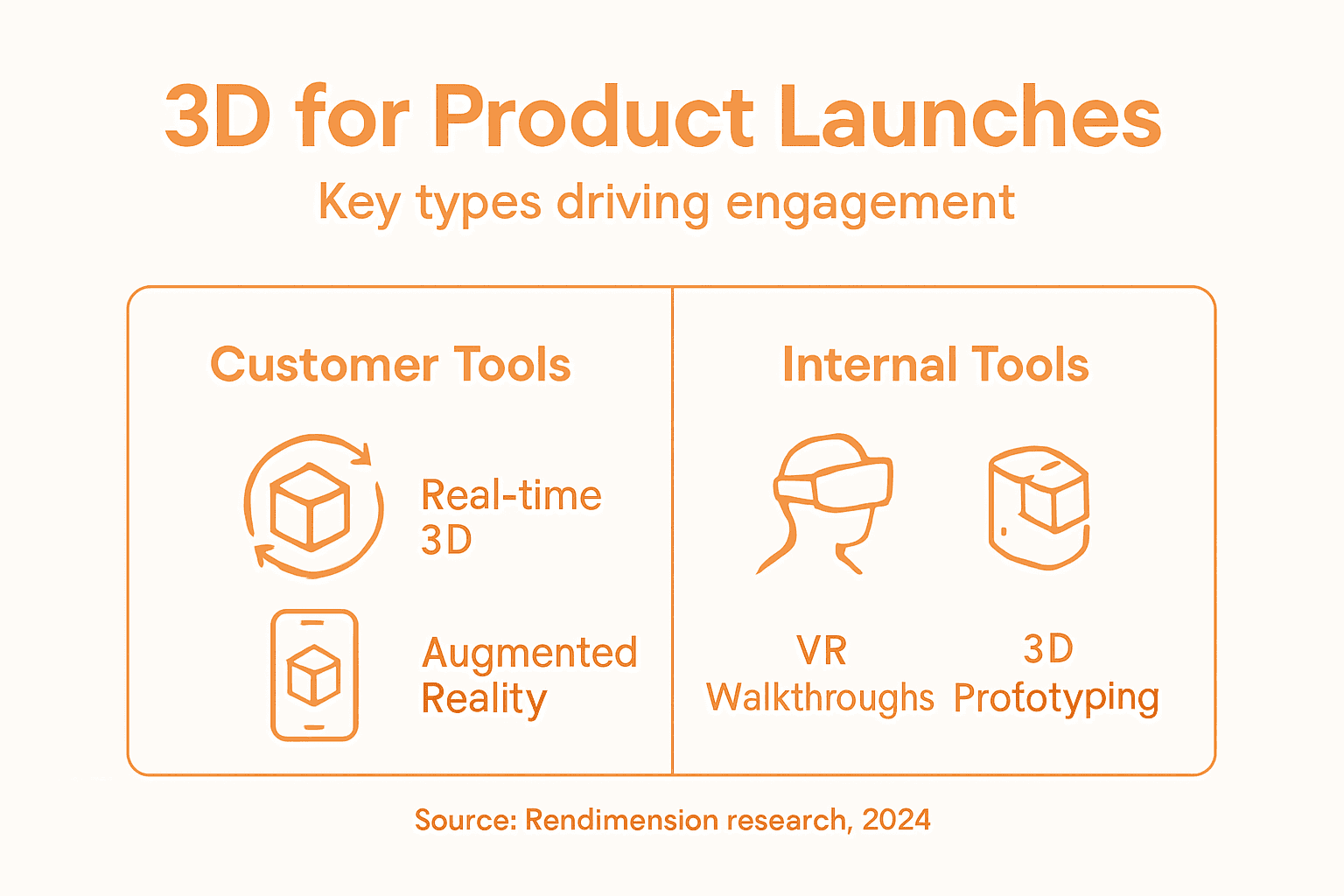
Real-time 3D rendering powers interactive product experiences directly on websites and apps. Customers spin products, zoom into details, and customize colors or configurations without waiting for image loads. This approach works exceptionally well for consumer electronics because buyers want to examine specifics before deciding.
Augmented reality (AR) bridges digital and physical worlds by placing virtual products in real environments. When a customer points their smartphone at their desk, they see your new monitor sitting there. They visualize scale, fit, and aesthetics in their actual space, eliminating guesswork about whether something will work for them.
Virtual reality (VR) creates fully immersive experiences where customers explore products as if already owning them. For high-value items or complex devices, VR removes purchase anxiety by letting buyers experience products in realistic scenarios before commitment.
Beyond these customer-facing tools, interactive 3D visualization technologies also support internal design workflows through parametric and direct modeling, enabling teams to refine products with precision.
Which 3D type to use depends on your product and audience:
Here is a quick comparison of the main 3D visualization types and their optimal use cases:
| 3D Type | Ideal Use Case | Audience Benefit |
|---|---|---|
| Real-time 3D | Product exploration | Interactive customization |
| Augmented Reality (AR) | Try in real environment | Visualizes true fit |
| Virtual Reality (VR) | Complex products | Immersive experience |
| Parametric Modeling | Stakeholder review | Design precision |
| Direct Modeling | Fast design changes | Iterative improvements |
- Real-time 3D for quick product exploration and web integration
- AR for helping customers envision products in their environments
- VR for premium products where experience and confidence matter most
- Parametric modeling for detailed design communication with stakeholders
- Direct modeling for flexible, rapid design iterations
Many successful launches use multiple types together. A launch might feature real-time 3D on your website, AR in your mobile app, and VR experiences at trade shows. Each serves a specific purpose in moving customers from curiosity to purchase.
The most effective product launches combine 3D types strategically rather than relying on a single approach—matching each technology to the specific decision point in your customer journey.
Product managers should consider customer journey stages when selecting 3D types. Early awareness works well with social media-friendly AR experiences. Pre-purchase decisions benefit from detailed real-time 3D exploration. Premium launches leverage VR for experiential differentiation.
Pro tip: Start with real-time 3D on your website or app since it’s the most versatile and accessible tool, then layer in AR for mobile engagement and VR for high-value product categories once you validate initial customer interest.
How 3D Enhances Launch Strategies
3D visualization transforms product launches from passive announcements into active customer engagement events. Instead of waiting for customers to discover your product, you pull them into interactive experiences that build confidence and excitement.

Traditional launch campaigns rely on static images and written descriptions. 3D changes this by letting customers explore products dynamically, which reduces uncertainty and accelerates purchasing decisions. When buyers understand exactly what they are getting, they commit faster.
Speed and timing matter in product launches. 3D models let you showcase products weeks or months before physical availability. This pre-launch buzz builds demand, generates press coverage, and creates anticipation. Your sales team gains qualified leads before inventory even exists.
Stakeholder alignment becomes simpler with 3D. Executives, designers, retailers, and marketing teams all view the same precise representation. This eliminates miscommunication about what you are actually launching. Interactive and immersive digital experiences ensure everyone shares identical expectations.
Core benefits 3D brings to launch strategies:
- Customers see product details before purchase, reducing return rates
- Multi-channel campaigns use one 3D asset across websites, apps, social media, and trade shows
- Design validation happens faster with stakeholder feedback on visualizations
- Virtual demonstrations reach global audiences without shipping physical prototypes
- Measurable engagement metrics show which product angles drive interest
By incorporating 3D visualization into launch strategies, companies achieve faster design validation and better stakeholder communication, which directly improves launch effectiveness and market reach.
Personalization becomes possible at scale. Customers customize colors, configurations, and materials in real-time 3D, creating unique previews of their potential purchase. This personalized experience drives stronger emotional connection than generic product photos.
The strongest product launches combine 3D visualization with strategic storytelling, using interactive experiences to move customers from curiosity through consideration to commitment.
Retailers benefit too. Store staff can access 3D models to answer customer questions accurately. Remote sales teams use VR demonstrations to close deals without traveling. These leverage points multiply your launch impact across distribution channels.
The following table summarizes how 3D visualization strengthens each launch phase for consumer electronics:
| Launch Phase | 3D Visualization Impact | Key Outcome |
|---|---|---|
| Pre-launch | Visual previews and demos | Increased buyer anticipation |
| Launch | Interactive web experiences | Faster purchase decisions |
| Post-launch | Real-time customization and support | Higher satisfaction, loyalty |
| Internal Alignment | Shared 3D models for clarity | Fewer miscommunications |
Pro tip: Launch with real-time 3D on day one to maximize reach, then layer in VR experiences and personalized AR offers over the following weeks to maintain momentum and extend engagement throughout your launch window.
Common Pitfalls in 3D Implementation
Many product managers start 3D visualization projects with enthusiasm but run into obstacles that undermine results. Understanding these common pitfalls helps you avoid expensive mistakes and wasted timelines.
Cost overruns plague many 3D initiatives. Advanced software licenses, powerful workstations, and skilled 3D artists demand significant budgets. Without proper planning, projects balloon beyond initial estimates. Teams discover mid-project that their infrastructure cannot handle the complexity of photorealistic models.
Creating accurate 3D models requires deep technical expertise. If your team lacks experience, you end up with visualizations that miss critical product details or misrepresent materials and dimensions. Poor-quality models damage your brand rather than enhance it.
Implementation challenges for 3D visualization often involve technology adoption barriers, such as inadequate infrastructure and high development time. Many companies underestimate how much work goes into building, updating, and maintaining 3D assets across multiple product variations.
Integration failures derail launches. Your 3D models sit isolated in design studios instead of connecting to websites, apps, and marketing platforms. This fragmentation creates bottlenecks and limits how effectively you can use 3D across channels.
Common pitfalls to avoid:
- Choosing software without testing it against your actual workflow and product complexity
- Underestimating timeline and budget requirements for model creation and refinement
- Building 3D assets without clear specifications from product teams
- Neglecting user experience, creating visualizations that are beautiful but confusing
- Failing to establish a system for updating models when products change
- Prioritizing photorealism over performance, making files too heavy for web and mobile
User experience gets overlooked frequently. You build stunning 3D models, but customers cannot interact with them intuitively. Confusing controls and poor navigation frustrate users and undermine engagement.
The photorealism versus performance tradeoff trips up many teams. Balancing photorealism and performance affects customer engagement and satisfaction negatively when mismanaged. Your model might look amazing on a desktop but fail completely on mobile devices where most customers shop.
Prevention beats rescue: define clear requirements, choose appropriate tools, allocate realistic budgets, and prioritize user experience over visual perfection.
Maintenance becomes overwhelming without planning. Products update constantly. Each change requires model revisions. Without a sustainable system, your 3D assets become outdated and unreliable.
Pro tip: Start small with a single product line to test your workflow, tools, and team capacity before scaling to your full portfolio—this prevents costly mistakes and helps you establish sustainable processes.
Best Practices for Effective 3D Use
Successful 3D implementation requires strategy beyond simply creating models and launching them. The best results come from deliberate practices that align 3D with your broader launch objectives.
Start with clear user experience priorities. Beautiful models mean nothing if customers cannot interact with them intuitively. Design navigation so users explore products effortlessly. Make zooming, rotating, and customization obvious and responsive. Your 3D experience should feel natural, not technical.
Optimization matters enormously for reach. A photorealistic model that takes 30 seconds to load on mobile loses customers immediately. Leveraging real-time rendering for interactivity ensures your 3D assets perform across devices and networks. Prioritize fast loading over perfect detail on lower-end devices.
Essential best practices for 3D launches:
- Build accurate, detailed models that represent final products precisely
- Test user experience with real customers before full launch
- Optimize file sizes and rendering performance for mobile and web
- Integrate 3D across all marketing channels, not just websites
- Use consistent branding and product information across all 3D implementations
- Enable customization so customers personalize products in real-time
Coordination across teams prevents disconnects. Designers, marketers, engineers, and IT specialists must collaborate from the start. When teams work in silos, 3D assets fail to integrate with campaigns or miss technical requirements.
Cloud-based platforms offer flexibility that legacy software cannot match. Adopting scalable cloud-based platforms allows flexibility and continuous enhancement without expensive infrastructure. This approach makes it easier to update products and scale across multiple launches.
Regular updates keep 3D assets relevant. When your product changes, update the model immediately. Stale 3D visualizations damage credibility more than no 3D at all. Establish a maintenance schedule and assign ownership.
Consistency across all touchpoints—website, app, social media, and trade shows—amplifies 3D impact and builds customer confidence.
Training your team matters more than tool selection. Even excellent software delivers poor results without skilled users. Invest in training so your team operates efficiently and maintains quality standards across all projects.
Measure what works. Track engagement metrics around 3D experiences. Which product angles drive clicks? Where do customers drop off? Use data to refine future implementations and prove ROI to stakeholders.
Pro tip: Create a reusable 3D asset library from your first successful launch so subsequent products benefit from established workflows, proven quality standards, and faster production timelines.
Elevate Your Product Launch with Stunning 3D Visualization
Navigating the challenges of product launches means overcoming uncertainty, enhancing customer engagement, and speeding decision-making. The article highlights how real-time 3D, augmented reality, and virtual reality create immersive experiences that build purchase confidence and align stakeholders with precise visual references. If you seek to transform your launches into interactive journeys that captivate buyers and accelerate market success, leveraging advanced visualization solutions is key.
At Rendimension, we specialize in delivering high-quality, photorealistic 3D renderings and immersive virtual experiences tailored to your product needs. Whether you need detailed 3D models for real-time exploration or virtual reality setups for experiential engagement, our collaborative process ensures your vision becomes a powerful tool for marketing and stakeholder alignment. Discover how our expertise in architectural visualization and product design can provide the visual proof and interactive assets necessary to drive your launches forward.
Ready to revolutionize your product launch with compelling 3D visualization that boosts customer confidence and accelerates sales? Visit Rendimension to explore our full range of services. Learn more about how our 3D visualization solutions can seamlessly integrate across your marketing channels and enhance your launch strategy. Don’t wait to captivate your audience with cutting-edge visual experiences that deliver tangible results.
Frequently Asked Questions
What are the main benefits of using 3D visualization in product launches?
3D visualization enhances customer engagement by allowing them to interact with products from multiple angles and in real-world contexts. This increases understanding of design and functionality, boosts purchase confidence, and can lead to reduced return rates.
How can different types of 3D visualization be utilized during a product launch?
Different types of 3D visualization serve varying purposes: Real-time 3D is ideal for website interactions, Augmented Reality (AR) helps customers visualize products in their own environment, and Virtual Reality (VR) provides immersive experiences, especially for high-value items.
What common pitfalls should be avoided when implementing 3D visualization?
Common pitfalls include cost overruns, insufficient user experience design, and neglecting updates for 3D assets. It’s important to choose the right tools, properly plan budgets, and ensure the models are user-friendly and regularly maintained.
How does 3D visualization improve stakeholder alignment during product launches?
3D visualization allows all stakeholders—executives, designers, and marketers—to see the same accurate product representation, which minimizes miscommunication and ensures everyone has identical expectations about the product being launched.
Recommended
- 3D Modeling For Real Estate: Boosting Sales And Engagement
- What Is Product Visualization: Elevating Client Presentations
- 7 Product Visualization Strategies For Architects And Designers
- 3D Walkthroughs Real Estate Agents – Rendimension
- Why Use 3D Pool Design for Custom Pools