3D Rendering Terminology Explained: Clear Communication for Architects
Clear communication often hinges on knowing the right term at the right moment, especially when coordinating a complex architectural visualization for a major North American real estate project. Inaccurate or vague language can cause confusion, delay approvals, or disrupt client trust during critical presentations. Strengthening your command of core 3D rendering concepts not only sharpens how you describe images and workflows but also boosts confidence in every stage of design delivery.
Table of Contents
- Core 3D Rendering Terms And Concepts
- Types Of 3D Renderings In Architecture
- Workflow And Technical Terminology Explained
- Comparing Visualization Techniques And Outcomes
- Common Terminology Mistakes To Avoid
Key Takeaways
| Point | Details |
|---|---|
| Understanding Core Concepts | Familiarize yourself with essential 3D rendering terminology like Modeling, Texturing, Lighting, and Rendering to enhance communication within design teams. |
| Choose the Right Rendering Technique | Select a rendering method based on project goals, considering factors like quality, speed, and detail to achieve optimal results. |
| Avoid Common Terminology Mistakes | Be aware of nuanced distinctions in rendering language to prevent miscommunication and ensure clarity in architectural projects. |
| Emphasize Visualization Goals | Tailor your rendering style and quality to effectively convey design intent and meet stakeholder expectations throughout the project lifecycle. |
Core 3D Rendering Terms and Concepts
In architectural visualization, 3D rendering transforms complex digital models into photorealistic images through sophisticated computational processes. Architectural rendering workflows involve multiple sophisticated stages that convert abstract digital representations into lifelike visual experiences.
The core terminology in 3D rendering encompasses several critical technical concepts:
- Modeling: Creating the initial three-dimensional digital geometry of objects or environments
- Texturing: Applying surface details, colors, and material characteristics to 3D models
- Lighting: Simulating realistic illumination conditions that define shadows, reflections, and visual depth
- Rendering: The final computational process of converting 3D scene data into a 2D image
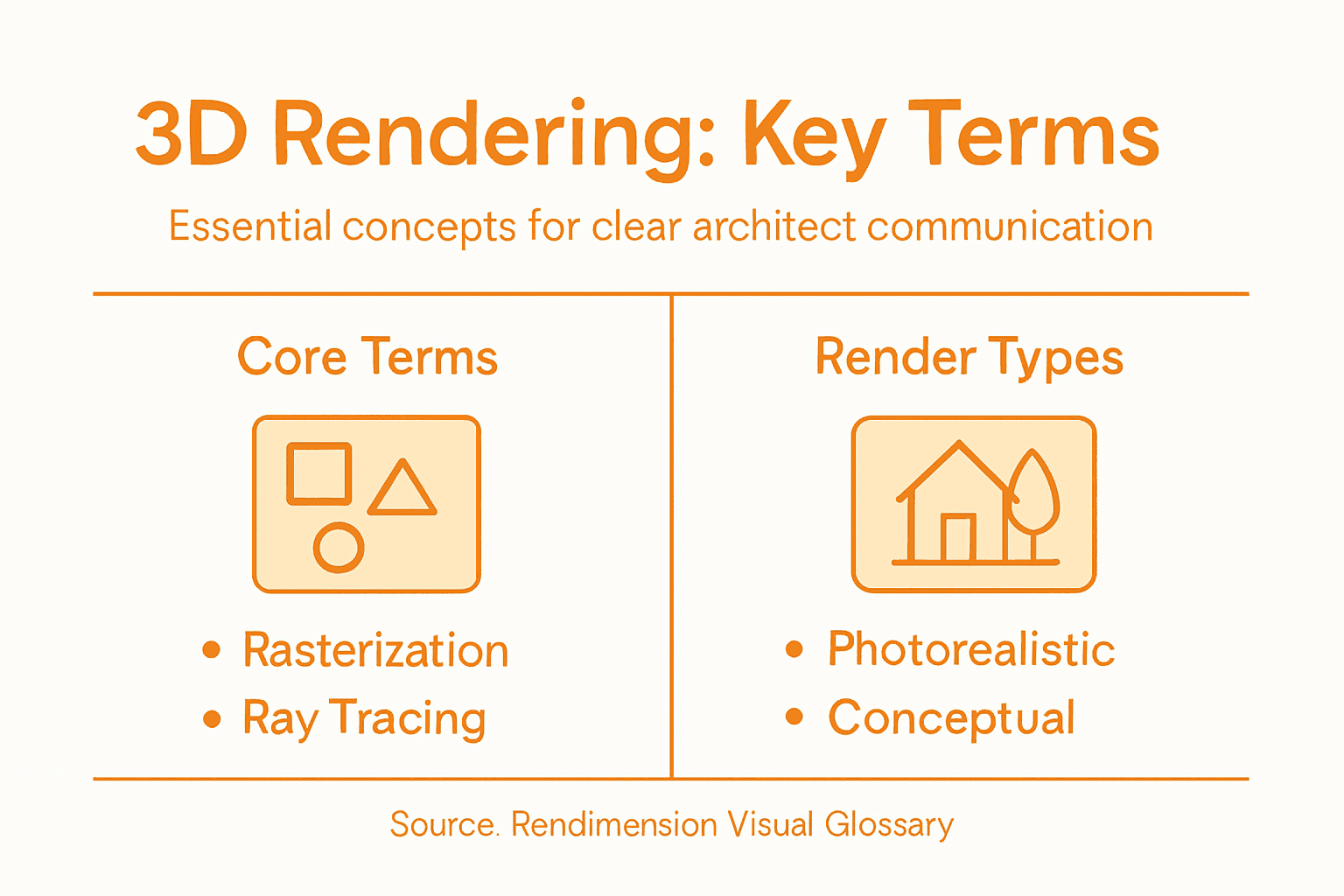
Rendering techniques can be broadly categorized into two primary approaches. Rasterization generates images by converting vector graphics into pixel-based representations, while ray tracing simulates how light interacts with virtual surfaces to produce dramatically more photorealistic results. Ray tracing tracks individual light rays, calculating their interactions with different materials to generate incredibly nuanced visual representations.
Render engines serve as the computational powerhouses driving these sophisticated visualization processes. These specialized software platforms leverage advanced algorithms to translate complex geometric data into visually compelling architectural representations, enabling designers to communicate spatial concepts with unprecedented clarity.
Pro Tip: Always choose a render engine that balances computational efficiency with high-quality output resolution for optimal architectural visualization results.
Types of 3D Renderings in Architecture
Architectural rendering encompasses diverse visualization strategies designed to communicate design intent across different project stages. Architectural rendering techniques range from conceptual sketches to hyperrealistic representations that capture minute design details with extraordinary precision.
The primary types of architectural 3D renderings include:
- Conceptual Renders: Preliminary visual explorations focusing on design philosophy and spatial relationships
- Schematic Renders: Early-stage visualizations demonstrating basic spatial configurations and design potential
- Photorealistic Renders: Highly detailed images mimicking real-world lighting, materials, and environmental conditions
- Interior Renders: Detailed visualizations of internal spaces, emphasizing material textures and lighting dynamics
- Exterior Renders: Comprehensive representations showing buildings within their surrounding landscape and urban context
Each rendering type serves a distinct communicative purpose, allowing architects to translate complex spatial concepts into accessible visual narratives. Photorealistic renders provide stakeholders with immersive experiences that closely simulate actual built environments, enabling more informed decision-making processes.
Visualization techniques continue evolving, with advanced render engines now capable of generating increasingly sophisticated representations that blur the lines between digital imagination and physical reality. These technologies enable architects to present design concepts with unprecedented clarity and emotional resonance.
Pro Tip: Select rendering styles strategically, matching the visualization approach to your specific project communication goals and stakeholder expectations.
Workflow and Technical Terminology Explained
The 3D rendering workflow represents a complex, multi-stage process that transforms abstract digital designs into visually compelling architectural representations. Comprehensive rendering workflows involve intricate technical stages that demand precision and specialized knowledge from architectural visualization professionals.
The typical 3D rendering workflow encompasses several critical stages:
- 3D Modeling: Creating precise geometric representations of architectural elements
- Texturing: Applying surface materials, colors, and detailed visual characteristics
- Lighting: Simulating realistic light interactions and environmental conditions
- Rendering: Converting 3D models into final two-dimensional images
- Post-Processing: Refining rendered images through color correction and visual enhancement
Technical terminology plays a crucial role in navigating this complex process. GPU rendering has revolutionized architectural visualization by leveraging graphics processing units to dramatically accelerate computational rendering times, enabling faster and more complex visual iterations.
Understanding specialized rendering techniques allows architects to communicate more effectively and produce more sophisticated visualizations. Advanced methods like ray tracing simulate light behavior with extraordinary precision, creating photorealistic representations that closely mimic real-world visual experiences.
Pro Tip: Master the technical vocabulary of 3D rendering to communicate more precisely with visualization teams and software specialists.
Comparing Visualization Techniques and Outcomes
Architectural rendering techniques represent a sophisticated spectrum of visual communication strategies, each with unique strengths and limitations. Rendering methods comparison) reveals critical differences in image quality, computational requirements, and visual communication effectiveness that directly impact design presentation and stakeholder understanding.
The primary visualization techniques in architectural rendering include:
- Rasterization: Fast rendering technique producing real-time images with moderate visual complexity
- Ray Tracing: High-fidelity method simulating precise light interactions for photorealistic results
- Real-Time Rendering: Interactive visualizations enabling immediate design exploration
- Offline Rendering: Computationally intensive processes generating extremely detailed, high-resolution images
- Physically Based Rendering (PBR): Advanced technique mimicking real-world material and light behavior
Ray tracing represents the pinnacle of rendering sophistication, allowing architects to create breathtakingly realistic visualizations that capture subtle light interactions, material textures, and environmental nuances with unprecedented accuracy. This technique transforms abstract digital models into immersive visual experiences that closely approximate physical reality.
Understanding these techniques empowers architects to select the most appropriate visualization strategy based on project requirements, presentation goals, and available computational resources. Different rendering approaches offer varying trade-offs between image quality, rendering speed, and computational complexity.
To help distinguish architectural rendering methods, here’s a side-by-side comparison of key visualization techniques:
| Technique | Image Quality | Computational Speed | Typical Use Cases |
|---|---|---|---|
| Rasterization | Moderate detail, less realism | Very fast | Real-time walkthroughs |
| Ray Tracing | Highly photorealistic | Slower | Marketing visuals, client presentations |
| Real-Time Rendering | Interactive, mid-level realism | Instant | Design reviews, VR experiences |
| Offline Rendering | Ultra-high detail, custom effects | Time consuming | Final portfolio imagery |
| Physically Based Rendering | Accurate materials, nuanced light | Moderate | Material studies, detailed mockups |
Pro Tip: Match your rendering technique to your specific project communication needs, balancing visual quality with computational efficiency.
Common Terminology Mistakes to Avoid
Precision in architectural rendering terminology is crucial for effective communication and avoiding costly misunderstandings. Rendering language pitfalls reveal nuanced distinctions that can significantly impact project interpretation and professional credibility.
Common terminology mistakes architects frequently encounter include:
- Misusing “Rendering” vs “Visualization”: Not understanding the technical differences between these related but distinct processes
- Confusing Light Types: Incorrectly interchanging terms like ambient, direct, and indirect lighting
- Biased vs Unbiased Rendering: Failing to distinguish between computational rendering approaches
- Resolution Terminology: Misapplying terms like pixel density, aspect ratio, and image quality
- Material Definition Errors: Imprecisely describing surface properties and texture characteristics
Ambient lighting is particularly prone to misinterpretation, often being confused with indirect lighting. Professional architects must understand that ambient light represents the overall environmental illumination, while indirect lighting specifically tracks light bounces and reflections from surfaces.
Technical precision matters tremendously in architectural communication. Misusing specialized rendering terminology can lead to miscommunication, potentially causing design misunderstandings, incorrect client expectations, or inefficient workflow processes between design teams and stakeholders.
A handy summary clarifies frequent terminology pitfalls encountered in architectural rendering:
| Incorrect Use | Correct Term | Impact of Misuse |
|---|---|---|
| “Ambient lighting” | “Indirect lighting” | Inaccurate lighting simulation |
| “Rendering” | “Visualization” | Confused workflow differentiation |
| “Biased rendering” | “Unbiased rendering” | Misjudged image accuracy |
| “Pixel density” | “Resolution” | Misrepresented image clarity |
| “Material” | “Texture” | Poorly described surface properties |
Pro Tip: Create a personal glossary of rendering terms to ensure consistent and accurate technical communication across project teams.
Elevate Your Architectural Communication with Expert 3D Rendering Solutions
Clear and precise 3D rendering terminology is crucial for architects who want to avoid misunderstandings and present their visions effectively. If you have struggled with communicating complex concepts like ray tracing, texturing, or lighting, you are not alone. At Rendimension, we understand these challenges and specialize in converting your technical designs into stunning photorealistic visualizations that speak volumes to clients and stakeholders.

Unlock the power of immersive visualization by partnering with Rendimension. Our team ensures every detail from modeling to post-processing is crafted with precision and clarity. Explore how our architectural visualization services bring your projects to life with unmatched realism. Don’t let confusing terminology hold your presentations back. Visit Rendimension today and take the first step toward transforming your concepts into compelling, easy-to-understand visual experiences.
Frequently Asked Questions
What is 3D rendering in architecture?
3D rendering in architecture is the process of transforming digital models into photorealistic images using sophisticated computational techniques. It helps architects visually communicate their design concepts.
What is the difference between modeling and rendering?
Modeling refers to creating the 3D geometry of objects or environments, while rendering is the final step that converts those models into 2D images, adding textures, lighting, and other enhancements to depict realism.
Why is ray tracing preferred over rasterization?
Ray tracing is preferred for its ability to simulate how light interacts with surfaces, resulting in more photorealistic images compared to rasterization, which generates images using simpler pixel-based techniques.
What are the main types of architectural 3D renderings?
The main types include conceptual renders, schematic renders, photorealistic renders, interior renders, and exterior renders. Each type serves a unique purpose in visualizing and communicating design intent.