The Expert Guide to 3d Max and Vray (2026 Edition)
The rise of 3D visualization has revolutionized architecture, design, and entertainment, bringing dreams to life with stunning realism. In 2026, 3d max and vray stand as the industry’s gold standard for crafting photorealistic scenes that captivate clients and audiences alike.
This expert guide will help you master every aspect of 3d max and vray, from core fundamentals to advanced workflows used by top professionals. You will discover essential features, setup tips, best practices, advanced rendering techniques, and the latest trends shaping the future.
Ready to elevate your visualization skills? Continue reading for actionable insights that can transform your creative process.
Understanding 3ds Max and V-Ray: The Industry Power Duo
The creative world of 3D visualization has been revolutionized by the synergy of 3d max and vray. These two tools set the benchmark for digital artistry, enabling professionals to transform ideas into compelling visual realities. Whether you design skyscrapers, craft immersive game worlds, or produce cinematic effects, mastering this power duo is essential for success in 2026.
What is 3ds Max? Core Capabilities and Use Cases
3ds Max stands as a cornerstone in the 3D industry, with decades of evolution driving its advanced capabilities. Over the years, 3d max and vray have become synonymous with professional-grade modeling, animation, and rendering. Today, 3ds Max is trusted by architects, game developers, filmmakers, and product designers to deliver intricate and lifelike digital content.
Key features include parametric modeling, a robust modifier stack, and sophisticated animation tools. These allow users to build complex objects, simulate movement, and refine every detail with precision. For example, leading architecture firms use 3d max and vray to visualize building interiors and exteriors, making design decisions faster and more confidently.
In the entertainment sector, blockbuster films rely on 3ds Max for realistic environments and dynamic character animation. According to Autodesk, over 60% of architectural firms preferred 3ds Max in 2024, a testament to its widespread industry adoption. This dominance is rooted in its flexibility and deep integration with rendering engines like V-Ray.
What is V-Ray? Photorealistic Rendering Engine Explained
V-Ray is the rendering engine that elevates 3d max and vray workflows to new heights of realism. As a plugin, V-Ray brings advanced photorealistic rendering to 3ds Max, offering global illumination, physically accurate lighting, and a versatile material system. These features allow artists to replicate real-world lighting conditions and materials with unmatched fidelity.
A prime example of V-Ray in action is its role in real estate marketing, where lifelike interior renders help clients envision spaces before a single brick is laid. V-Ray stands out for speed, flexibility, and high-quality results. When compared to Arnold and Corona Renderer, V-Ray often leads in rendering speed and offers a broader range of customization options for both beginners and experts.
| Renderer | Speed | Realism | Flexibility |
|---|---|---|---|
| V-Ray | Fast | Excellent | High |
| Arnold | Moderate | Excellent | Moderate |
| Corona Renderer | Fast | Very Good | Moderate |
For those aiming for the highest level of authenticity, mastering V-Ray is essential. To deepen your expertise, explore this Guide to photorealistic rendering for proven techniques and industry insights.
Why Combine 3ds Max and V-Ray?
The integrated workflow of 3d max and vray delivers efficiency and creative control that few other combinations can match. Their seamless connection means artists can model, texture, light, and render within a unified environment, reducing friction and accelerating project timelines.
V-Ray’s deep integration with 3ds Max gives users granular control over lighting and materials, making it possible to craft images that are indistinguishable from real photographs. In fact, industry surveys from 2025 report that commercial project timelines can be reduced by up to 30% when using 3d max and vray together.
For professionals, this combination is the gold standard. It empowers teams to meet demanding client expectations, handle complex scenes, and deliver consistently high-quality results. As visualization projects grow in scale and ambition, the importance of mastering both 3d max and vray only continues to rise.
Setting Up 3ds Max and V-Ray for Optimal Performance
Setting up 3d max and vray for peak performance is the foundation for any successful visualization project. Whether you are a freelancer or part of a large studio, the right setup ensures smoother workflows, faster renders, and fewer technical hiccups.
Hardware and Software Requirements in 2026
The performance of 3d max and vray depends heavily on your hardware and software. By 2026, minimum specs include a multi-core CPU, at least 32GB RAM, and a GPU with RTX support. For professional results, aim for 64GB RAM or more and a high-end NVIDIA or AMD GPU.
| User Type | CPU | RAM | GPU | Storage |
|---|---|---|---|---|
| Freelancer | 8-core, 3.0 GHz | 32GB | RTX 4060/4070 | 1TB NVMe SSD |
| Studio | 16-core, 3.5 GHz | 64GB+ | RTX 4090/6000 | 2TB NVMe SSD |
A 64-bit Windows OS is recommended, while the latest drivers and regular updates ensure compatibility. GPU acceleration is essential for rendering large scenes efficiently in 3d max and vray, making it a priority for all users.
Installation and Licensing: Step-by-Step Guide
To install 3d max and vray, start by downloading the official installers from Autodesk and Chaos Group. Choose the 2026 versions for maximum feature support. Installation is straightforward, but always run installers as an administrator for best results.
Licensing offers flexibility. Options include monthly or annual subscriptions, perpetual licenses, and cloud-based floating licenses for teams. Studios often prefer cloud licenses to scale seats easily. Common pitfalls include firewall issues or activation errors, so keep your login credentials and license keys handy. If you encounter problems, consult the official support channels for 3d max and vray to resolve installation or licensing issues quickly.
Configuring 3ds Max and V-Ray for Productivity
After installation, configure 3d max and vray to match your workflow. Customize the UI by docking toolbars, saving custom layouts, and creating hotkeys for frequent actions. Set up dedicated project folders and asset libraries for organized file management.
For V-Ray, adjusting settings is key for efficiency. Use draft quality for test renders and switch to higher quality for finals. Setting up batch rendering and configuring default output folders streamlines repetitive tasks. Explore 3ds Max rendering techniques to further optimize your workflow and achieve the best results with 3d max and vray.
Essential Plugins and Add-ons
Enhance the power of 3d max and vray by integrating essential plugins. Popular options in 2026 include:
- Forest Pack: Advanced scattering for landscaping and vegetation
- RailClone: Parametric modeling for architecture
- V-Ray Scatter: Efficiently populates large scenes
- Asset tracking tools: Streamline material and model management
When selecting plugins, ensure compatibility with your 3d max and vray version. Many plugins now offer cloud integration for collaborative teams. By leveraging these add-ons, artists and studios can handle complex projects, automate repetitive processes, and maintain a competitive edge in the fast-evolving world of 3D visualization.
Core Workflow: From Modeling to Rendering in 3ds Max and V-Ray
Mastering the complete workflow in 3d max and vray is the key to producing exceptional, photorealistic 3D visuals. Each stage, from initial modeling to final rendering, requires attention to both technical precision and creative detail.
This section will walk you through the essential steps, highlight best practices, and offer practical examples to help you achieve professional results with 3d max and vray.
Step 1: 3D Modeling Best Practices
Efficient modeling is the foundation of every successful project in 3d max and vray. Start by choosing the right modeling approach. Polygonal modeling offers flexibility for organic shapes, while parametric and spline techniques are ideal for architectural forms.
Organize your scene with clear layer management. Group elements logically, label objects, and use color coding to distinguish between structure, furniture, and décor. This streamlines revisions and reduces errors.
For complex interiors, create modular assets. For example, design a modern living room by modeling the walls, floor, and ceiling separately, then add furniture and fixtures as reusable components. This method speeds up iteration and ensures consistency.
Apply modifiers such as TurboSmooth or Bend to refine geometry without destroying the base mesh. Always optimize meshes to avoid excessive polygon counts, especially for large scenes.
By following these modeling best practices in 3d max and vray, you lay the groundwork for a smooth, efficient workflow and high-quality results.
Step 2: Material Creation and Texturing
Materials bring your 3d max and vray models to life. Use the V-Ray Material Editor to build physically based (PBR) materials, adjusting parameters like reflection, glossiness, and bump for realism.
Texture mapping is crucial. Apply UV mapping to avoid stretching and ensure patterns align perfectly. Blend procedural textures with image-based maps for unique surfaces. When creating marble, for example, layer noise and swirl patterns for depth, then add subtle reflectivity.
Pay special attention to glass, metal, wood, and fabric. For glass, use low IOR values and enable refraction. Metals require high reflectivity and a tailored Fresnel curve. Wood benefits from bump and displacement maps to simulate grain, while fabrics often need subsurface scattering for softness.
For advanced techniques, explore Architectural Visualization Techniques with 3ds Max and V-Ray to combine digital painting with procedural texturing.
Mastering material creation in 3d max and vray is essential for achieving photorealistic surfaces and elevating your visualizations.
Step 3: Lighting Setup for Realism
Lighting transforms 3d max and vray scenes from flat to immersive. Choose from V-Ray Dome, Sun, Area, and IES lights to match your project’s needs.
For natural daylight, use a Dome Light with an HDRI map. This simulates real-world sky and sunlight, creating soft shadows and realistic reflections. The V-Ray Sun system is ideal for exterior scenes, allowing you to control sun angle and intensity.
Artificial lighting, such as Area and IES lights, enhances interior scenes. Combine them with natural sources for balanced illumination. Test your setup by rendering both day and night scenes to compare results.
Balance is key. Too many light sources can cause unwanted shadows or noise. Adjust intensity and color temperature for mood. A well-lit scene in 3d max and vray ensures depth, realism, and visual interest.
Step 4: Camera Placement and Composition
Effective camera work in 3d max and vray mimics real-world photography. Use V-Ray Physical Cameras to capture accurate perspectives and depth of field.
Follow composition rules like the rule of thirds to guide the viewer’s eye. Adjust focal length to match the subject; wide angles suit interiors, while longer lenses compress perspective for exteriors.
Frame your shot thoughtfully. For an exterior architectural render, position the camera at eye level, align verticals, and leave space around the building to create a sense of scale. Use target cameras for precise control, and lock camera settings once the composition is approved to prevent accidental changes.
Strong camera composition in 3d max and vray enhances storytelling and ensures your visuals are both engaging and professional.
Step 5: Rendering Settings and Output
Rendering is where your 3d max and vray project comes to life. Start with draft settings to preview lighting and composition quickly. Lower resolution, fewer samples, and simplified materials speed up test renders.
For final output, increase image resolution and sampling quality. Adjust V-Ray’s noise threshold and use denoising tools for crisp results. Batch rendering lets you process multiple views efficiently, while render elements (like Z-depth or reflection passes) enable advanced post-production.
Export formats depend on your project: JPEG or PNG for web, TIFF for print, and EXR for animation. Optimize render times by using region rendering for revisions and distributed rendering for large scenes.
By mastering these output strategies in 3d max and vray, you ensure your visuals are polished, deliverable, and ready for any platform.
Advanced Techniques and Pro Tips for 2026
Mastering 3d max and vray in 2026 means going beyond the basics and embracing advanced techniques that deliver unmatched realism, efficiency, and creative control. This section explores the methods top professionals use to push the boundaries of visualization.
Photorealism: Achieving Next-Level Realism
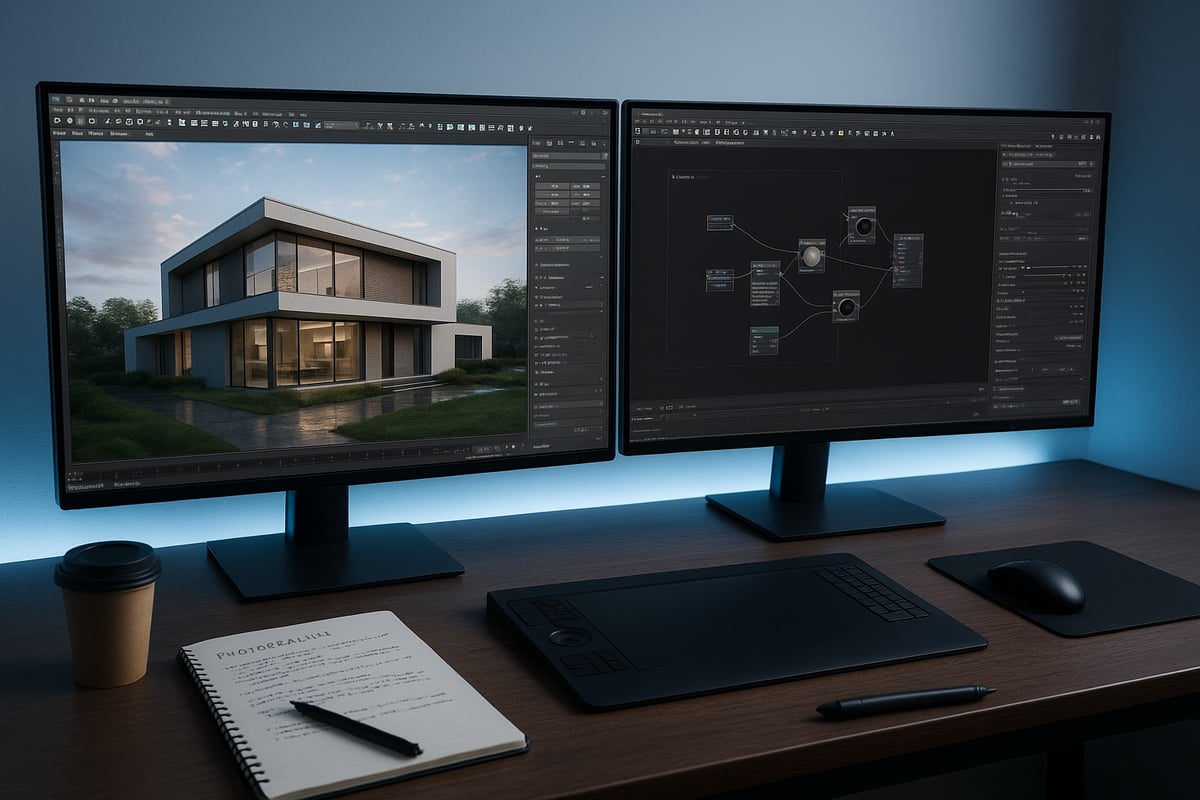
Taking photorealism to the next level with 3d max and vray involves mastering advanced material techniques. Layering materials allows you to simulate real-world surfaces, such as blending diffuse, gloss, and bump maps for depth and subtlety. Subsurface scattering is essential for realistic skin, wax, or marble, enabling light to penetrate and scatter within materials.
Reflections and refractions are crucial for believable glass, water, and polished metals. Fine-tuning Fresnel effects and index of refraction settings can make or break the illusion. Use V-Ray’s advanced shader options to add micro-details, like smudges or fingerprints, to surfaces.
For translucent materials, adjust the scatter radius and color to match reference photos. Always test materials under various lighting conditions to ensure consistency across scenes. With 3d max and vray, attention to detail transforms ordinary renders into lifelike visual experiences.
Animation and Motion in 3ds Max and V-Ray
Animating scenes with 3d max and vray lets you bring projects to life through movement and dynamic storytelling. Set up camera flythroughs to guide viewers through architectural spaces or product designs, using V-Ray’s physical camera controls for cinematic realism.
Leverage motion blur for smooth, natural transitions, especially in scenes with moving objects or animated lights. Animated textures, such as flickering screens or flowing water, add richness and believability. Recent updates, like those in Chaos Releases V-Ray 7 for 3ds Max, introduce support for Gaussian Splats and interactive virtual tours, expanding creative possibilities.
When creating walkthroughs, use keyframe animation for precise control, and preview sequences with draft settings to optimize workflow. 3d max and vray enable seamless integration between static and animated assets, ensuring visual consistency throughout your project.
Post-Production Workflows
Post-production is where 3d max and vray renders truly shine. Begin by rendering out multiple passes, such as diffuse, specular, reflections, Z-depth, and masks, to separate visual elements for greater control in compositing software like Photoshop or After Effects.
Use these passes to fine-tune color balance, highlight details, and correct minor flaws without the need for full re-renders. Color grading can dramatically alter the mood of a scene, while atmospheric effects like fog, bloom, or lens flares add cinematic depth.
For architectural visualizations, overlay subtle grain or vignette effects to enhance realism. Save time by using batch processing for similar scenes, ensuring consistency across a series. With 3d max and vray, an efficient post-production workflow is essential for delivering polished, client-ready results.
Automation and Scripting
To maximize productivity in 3d max and vray, automation and scripting are invaluable. MaxScript provides tools to automate repetitive tasks, such as renaming objects, organizing layers, or batch importing assets. V-Ray’s scripting capabilities allow you to set up complex rendering sequences, tweak settings across multiple scenes, or trigger batch renders with different camera angles.
For example, you can write a script to automatically assign materials, apply modifiers, or export renders to specific folders. This approach minimizes manual errors and saves valuable time, especially in large projects.
Professionals often create custom toolsets or macros tailored to their studio’s workflow. By integrating automation into your pipeline, 3d max and vray become powerful allies for tackling high-volume or deadline-driven projects efficiently.
Troubleshooting Common Issues
Even experts using 3d max and vray face challenges like noise, fireflies, or render artifacts. To combat noise, increase sample rates or use denoising filters, but balance these against render times. Fireflies, those bright, random pixels, often result from caustics or glossy reflections; refine light sampling and clamp values to reduce them.
Memory management is crucial for complex scenes. Use proxies for high-poly models, optimize textures, and monitor RAM usage to prevent crashes. If you encounter persistent problems, consult the Autodesk and Chaos Group forums for community-driven solutions.
Below is a quick troubleshooting table for common render issues:
| Issue | Solution |
|---|---|
| Noise | Increase samples, use denoiser |
| Fireflies | Adjust light sampling, clamp |
| Artifacts | Check geometry/materials |
| Memory errors | Use proxies, optimize assets |
By mastering troubleshooting, you ensure that your 3d max and vray projects maintain professional quality and meet client expectations every time.
Integrating 3ds Max and V-Ray into Professional Pipelines
Seamlessly integrating 3d max and vray into professional pipelines is essential for streamlined production and consistent quality. As workflows grow more complex, efficient collaboration, asset management, scalable rendering, and standardized deliverables become critical for success in architecture, design, and visualization studios.
Collaboration and Team Workflows
Effective teamwork is the foundation of any large-scale visualization project. With 3d max and vray, studios rely on best practices that keep teams aligned and productive.
- Use shared project folders to centralize assets.
- Implement version control systems like Perforce or Git for scene files and scripts.
- Establish naming conventions and folder structures for easy navigation.
For example, an architectural studio might assign specific roles, modelers, texture artists, lighting specialists, to different team members. Regular sync meetings and cloud-based project management tools help ensure that every stage of the pipeline moves smoothly. By keeping everyone on the same page, teams minimize errors and accelerate delivery.
File Management and Asset Libraries
Organizing models, textures, and references is vital for efficient work in 3d max and vray. Asset libraries allow teams to quickly locate and reuse high-quality materials and objects across projects.
- Store textures and models in dedicated network drives or cloud storage.
- Categorize assets by type, size, or project for easy retrieval.
- Integrate asset management plugins, such as V-Ray Scatter plugin overview, to automate placement of vegetation or props in scenes.
Maintaining a robust asset library reduces duplication and ensures consistency in visual quality. Studios often set up recurring project elements, like furniture, plants, or lighting rigs, so artists can focus on creativity rather than repetitive setup. This approach increases productivity and maintains a professional edge.
Rendering Farms and Cloud Solutions
As rendering demands grow, leveraging scalable resources becomes essential. Many studios using 3d max and vray turn to rendering farms or cloud-based solutions for faster turnaround.
- Render farm services allow parallel processing of multiple frames or scenes.
- Cloud rendering platforms make it easy to scale up for tight deadlines.
- Automatic job distribution and remote monitoring improve efficiency.
Industry data highlights this shift, with the 3D Rendering Market Growth Projections showing sustained growth in cloud-based visualization tools. For example, studios have reported reducing project deadlines by up to 50 percent when utilizing cloud rendering. This flexibility is critical for meeting client expectations and managing large-scale projects.
Industry Standards and Deliverables
Delivering professional results with 3d max and vray means adhering to industry expectations for file formats, resolution, and presentation.
- Provide clients with standard formats: .jpg, .png, .exr for images, .mov or .mp4 for animations.
- Ensure outputs meet resolution requirements for print, web, or VR.
- Prepare layered files and render passes for post-production.
In addition, many studios offer interactive VR tours alongside traditional renders. Preparing organized, clearly labeled deliverables ensures smooth handoff to architects, marketers, or developers. Consistency and attention to detail at this stage reinforce a studio’s reputation for reliability and quality.
Future Trends: What’s Next for 3ds Max, V-Ray, and 3D Visualization
The world of 3d max and vray is on the verge of a new era, shaped by rapid advances in technology and changing industry demands. As visualization professionals look to the future, several trends stand out that will redefine workflows, creative possibilities, and career opportunities. Understanding these shifts is crucial for anyone aiming to stay competitive and inspired in the years ahead.
AI and Machine Learning in 3D Rendering
Artificial intelligence is rapidly transforming the capabilities of 3d max and vray. Machine learning algorithms now assist with material creation, automate noise reduction, and optimize scene complexity for faster results. For example, V-Ray’s adaptive sampling in 2026 leverages AI to automatically balance image quality and render speed.
Researchers are also developing new techniques for efficient ray tracing. The GRTX: Efficient Ray Tracing for 3D Gaussian-Based Rendering method demonstrates how cutting-edge algorithms can further accelerate render times and improve realism in 3d max and vray workflows. These innovations make photorealistic rendering more accessible and scalable, even on complex projects.
Real-Time Rendering and Virtual Reality
The integration of real-time engines with 3d max and vray is reshaping client presentations and user experiences. Artists can now export scenes directly to Unreal or Unity, delivering interactive walkthroughs that allow clients to experience designs in virtual reality.
VR-ready outputs are becoming standard, especially in real estate marketing and architectural visualization. With 3d max and vray, professionals can quickly iterate on lighting, materials, and composition, then showcase immersive environments that help clients make decisions faster and with greater confidence.
Cloud Collaboration and Remote Workflows
Cloud technology is enabling global teams to work together on large-scale 3d max and vray projects. Secure cloud storage, version control, and online asset libraries streamline collaboration, making it easy to manage files and feedback across continents.
Remote workflows are now the norm, with artists sharing scenes, textures, and renders in real time. This flexibility allows studios to tap into talent worldwide, ensuring that projects powered by 3d max and vray benefit from diverse skills and perspectives while meeting tight deadlines.
Sustainability and Green Rendering
As the environmental impact of digital workflows gains attention, 3d max and vray users are adopting green rendering practices. Energy-efficient hardware, optimized render settings, and cloud-based solutions help minimize electricity consumption and reduce carbon footprints.
The industry is also prioritizing eco-friendly data centers and sustainable hardware choices. By focusing on sustainability, professionals using 3d max and vray can deliver high-quality visuals while supporting broader environmental goals.
Evolving Industry Demands and Job Market
The demand for skilled experts in 3d max and vray is rising across architecture, entertainment, and product design. New roles are emerging in AR, VR, the metaverse, and digital twins, reflecting the expanding influence of 3D visualization.
Industry reports show a steady increase in job postings for 3d max and vray specialists, with growth projected at 18% year-over-year through 2025. Employers seek candidates who understand both traditional rendering and the latest trends, making ongoing learning a top priority.
Staying Ahead: Learning Resources and Community Support
Continuous education is essential for mastering 3d max and vray as technology evolves. Top online courses, certification programs, and active forums offer resources for every skill level. Participating in global communities ensures access to the latest tips, troubleshooting advice, and portfolio feedback.
Gaining certifications from Autodesk or Chaos Group can significantly boost your career prospects. To explore more about where the industry is headed, the Future of 3D rendering page offers expert insights and predictions tailored to 3d max and vray professionals.